
Reviewed · CITY TOURS
Frankfurt: Discover the heart of Frankfurt – a city tour in Russian
Frankfurt hides its best stories in plain sight. This Russian-language walking tour links the Römerberg, Paulskirche, cathedral, Iron Bridge, and New Old Town with smaller lanes and courtyards that are easy to miss alone. I especially like the mix of famous sights and overlooked corners, plus Dimitri’s use of old photographs to show how the city once looked.
The guide’s humor, clear storytelling, and local experience are major strengths. One thing to consider is that most sights are viewed from outside, and visits to Paulskirche or the Kaisersaal depend on opening hours and city events. The tour is also not suitable for wheelchair users.
In This Review
- Key points to know before you go
- Starting at Paulskirche, where modern Germany found its voice
- The Römerberg and the faces of Frankfurt’s old center
- Crossing the Iron Bridge for city views and stories
- Haus Wertheym and the traces of an older Frankfurt
- Saalgasse, Schirn, and the city’s rebuilt medieval core
- The cathedral and the road of coronations
- The New Old Town, Frankfurt’s carefully rebuilt quarter
- How Dimitri’s guiding style shapes the experience
- Is $20 a fair price for two hours?
- Who should book this Frankfurt walk?
- Should you book it?
- FAQ
- What language is the tour conducted in?
- How long does the tour last?
- Where does the tour begin?
- Where does the tour finish?
- What sights are included?
- Can I go inside the Kaisersaal?
- Can I visit the imperial palace?
- What should I bring?
- Is the tour wheelchair accessible?
Key points to know before you go
- Dimitri leads in Russian: He has lived in Frankfurt for 35 years and brings personal affection for the city to the tour.
- The route covers old and rebuilt Frankfurt: You’ll see medieval ruins, the Römer, the cathedral, and the carefully reconstructed New Old Town.
- Old photographs add real value: Dimitri uses visual material to help you picture buildings and streets that no longer look as they once did.
- Expect a compact walking route: One family covered no more than about 2 kilometers and still had energy left for local food afterward.
- Interior visits are possible but not promised: Short visits to the Imperial Hall and the imperial palace may happen if they are open.
- The price is modest for a private-style introduction: At $20 per person for two hours, the tour is especially useful early in a Frankfurt stay.
Starting at Paulskirche, where modern Germany found its voice
Meet Dimitri in front of the main entrance to St. Paul’s Church, marked by an Experience Frankfurt sign and his guide pass. This is a sensible starting point because Paulskirche is not simply another handsome church. It is closely tied to Germany’s first freely elected national assembly in 1848.
Your first stop is a short guided look at the church, usually around ten minutes. Dimitri’s job here is not to bury you in dates. He helps connect the building to Frankfurt’s place in German political history, making the stop useful even if you are seeing Paulskirche for the first time.
You should expect an outdoor visit rather than a guaranteed interior tour. Paulskirche may be closed because of city events, so do not book this walk solely for access inside. The wider story still works from the square.
From here, the route moves toward the Römer complex. Frankfurt’s old center was heavily damaged during the Second World War, then rebuilt in stages. That fact matters throughout the walk. You are not looking at a perfectly untouched medieval quarter, but at a city that has repeatedly rebuilt itself while trying to keep its old identity visible.
More City Tours in Frankfurt
- From Frankfurt: Heidelberg, Castle and Old City Guided Tour
★ 4.5 · 677 reviews - Heidelberg Castle and City Day Tour from Frankfurt
★ 4.5 · 292 reviews - Frankfurt: Discover the heart of Frankfurt – a city tour in German
★ 5.0 · 196 reviews
The Römerberg and the faces of Frankfurt’s old center
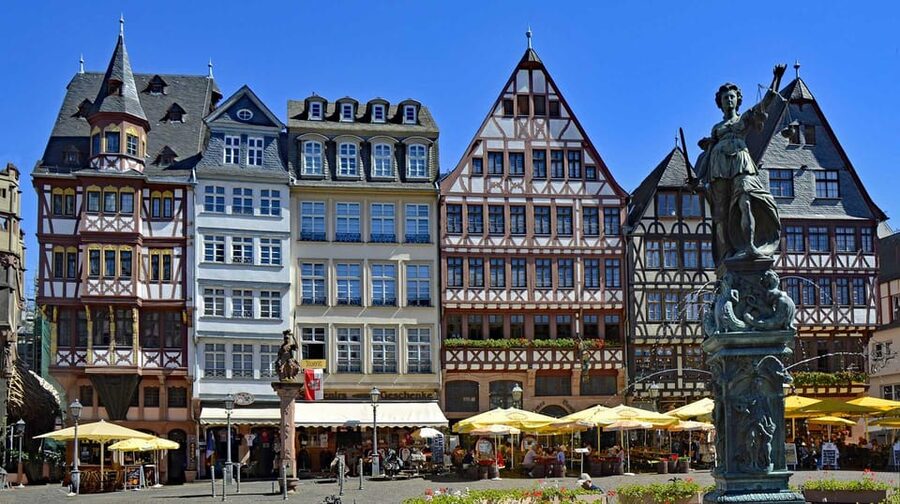
The Römerberg is the visual heart of the tour. Its most famous building is the Römer, Frankfurt’s historic town hall, with its distinctive stepped gables. The square gathers several of the city’s key sights into one place, including the Old St Nicholas Church, the Fountain of Justice, and the reconstructed houses of the New Old Town.
The formal stop at the Römer is brief, only about five minutes, but the surrounding area returns several times as the route winds through nearby streets. That is a good design choice. Instead of spending the whole tour in one square, you see how the buildings relate to one another.
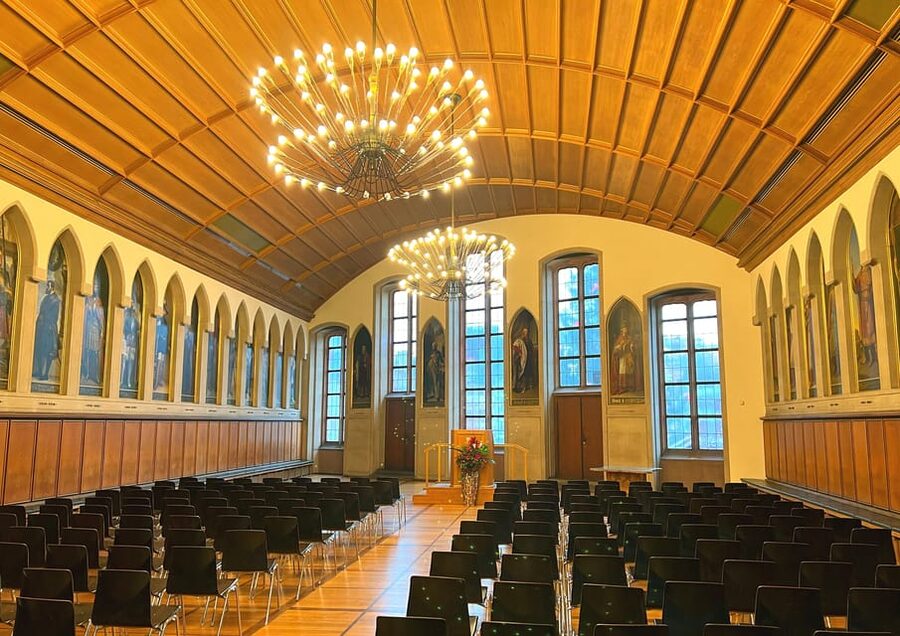
The Kaisersaal, inside the Römer, is one of the possible short interior visits. This ceremonial hall is associated with the Holy Roman Empire’s imperial coronations. If it is open, Dimitri can add a short explanation that gives meaning to the grand room rather than leaving you to admire it without context.
Still, keep your expectations realistic. The Kaisersaal is not an obligatory part of the tour. Opening hours and special events can shut it to visitors, and the advertised two-hour schedule does not allow for a long museum-style visit.
The Old St Nicholas Church receives only a few minutes, but it helps complete the picture of the square. The nearby Fountain of Justice is another quick stop. These small pauses are useful because Dimitri can point out details you might walk past while focusing on the larger Römer façade.
Crossing the Iron Bridge for city views and stories
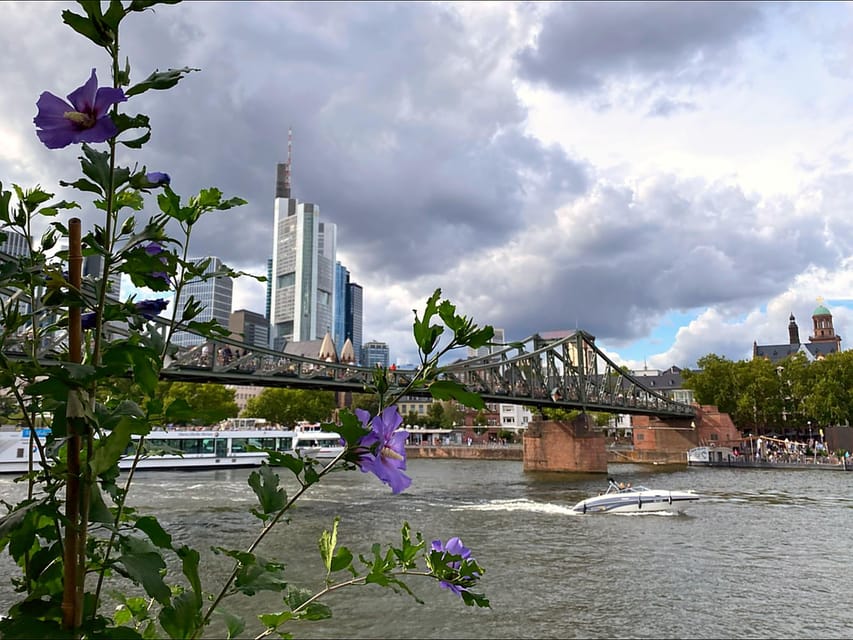
The Eiserner Steg, or Iron Bridge, takes the tour across the Main. It is one of Frankfurt’s most recognizable pedestrian crossings and gives you a different angle on the city. From the bridge, you can look back toward the old center and across to the Museum Embankment.
This is one of the more scenic parts of the walk, but the bridge is also a storytelling stop. Dimitri explains the link between the crossing, the river, and the museums along the opposite bank. The route also refers to the Alte Brücke, or Old Bridge, allowing him to set the modern pedestrian bridge within the longer story of Frankfurt’s river crossings.
The Museum Embankment is not treated as a full museum visit. You will see it from the route and hear why this stretch of the Main matters to Frankfurt’s cultural life. If you want to visit the museums themselves, plan a separate block of time.
A practical note: you are walking outdoors for the whole experience, with pauses on a bridge, squares, and streets. Comfortable shoes, weather-appropriate clothing, and an umbrella are sensible. One family found the walking distance easy, but cold or wet weather can still make a two-hour city walk feel longer.
Haus Wertheym and the traces of an older Frankfurt
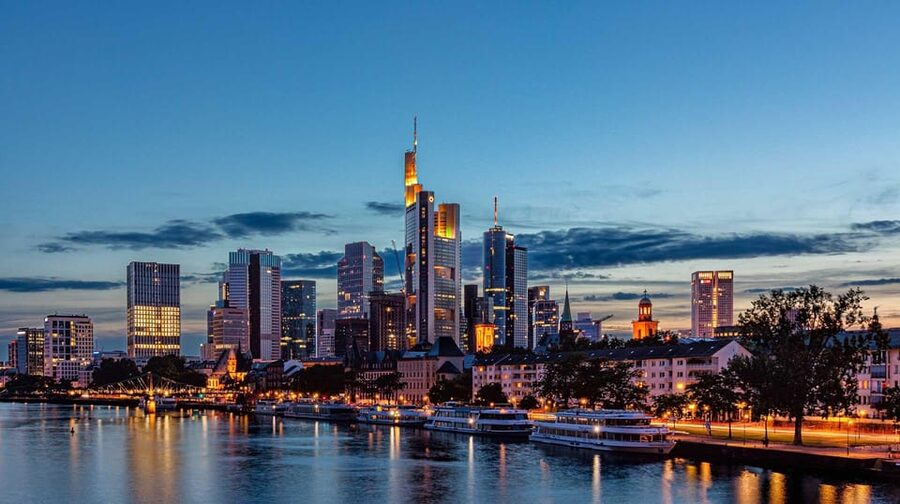
Haus Wertheym is one of the route’s charming details. Its half-timbered appearance offers a sharp contrast to the modern financial district that makes Frankfurt famous. The stop is short, around ten minutes, but it helps you see how much visual variety remains around the old center.
The tour does not treat Frankfurt as only a city of glass towers and banks. That is one of its strengths. Dimitri takes you through streets where older façades, rebuilt houses, and modern structures sit close together.
The Historical Museum Frankfurt is another brief exterior stop. You should not expect to go inside or receive a full museum tour during this walk. Instead, it serves as a marker for the city’s layered past and gives Dimitri another chance to explain how Frankfurt developed.
This is also where the guide’s knowledge of small details matters most. A person walking alone may notice a building but miss why it looks different from the house beside it. Dimitri’s focus on details was repeatedly praised, and his 35 years living in Frankfurt give the explanations a personal local angle.
Still Frankfurt, at a slower pace:
- Frankfurt: River Main Sightseeing Cruise with Commentary
★ 4.3 · 5,127 reviews - Frankfurt: Hop-On, Hop-Off Grand or Express Bus Ticket
★ 3.9 · 2,088 reviews - Frankfurt: 1-Hour Panorama Boat Cruise on the river Main
★ 4.4 · 1,822 reviews - From Frankfurt: Rhine Valley Day Trip
★ 4.4 · 1,317 reviews
Saalgasse, Schirn, and the city’s rebuilt medieval core
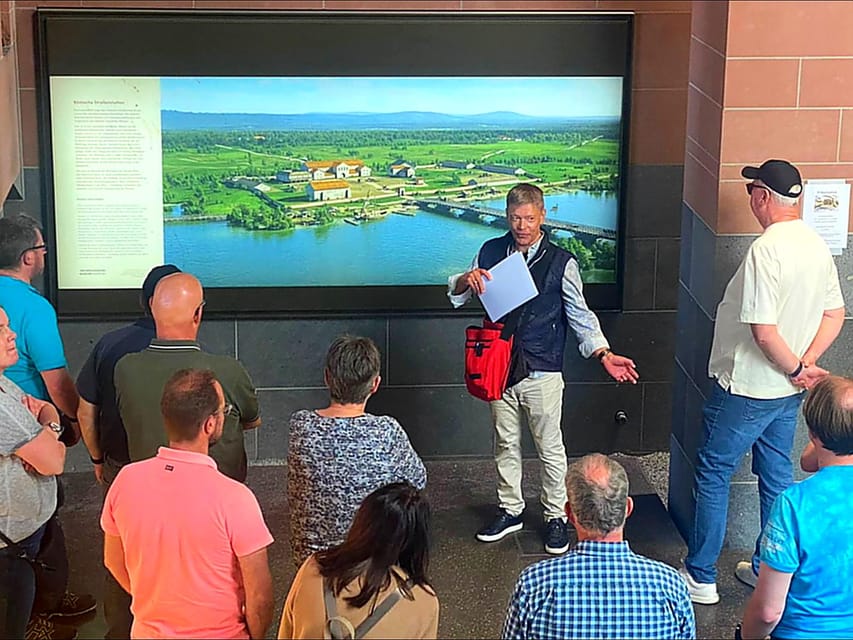
The route next takes you through Saalgasse and past the Schirn Art Gallery. Saalgasse is especially useful for understanding Frankfurt’s approach to reconstruction. Its buildings do not all imitate one historic style. Instead, the street shows how newer architecture can sit within the footprint of an older neighborhood.
That contrast may appeal to you if you prefer cities with visible layers rather than a perfectly preserved old town. It may disappoint you if you expect every building to be genuinely medieval. Dimitri’s explanation helps separate original remains, reconstructed structures, and modern additions.
The Roman ruins provide another reminder that Frankfurt’s story goes back much further than the familiar town hall square. The remains of the medieval imperial palace, often called Kaiserpfalz Franconofurd, are among the tour’s most interesting stops. If access is available, Dimitri may offer a short visit inside with an explanation of what you are seeing.
This possible interior stop is valuable because ruins can be hard to read on your own. A few walls or foundations do not always announce their importance. With a guide, the site becomes evidence of Frankfurt’s role as an imperial center rather than just another archaeological fragment.
The practical limitation is the same as with the Kaisersaal. The imperial palace visit depends on opening hours. The activity includes the short visit when possible, not a guaranteed admission at every departure.
The cathedral and the road of coronations
Frankfurt Cathedral, or the Kaiserdom, is one of the tour’s essential landmarks. Its tall exterior dominates the old center, and its importance reaches beyond religious architecture. German kings were elected and crowned in Frankfurt, linking the cathedral and the city to the empire’s political life.
You will see the cathedral from outside during the main route. Dimitri may be able to take you inside if timing and opening hours allow, but you should not count on a full interior visit.
The Krönungsweg, or Coronation Route, adds a helpful thread to the walk. It connects the ceremonial movement through the old city with the imperial events associated with the cathedral and Römer. That connection makes the narrow streets feel less random. You are following a route shaped by power, ceremony, and public life.
Nearby, the Coffee House to the Golden Scale, Hühnermarkt, Neues Rotes Haus, and Goldenes Lämmchen add smaller architectural points to the walk. These stops are short, often only two to five minutes. Their value comes from accumulation: each one gives you another view of the rebuilt old town and another chance to compare old designs with modern reconstruction.
The New Old Town, Frankfurt’s carefully rebuilt quarter
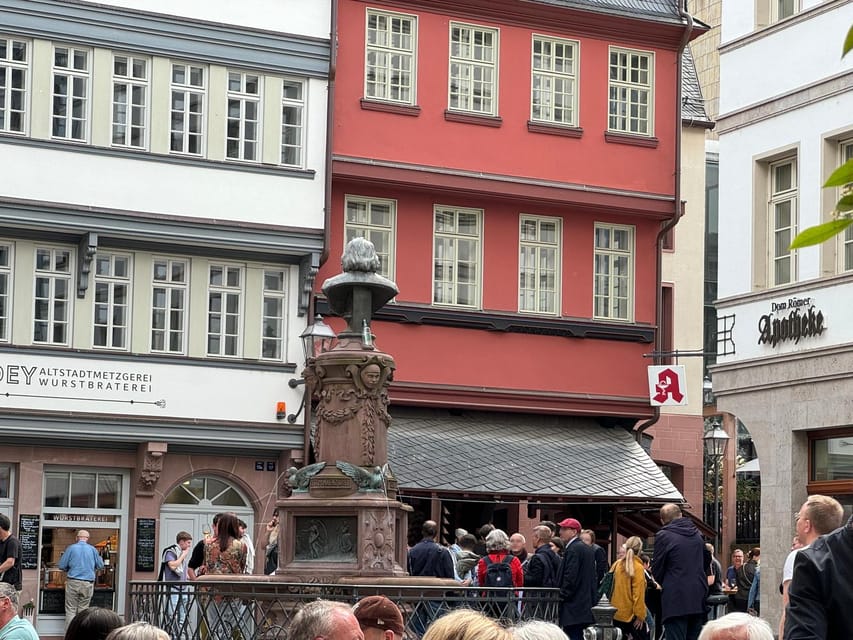
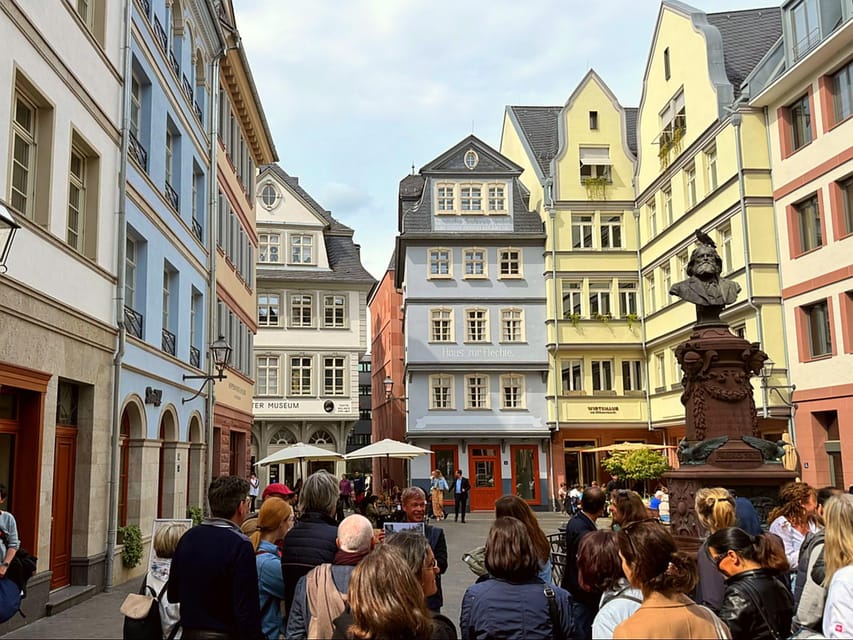
The Neue Altstadt, or New Old Town, is the tour’s main architectural surprise. Frankfurt rebuilt this quarter between the Römerberg and the cathedral using a mixture of reconstructed historic façades and newly designed buildings. The result is attractive, but it is not an untouched medieval neighborhood.
That distinction is worth knowing before you arrive. You can appreciate the craftsmanship without mistaking the area for a surviving old town. Dimitri’s explanations and old photographs help you see what was lost, what was rebuilt, and how the city chose to present its past.
Hühnermarkt is one of the prettiest spaces in this quarter. The Golden Scale and Goldenes Lämmchen add ornate façades and narrow urban views. Neues Rotes Haus and the Coronation Route give the walk more context, while the courtyard passages offer the sort of details you might miss on a self-guided visit.
The tour also passes the Struwwelpeter Museum near the end. The stop is very short, around two minutes, so this is a sighting rather than a museum visit. If the character is unfamiliar to you, Dimitri can provide a quick connection to Frankfurt’s cultural life.
I like that the New Old Town comes late in the walk. By then, you have seen ruins, churches, political buildings, bridges, and older surviving façades. You can judge the rebuilt quarter with more context instead of treating it as a decorative photo stop.
How Dimitri’s guiding style shapes the experience
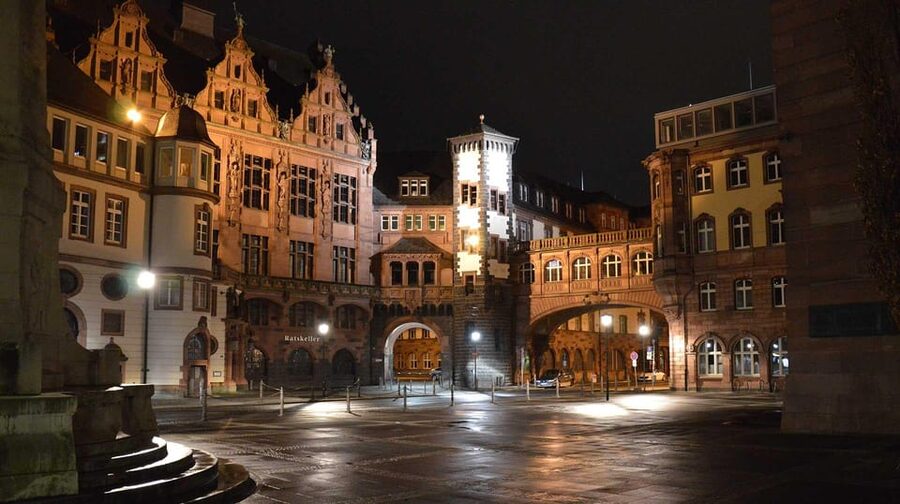
Dimitri is the central reason to choose this tour in Russian. He has lived in Frankfurt for 35 years and clearly enjoys explaining what he calls the smallest big city in the world. His approach combines humor, facts, photographs, and answers to questions.
The visual material is particularly useful. Old photographs can show you how a square looked before wartime destruction or how a modern façade replaced an earlier building. That makes the city’s changes easier to picture than a spoken description alone.
The strongest praise centers on Dimitri’s ability to hold attention and notice small details. He is described as expressive, friendly, and willing to answer questions. That matters on a compact route with many short stops, since a flat lecture could make the schedule feel rushed.
The language choice is important. This is a live tour in Russian, and the guide’s Russian roots make it a natural fit for Russian-speaking visitors who want more than a translated audio guide. Some content may be shown in its original language, so ask Dimitri if you need clarification at a particular stop.
A private group option is available. The supplied details do not specify the size or price of a private group, so confirm those points before booking if privacy is important to you.
Is $20 a fair price for two hours?
At $20 per person, the tour offers good value if you want a structured introduction to central Frankfurt. You get a certified Russian-speaking guide, a route through the city’s most important historic areas, and possible short interior visits at the Römer’s Imperial Hall and the imperial palace.
The value is strongest for a first visit. You receive orientation, historical context, and practical suggestions for the rest of your stay. Dimitri even helped one family choose Frankfurt food after the walk, which shows how the tour can lead naturally into the next part of your day.
The price does not include food, drinks, or transportation to the meeting point. Those exclusions are normal for a walking tour, but budget a little extra if you want to stop for a meal afterward.
The schedule is listed as two hours, while one family’s experience lasted about two and a half hours. I would avoid booking a tight train connection or timed attraction immediately afterward. Allow a little breathing room, especially if a short interior visit is possible.
Who should book this Frankfurt walk?
I would recommend it most strongly to Russian-speaking first-time visitors, families, and anyone who wants the old center explained rather than simply photographed. A 14-year-old enjoyed the stories and visual material, suggesting that Dimitri’s style can work well for older children and teenagers.
It also suits visitors who want a gentle walking route. One family covered roughly two kilometers and did not feel worn out. Still, the route includes streets, squares, and the Iron Bridge, so you should wear comfortable shoes and be ready for changing weather.
You may want a different experience if your priority is entering every major sight, spending a long time in museums, or taking a wheelchair-accessible route. The tour is mainly outdoors, interior access is conditional, and it is not suitable for wheelchair users.
Free cancellation up to 24 hours before the start and reserve-now, pay-later booking add flexibility. Those terms are useful if your Frankfurt schedule is still shifting, though they do not change the tour’s main limitation: the most important interiors may be unavailable.
Should you book it?
Book this tour if you want Frankfurt’s old center to make sense in Russian, with a guide who mixes humor, visual aids, and close attention to small details. Dimitri’s local experience, the short distance, and the broad route from Paulskirche to the New Old Town make this a strong first-day choice.
Do not book it expecting a full museum program or guaranteed entry to Paulskirche, the Kaisersaal, or the imperial palace. Think of it as a lively introduction to Frankfurt’s layers, with possible interior bonuses when the doors are open.
FAQ
What language is the tour conducted in?
The live tour is conducted in Russian.
How long does the tour last?
The advertised duration is two hours. One family’s tour lasted about two and a half hours, so it is wise to allow extra time.
Where does the tour begin?
It begins at the main entrance to St. Paul’s Church, or Paulskirche. Look for the Experience Frankfurt sign and the guide’s pass.
Where does the tour finish?
The tour finishes at Römerberg.
What sights are included?
The route includes Paulskirche, the Römer complex, Römerberg, the Iron Bridge, Museum Embankment, Haus Wertheym, the Historical Museum exterior, Old St Nicholas Church, the cathedral, medieval Roman ruins, Saalgasse, Schirn Art Gallery, and the New Old Town.
Can I go inside the Kaisersaal?
A short visit to the Imperial Hall in the Römer is included if it is open. It is not guaranteed because opening hours and city events can affect access.
Can I visit the imperial palace?
A short visit to the imperial palace Franconofurd may be offered if opening times allow. It is not an obligatory part of every tour.
What should I bring?
Bring comfortable shoes, an umbrella, and clothing suitable for the weather.
Is the tour wheelchair accessible?
No. The activity is not suitable for wheelchair users.
Just added around Frankfurt
- Day Trip to Rothenburg from Frankfurt★ 4.6 · 25 reviews
- Rhine Valley: Half Day Tour from Frankfurt★ 3.7 · 66 reviews
- Private Tour with Native English speaking Local★ 4.9 · 60 reviews
- Darmstadt: Mathildenhöhe UNESCO Site Guided Visit★ 4.7 · 124 reviews
- Mainz: Private custom tour with a local guide★ 3.8 · 11 reviews
- Mainz: guided evening tour of the Rhine embankment/old town in German and English★ 4.9 · 38 reviews
- Mainz Highlights, private walking tour★ 4.9 · 15 reviews
- Hohenzollern Castle: Full-Day Tour from Frankfurt★ 4.3 · 11 reviews
City Tours, compared.
1-Hour City Tour by Boat with Guaranteed Seating
Read our review →
City History Canal Sightseeing Tour on a Motorboat
Read our review →
Browse the lists this tour appears in