
Reviewed · WALKING TOURS
Aachen: Private Walking Tour With A Professional Guide
Aachen keeps its biggest stories close together. This 90-minute private walk links Charlemagne, German kings, Roman beginnings, medieval city life, and the curious figures of the Puppet Fountain in one compact route. I like the personal format and the chance to ask questions as you go. I also like that the guide can adjust the tour on the spot, rather than forcing every group through the same script.
The main consideration is price. At $288 per group of up to 15, this can be good value for a family or full group, but it feels expensive for one or two people. Entrance fees are not included, so check what you want to see inside the cathedral before you arrive.
In This Review
- Five details that shape the experience
- Why Aachen makes a fine history walk
- Meeting at the cathedral
- Charlemagne’s throne and the cathedral story
- The Puppet Fountain’s odd and clever cast
- Medieval buildings, gates, and Roman beginnings
- The advantage of a private guide
- Is 90 minutes enough?
- The price and who gets the best value
- How I would plan the visit
- Should you book this Aachen walk?
- FAQ
- How long does the Aachen private walking tour last?
- Where does the tour meet?
- What languages are available?
- Is this a private tour?
- What is included in the price?
- Are entrance fees included?
- Can the tour be customized?
- How much does the tour cost?
Five details that shape the experience
- Charlemagne’s Aachen: Learn why the Frankish emperor chose this spa town as the capital of his empire and how his life shaped the city.
- Aachener Dom: See the cathedral connected with Charlemagne’s burial, holy relics, royal coronations, and the throne that still remains inside.
- Thirty crowned kings: Hear the story behind the cathedral’s role in the coronation of 30 German kings.
- Puppet Fountain characters: Look closely at the rooster, horse, professor, canon, and other moving figures, each tied to a piece of Aachen’s identity.
- A private, adjustable route: Your English or German-speaking guide can respond to individual questions and adapt the emphasis during the walk.
- A compact introduction: The 90-minute length gives you a useful first look without taking over an entire day in Aachen.
Why Aachen makes a fine history walk
Aachen is not simply a cathedral town. Its importance reaches from the Roman era through Charlemagne’s reign and into the long story of German monarchy. That gives your guide several layers to work with, and the best part of this tour is the way those layers meet in a small area.
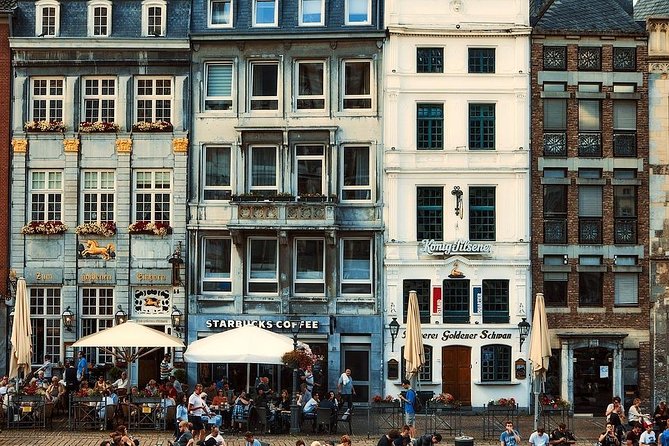
Charlemagne chose Aachen as the capital of his empire. The choice was tied to the town’s earlier Roman importance and its spa tradition, but the city became much more than a place to rest and take the waters. Under Charlemagne, Aachen became a center of power, religion, and administration.
You will hear this story as a city story rather than as a list of dates. That matters because Aachen’s buildings make more sense once you know why the emperor cared about the place. A medieval wall, a city gate, or a cathedral interior is easier to appreciate when you understand how royal authority and religious life shaped the city.
The route also covers the different names used for Aachen in other languages. That may sound like a small detail, but it helps explain the city’s position between cultural and language regions. You may know the city by one name and then encounter another in historical writing or on maps.
More Walking Tours in Cologne
- Cologne: The Night Watchman Old Town Walking Tour in German
★ 4.6 · 1,395 reviews - Cologne: Old Town Highlights Walking Tour
★ 4.6 · 1,093 reviews - Cologne: Südstadt Guided Foodie Walking Tour
★ 4.6 · 624 reviews
Meeting at the cathedral
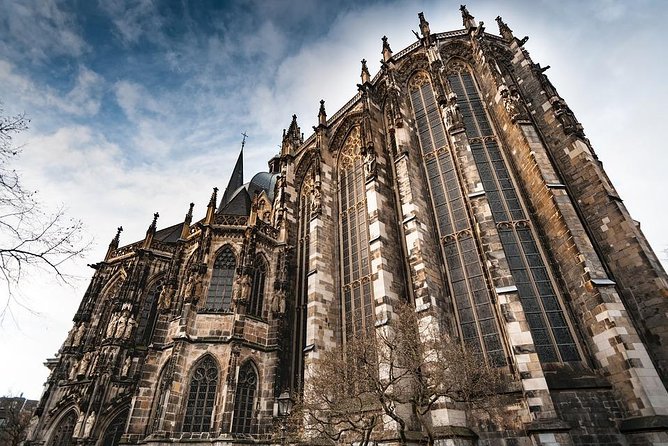
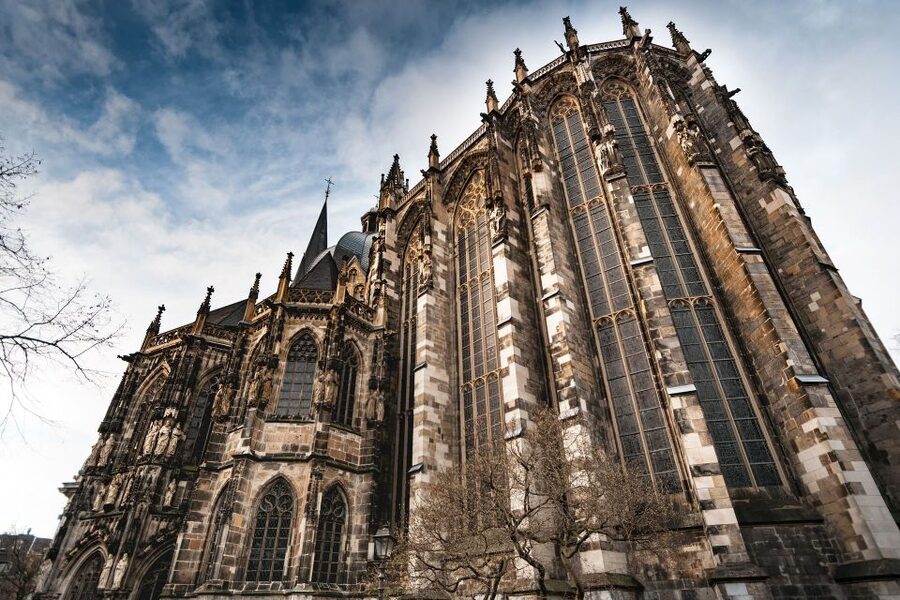
The tour begins in front of the cathedral, known locally as the Aachener Dom. This is a practical meeting point because it puts you beside the city’s most important sight from the first minute.
You should arrive ready for a walking tour rather than a cathedral-only visit. The cathedral is the anchor, but the experience also includes the Puppet Fountain, medieval buildings, city gates, and stories that reach back to the Roman era.
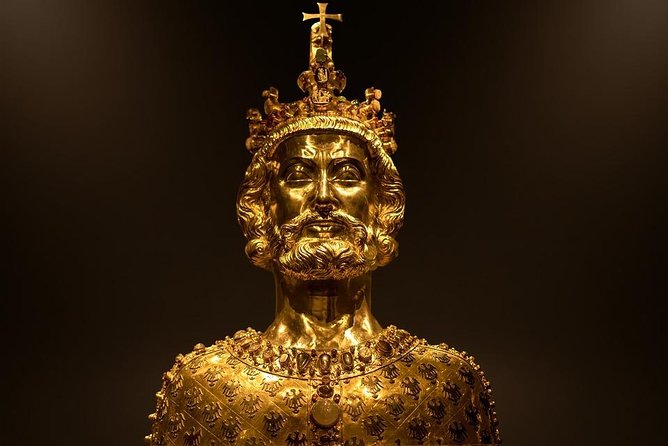
Starting here gives the guide an easy way to explain Charlemagne’s role. Aachen was his chosen capital, and the cathedral is closely tied to his memory. He was buried there, his throne remains there, and the building holds holy relics that have drawn religious visitors for centuries.
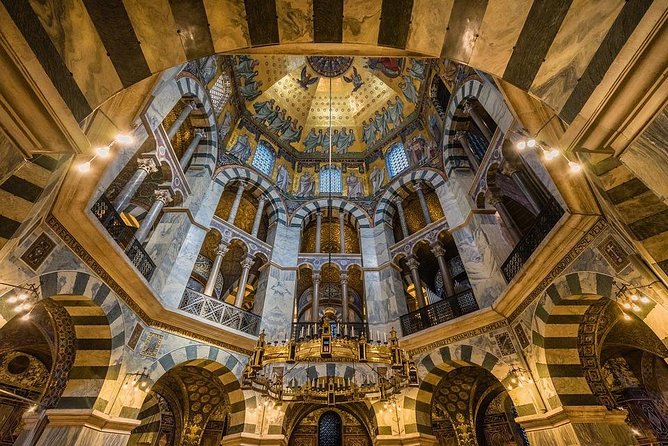
The cathedral was Germany’s first UNESCO World Heritage Site. That distinction is not just a plaque for a sightseeing checklist. It reflects the building’s importance as the burial place of Charlemagne, a royal church, and a place connected with the coronation of 30 kings.
Your guide can help turn those facts into a readable story. Without context, the cathedral can feel like a grand but confusing mix of stone, ceremony, and religious objects. With context, you can see why this one building carried such weight for Aachen and for the rulers who came after Charlemagne.
Charlemagne’s throne and the cathedral story
The Charlemagne section is likely the strongest reason to book this walk. His life is central to Aachen, and the tour gives you a way to connect the emperor’s political choices with what you see around the cathedral.
The throne is especially important. It is not presented simply as an old chair. It is a surviving symbol of royal authority and one of the clearest physical links between the medieval empire and the later coronation tradition.
Thirty kings were crowned in the cathedral. That number gives the building a long political afterlife beyond Charlemagne himself. You can think of the cathedral as both a religious center and a stage for royal power.
The holy relics add another layer. The information provided for the tour identifies the cathedral as a holder of many important relics, but entrance fees are not included. That means you should treat the walking tour as an introduction to the cathedral’s meaning, then decide if you want to pay separately for any interior visit or additional access.
This arrangement has a benefit. You are not forced into paying an entrance charge as part of a package when you may only want the outside history. The drawback is that you need to budget separately if seeing the interior or relics is a major goal.
The Puppet Fountain’s odd and clever cast
The Puppet Fountain offers a welcome change of mood. After stories of emperors, kings, burials, and relics, you get a playful public artwork filled with movable figures.
The fountain includes a rooster, horse, professor, canon, and other puppet characters. Each one has a meaning, and the guide explains what is behind the figures rather than treating the fountain as a quick photo stop.
This is one of the most appealing parts for families. Children can focus on the moving characters while adults listen for the social and historical clues. The fountain also gives the guide a chance to explain Aachen through symbols instead of dates.
Look carefully at the characters and listen to how they relate to the city. The rooster, horse, professor, and canon are not random decorations. Their presence reflects different parts of Aachen’s civic, academic, religious, and cultural life.
The fountain is also a useful reminder that a city’s identity is not made only from major monuments. Small public artworks can carry local jokes, old rivalries, and civic pride. A good guide makes those details easy to notice.
Still Cologne, at a slower pace:
- Cologne: Panoramic City Cruise
★ 4.3 · 5,698 reviews - Cologne: Brewery Tour with 3 Kölsch Beer Tastings
★ 4.7 · 3,108 reviews - Cologne: Top Sights Rhine River Cruise – Skyline Tour
★ 4.4 · 3,030 reviews - Cologne: Chocolate Museum Entrance Ticket
★ 4.4 · 2,790 reviews
Medieval buildings, gates, and Roman beginnings
The tour also takes in well-preserved medieval buildings and city gates. The supplied details do not name each gate or building, so you should not expect a fixed list of stops with a separate lecture at every one. Instead, these sights help fill out the story between the cathedral and the fountain.
This part of the route is valuable because it shows how Aachen changed over time. The Roman era forms the early layer. Charlemagne’s capital adds a major imperial layer. The medieval buildings and gates show how the city continued to function after the emperor’s time.
You will get more from these sights if you pay attention to the contrast between survival and change. A preserved gate tells you something about defense and city limits, while a historic building can hint at trade, administration, or daily life. The guide’s job is to connect the physical remains with the people who used them.
Do not expect the 90-minute format to cover every period in equal depth. That is the tradeoff. The route gives you a broad introduction, but it cannot offer a full architectural study or a detailed account of every Roman and medieval site.
For a first visit, that balance works well. You leave with a map in your head and enough context to decide where to spend more time afterward.
The advantage of a private guide
The private format is the clearest practical benefit. Your group has the guide’s attention, and the tour is not built around the pace or interests of strangers.
The group can include up to 15 people for the stated $288 price. That makes the cost easier to justify for a family, school group, or group of friends. For a couple, the per-person price is much higher, so you should compare it with a shared city walk if keeping costs low is your top concern.
The guide can customize the tour on the spot. You might ask for more Charlemagne, more cathedral history, more attention to the city’s names, or a closer explanation of the Puppet Fountain. The exact amount of adjustment will depend on your guide and the time available, but the option is built into the experience.
The guide feedback is especially strong on communication. Julia-Anna is praised for offering ideas about other sights in Aachen and the surrounding area. Frau Haas is described as making the 90 minutes lively and interesting, with a clear style that kept the time moving quickly.
Another German-language assessment highlights a friendly and engaged guide who handled individual questions well and adjusted explanations to the group’s wishes. That is the sort of detail I value in a private walk. A guide who listens can turn a standard route into a better fit for your interests.
English and German are available. If you have a preference, select the language that lets you ask questions comfortably.
Is 90 minutes enough?
Ninety minutes is enough for orientation, not total coverage. You can expect a brisk introduction to Aachen’s major themes, with time for the cathedral, Puppet Fountain, Charlemagne, the Roman period, medieval remains, and the city’s changing names.
The short length is useful if Aachen is part of a larger German itinerary. You can fit the walk into a morning or afternoon without losing a full day. It also works well at the start of your stay because the guide can suggest other things to see afterward.
The limit is depth. You will not receive an exhaustive account of Charlemagne’s reign or a long, quiet visit at every sight. You should also avoid planning the tour as though it includes every interior visit. Entrance fees are separate, and the meeting point is outside the cathedral.
I would use the walk as a foundation. Take notes on the places that catch your interest, then return on your own if you want more time. The private guide’s suggestions can help you choose what deserves a longer look.
The price and who gets the best value
The cost is $288 for a private group of up to 15 people. That is not a budget walk, and one German-language rating specifically considers it somewhat expensive. The value depends almost entirely on your group size and how much you want personal attention.
For a full group, the calculation changes. Split among 10 people, the cost is about $28.80 each. Split among 15, it is about $19.20 each. At that point, a private guide can be a fair deal, especially if your group wants to ask questions or shape the emphasis.
For one or two people, the price is harder to defend unless you place a high value on privacy and customization. You are paying for a guide devoted to your group rather than for a longer tour or included admissions.
The strong rating of 4.8 from 22 ratings supports the quality of the guiding, especially in the areas that matter most: friendly delivery, interesting explanations, and attention to individual questions. Still, a high rating does not erase the cost concern. Decide based on your party size, not only on the score.
How I would plan the visit
I would book this tour early in my Aachen stay. The cathedral meeting point makes it easy to begin, and the guide’s suggestions can help shape the rest of your time in the city.
Wear comfortable shoes. The route includes several city sights, and the experience is a walking tour rather than a seated talk. The duration is short, but the guide covers several historical periods, so you will get more from it if you arrive with one or two questions ready.
If the cathedral interior is a priority, ask about entrance arrangements and fees before or during the tour. The tour price does not include them. You should also tell the guide if your group wants to focus on Charlemagne, royal coronations, the fountain’s symbolism, or broader city history.
Families may find the Puppet Fountain especially helpful as a visual break. History fans will probably want to spend more time on Charlemagne, the throne, and the coronation tradition. Groups with limited time will appreciate the compact route.
The tour is offered with live guides in English or German. Free cancellation is available up to 24 hours before the start, and you can reserve while paying later, which gives you some flexibility if your plans are still shifting.
Should you book this Aachen walk?
Book it if you want a private historical introduction and your group can share the cost. The combination of Charlemagne’s story, the cathedral, royal coronations, medieval remains, and the Puppet Fountain gives you a broad sense of why Aachen matters.
I would be more cautious if you are traveling alone or as a couple on a tight budget. The 90-minute length and separate entrance fees also mean this is not a full cathedral visit or a detailed architectural tour.
For families, friend groups, and first-time visitors, the tour makes a good starting point. You get a guide who can answer questions, explain the city’s symbols, and point you toward worthwhile follow-up sights. If that personal connection is worth the price, Aachen’s long story becomes much easier to read.
FAQ
How long does the Aachen private walking tour last?
The tour lasts 90 minutes.
Where does the tour meet?
You meet your guide in front of the cathedral.
What languages are available?
The live tour is available in English and German.
Is this a private tour?
Yes. It is offered for a private group of up to 15 people.
What is included in the price?
The price includes a private tour, a local guide, and possible customization with the guide during the tour.
Are entrance fees included?
No. Entrance fees are not included.
Can the tour be customized?
Yes. The information provided says possible customization can be arranged with your local guide on the spot.
How much does the tour cost?
The listed price is $288 per group of up to 15 people.
Just added around Cologne
- The rather unknown Melaten★ 4.9 · 26 reviews
- Rickshaw Glühwein Ride★ 4.6 · 24 reviews
- Public brewhouse tour Cologne in English★ 4.9 · 154 reviews
- Informative and fun brewery tour in German, public★ 4.9 · 47 reviews
- Private photoshoot in Cologne★ 5.0 · 5 reviews
- Cologne: Old City Guided Walking Tour★ 4.9 · 63 reviews
- Cologne-Nippes: Gourmet wine tasting with cheese platter★ 4.6 · 26 reviews
- Cologne-Nippes: wine hopping (wine trip)★ 4.9 · 7 reviews
Walking Tours, compared.




Old Town & Viktualienmarkt City Walk in German
Read our review →Browse the lists this tour appears in