
Reviewed · WALKING TOURS
Discover Berlin Half-Day Walking Tour
Berlin’s past is written into its streets. This 3.5-hour walking tour links royal boulevards, Nazi memorials, Cold War checkpoints, and Berlin Wall sites in one well-planned route. I like the strong historical arc, and I like that a guide adds meaning to places that can otherwise look like ordinary city blocks. The main drawback is simple: you will walk a lot, often outdoors, and some stops are brief explanations rather than full visits.
The $24.19 price is fair for a professional English-speaking guide and a first look at so many major sights. I would book it early in a Berlin stay, since it helps you get your bearings and shows you where to return for a longer visit. Just wear good shoes, check the weather, and keep your expectations clear: this is an overview on foot, not a museum tour with extended indoor time.
In This Review
- Key points to know before you book
- Why this $24.19 Berlin walk is good value
- Starting at Hackescher Markt and Museum Island
- Unter den Linden, Bebelplatz, and the Prussian center
- Brandenburg Gate, Pariser Platz, and the Reichstag
- The Holocaust Memorial and the Führerbunker site
- From the death strip to Checkpoint Charlie
- Topography of Terror and the final stretch
- What the guides add to the experience
- Best timing, clothing, and planning tips
- Who should book this Berlin walking tour?
- Should you book the Discover Berlin Half-Day Walking Tour?
- FAQ
- How long is the Discover Berlin Half-Day Walking Tour?
- How much does the tour cost?
- What language is the tour offered in?
- Where does the tour begin?
- Where does the tour end?
- What sights are included?
- Are food and drinks included?
- How large can the group be?
- Is cancellation available?
Key points to know before you book
- A 34-stop route covers Berlin’s biggest historical landmarks, from Museum Island and Unter den Linden to Checkpoint Charlie and the Topography of Terror.
- The tour connects four very different Berlins: Prussian, imperial, Nazi, and divided Cold War Berlin.
- Brandenburg Gate, the Reichstag, and the Holocaust Memorial receive special attention, with nearby sites adding vital context.
- The starting point is Neue Promenade 3, near Hackescher Markt and Museum Island, while the tour ends elsewhere.
- Guides shape the experience, with strong praise for clear storytelling, humor, personal insight, and thoughtful treatment of difficult subjects.
- The group can include up to 25 people, so you get a social walking tour rather than a private experience.
Why this $24.19 Berlin walk is good value
At $24.19 per person, this is priced like an orientation tour, but the route covers enough ground to give it real substance. You are not paying for attraction admissions. You are paying for a guide who explains why each monument matters, how Berlin changed, and how one period left traces on the next.
That distinction matters in Berlin. Brandenburg Gate is impressive on its own, but it means more when you understand its role in Prussian power, imperial ceremony, Nazi propaganda, and the divided city. The same is true of Checkpoint Charlie. Without context, it can feel like a busy photo stop surrounded by shops. With a good explanation, it becomes part of a much larger story about a city split by force.
I also like the timing. Three and a half hours is long enough to move beyond a quick highlights stroll, but short enough to fit into a morning or afternoon. You can use the rest of the day to return to the places that caught your attention, such as the Holocaust Memorial, Museum Island, or the Topography of Terror.
The group limit of 25 is worth noting. That is not a tiny group, yet it is manageable for a guide who speaks clearly and keeps people together. One guide was praised for being easy to hear even with a group of about 30, but conditions vary. In a larger group, stay near the guide at crossings and crowded squares.
More Walking Tours in Berlin
- Berlin: Third Reich and Cold War 2 Hour Walking Tour
★ 4.9 · 6,830 reviews - Berlin: Discover Berlin Walking Tour
★ 4.9 · 5,998 reviews - Berlin’s Best: 2 Hour Walking Tour Third Reich and the Cold War
★ 5.0 · 5,486 reviews
Starting at Hackescher Markt and Museum Island
The meeting point at Neue Promenade 3 places you near Hackescher Markt, a useful starting area for exploring central Berlin. The first stops include Hackescher Markt and James Simon Park, followed by Museum Island.
These early minutes set up Berlin’s geography. You begin near the Spree and the museum district, then move through a cluster of landmarks that show how the city developed around royal power, culture, religion, and government. Museum Island includes the Neues Museum, Pergamonmuseum, Altes Museum, Lustgarten, and Berliner Dom.
You should not expect entry into the museums during this walk. The guide explains the buildings and their place in Berlin’s story from outside. That is a benefit if you want a quick orientation, but a limitation if you hoped to see the famous collections. Plan a separate museum visit later.
The Pergamonmuseum is included as an exterior stop, even though access and opening arrangements can change. The Altes Museum and Neues Museum add a useful sense of the island’s scale, while the cathedral and Lustgarten show how religious, royal, and civic spaces meet in this part of town.
The route also passes the Berlin TV Tower, Rotes Rathaus, Nikolaiviertel, and the rebuilt Stadtschloss. These stops broaden the picture beyond the best-known memorials. You see how Berlin has reconstructed, replaced, or reinterpreted parts of its center after wartime destruction and decades of division.
Unter den Linden, Bebelplatz, and the Prussian center
From Museum Island, the walk follows the grand axis of Unter den Linden. This boulevard once linked the royal palace area with Brandenburg Gate and Pariser Platz. The guide explains how it became one of Berlin’s most important ceremonial streets as the city expanded westward.
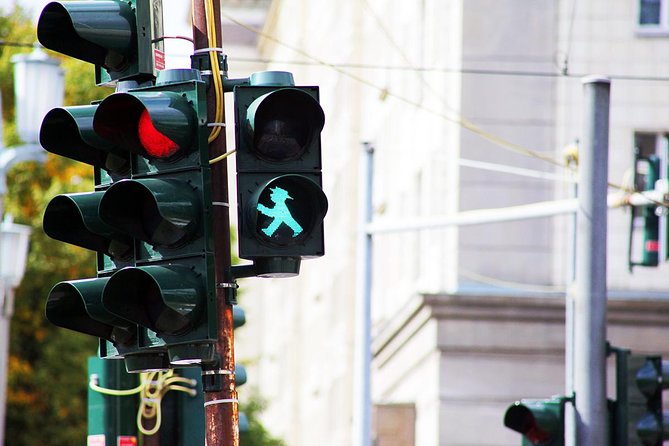
This section is especially useful for understanding Prussian and imperial Berlin. The route passes Schlossbrücke, the German Historical Museum, Neue Wache, the Staatsoper, St. Hedwig’s Cathedral, Humboldt University, and the Ampelmann shop.
Some of these are quick stops, often around five minutes. That sounds short, but it works when the guide is making a focused point about a façade, statue, memorial, or street plan. You get a readable introduction rather than a long architectural lecture.
Neue Wache is one of the more meaningful stops. Its memorial setting invites a discussion of war, mourning, and how Germany has chosen to remember its dead. Bebelplatz is even more direct. In 1933, Nazi students and supporters burned books here. The underground memorial is a quiet, unsettling reminder of censorship and the destruction of ideas.
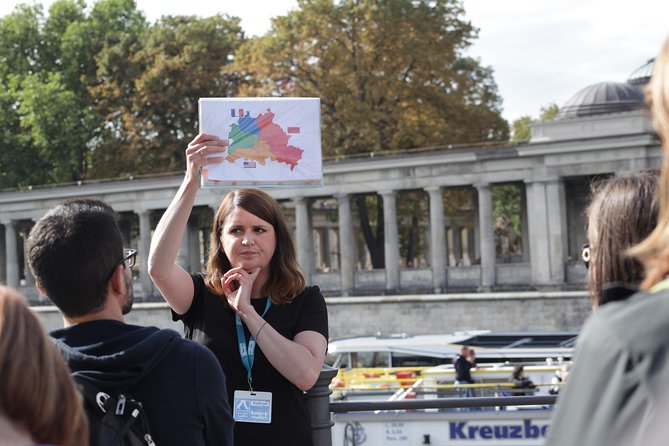
I appreciate that the tour does not treat Berlin’s darker subjects as quick photo opportunities. Guides such as Ruaridh and Gregor were praised for handling difficult German history with care while still keeping the walk approachable. Personal stories and, in some cases, East Berlin perspectives can make the Cold War section feel less like a textbook lesson.
Brandenburg Gate, Pariser Platz, and the Reichstag
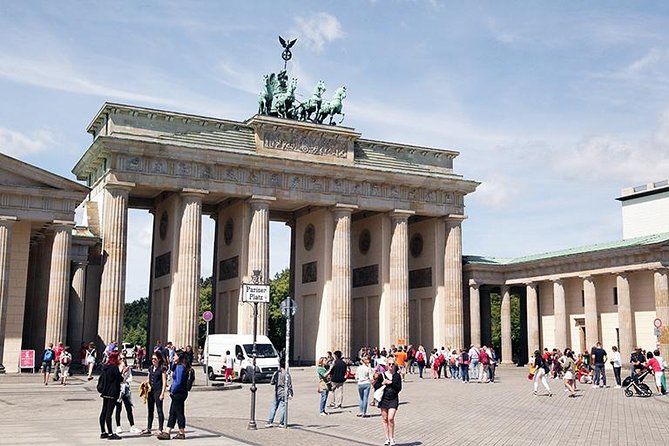
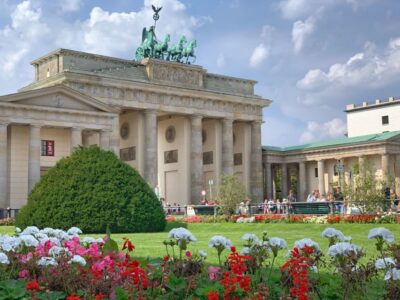
Pariser Platz leads you to Brandenburg Gate, probably the most recognizable stop on the route. The gate once marked the edge of Berlin and later became a symbol of division before turning into an image of reunification.
The guide’s value here is the timeline. You hear how the gate fit into the Prussian city, how it was used during the Nazi period, and why it became so powerful during the Cold War and after the Wall fell in 1989.
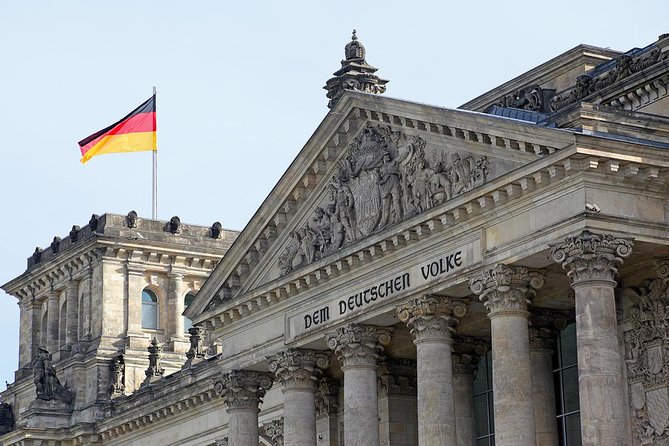
Nearby, the Reichstag is another essential stop. You see Germany’s parliament building and hear about its role in the country’s political history. The tour does not include a parliamentary visit or admission to the glass dome, so arrange that separately if it is important to you.
The itinerary also lists the Victory Column, though this is best understood as part of the wider central Berlin story rather than a long stop. The guide points out how monuments can change meaning as governments change. In Berlin, statues and grand buildings often carry several layers of political use.
This is one of the most rewarding parts of the walk for first-time visitors. The landmarks are close enough to connect on foot, yet each has a different role. You are not simply collecting photographs. You are learning how Berlin’s ceremonial center became a stage for power, defeat, division, and renewal.
Still Berlin, at a slower pace:
- Berlin: Reichstag, Dome and Government District Guided Tour
★ 4.7 · 18,288 reviews - Berlin: 1-Hour City Tour by Boat with Guaranteed Seating
★ 4.3 · 16,993 reviews - Berlin: Boat Tour Along the River Spree
★ 4.4 · 11,252 reviews - Berlin: Hop-on Hop-off Bus Tour with Live Commentary
★ 4.3 · 8,579 reviews
The Holocaust Memorial and the Führerbunker site
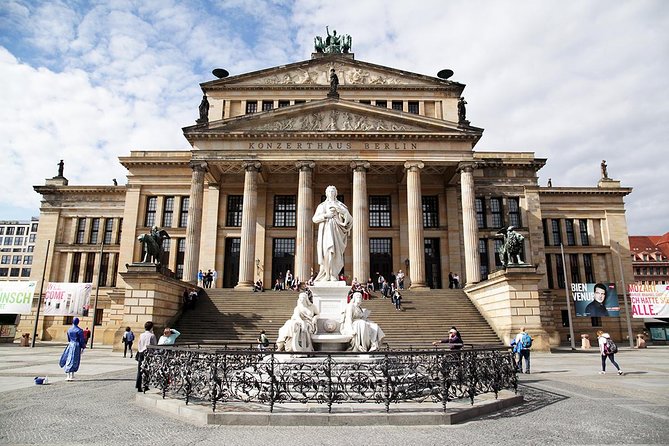
The Memorial to the Murdered Jews of Europe is one of the tour’s most important stops. Its field of concrete slabs is difficult to read from a distance because the ground changes as you walk through it. The guide helps place the memorial within the history of the Holocaust and explains why this site matters.
You also pass the location of Hitler’s bunker. There is no grand entrance or preserved underground attraction to visit here. That is part of the point. The site is marked in a deliberately restrained way, and the surrounding ordinary buildings can make the history feel especially stark.
The stop works best when the guide provides careful context without turning the place into spectacle. This is not a section for rushed jokes or sensational storytelling. The strongest guide reports describe a serious, respectful approach, while still allowing room for questions.
Give yourself time to return to the Holocaust Memorial after the tour if you want to walk through it quietly. During a guided route, you are sharing the space and keeping to a schedule. A later visit lets you absorb it at your own pace.
From the death strip to Checkpoint Charlie
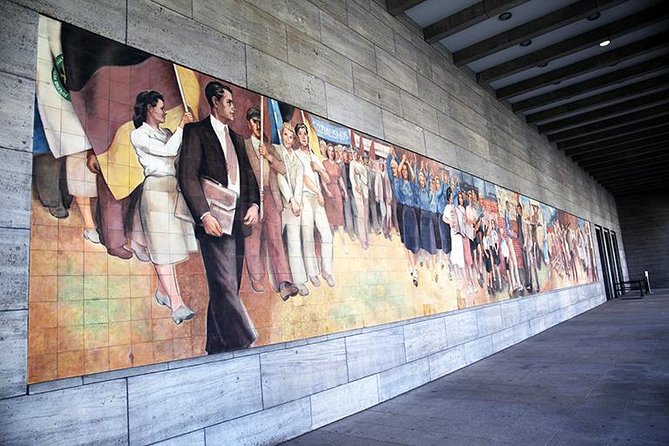
The walk then follows the path of the former Berlin Wall and the border zone that divided East and West Berlin. The guide explains the death strip, the barriers, and the human cost of a border that cut through neighborhoods, streets, and families.
This is where Berlin’s geography becomes personal. A road that now carries normal city traffic once marked a heavily guarded frontier. The tour helps you see the distance between the former sectors and understand why crossing points such as Checkpoint Charlie became so famous.
Checkpoint Charlie itself can feel commercial and crowded. I would not visit it expecting an untouched Cold War scene. Its value comes from the explanation of what happened here and how the checkpoint functioned within the divided city.
The tour also includes Platz des Volksaufstandes von 1953, connected to the East German uprising, and the former Aviation Ministry of Berlin. These are the kinds of places you might pass without noticing on your own. A guide turns them into evidence of the political struggles that shaped postwar East Germany.
The Berlin Wall Memorial stop adds another layer. The Wall was not simply a single slab of concrete. It was a system of walls, fences, patrol areas, and restricted ground. Listening to the story while standing along its former route makes the division easier to picture.
Topography of Terror and the final stretch
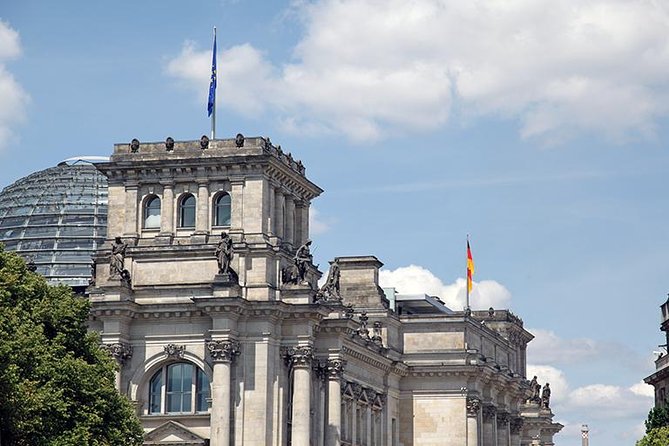
The Topography of Terror is located at the former headquarters of the Gestapo and SS. The outdoor and indoor documentation center confronts the institutions behind Nazi terror, rather than presenting the period only through the actions of one leader.
The tour points out the excavated cellars where political prisoners were tortured and killed. It is a grim stop, but an important one. Berlin has made a conscious choice to preserve and explain sites connected to its crimes instead of hiding them behind a polished city center.
The walk finishes around Checkpoint Charlie and nearby sights such as the French Cathedral. The exact ending point is different from the starting point, so you should allow time to orient yourself afterward. The central location makes it practical to continue sightseeing, but the activity does not provide a return transfer.
The route is full. Guides must keep moving to cover so many sites in roughly three and a half hours. Some stops last only five minutes, while the Holocaust Memorial and Reichstag receive about ten minutes. That pace suits an overview, but it will frustrate you if you want long periods for photographs or museum interiors.
What the guides add to the experience
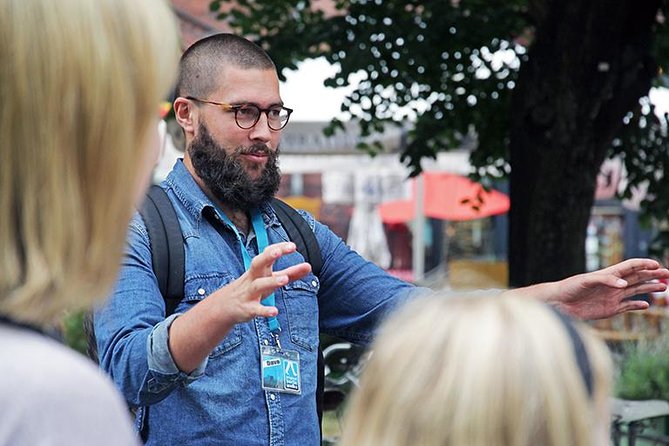
The guide is the deciding factor here. Strong guides have included Amanda, Joacham, Emma, Georgia, Rebecca, Tobi, Luisa, Glenn, Gregor, Walid, Anika, Jonathan, Sarah, Ruaridh, and Ruben. Their approaches differ, but the most praised qualities are clear delivery, humor used at the right time, strong command of Berlin’s past, and openness to questions.
Personal perspective can be especially valuable in Berlin. One guide offered an East Berliner’s view, while another used personal anecdotes about life in East Berlin. Those details help you understand that the Cold War was not only a conflict between governments. It affected work, travel, family life, and everyday choices.
Several guides were also praised for practical help beyond the formal route, including advice about areas to visit and places to eat. A short bakery or coffee stop may be offered, but food and drinks are not included, so carry water and budget for any break.
The tour is offered in English. Some guides have used more than one language to clarify a point, but English is the stated language of the activity. Most people can participate, and service animals are allowed. You still need enough stamina for several hours of walking in open air.
Best timing, clothing, and planning tips
I would take this tour near the beginning of your Berlin stay. It gives you a useful map of central Berlin and helps you decide which places deserve a longer visit. Several people found it helpful for planning the rest of their time in the city.
Berlin weather can change the experience sharply. Reviews describe cold, snowy, and windy walks that were still enjoyable because the guides kept the group engaged. Wear warm layers in winter, bring rain protection when needed, and use comfortable shoes in every season.
You receive confirmation when booking, and the tour is near public transportation. The mobile ticket is convenient, but check the meeting address carefully. The tour begins at Neue Promenade 3, and it does not return to that same spot.
Cancellation is free with at least 24 hours’ notice. If you cancel within 24 hours of the start time, you do not receive a refund, and late changes are not accepted.
Who should book this Berlin walking tour?
I recommend it most to first-time visitors, history fans, families with older children or teenagers, and anyone who wants the city explained rather than simply photographed. It also works well for solo visitors who prefer the structure and company of a group.
You may want a different format if you have limited mobility, dislike long walks, or want to enter several museums. The tour covers a great deal, but the price does not include food, drinks, or attraction admission.
Should you book the Discover Berlin Half-Day Walking Tour?
Yes, if you want an affordable and lively introduction to Berlin’s major historical zones. The 4.9 rating from 9,624 reviews and 98 percent recommendation rate match the tour’s strongest qualities: a smart route, engaging guides, and serious treatment of Berlin’s difficult past.
Book it early, bring shoes suited to a full morning or afternoon on foot, and treat the route as your city primer. I would not choose it as a substitute for the museums or memorials themselves. I would choose it as the explanation that makes those later visits far more meaningful.
FAQ
How long is the Discover Berlin Half-Day Walking Tour?
The tour lasts approximately 3 hours and 30 minutes.
How much does the tour cost?
The listed price is $24.19 per person.
What language is the tour offered in?
The tour is offered in English.
Where does the tour begin?
The meeting point is Neue Promenade 3, 10178 Berlin, Germany.
Where does the tour end?
The activity ends in a different location from the meeting point. The exact ending details are provided with the booking information.
What sights are included?
The route includes Museum Island, Unter den Linden, Bebelplatz, Brandenburg Gate, the Reichstag, the Holocaust Memorial, the Berlin Wall, the Topography of Terror, and Checkpoint Charlie, among many other central Berlin landmarks.
Are food and drinks included?
No. Food and drinks are not included unless specifically stated. Some guides may offer a short break where you can buy something, but any purchase is at your own expense.
How large can the group be?
The tour has a maximum of 25 participants.
Is cancellation available?
Yes. You can cancel at least 24 hours before the start time for a full refund. Cancellations or changes made less than 24 hours before the start time are not accepted for a refund.
Just added around Berlin
- Private Walking Tour in Berlin: Hitler’s Germany & WWII★ 5.0 · 7 reviews
- The History of Berlin: WWII PRIVATE Walking Tour With Locals★ 5.0 · 209 reviews
- Private Berlin WWII and Cold War History Tour with Local Expert Guide★ 5.0 · 28 reviews
- Private Walking Tour Berlin 3 hours: Brandenburg, Historic Center★ 5.0 · 7 reviews
- Berlin: Private Bike Tour of the Berlin Wall and Third Reich★ 5.0 · 23 reviews
- Berlin: Guided Private Bike Tour to Explore the Highlights★ 5.0 · 12 reviews
- Berlin Photography Masterclass – Private Photography Lesson★ 4.5 · 23 reviews
- Group Driving Tour 1 to 6 people. Berlin Shore Excursion incl pick-up at Port★ 5.0 · 8 reviews
Walking Tours, compared.
Old Town & Viktualienmarkt City Walk in German
Read our review →
Browse the lists this tour appears in