
Reviewed · OLD TOWN TOURS
Münster: Old Town Highlights Guided Tour
Münster keeps its history in plain sight. This 1.5-hour old town tour links the cathedral, Prinzipalmarkt, Lambertus Church, Historic City Hall, and Baroque buildings into one clear story. I like the way it explains not just what Münster looks like, but how disputes between clergy, merchants, and religious rebels shaped the streets you see today.
I also like the modest $16 price, which makes this a sensible first look at the city, and the guides’ reported mix of punctuality, humor, and solid answers. The main drawback is simple: the tour is held in German, so you need enough German to follow a fast-moving account of Münster’s past.
In This Review
- Key points about the Münster old town tour
- Starting opposite the Historic City Hall
- St. Paul’s Cathedral and the birth of Münster
- The Überwasserkirche and the marks left by rebellion
- St. Lambertus Church and the famous cages
- Prinzipalmarkt and the civic face of Münster
- The Historic City Hall and the Peace Hall
- Schlaun’s Baroque Münster at Erbdrostenhof and Clemenskirche
- What the 90-minute format gives you
- Is $16 a fair price?
- Who should book this Münster walk?
- My verdict on the k3 city tour
- FAQ
- Where does the Münster old town tour meet?
- How long does the tour last?
- What language is the tour conducted in?
- How much does the tour cost?
- Can children join for free?
- Which Münster sights are included?
- Can I cancel the booking for a full refund?
Key points about the Münster old town tour

- Mimigernaford becomes Münster: Start at St. Paul’s Cathedral and learn how a small Saxon settlement grew into a city.
- The Anabaptists left visible marks: A roofless tower, headless saints, and iron cages turn difficult history into things you can actually see.
- The Peace Hall gives Münster wider importance: The Historic City Hall connects the town to the 1648 Peace of Westphalia.
- Johann Conrad Schlaun shaped the city’s look: The Erbdrostenhof and Clemenskirche show off Münster’s elegant Baroque side.
- The tour stays compact and affordable: At 90 minutes and $16 per person, it fits neatly into a day of sightseeing.
- Young children join free: Children aged 0 to 5 can take part without an additional charge.
Starting opposite the Historic City Hall

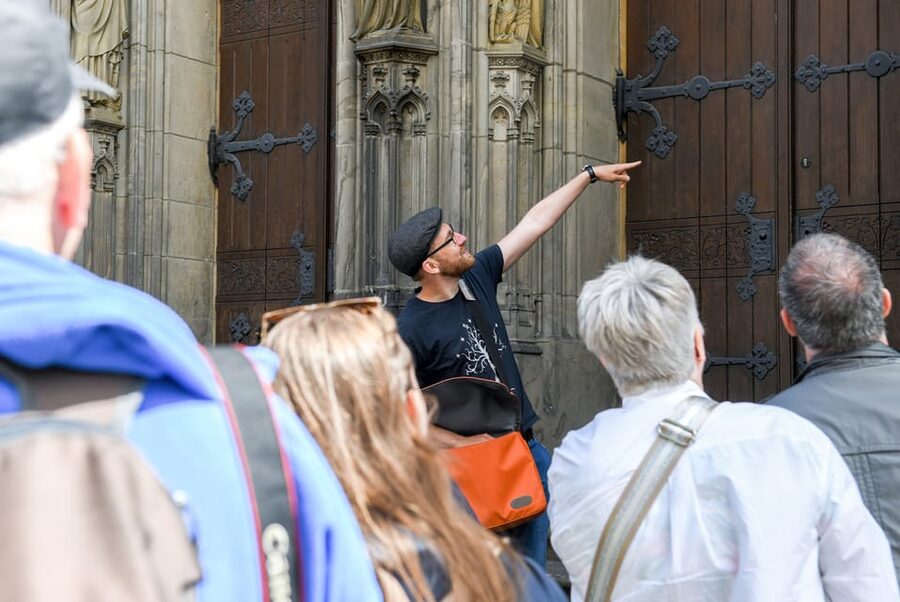
Your meeting point is opposite the Historic City Hall, beneath the sign marked Michaelisplatz and close to the Rathausrelief. Look for the guide carrying an orange bag with the k3 sign.
That location is useful. You are already near one of Münster’s most important sights, so you can begin with the city’s civic center rather than spending time finding a remote meeting place. Arrive with enough time to identify the sign and the orange bag, since the tour starts promptly. One recent participant specifically praised the punctual start, a small detail that matters when you have other plans later.
The tour is led in German by a live guide from k3 stadtführungen. The strongest reports describe a guide who was sympathetic, entertaining, well prepared, and happy to answer questions. A short city tour depends heavily on its guide, and here that personal element appears to be one of the main reasons the experience earns a 4.7 rating from 286 reviews.
You should not expect an audio guide or a self-paced walk. The point is to move through the center with someone who can connect the buildings and explain why they matter. The exact group size is not provided, so I would not book this expecting either a private walk or a very small group.
More Old Town Tours in Munster:
- Münster: Night watchman tour through the picturesque old town by lantern light
★ 4.8 · 65 reviews - Münster: Old Town Historical Walking Tour by “Geo Epoche”
★ 4.7 · 51 reviews - Münster: Old Town Crime Mystery Tour
★ 4.0 · 35 reviews
St. Paul’s Cathedral and the birth of Münster
The first major stop is St. Paul’s Cathedral, where the story begins with Mimigernaford, the small Saxon settlement that became Münster. This is a good opening because it gives you a starting point before the tour moves into religious conflict, city politics, and international diplomacy.
The cathedral also introduces the idea of cathedral immunity. In simple terms, this refers to the area connected with the cathedral where the clergy held special rights and influence. The tour uses that subject to explain how the church affected the early city and why the boundary between religious and civic power mattered.
You also hear about earlier disputes between merchants and clergy. That is more useful than a list of dates because it helps you read Münster’s center as a record of competing interests. The city was not shaped by one ruler or one grand plan. Its streets and buildings reflect arguments over who controlled urban life.
I like this section for another reason: it gives the cathedral a role beyond being an impressive building. You are not simply told to admire its architecture. You are shown how it helped shape the city’s identity and power structure.
The Überwasserkirche and the marks left by rebellion
The tour then turns to the Anabaptist period in the 16th century. This is the most unusual part of the walk because the evidence is still visible in the form of damaged architecture and altered religious images.
The tower of the Überwasserkirche still has no point. Some saints there remain headless. Those details make the story immediate. Instead of hearing only about a religious movement in abstract terms, you see the physical damage linked to the Anabaptist rule and its aftermath.
This stop needs a careful explanation, and that is where a live guide earns the fee. A bare fact such as a missing spire or headless statue can feel like a curiosity. Placed in the story of Münster’s religious upheaval, it becomes a clue to the force of the conflict.
Do not expect a polished, cheerful version of city history at every stop. Münster’s past includes violence, religious extremism, and lasting damage. The tour appears to handle those subjects through specific local details, which is more useful than smoothing them over.
The drawback is that the description does not promise a long interior visit or extensive time at the church. You should think of the Überwasserkirche as an explained landmark along a walking route, not as a separate church tour.
St. Lambertus Church and the famous cages
At the market church of St. Lambertus, the tour continues the Anabaptist story. The iron cages on the tower symbolize the end of the movement. They are also tied to the tower keeper, who worked from the church tower.
These cages are among the strongest visual stops on the route. You can look up and see objects that carry a grim historical message, while the guide explains why they were placed there and what they came to represent. This is the kind of detail you might miss if you simply walked through Münster with a map.
The tower also shows how practical city life once operated. The mention of the tower keeper brings the church into the daily routine of the town, not just its religious life. A tower could be a place of warning, observation, and work, as well as worship.
I would give this stop your full attention. The cages are easy to photograph, but the explanation matters more than the picture. Without the context, they are strange metal objects. With the story, they become one of Münster’s clearest reminders of the city’s troubled 16th century.
A few more Munster trips worth comparing
- Münster: Nachtwächter-Führung (Erlebnistour)
★ 4.4 · 213 reviews - Münster: Private Guided Rickshaw City Tour
★ 4.8 · 143 reviews - Münster: Beer Tasting Rickshaw Tour
★ 4.7 · 56 reviews - Private Christmas Tour in Münster including Glühwein
★ 4.9 · 54 reviews
Prinzipalmarkt and the civic face of Münster
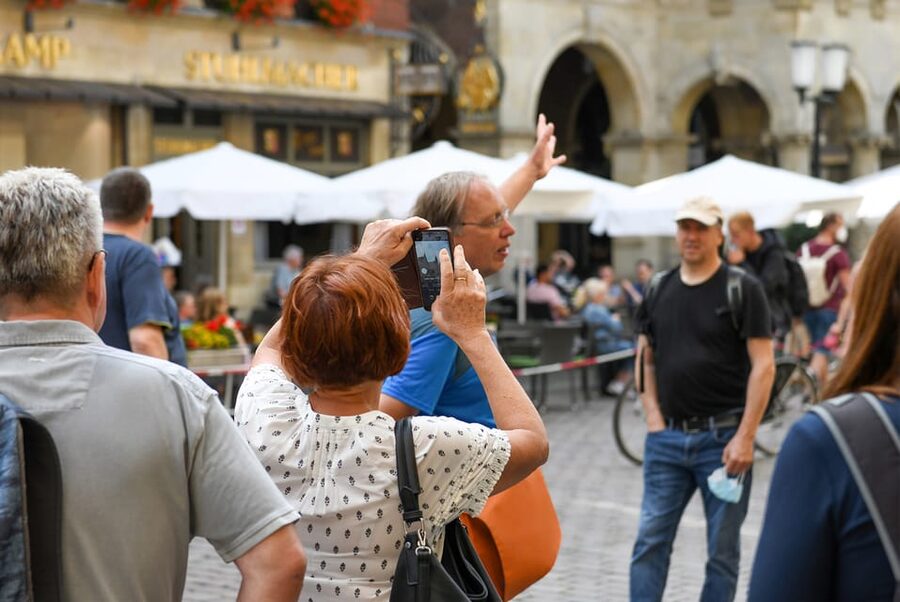
The walk includes Prinzipalmarkt, one of Münster’s central sightseeing highlights. Here, the focus shifts from religious power and rebellion to the city’s public and commercial character.
The earlier conflict between merchants and clergy becomes easier to understand as you move through the center. The tour’s value lies in connecting the visible cityscape with those old disputes. You are not just looking at a handsome market area. You are considering who traded, who governed, and who had the right to shape urban space.
This part should appeal to you if you like city walks that explain how places functioned. The tour is not limited to famous façades. It treats Münster as a working city formed by trade, faith, administration, and conflict.
One recent participant found the route entertaining and informative, with the guide also leading the group into corners that are easy to miss on your own. That is a useful expectation to carry into the tour. The value is not only in reaching the major sights. It is also in noticing smaller details and less obvious viewpoints along the way.
Since the tour lasts only 90 minutes, the time at each stop will be measured. You will get a guided overview rather than an exhaustive study of every building around Prinzipalmarkt. That is a fair trade if you want orientation early in your stay.
The Historic City Hall and the Peace Hall

The Historic City Hall brings Münster into the story of European diplomacy. In the Peace Hall, peace was signed between the Dutch and the Spanish in 1648. The tour uses this setting to explain the Peace of Westphalia, which ended the horrors of the Thirty Years’ War.
This is the point where the tour expands beyond local history. The cathedral and churches show how Münster developed from inside. The town hall shows how events in Münster reached far beyond its streets.
The Peace Hall is also a strong example of how a building can carry several meanings at once. It is part of the city government, a historic room, and a symbol of an agreement that brought a long and destructive war to an end. You do not need to be a specialist in European history to see why that gives the building unusual weight.
The available details do not say how much time is spent inside the Peace Hall or whether a separate admission is included. Keep that in mind when planning. The tour definitely explains the site, but you should not assume it includes a full museum visit or extended interior access.
Still, for $16, having the Peace Hall placed in its proper setting is good value. A guide can show you why the building matters before you return for a longer visit on your own, if your plans allow.
Schlaun’s Baroque Münster at Erbdrostenhof and Clemenskirche
The final architectural turn brings you to two buildings linked to Johann Conrad Schlaun, the Baroque master builder whose style remains important to Münster’s appearance.
The Erbdrostenhof and Clemenskirche offer a change of mood after the darker stories of religious conflict and war. Their importance is not only that they are attractive buildings. Together, they show how one architect helped give the city a recognizable visual character.
This is a useful reminder that Münster’s appearance did not come from one historical period. The route moves from a Saxon settlement to cathedral power, from religious upheaval to peace negotiations, and then to the formal elegance of the Baroque era.
I like the inclusion of these two buildings because it prevents the tour from becoming only a political and religious history lesson. You get architecture as well as events, and the final section gives the walk a more balanced rhythm.
Again, expect explanation rather than a dedicated architecture lecture. The supplied details do not promise interior access to either building. You will learn why they matter and how Schlaun’s work influenced the city, while the guide keeps the pace suitable for a general old town tour.
What the 90-minute format gives you
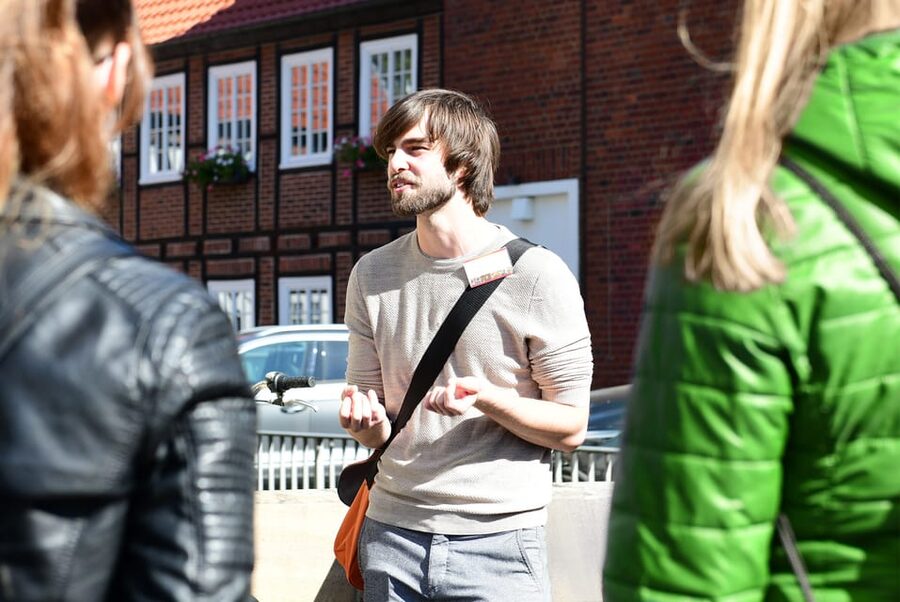
Ninety minutes is long enough to create a clear framework for Münster, but short enough to fit before lunch, after arrival, or between other visits. One person specifically found the duration well judged, and I can see why. The route covers several major subjects without asking you to commit half a day.
The compact format also keeps the tour focused. You will not receive every detail about every street. Instead, you get a connected sequence:
- the city’s early growth at St. Paul’s Cathedral
- church and merchant power
- the Anabaptist period at Überwasserkirche and St. Lambertus
- civic and international history at the Historic City Hall
- Baroque design at the Erbdrostenhof and Clemenskirche
That sequence is the real strength. Each stop adds another layer, and the guide’s job is to prevent the walk from becoming a string of unrelated facts.
The cost is limited depth. If you want long interior visits, detailed architectural measurements, or a full account of the Thirty Years’ War, you will need more time elsewhere. For a first introduction, the balance is sensible.
Is $16 a fair price?
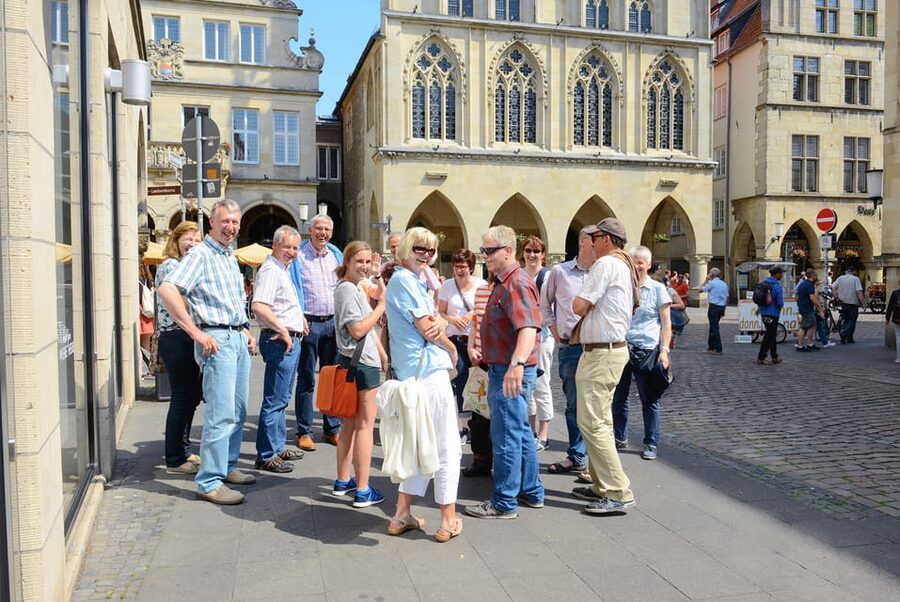
At $16 per person, I consider this good value, especially if you are new to Münster. The tour covers several of the city’s central sights and gives you a reason to notice details that are easy to pass without context.
The value is strongest when you treat the tour as an orientation walk. Afterward, you will have a better sense of which buildings deserve a return visit and how the cathedral, churches, market, town hall, and Baroque landmarks fit together.
Children aged 0 to 5 can join free, which helps families keep the cost down. The tour’s subject matter includes difficult history, so parents may want to decide in advance how much explanation is suitable for younger children. The free age policy removes the price concern, but not the question of attention span.
The booking terms are also practical. You can reserve now and pay later, and cancellation is free up to 24 hours before the start for a full refund. Those terms help if your Münster schedule is still changing.
Who should book this Münster walk?
I would choose this tour if you want:
- a first look at Münster’s old town in 90 minutes
- a guide-led explanation rather than a list of dates
- local stories tied to visible buildings and details
- a low-cost activity in the center
- a German-language experience
- a route that works well at the beginning of a city visit
It is especially suited to people who enjoy history when it is attached to real places. The headless saints, tower without a point, iron cages, and Peace Hall give you strong visual reminders of the stories.
Families can also consider it, thanks to free admission for children under six. The German language is the key limitation. If you do not understand German well, you may miss the quick connections between the stops, even if the buildings are still interesting to see.
I would be less likely to choose it if you need an English guide, want a private tour, or prefer to spend most of your time inside monuments. None of those options is promised here. This is a public, live German walk through Münster’s historic center.
My verdict on the k3 city tour
I like this tour because it makes Münster readable. You see a church tower without its point, saints without their heads, cages high above a market church, a town hall tied to a major peace agreement, and Baroque buildings by Schlaun. The guide supplies the links between those sights.
The strongest praised qualities are the well-managed length, punctual start, friendly manner, clear answers, and ability to share facts beyond the obvious route. Those are exactly the details that make a short walking tour work.
Book it if you can follow German and want an affordable, well-shaped introduction to the city. Skip it if you need English or expect a long interior-focused visit. For the right audience, $16 buys more than a walk past Münster’s façades. It gives you the arguments, beliefs, disasters, and decisions that helped put those façades where they are.
FAQ
Where does the Münster old town tour meet?
Meet opposite the Historic City Hall beneath the sign marked Michaelisplatz, close to the Rathausrelief. The guide carries an orange bag with the k3 sign.
How long does the tour last?
The guided tour lasts 1.5 hours, or 90 minutes.
What language is the tour conducted in?
The tour is held in German and includes a live German-speaking guide.
How much does the tour cost?
The listed price is $16 per person.
Can children join for free?
Yes. Children aged 0 to 5 years can take part for free.
Which Münster sights are included?
The route includes St. Paul’s Cathedral, Lambertus Church, Prinzipalmarkt, and the Historic City Hall. It also covers the Überwasserkirche, the Erbdrostenhof, and Clemenskirche.
Can I cancel the booking for a full refund?
Yes. You can cancel up to 24 hours in advance for a full refund. You can also reserve now and pay later.
Just added around Munster
- Private crime city tour by rickshaw including guide★ 5.0 · 21 reviews
- Münster: Private Guided Sculptures Tour on a Rickshaw★ 5.0 · 12 reviews
- Münster Private Guided Walking Tour★ 4.5 · 18 reviews
- Münster Old Town: Outdoor Escape Game★ 4.1 · 14 reviews
- Münster: Old Town Historical Walking Tour by “Geo Epoche”★ 4.7 · 51 reviews
- Münster: Private pub crawl with insider guide & free shots★ 4.6 · 11 reviews
- Münster Escape Tour Kreuzviertel★ 4.2 · 8 reviews
- Münster: Old Town Crime Mystery Tour★ 4.0 · 35 reviews
Old Town Tours, compared.
Old Town & Viktualienmarkt City Walk in German
Read our review →

The Night Watchman Old Town Walking Tour in German
Read our review →
Browse the lists this tour appears in