
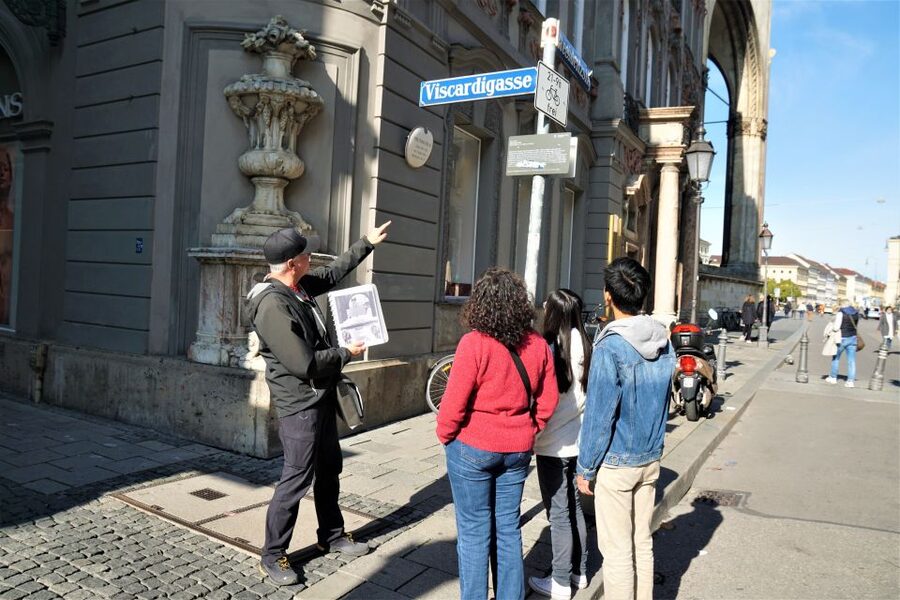
Reviewed · THIRD REICH HISTORY TOURS
National Socialism WWII with licensed guide – private tour
Munich’s grand center carries a grim story. This private walking tour makes that past easier to follow, linking Hitler’s early years, the Nazi rise, resistance groups, and surviving sites across the city. I especially like the use of historical photographs and the chance to ask questions in a private group.
I also like the route’s clear shape, from Odeonsplatz to Königsplatz, and the way it includes the White Rose resistance movement rather than focusing only on Nazi power. Guide Wolfgang Brehm has earned praise for making the subject clear and engaging, including from a family using the tour to support a student’s GCSE history work.
The main drawback is the tight two-hour schedule. You cover a lot of ground and several major sites, but the tour is more of a focused introduction than a full museum visit. Admission to the NS Documentation Centre costs extra, and you will need additional time if you want to see its exhibitions properly.
In This Review
- Key points to know before booking
- Why Munich is the right place for this difficult subject
- Starting at Feldherrnhalle and Odeonsplatz
- Through the Court Garden and toward resistance
- The Square of the Victims of National Socialism
- Haus der Kunst and Nazi control of art
- Munich Residenz and the city’s political setting
- Karolinenplatz and the money behind the movement
- Königsplatz and the former Nazi party center
- Adding the NS Documentation Centre after the walk
- Guide quality, group size, and value
- Who will get the most from this tour
- Should you book the Munich Nazi history walk?
- FAQ
- Where does the tour begin?
- Where does the tour finish?
- How long does the tour last?
- How much does the private tour cost?
- Are tickets to the NS Documentation Centre included?
- Can I visit the NS Documentation Centre after the tour?
- Which languages are available?
- Is this a private group experience?
- Is the tour wheelchair accessible?
- Can I cancel for a full refund?
Key points to know before booking
- The tour follows Munich’s Nazi story on foot: You begin at the Feldherrnhalle on Odeonsplatz and finish at Königsplatz, the former party center.
- You see places tied to both power and resistance: The route covers the Hitler coup, Nazi architecture, the White Rose, and the Square of the Victims of National Socialism.
- Photographs add useful context: The guide uses extensive photo material to show how these sites looked and functioned during the Nazi period.
- The private format suits questions: The price is $259 for a group of up to 30, so the value improves sharply when shared by a larger family or group.
- The NS Documentation Centre is an optional follow-up: The guide introduces the site, but museum admission is not included.
- English and German tours are available: The tour lasts two hours and is wheelchair accessible.
Why Munich is the right place for this difficult subject
Munich is closely tied to the early history of National Socialism. Adolf Hitler came to the city, built his political career there, and helped turn the German Workers’ Party into the NSDAP. The movement later used Munich as a center of administration, ceremony, propaganda, and political control.
That makes this tour useful for more than identifying old buildings. You are shown how public squares, government offices, monuments, art institutions, and universities fitted into the story. The city center becomes a kind of open-air classroom, but one where the evidence can be easy to miss without a guide.
I appreciate that the tour does not treat the subject as a parade of Nazi landmarks. It also asks what opposition looked like in Munich and who suffered under the regime. That balance matters. A tour of this kind should explain power without turning its symbols into curiosities.
The subject is serious, and the provider makes clear that the experience is not intended for people seeking Nazi fascination or right-wing political entertainment. You should book it as a historical and educational tour.
More Third Reich History Tours in Munich
- Munich: Third Reich & WWII Walking Tour
★ 4.6 · 6,181 reviews - Third Reich Walking Tour Munich
★ 4.5 · 4,291 reviews - Munich: Birthplace of the Third Reich Guided Walking Tour
★ 4.6 · 771 reviews
Starting at Feldherrnhalle and Odeonsplatz
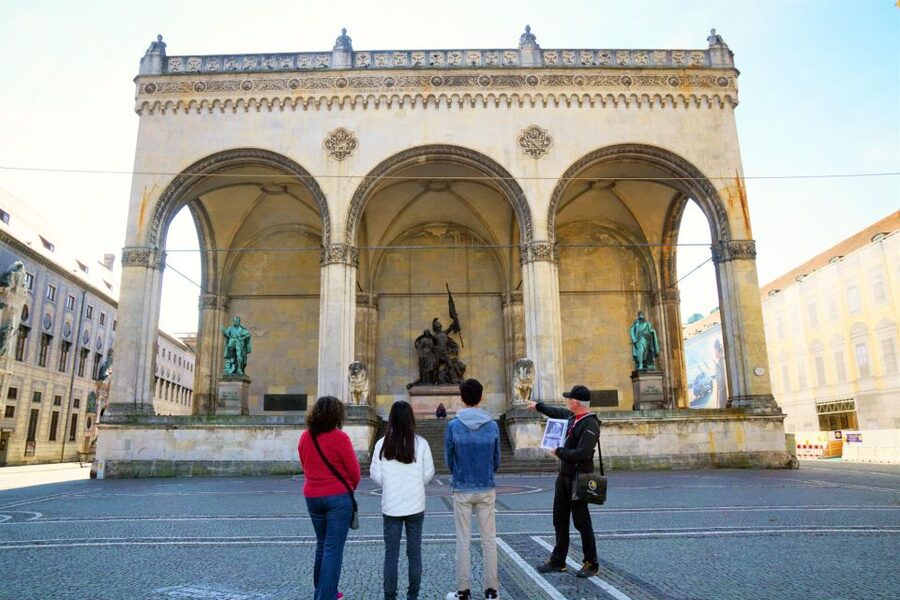
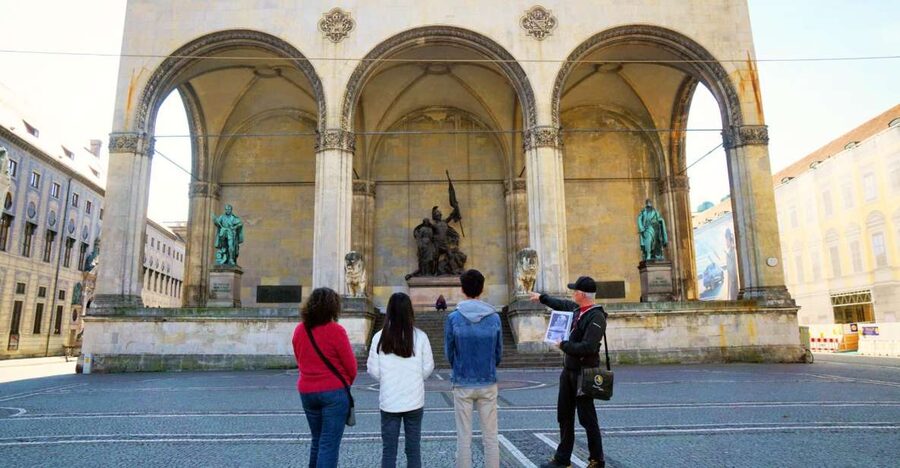
The meeting point is at the steps of the Feldherrnhalle on Odeonsplatz. This is a practical location in central Munich, and the opening stop immediately places you at one of the most important scenes connected to Hitler’s rise.
The guide explains why Hitler came to Munich, where he lived, and how he made a living before politics gave him a larger public role. That early background helps you see him as a political operator who developed in a particular city, rather than as a figure who appeared fully formed.
The Feldherrnhalle is also linked to the failed Hitler coup, known as the Beer Hall Putsch. The tour explains where the coup ended and points out the former monument erected for the men who died during it. That detail is important because monuments can reveal how later governments wanted events remembered.
You receive about 10 minutes of guided explanation at the Feldherrnhalle, followed by another short segment listed at the same site. The repeated stop suggests that the guide treats the location as a key turning point rather than rushing past it. Still, you should expect a compact talk, not a long historical lecture.
Through the Court Garden and toward resistance
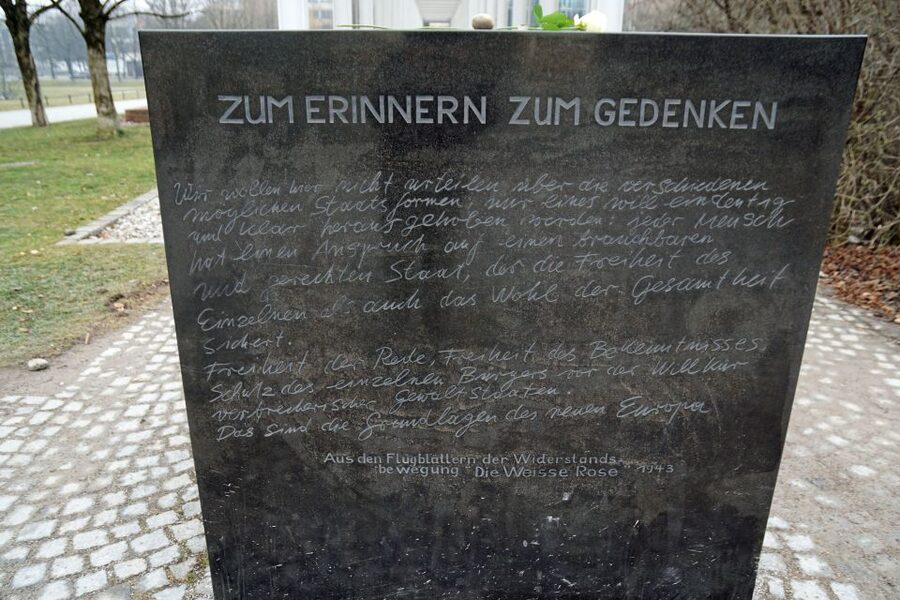
From Odeonsplatz, the walk continues through the Court Garden. Here the emphasis shifts from Nazi action to people who resisted the regime.
One monument honors resistance fighters. The tour then moves toward the Ludwig Maximilian University of Munich, known as LMU, where you learn about the White Rose. This group produced leaflets opposing Hitler and the Nazi government. Several members were arrested and beheaded.
For me, this is one of the strongest parts of the route. The White Rose story gives the tour a human scale. Instead of hearing only about party structures and grand buildings, you encounter young people who used words and printed leaflets against a system that could respond with deadly force.
The guide presents this material at one of Germany’s largest universities, giving the story a clear setting. The stop is listed at around 15 minutes, though the tour description places the university within the broader route rather than giving it a separate numbered stop. You may want to ask the guide to clarify exactly where the White Rose discussion takes place if this subject is a main reason for your booking.
A UK family found the tour useful for GCSE history study, and I can see why. The route connects people, places, ideology, and consequences in a way that can be easier to remember than isolated textbook chapters.
The Square of the Victims of National Socialism
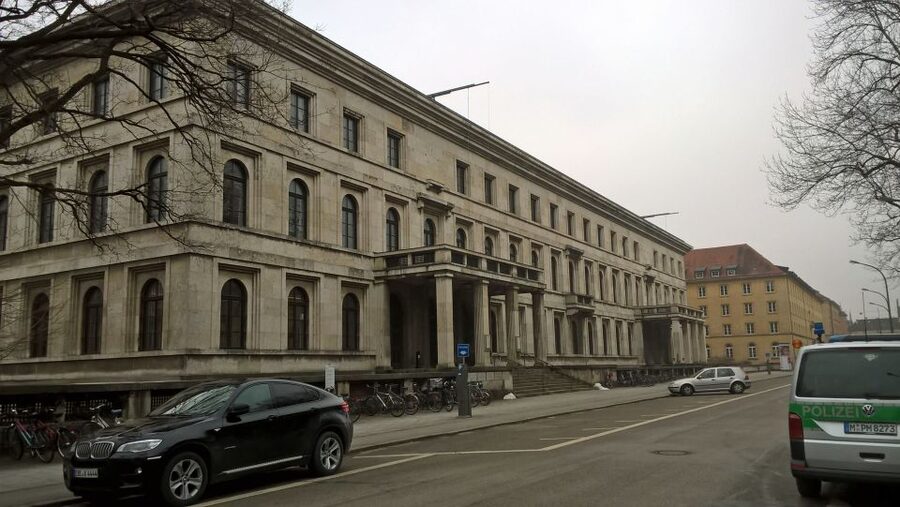
The Square of the Victims of National Socialism provides a needed pause in the tour’s story. Here the guide explains who the victims were, rather than leaving the phrase as a general memorial label.
The stop lasts about 10 minutes. That is not long, so you should listen closely and ask questions while you have the chance. The value of a guide here is not just in naming the site. It is in helping you understand how different groups and individuals were affected by Nazi rule.
This is also where the tour’s tone becomes especially important. The subject is not reduced to Hitler, military buildings, and political drama. The route directs attention toward victims and resistance, which gives you a fuller sense of what the regime meant in daily life.
If you prefer a quiet, self-guided visit to memorials, the group setting may feel a little brisk. If you want historical framing, the short explanation can make the square more meaningful.
Still Munich, at a slower pace:
- From Munich: Neuschwanstein & Linderhof Castle Full-Day Trip
★ 4.5 · 12,494 reviews - Neuschwanstein & Linderhof Castle-Fairytale Day Tour from Munich
★ 4.5 · 7,275 reviews - Dachau Concentration Camp Memorial Site Tour from Munich by Train
★ 4.5 · 5,637 reviews - Neuschwanstein Castle Tour from Munich
★ 4.5 · 5,117 reviews
Haus der Kunst and Nazi control of art
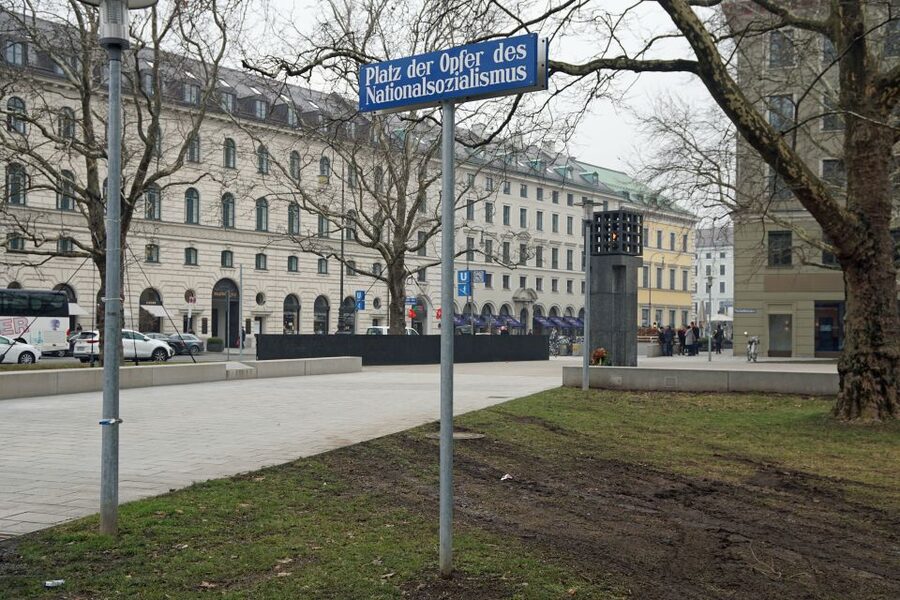
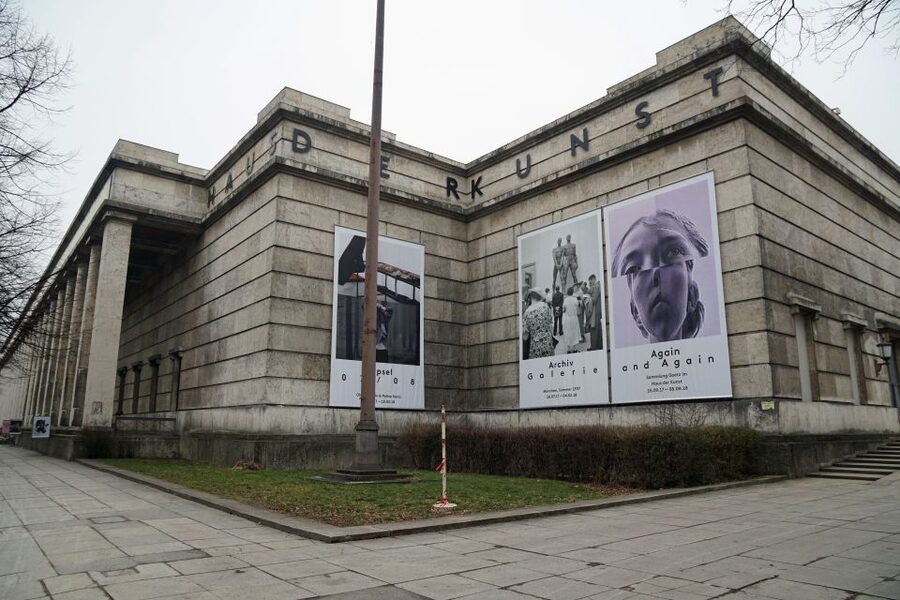
At Haus der Kunst, the tour examines how the Nazis used art and cultural institutions. The guide explains the political influence placed on art, showing that the regime’s control was not limited to police, elections, and military power.
You also hear about the Degenerate Art exhibition and where it took place in Galeriestraße. This is a useful part of the route because it shows how the Nazis attacked art they considered politically or racially unacceptable, while promoting their own preferred style.
The Haus der Kunst stop lasts about 15 minutes. It is enough time for a clear explanation, but not a full study of the building or the exhibition history. You will probably get more from it if you already have some interest in modern art, propaganda, or cultural censorship.
The guide’s photographs are particularly useful here. Historical images can show how buildings were presented, how crowds were arranged, and how political messages were placed in public view. You are not simply looking at a present-day façade and trying to imagine its past.
Munich Residenz and the city’s political setting
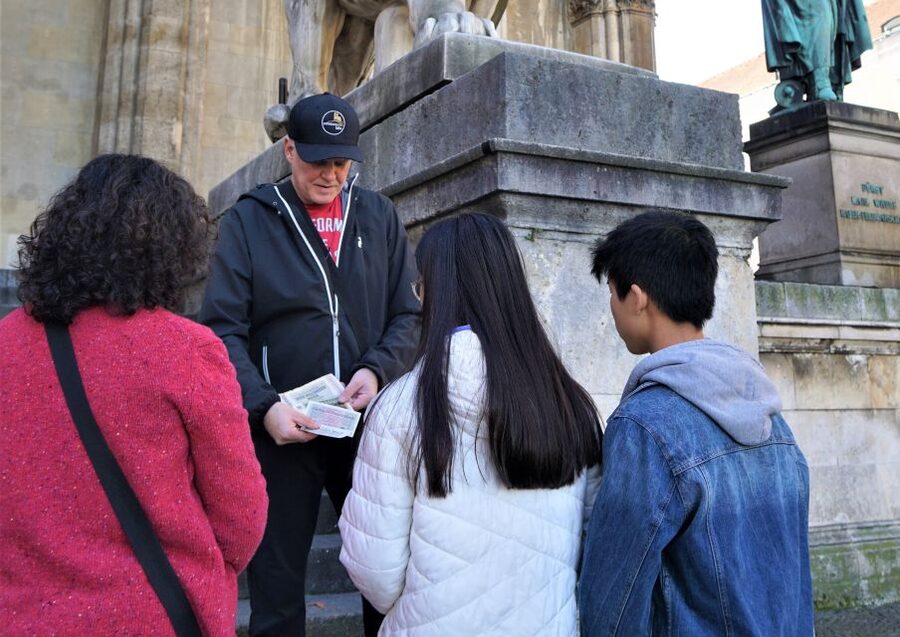
The itinerary includes a 10-minute guided stop at the Munich Residenz. This grand complex helps place Nazi activity within the older political center of Bavaria.
The tour does not present the Residenz as a Nazi building. Instead, its inclusion helps you understand the setting in which later political movements worked. Munich’s Nazi history unfolded among royal, civic, artistic, and academic institutions, not in a separate area cut off from ordinary city life.
This stop may appeal most to people who want the wider city context. If your main interest is Nazi architecture, the Residenz may feel less direct than Feldherrnhalle or Königsplatz. Still, it helps prevent the tour from becoming a narrow list of party offices.
The exact amount of walking between stops is not specified, but the route connects central Munich sites on foot. Comfortable shoes are sensible, particularly if you plan to continue exploring after the tour.
Karolinenplatz and the money behind the movement
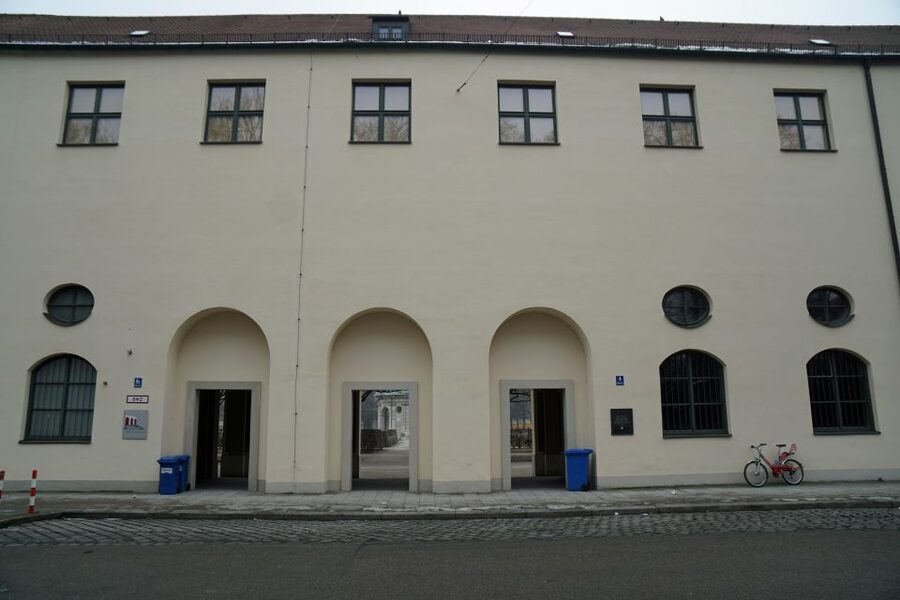
Karolinenplatz is where the tour discusses major sponsors of the Nazis. This part is valuable because political power needs more than speeches and symbols. Money, influence, and support from important figures helped movements grow.
The supplied schedule does not assign a separate duration to Karolinenplatz, but the tour description includes it before the final section at Königsplatz. You should expect this material to fit into the overall two-hour route.
I like this stop because it widens the usual story. Many introductions to Hitler focus on his speeches and personal ambition. Looking at sponsors asks a harder question: who helped make the movement possible, and why?
The short format means you may not get a long account of each sponsor. If you want names, business connections, or a detailed study of political financing, ask the guide while you are there.
Königsplatz and the former Nazi party center
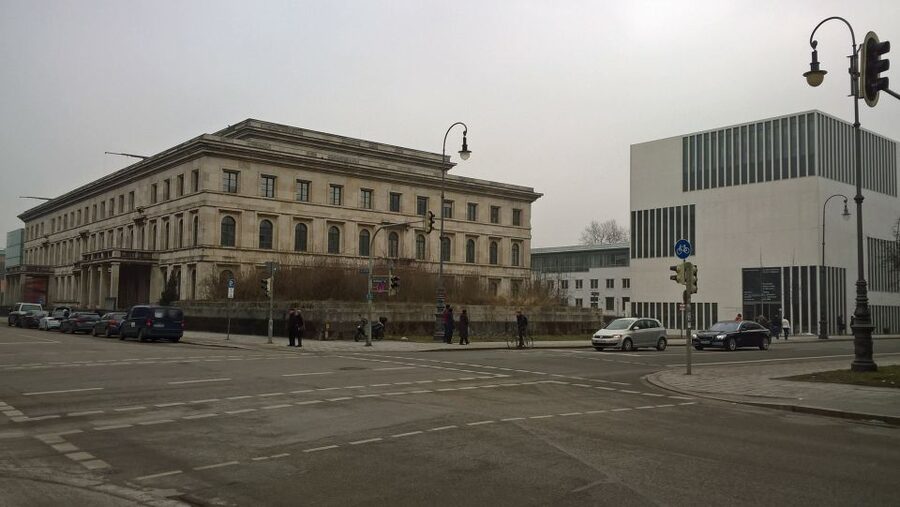
The tour finishes at Königsplatz, the former center of Nazi party activity in Munich. This is the most concentrated section of the route, with several sites tied to Nazi administration and leadership.
You learn about the Brown House, the former Nazi headquarters, as well as the Führerbau, where Hitler’s office was located. The tour also covers the NSDAP administration buildings. The listed explanation of the Führerbau lasts about 15 minutes, giving this final section enough time for more than a quick photo stop.
Königsplatz is an effective ending because it brings together the political organization, offices, architecture, and public image of the movement. After beginning with Hitler’s arrival in Munich, you finish at the place where the Nazi apparatus had become established.
The present-day setting can make the history harder to read on your own. Buildings change function, signs disappear, and the meaning of a square is not always obvious. This is where the guide’s photographs do real work, helping you compare the current scene with its Nazi-era use.
Adding the NS Documentation Centre after the walk
The NS Documentation Centre is the natural follow-up to this tour. It opened in 2015 on the site connected with the former Nazi headquarters, and the walking tour ends nearby.
Admission is not included. The guide introduces the center and explains its place in the story, but you need to pay separately if you want to enter. The two-hour tour itself does not appear to include a full museum visit, so plan additional time if you want to read the displays rather than simply see the building.
This arrangement has both strengths and limits. Keeping the museum separate lets you choose how much time and money to spend. On the other hand, if you expected a guided museum tour, you may find the experience ends before the indoor exhibits begin.
I would treat the walking tour as preparation for the center. The guide gives you a map of the people, places, and events first. The museum can then add documents and displays to that framework.
Guide quality, group size, and value
The tour costs $259 per private group of up to 30 people. That sounds expensive for two hours if you are booking alone or as a couple. It becomes more reasonable when divided among a family, school group, or larger circle of friends.
A full group of 30 would pay less than $9 per person. A group of four would pay nearly $65 per person, so group size makes a major difference. The private format is the main reason to consider the price. You are not paying for a seat on a standard shared walk, but for a guide assigned to your group.
Wolfgang Brehm is the named guide associated with the experience, and the feedback highlights his skill. Comments describe the tour as clear, educational, interesting, and never boring. One German-language assessment specifically praises the very experienced guide, while an English-language booking from the United States praises the guide’s command of the subject.
English and German are offered. The tour is wheelchair accessible, though the supplied information does not give details about pavement, steps, or accessible entrances at each stop. The meeting point is at the Feldherrnhalle steps, so you may want to confirm the easiest access route when booking.
Cancellation is flexible up to 24 hours before the start for a full refund, and you can reserve now and pay later. Those policies are useful if your Munich schedule is still shifting.
Who will get the most from this tour
I would recommend this tour to you if you want a guided introduction to Munich’s Nazi past and prefer asking questions as you walk. It is especially suitable for families, students, history-minded groups, and anyone who wants both Nazi sites and resistance stories in the same outing.
The tour also works well near the start of a Munich stay. It gives you historical context for central places you may pass again, and the final stop puts you beside the NS Documentation Centre.
You may want something else if you prefer a slow museum visit, extensive time at each memorial, or a highly specialized academic tour. Two hours is enough for a strong overview, not enough for every historical detail.
I would also avoid booking it as a casual sightseeing walk. The subject includes executions, victims, dictatorship, and political violence. You should be ready to give it your full attention.
Should you book the Munich Nazi history walk?
Book it if you are traveling with a group and want a serious, well-organized introduction to Munich’s role in National Socialism. The route is strong because it includes power, propaganda, art, finance, victims, and the White Rose resistance rather than treating the past as a collection of dramatic buildings.
The value is best with several people sharing the $259 fee. Add the NS Documentation Centre afterward if you want a fuller museum experience, and allow extra time beyond the two-hour walk.
If you are traveling alone or as a couple, compare the private price with other available Munich history tours. But for a family, school group, or private circle, this is a thoughtful way to face one of the city’s most important and difficult chapters.
FAQ
Where does the tour begin?
The tour begins at the steps of the Feldherrnhalle on Odeonsplatz, at Residenzstraße 1.
Where does the tour finish?
It finishes at Königsplatz 1, 80333 Munich, near the former Nazi party center and the NS Documentation Centre.
How long does the tour last?
The walking tour lasts two hours.
How much does the private tour cost?
The price is $259 per private group of up to 30 people.
Are tickets to the NS Documentation Centre included?
No. Admission to the NS Documentation Centre is not included in the tour price.
Can I visit the NS Documentation Centre after the tour?
Yes. The tour ends nearby, and you have the opportunity to visit the center afterward. You must purchase admission separately.
Which languages are available?
The live guide is available in English and German.
Is this a private group experience?
Yes. The tour is offered as a private group experience.
Is the tour wheelchair accessible?
Yes, the activity is listed as wheelchair accessible.
Can I cancel for a full refund?
Yes. You can cancel up to 24 hours in advance for a full refund. The booking also offers a reserve now and pay later option.
Just added around Munich
- Pub crawl incl. Oktoberfest museum guided tour with beer tasting (private)★ 5.0 · 5 reviews
- South Tyrolean specialties and wine tasting★ 5.0 · 5 reviews
- Size Matters Beer Tour Munich★ 4.6 · 105 reviews
- Short & sweet: Tasting the Viktualienmarkt★ 4.8 · 37 reviews
- Secret Food Tours Munich★ 4.8 · 5 reviews
- Munich: Romantic Wine Experience for Two at Viktualienmarkt★ 4.2 · 14 reviews
- Residence of Munich private tour with skip the line ticket★ 5.0 · 4 reviews
- Munich: Resistance against Hitler – Historical Walking Tour★ 5.0 · 5 reviews