
Reviewed · CITY TOURS
City tour Chemnitz
Chemnitz has more layers than its name suggests. This 90-minute minibus tour makes the city easy to understand, linking its industrial past with its modern center and its role as European Capital of Culture 2025. I like the small vehicle, which carries up to eight people, and I like the sharp contrast between grand Wilhelminian homes, GDR housing, and factory-era streets.
The tour also gives you a useful overview without asking you to spend half a day on foot. The trade-off is simple: an hour and a half goes quickly, so you will see many districts from the minibus rather than stop for long visits at each one.
In This Review
- Key points about the Chemnitz city tour
- Why Chemnitz makes a good city tour subject
- Starting near Straße der Nationen
- The modern center and the Karl Marx head
- Between Zwickauer and Annaberger Straße
- Kaßberg and the Wilhelminian city
- Heckert and the GDR housing story
- The Castle District and the city’s older beginnings
- How the minibus changes the experience
- Is $23 a fair price?
- Who should book this Chemnitz tour?
- Should you book the Chemnitz minibus tour?
- FAQ
- How long does the Chemnitz city tour last?
- What language is the tour offered in?
- How many people can ride in the minibus?
- Is a private tour available?
- Where does the tour start?
- Where does the tour finish?
Key points about the Chemnitz city tour
- A compact 90-minute introduction: You cover the city by minibus instead of walking between widely separated districts.
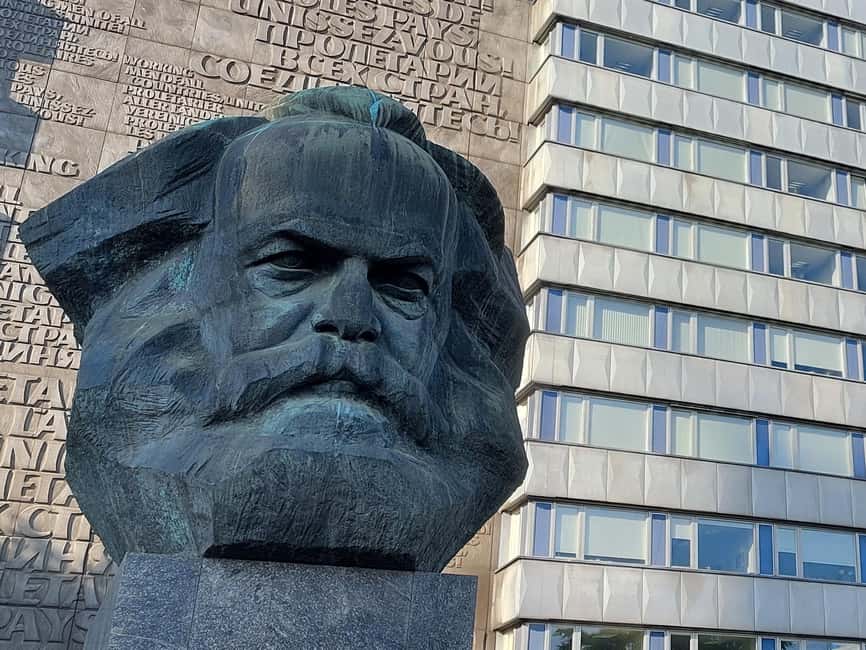
- The famous Karl Marx head: The large monument in the center is one of Chemnitz’s defining sights and a reminder of its former name, Karl-Marx-Stadt.
- Industrial Chemnitz in context: The route connects textile production, machinery, locomotives, bicycles, cars, and wartime industry.
- Four very different city areas: You pass through the modern center, Kaßberg, the Heckert residential area, and the Castle District.
- Small-group format: The minibus holds up to eight people, with private and small-group options available.
- A strong value at $23: The price is modest for a guided city overview, especially if you want orientation before exploring on your own.
Why Chemnitz makes a good city tour subject
Chemnitz is not a city that reveals itself in one postcard view. Its story is spread across industrial streets, rebuilt central blocks, elegant late-19th-century housing, planned GDR neighborhoods, and the older Castle District.
That makes a guided drive useful. I can look at a building and know it belongs to the industrial age, but a guide can explain why the city grew so quickly and why its identity changed so sharply after 1945.
The city began as a Slavic settlement. Around 130 years ago, it grew into one of Germany’s largest and wealthiest industrial centers. Its early advantages included a Saxon monopoly on linen bleaching and its closeness to the Ore Mountains, where mining supported related trades and manufacturing.
Then technology changed the pace of everything. The spinning jenny and steam engine, developed in England, helped break open older limits on production. Chemnitz began making the machines that powered industry, along with locomotives, bicycles, and cars.
The city became known as the Manchester of Saxony. Its heavy industry also earned it the nickname Rußchamtz, a reference to the soot associated with its many chimneys. Those names tell you what mattered here: production, engineering, factories, and work.
The route also addresses the darker side of that industrial rise. The German armaments industry was strongly represented in Chemnitz until the end of the Second World War. That brought wealth and employment, but it also tied the city to wartime manufacturing and helped shape the destruction and political changes that followed.
More City Tours in Germany:
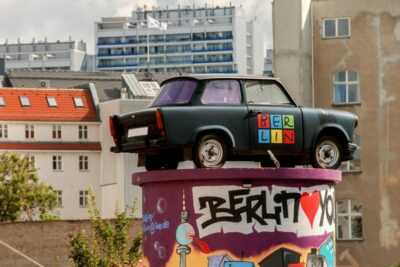
- Berlin: 1-Hour City Tour by Boat with Guaranteed Seating
★ 4.3 · 16,993 reviews - Leipzig: City History Canal Sightseeing Tour on a Motorboat
★ 4.7 · 6,232 reviews - Cologne: Panoramic City Cruise
★ 4.3 · 5,698 reviews
Starting near Straße der Nationen
The tour has two listed starting options: Straße der Nationen and Hotel Chemnitzer Hof. Check the exact meeting point attached to your booking, since the selected option may determine where you begin.
Both locations put you in the central part of the experience. This matters because the tour is designed as a circuit rather than a one-way transfer. At the end, you return to Hotel Chemnitzer Hof or Straße der Nationen, depending on the chosen option.
A central start also makes this practical for a first look at Chemnitz. You can use the tour to decide which district deserves a longer walk later. If you already know the center well, the value lies in the outer neighborhoods and the historical connections between them.
Since the trip lasts only 90 minutes, arrive ready to board rather than expecting a long orientation at the meeting point. The start time depends on availability, so check that before building the rest of your day around it.
The modern center and the Karl Marx head
The central stop brings you face to face with the Karl Marx head, the city’s most recognizable monument. It is not a subtle sight. That is part of its value.
Chemnitz was called Karl-Marx-Stadt during the GDR period, and the monument remains a direct reminder of that chapter. After German reunification, the city returned to the name Chemnitz. The contrast between those names is a quick way to understand the political and cultural changes the tour explores.
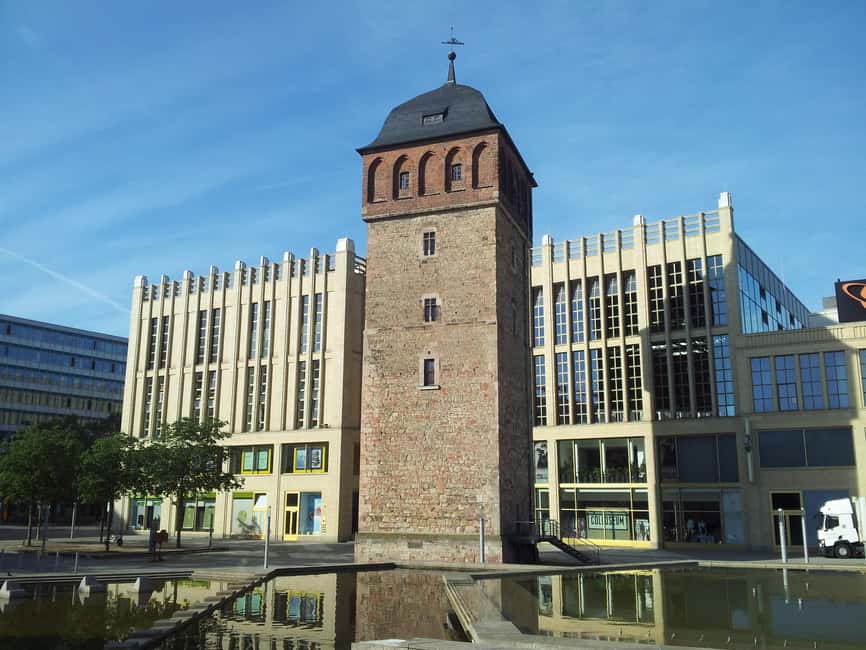
The center also shows the city looking forward. Modern buildings share space with reminders of earlier periods, giving you a visual sense of a place still deciding how to present itself. As European Capital of Culture 2025, Chemnitz is using culture to write a new chapter while keeping its industrial identity in view.
I would pay close attention to how the guide explains the center rather than treating it as a simple collection of sights. The important point is not only what the Karl Marx monument looks like, but what it says about the city’s changing public identity.
You should also keep your expectations realistic. The tour does not describe a long stop with time for a full museum visit or extended photography. This is an orientation point, not a stand-alone attraction visit.
Between Zwickauer and Annaberger Straße
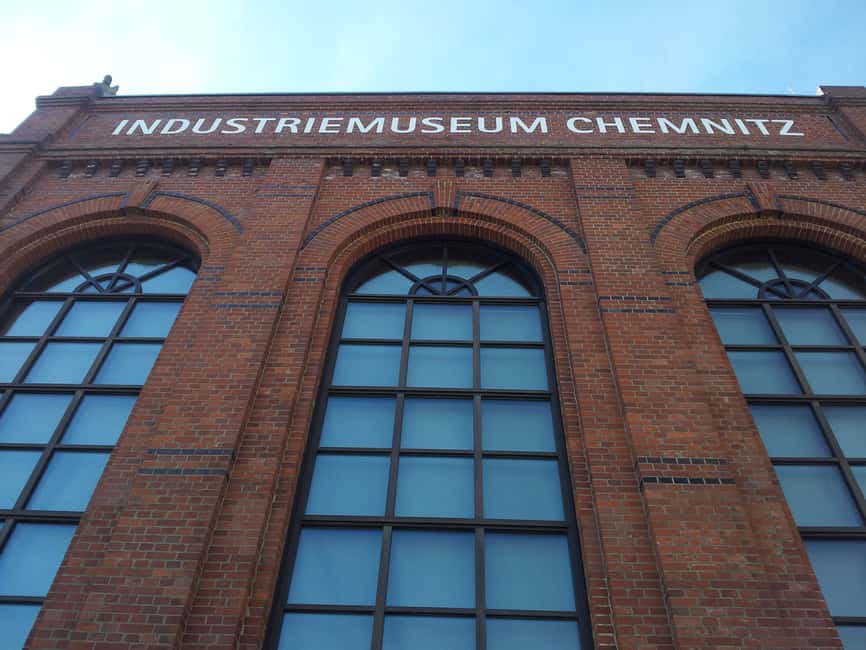
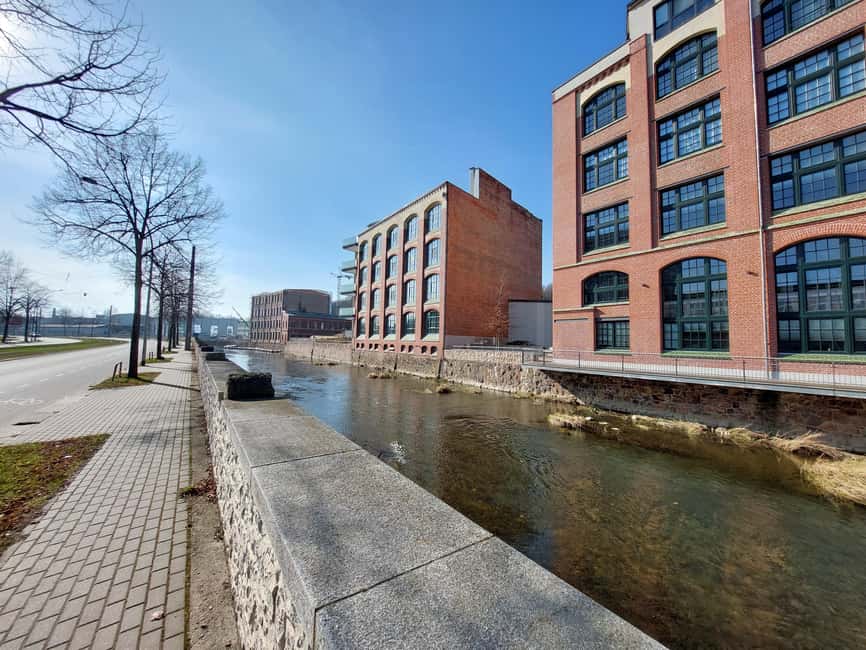
The route through the area between Zwickauer and Annaberger Straße is the heart of the industrial story. Here, the guide connects streets and districts with the manufacturing that made Chemnitz powerful.
This is where the old nicknames begin to make sense. Textile machines, locomotives, bicycles, and cars were all part of the city’s industrial output. Chemnitz was not built around just one factory or one product. Its strength came from a wide network of engineering and production.
The connection to Auto-Union is especially important for anyone interested in cars. Chemnitz was once home to Auto-Union, the company that later became Audi. The tour presents this as part of the city’s larger industrial culture, rather than isolating it as a car-history topic.
That approach suits Chemnitz. You are not simply looking at old industrial buildings. You are seeing how technology, mining nearby in the Ore Mountains, transport, and skilled manufacturing worked together to change the city.
The minibus format helps here because the industrial story is spread over a wider area. Walking from one district to the next would take more time and energy, while the vehicle lets you see the relationship between different parts of the city within the scheduled 90 minutes.
Still, this section may feel more interpretive than scenic. The appeal comes from understanding what the streets represent. If you want polished architecture at every stop, the industrial portions may seem plain. If you enjoy seeing how work shaped a city, this will likely be one of the most useful parts of the route.
Still Germany, at a slower pace:
- Berlin: Reichstag, Dome and Government District Guided Tour
★ 4.7 · 18,288 reviews - Hamburg: Sex and Crime in St. Pauli Tour for Ages 18+
★ 4.7 · 15,447 reviews - Hamburg: 1.5-Hour Harbor and Speicherstadt Day Cruise
★ 4.6 · 14,200 reviews - From Munich: Neuschwanstein & Linderhof Castle Full-Day Trip
★ 4.5 · 12,494 reviews
Kaßberg and the Wilhelminian city
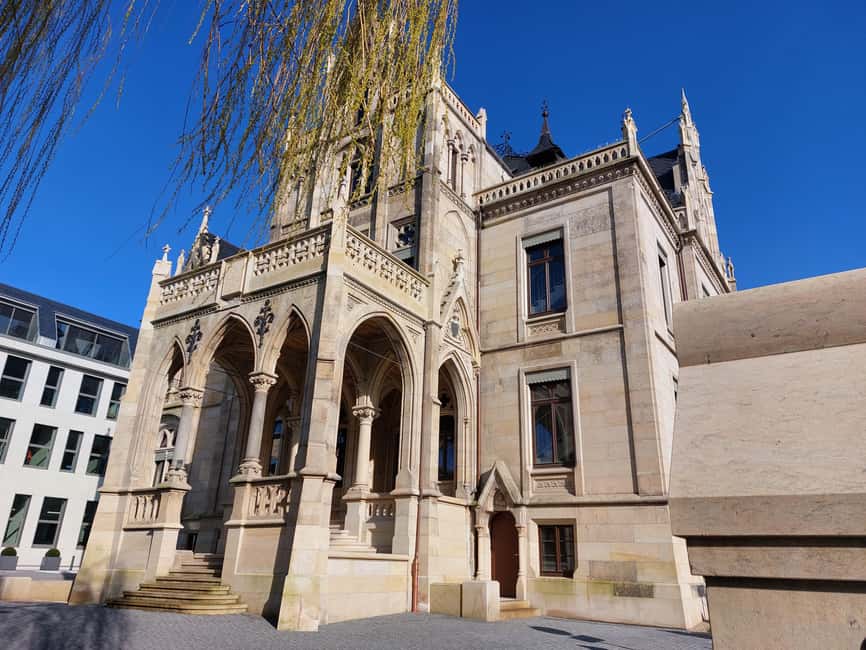
Kaßberg offers a different face of Chemnitz. The area is associated with Wilhelminian-style buildings, reflecting the wealth and confidence created during the city’s industrial growth.
This is an important counterpoint to the factories. Successful industry did not only produce machines and smoke. It also produced comfortable urban districts and substantial homes for people connected with the city’s prosperity.
The tour helps you see how quickly Chemnitz expanded. The earlier settlement and industrial core could not contain the population and wealth created by rapid manufacturing growth, so new districts developed around it.
From a minibus, you may not inspect every facade closely. That is the main limitation here. A walking tour would give you more time to study doorways, decorative details, and the scale of the streets.
But the vehicle offers a useful overview of Kaßberg as a district. You can compare its planned, residential character with the working and manufacturing areas elsewhere on the route. That comparison is more valuable than seeing a single attractive building without context.
If you enjoy architecture, make a note of Kaßberg during the drive. It is one of the districts that may reward a second visit on foot after the tour, when you can set your own pace.
Heckert and the GDR housing story
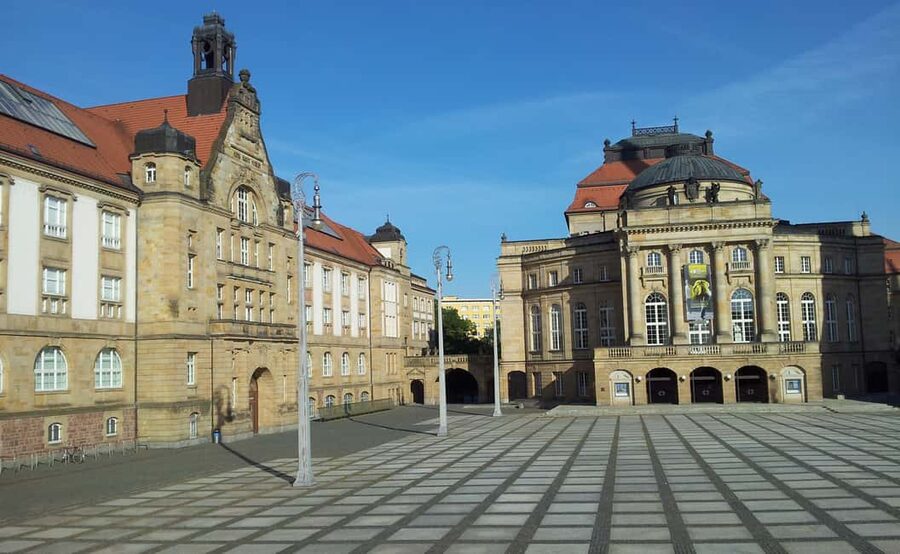
The Heckert residential area brings the tour into the GDR period. This is a major shift in both appearance and political background.
Where Kaßberg reflects the wealth of the Wilhelminian period, Heckert represents large-scale housing built under East German socialism. The two areas show different answers to the same urban question: how should a growing city house its people?
The value here is comparison. You are not asked to see Chemnitz as one uniform place. Its neighborhoods reflect different governments, economic systems, building methods, and ideas about daily life.
For visitors who know little about East German urban planning, this may be especially helpful. The name Karl-Marx-Stadt is no longer just a monument or a former name. It becomes part of a wider story about how the city was reshaped during the GDR.
There is also a practical advantage to seeing Heckert by minibus. Large residential districts are difficult to fit into a short walking route, and their meaning is often easier to grasp as a whole than from one street corner.
Do not expect Heckert to provide the same visual drama as the Karl Marx head or Kaßberg. Its importance is social and urban. The guide’s explanation is what turns a large residential area into a meaningful part of Chemnitz’s story.
The Castle District and the city’s older beginnings
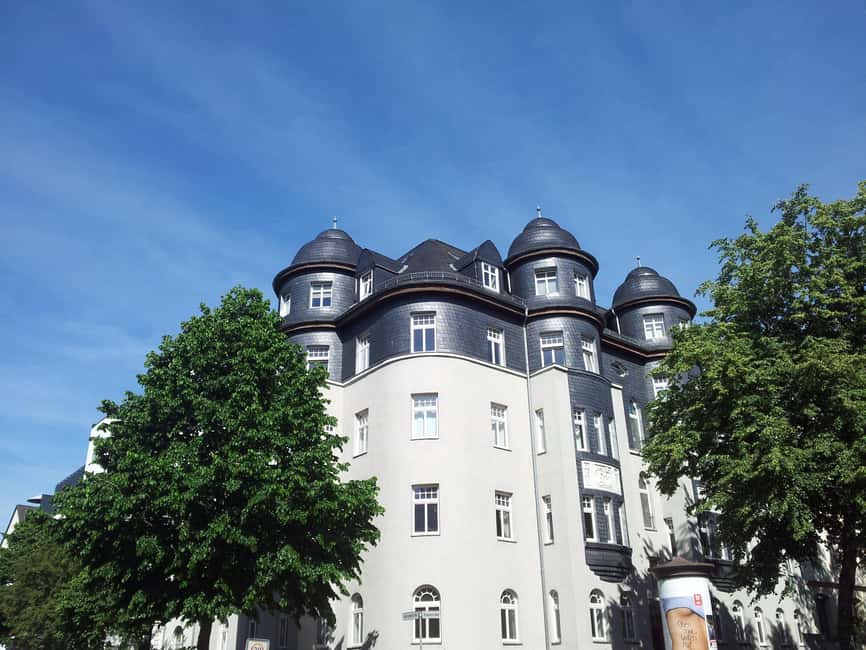
The Castle District takes you back toward Chemnitz’s earlier roots. The city’s story did not begin with factories, railways, or motorcars. It began with a settlement that later grew into a major industrial center.
This district provides a needed pause in the industrial narrative. After hearing about machines, armaments, and urban expansion, you get a reminder that Chemnitz had an older foundation beneath all that growth.
The route describes the modern center and the Castle District alongside the areas shaped by industrialization and the GDR. That structure gives the tour a clear arc: early beginnings, industrial power, political change, and a present-day search for identity.
The Castle District may appeal most to you if you want more than an industrial sightseeing route. It helps explain why Chemnitz cannot be reduced to factories or its Karl Marx monument.
Again, the short duration affects the experience. You will get an introduction to the area, not a detailed architectural or historical walking tour. If the district catches your interest, use the tour as a prompt to return later.
How the minibus changes the experience
A 90-minute drive is a smart format for Chemnitz because the featured areas are distinct and spread out. You avoid spending the whole visit walking between neighborhoods, while still receiving a connected explanation from a local certified guide.
The small vehicle holds up to eight people. That is a useful middle ground. You get more personal space than on a large sightseeing bus, but the experience can still have a social feel if you book a small group rather than a private departure.
Private options are available if you want the guide’s attention focused on your party. A small group can offer better value, especially when you want a general introduction rather than a custom route.
The tour is offered in English and German. That makes it practical for international visitors, and it also suits German-speaking visitors who want a concise local overview.
I like the fact that the route returns to the meeting point. You do not have to work out how to get back from a distant neighborhood, and you can continue your day from the central area.
The main compromise is the fixed pace. You will not choose how long to spend at the Karl Marx head, Kaßberg, or the Castle District. For many people, that is a fair trade for covering more ground.
Is $23 a fair price?
At $23 per person, this is a reasonable price for a guided 90-minute city introduction. You are paying for the vehicle, the local certified guide, and the ability to connect several districts that would be awkward to cover quickly on foot.
The price is strongest if you are new to Chemnitz or have only a short stay. A clear overview can save you from wandering without context, especially in a city whose main points of interest are spread across different periods.
It is also good value for visitors interested in urban history. You are not only seeing a central monument. The route covers industrial production, Auto-Union, Wilhelminian housing, GDR residential planning, and the Castle District.
The calculation changes if you want long stops or museum time. This is not a full-day experience, and the route is not presented as a series of extended visits. You should think of it as a guided introduction that helps you plan the rest of your time.
The rating of 4.9 from 30 ratings supports the idea that the concise format works well for its intended purpose. The strongest direct praise describes it as a good overview that remains entertaining, which is exactly the right test for a 90-minute city tour.
Who should book this Chemnitz tour?
I would recommend it to first-time visitors, especially those with one day or less in Chemnitz. You will quickly learn how the city’s districts connect and why its identity is more complicated than the Karl Marx monument alone suggests.
It also suits anyone interested in industrial culture, cars, urban planning, or the GDR period. The mixture of textile production, machinery, locomotives, bicycles, Auto-Union, and postwar housing gives the tour a broad range.
Families and older visitors may appreciate the limited walking. The minibus lets you see more without turning the visit into a long trek between neighborhoods.
Architecture lovers should also consider it, with one qualification. Kaßberg and the Castle District may leave you wanting a slower second look, so plan time afterward if those areas appeal to you.
I would be less enthusiastic if your main goal is a detailed walking tour of the city center. The 90-minute schedule favors breadth over long stops. You will understand Chemnitz better, but you will not examine every building in depth.
Booking is flexible, with free cancellation up to 24 hours before the tour and a reserve-now, pay-later option. Those policies are useful if your Saxony plans are still shifting, but the bigger decision is whether you want an overview or a slower, more focused visit.
Should you book the Chemnitz minibus tour?
Book it if you want a practical first look at Chemnitz, especially if you are curious about how industrial success, GDR planning, and present-day cultural renewal fit together. The small vehicle, modest price, English or German guiding, and return to the central meeting point make it easy to add to a day in the city.
Skip it if you prefer to explore every district on foot or spend a long time inside individual sights. For most visitors, though, this tour offers a useful map of Chemnitz’s past and present, with enough variety to make the city more than a quick stop between better-known Saxon destinations.
FAQ
How long does the Chemnitz city tour last?
The tour lasts 1.5 hours, or 90 minutes.
What language is the tour offered in?
The live tour guide offers the experience in English or German.
How many people can ride in the minibus?
The minibus accommodates up to eight people.
Is a private tour available?
Yes. Private and small-group options are available.
Where does the tour start?
The listed starting options are Straße der Nationen and Hotel Chemnitzer Hof. The exact meeting point may depend on the option you book.
Where does the tour finish?
The activity ends back at the meeting point, with Hotel Chemnitzer Hof and Straße der Nationen listed as the drop-off options.
Just added around Germany
- Private Walking Tour in Berlin: Hitler’s Germany & WWII★ 5.0 · 7 reviews
- The History of Berlin: WWII PRIVATE Walking Tour With Locals★ 5.0 · 209 reviews
- Private Berlin WWII and Cold War History Tour with Local Expert Guide★ 5.0 · 28 reviews
- Private Walking Tour Berlin 3 hours: Brandenburg, Historic Center★ 5.0 · 7 reviews
- Berlin: Private Bike Tour of the Berlin Wall and Third Reich★ 5.0 · 23 reviews
- Group Driving Tour 1 to 6 people. Berlin Shore Excursion incl pick-up at Port★ 5.0 · 8 reviews
- Berlin: Guided Private Bike Tour to Explore the Highlights★ 5.0 · 12 reviews
- Berlin Photography Masterclass – Private Photography Lesson★ 4.5 · 23 reviews
City Tours, compared.

1-Hour City Tour by Boat with Guaranteed Seating
Read our review →
City History Canal Sightseeing Tour on a Motorboat
Read our review →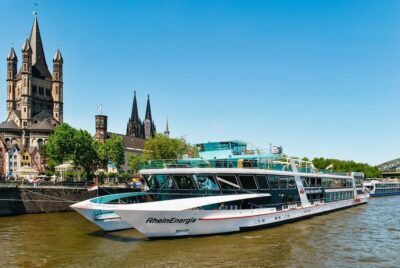
Browse the lists this tour appears in