
Reviewed · BERLIN WALL TOURS
Berlin: Private Bike Tour of the Berlin Wall and Third Reich
Berlin’s past is best read at street level. This private bike tour links the Berlin Wall, Nazi-era sites, Jewish memorials, and Cold War landmarks in about three hours, giving you far more ground than you could cover on foot. I especially like the private format, which lets your guide shape the route around your interests, and the bike itself, which makes it possible to reach scattered sites without wasting half the day between them.
I also like the range of stops, from Nikolaiviertel and the Neue Synagoge to Checkpoint Charlie and the East Side Gallery area. The main consideration is pace: ten minutes at many stops is enough for a clear explanation and a few photographs, but not for a long museum visit. The tour is also limited to English or German unless another language is arranged in advance.
In This Review
- Key points at a glance
- Why a bike is the right tool for this Berlin route
- Starting in Nikolaiviertel, Berlin’s reconstructed old center
- The Neue Synagoge and a story of civil courage
- Memorials that frame deportation and the Holocaust
- The Berlin Wall Memorial: the strongest history stop
- Mauerpark and the failed search for a perfect border
- Humboldthain and the scale of Nazi construction
- Günter Litfin and Invalidenfriedhof
- The government district and Hitler’s unrealized Great Hall
- The Führerbunker site and the value of an empty space
- Holocaust memorials and Checkpoint Charlie
- What $107.42 buys you in practical terms
- Timing, languages, weather, and booking details
- Who should book this bike tour?
- Should you book it?
- FAQ
- How long does the private Berlin bike tour last?
- Where does the tour begin and end?
- Is bicycle and helmet use included?
- Is Checkpoint Charlie included in every language version?
- Can children join the tour?
- What happens if the weather is bad?
Key points at a glance
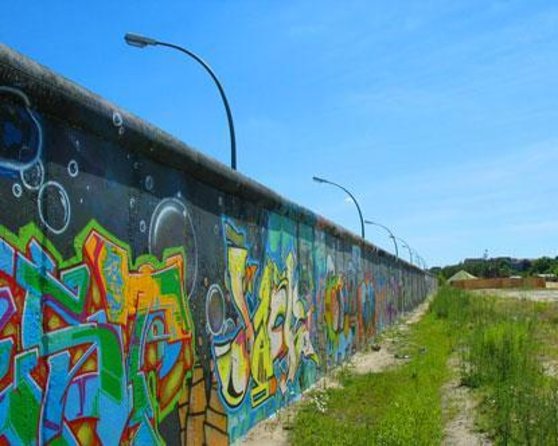
- See Berlin’s Wall in places where its meaning is still visible, especially at the Berlin Wall Memorial and Mauerpark.
- Cover Nazi and Cold War history in one ride, including the Führerbunker site, Reichstag, Checkpoint Charlie, and the Humboldthain flak tower.
- Ride privately with your own group, so the route can be adjusted toward Jewish Berlin, the Third Reich, the Wall, or postwar politics.
- Use bicycles to connect far-flung sites quickly, a major advantage over walking this route.
- Expect a brisk three-hour experience, with most stops lasting about 5 to 10 minutes.
- Bring the whole family if you wish, since bicycles, helmets, and infant seats on request are included.
Why a bike is the right tool for this Berlin route
Berlin’s important sites are spread across a wide area. The Wall once cut through the city in a long, irregular line, while Nazi government plans, wartime ruins, Jewish memorials, and Cold War checkpoints sit in different districts. A walking tour can explain these places well, but linking them all on foot would take much longer.
The bicycle solves that problem. You can move from central Berlin to former Wall territory, then on toward the government district and Checkpoint Charlie without spending the whole outing underground or waiting for taxis. One strong point of the experience is its efficiency. A previous booking described the bicycles as a way to see the sights in roughly half the time required on foot.
You are not signing up for a race. The supplied information describes the ride as family-friendly, and children may join when accompanied by an adult. Bikes and helmets are provided, while infant seats can be arranged on request. Still, you should be comfortable riding in city conditions and prepared for a tour that operates in all weather.
The tour requires at least four people, and only your group participates. That matters here because the subject can be personal and serious. If your group wants to pause longer at a memorial or spend less time on a site that does not interest you, a private guide has more room to respond than a large scheduled group would.
More Bike Tours in Berlin
- Berlin: Sights and Highlights Bike Tour with a Local Guide
★ 4.8 · 2,698 reviews - Berlin Highlights 3-Hour Bike Tour
★ 5.0 · 948 reviews - Berlin City Bike Tour with Beer Garden Stop
★ 5.0 · 917 reviews
Starting in Nikolaiviertel, Berlin’s reconstructed old center
The ride begins at Poststraße 11 in Nikolaiviertel, near Berlin’s central historic area. This is presented as the city’s only real old town, though its survival story is complicated by the heavy bombing Berlin endured during World War II.
That makes it a useful opening stop. You begin with a question about what old Berlin actually means. The area helps set up a larger theme of the tour: much of the city you see today has been rebuilt, altered, or deliberately preserved after war and political upheaval.
You receive about ten minutes here. That is enough to orient yourself, hear the basic story, and understand why Berlin can look old in one street and entirely modern in the next. If you want a long architectural discussion, this brief stop may feel short.
The Neue Synagoge and a story of civil courage
The next stop is the Stiftung Neue Synagoge Berlin, also called Centrum Judaicum. The visit lasts about five minutes and focuses on the story of a police officer who helped save the building during the Night of Broken Glass, the Nazi pogrom of November 1938.
This is an important early reminder that the tour is not only about buildings and political dates. It also deals with individual choices made under a brutal regime. The story of one police officer’s courage offers a human scale before the tour moves into broader discussions of deportation, genocide, and dictatorship.
The building itself is one of Berlin’s key Jewish landmarks, but this is an exterior history stop rather than an interior visit. You should not expect time inside the synagogue or the Centrum Judaicum as part of the three-hour route.
Memorials that frame deportation and the Holocaust
The route includes a memorial for victims of deportation and the Holocaust, described as a site designed during the East German period. Its appearance and message differ sharply from the better-known memorial near Brandenburg Gate.
That contrast is worth your attention. Berlin’s memorials reflect not only the crimes they remember, but also the political era in which each memorial was created. A site from the German Democratic Republic carries a different visual and political language from a memorial built after reunification.
The route also reaches one of three memorials associated with the largest victim groups of the Holocaust, followed by the Memorial to the Murdered Jews of Europe. The latter is the largest genocide memorial in the world according to the tour description, and its scale is impossible to miss.
The stop at the Holocaust Memorial lasts about ten minutes. You can walk among the concrete blocks and consider the effect of the changing ground, but the schedule does not allow an extended visit. If you want time to explore the memorial at length or visit its information center, plan a separate visit.
More Third Reich History Tours in Berlin
- Berlin: Third Reich and Cold War 2 Hour Walking Tour
★ 4.9 · 6,830 reviews - Berlin’s Best: 2 Hour Walking Tour Third Reich and the Cold War
★ 5.0 · 5,486 reviews - Third Reich Berlin: Hitler and WWII Walking Tour
★ 5.0 · 3,301 reviews - Berlin: Third Reich, Hitler, and WWII Walking Tour
★ 4.9 · 1,133 reviews
The Berlin Wall Memorial: the strongest history stop
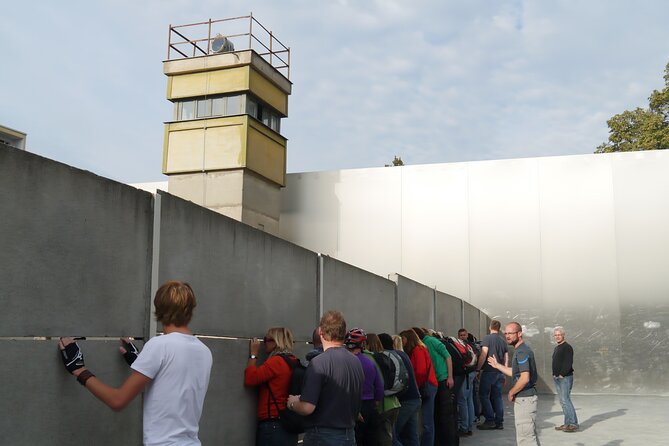
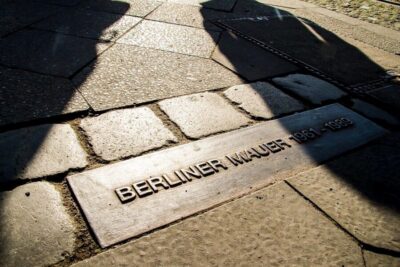
The Berlin Wall Memorial is the clearest place on this route for understanding what the Wall did to Berlin. The tour describes three locations where the Wall is still alive, meaning that the physical setting and remaining structures help explain the border as more than a strip of concrete.
You can expect a discussion of the Wall’s physical design, its effect on neighborhoods, and the attempts people made to cross it. This is where the tour’s title becomes most meaningful. Instead of treating the Wall as a photo opportunity, the guide uses the site to show how a border divided streets, families, and daily life.
The stop lasts around ten minutes. That is short for a place with so much to explain, but the bicycle allows the guide to include several related locations rather than spending the entire three hours in one spot. I would consider this the best part of the tour for anyone who has read about the Wall but wants a clearer sense of its actual geography.
Mauerpark and the failed search for a perfect border
Mauerpark is now widely associated with its Sunday flea market, but the tour uses it to explain East Germany’s repeated efforts to create a secure border. The modern recreational setting can make the former division hard to picture, which is exactly why the stop is useful.
You spend about ten minutes here. The guide connects the park to the larger Wall system and explains how border authorities kept changing the design in pursuit of what they considered a perfect barrier. The stop gives you a practical way to see that the Wall was not a single slab, but a controlled zone with layers of security.
If you visit on a Sunday, the market may add a lively layer to the setting. The tour data does not promise market time, though, so do not book this experience as a flea-market outing. Its purpose here is historical.
Humboldthain and the scale of Nazi construction
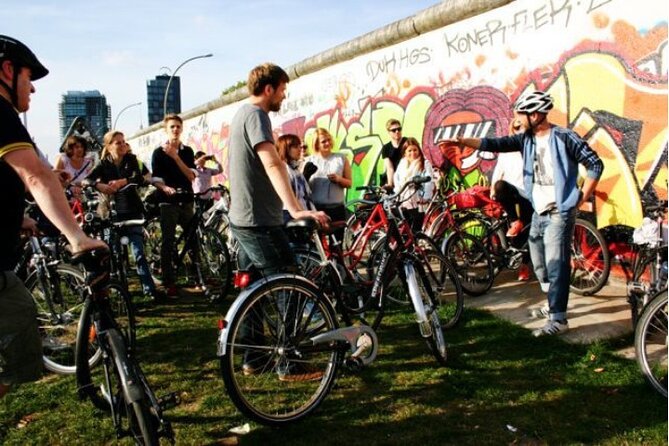
The Humboldthain flak tower is one of the route’s more striking physical remains. Built as a giant fortress and air-raid shelter, it offers panoramic views along with a look at Nazi military architecture.
The stop lasts about ten minutes. You get a sense of how large these structures were and how they shaped the city around them. The view also helps connect Berlin’s central districts, former Wall territory, and government quarter in a way that a street-level stop cannot.
The tour description does not promise a climb or a particular viewpoint access, so you should treat the panorama as part of the stop rather than assume a long ascent. Even from outside, the flak tower gives the Nazi period a physical presence that is hard to grasp from photographs alone.
Günter Litfin and Invalidenfriedhof
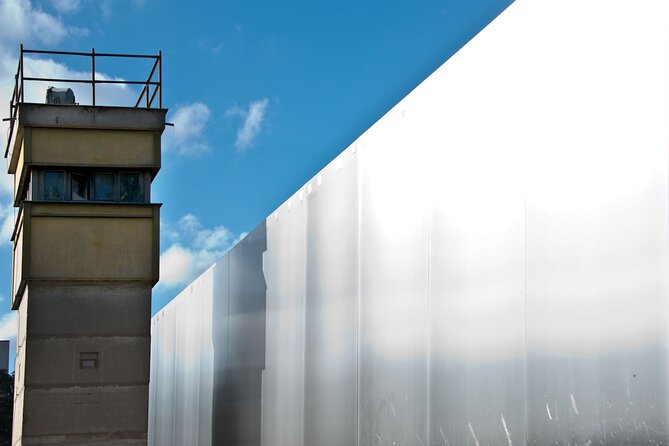
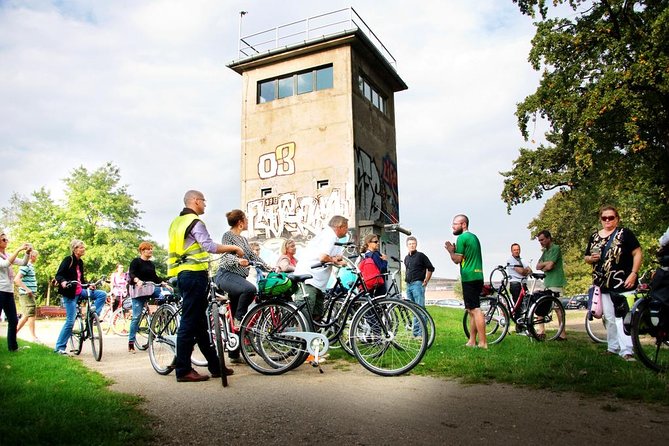
At the Günter Litfin Memorial, the original watchtower has been preserved in memory of Günter Litfin, identified here as the first person shot at the Wall. The stop takes about ten minutes.
This is a small site with a direct human focus. After the large-scale discussion of border systems, the watchtower and Litfin’s story bring the cost back to one person. The preserved structure also helps you understand how guards watched the border and why crossing attempts were so dangerous.
The route then continues to Invalidenfriedhof, a burial ground cut through by the Wall. It was created for figures regarded as heroes of German military history, though the tour also raises questions about which people should be honored and which should simply be remembered.
That distinction is one of the better features of the experience. Berlin does not present history as a tidy list of heroes and villains. A cemetery can preserve names while still inviting you to question the values behind the honors.
The government district and Hitler’s unrealized Great Hall
At Spreebogenpark, the tour pauses for about fifteen minutes, one of the longer stops. From here, you get a broad view of Germany’s government district and discuss Albert Speer’s plans under Hitler.
Speer’s proposed Great Hall would have held 180,000 people. The figure is so large that it can sound abstract, but the open view helps you think about the scale of the plan and its intended political message. The discussion also shows how Nazi architecture was meant to overwhelm ordinary human proportions.
The Reichstag follows with a five-minute exterior stop. Here the guide explains Hitler’s seizure of power and Germany’s democratic development. You do not go inside the building, but the outside view is enough to connect the current parliament with the country’s troubled political past.
This pairing works well. Spreebogenpark deals with the dictatorship’s grand plans, while the Reichstag brings you back to the political institution that survived, changed, and now represents modern German democracy.
The Führerbunker site and the value of an empty space
At the Führerbunker, you see a parking lot. That may sound anticlimactic, but the absence is the point. Hitler spent the last weeks of the war there and eventually died by suicide. The tour explains why the bunker is not presented as a preserved attraction.
You receive about ten minutes at the site. This is a useful stop for understanding how Berlin handles places connected to Hitler. There is no dramatic ruin to photograph and no preserved interior to turn into a spectacle. Instead, the guide explains the location and why the ground looks ordinary today.
I appreciate that the stop treats the bunker as a historical fact rather than a shrine. You should expect interpretation, not an underground visit.
Holocaust memorials and Checkpoint Charlie
The tour returns to Holocaust remembrance at the Memorial to the Murdered Jews of Europe. Its large field of concrete blocks near Brandenburg Gate is one of Berlin’s most recognizable memorial sites, but the tour places it within a broader set of memorials and political choices.
The final listed stop is Checkpoint Charlie, the famous Cold War border station. This stop is included only on the English version of the tour, so confirm your language before booking if it is important to you.
Checkpoint Charlie was the shared crossing point associated with the United States and the Soviet Union. The guide explains how a confrontation there brought the world close to a possible third world war. You spend about ten minutes at the site.
The modern setting can feel commercial and staged compared with the original confrontation, but the location still matters. Your guide’s explanation supplies the Cold War context that the present-day signs and photo opportunities cannot provide on their own.
What $107.42 buys you in practical terms
At $107.42 per person, this is not the cheapest way to see Berlin. The value comes from combining a private guide, bicycle use, helmet use, and a route that reaches many sites in three hours.
If you tried to connect Nikolaiviertel, the Wall Memorial, Mauerpark, Humboldthain, the government district, the Holocaust Memorial, and Checkpoint Charlie independently, you would spend time planning transport and navigating between stops. Here, the route is already organized, and the guide provides the historical thread.
The price makes the most sense for a group of four or more people who want a focused history introduction. It is less appealing if you prefer to enter museums, spend a long time at memorials, or explore at a slow photographic pace. The tour is best understood as a wide survey with guided interpretation, not as a series of full site visits.
The private setup can also improve value for families or friends with a shared interest in twentieth-century Berlin. You are paying for control and efficiency as much as for the bike.
Timing, languages, weather, and booking details
Several departures are offered throughout the day, which helps you fit the ride around other Berlin plans. The experience lasts approximately three hours and ends back at the starting point at Free Berlin Bike Tours & Rental, Poststraße 11, 10178 Berlin.
English and German are available. Dutch, French, and Spanish may be possible on request, while Checkpoint Charlie is specifically included only in the English version. Confirmation is received at booking, and free cancellation is available until 24 hours before the start time. Cancellations or changes made inside that window are not accepted for a refund.
The tour operates in all weather. Wear clothing suited to the forecast, and do not forget that a cool or wet day can feel colder on a bicycle. Food and drinks are not included, and hotel pickup and drop-off are not provided.
Who should book this bike tour?
I would choose this experience if you want a clear introduction to Berlin’s Wall, Nazi, Holocaust, and democratic history in one outing. It is particularly suitable for history buffs, first-time visitors with limited time, families, and private groups that want to adjust the emphasis.
You should think twice if your main goal is museum interiors, a long visit at the Holocaust Memorial, or a leisurely ride with little commentary. The stops are short, and the subject matter is serious. A private format gives you flexibility, but it does not turn a three-hour tour into a full-day study program.
The strongest praise attached to the experience is practical: the bikes let you cover much more ground, and the guide’s English was described as clear and easy to understand. That combination matters. Berlin history can feel scattered until someone connects the sites, streets, and political eras for you.
Should you book it?
Book this tour if you want to see a large slice of Berlin’s twentieth-century past quickly, with a guide who can connect physical places to the decisions made there. The Berlin Wall Memorial, Humboldthain flak tower, Führerbunker site, Reichstag, and Checkpoint Charlie create a strong sequence, even though each stop is brief.
I would book it early if your dates are fixed, since the experience is often reserved well ahead, with an average booking lead time of 43 days. Choose it for context, range, and private attention. Skip it if you need long museum visits or a slow, unstructured day.
FAQ
How long does the private Berlin bike tour last?
The tour lasts approximately three hours.
Where does the tour begin and end?
It begins at Free Berlin Bike Tours & Rental, Poststraße 11, 10178 Berlin, Germany, and ends back at the same meeting point.
Is bicycle and helmet use included?
Yes. The bicycle and helmet are included in the tour price.
Is Checkpoint Charlie included in every language version?
No. Checkpoint Charlie is included only in the English version of the tour.
Can children join the tour?
Yes. Children are welcome, but they must be accompanied by an adult. Infant seats can be provided on request.
What happens if the weather is bad?
The tour operates in all weather conditions, so you should dress appropriately for the forecast.
More Berlin Wall Tours in Berlin
- Skip-the-Line: Berlin Wall Museum at Checkpoint Charlie
★ 4.1 · 2,041 reviews - Cold War, Berlin Wall, Spies and the East Side Gallery
★ 5.0 · 1,024 reviews - Berlin: Guided Bike Tour of the Berlin Wall and Third Reich
★ 4.7 · 499 reviews - Berlin: Cold War Walking Tour on Berlin Wall Route
★ 4.8 · 437 reviews
Just added around Berlin
- Private Walking Tour in Berlin: Hitler’s Germany & WWII★ 5.0 · 7 reviews
- The History of Berlin: WWII PRIVATE Walking Tour With Locals★ 5.0 · 209 reviews
- Private Berlin WWII and Cold War History Tour with Local Expert Guide★ 5.0 · 28 reviews
- Private Walking Tour Berlin 3 hours: Brandenburg, Historic Center★ 5.0 · 7 reviews
- Berlin: Guided Private Bike Tour to Explore the Highlights★ 5.0 · 12 reviews
- Berlin Photography Masterclass – Private Photography Lesson★ 4.5 · 23 reviews
- Group Driving Tour 1 to 6 people. Berlin Shore Excursion incl pick-up at Port★ 5.0 · 8 reviews
- A Taste of Berlin: Craft Beer Private Tour★ 4.5 · 26 reviews
Berlin Wall Tours, compared.
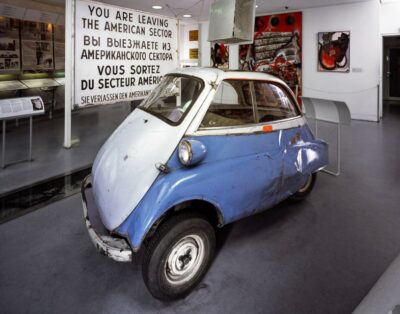
Skip-the-Line: Berlin Wall Museum at Checkpoint Charlie
Read our review →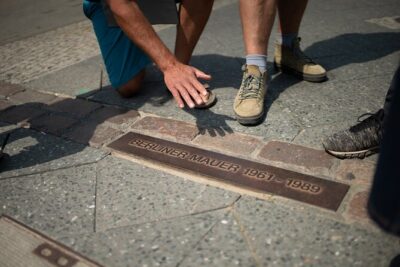
Cold War, Berlin Wall, Spies and the East Side Gallery
Read our review →
Cold War, Berlin Wall, Spies and the East Side Gallery
Read our review →
East Berlin and the Berlin Wall 2-Hour Walking Tour
Read our review →
Browse the lists this tour appears in