
Reviewed · WALKING TOURS
Frankfurt Highlights English Walking Tour
Frankfurt reveals itself one street at a time. This English walking tour links the city’s medieval core, rebuilt Old Town, Jewish heritage, and modern skyline in roughly three hours. I like the way it connects places that can feel scattered on a map, and I especially like the guides’ ability to explain how Frankfurt’s past still shapes daily life. The main caution is time: three hours can feel long if your back, knees, or patience for standing are limited.
The tour moves at a generally manageable pace, with frequent stops and occasional short breaks. It is stroller-friendly overall, though there are some intermittent steps, and the route may feel brisk for some older participants. Sunday visitors should also expect exterior-only visits at the cathedral and Old Nicholas Church, plus closures at the market and city planning office.
In This Review
- Key points to know before you book
- Why this Frankfurt walk works so well
- Frankfurt Cathedral and the imperial beginning
- Römerberg, the old city hall, and a difficult memorial
- Old Nicholas Church and the rebuilt Altstadt
- Karmeliterkloster and the art that survived
- Kleinmarkthalle, Frankfurt’s edible pause
- The Old Jewish Cemetery and the Holocaust Remembrance Wall
- Stadtplanungsamt and the city in miniature
- Eiserner Steg and the best open views
- Staufenmauer and the city’s medieval edge
- Guides, pace, and what the experience feels like
- Booking details and one meeting-point warning
- Who should book this Frankfurt walking tour?
- Should you book it?
- FAQ
- How long does the Frankfurt Highlights English Walking Tour last?
- What time does the tour start?
- Where does the tour begin and end?
- Is the tour offered in English?
- Is the walking route suitable for strollers?
- What happens on Sundays?
- Can I cancel for a refund?
Key points to know before you book
- A compact route with a wide historical range: You move from the Holy Roman Empire and medieval Jewish Frankfurt to postwar rebuilding and present-day urban planning.
- The Jewish heritage stops are especially meaningful: The Old Jewish Cemetery and Holocaust Remembrance Wall add weight and depth to an otherwise cheerful city walk.
- The guides make or break the experience: Guides named Jennifer, Hannes, Hennes, Anne, Anna, Annika, Justin, and Philip have been praised for clear storytelling, humor, and thoughtful answers.
- Sunday changes the itinerary: The cathedral and Old Nicholas Church are viewed from outside, while Kleinmarkthalle and Stadtplanungsamt are not open on Sundays or German holidays.
- You get river views without paying extra admission: Eiserner Steg offers views toward the European Central Bank, the museum riverbank, and Sachsenhausen.
- Check the meeting point carefully: The written address is Braubachstraße 41, but one booking map reportedly pointed about a block away.
Why this Frankfurt walk works so well

Frankfurt is often treated as a business city with a famous airport, tall office towers, and not much else. That is an incomplete picture. The center contains imperial ceremony, wartime destruction, Jewish history, rebuilt medieval streets, food culture, and a modern city still deciding what it wants to be.
This tour is useful because it gives you a storyline rather than a string of unrelated photo stops. At the start, you are in the old center. By the end, you have seen how Frankfurt grew, suffered, rebuilt, and changed.
The advertised length is two to three hours, with a 10:00 am start. Most people should plan on the full three hours. The group limit is 20, which is small enough for questions without guaranteeing an intimate private-tour feel. Some sessions have been much smaller, including one group of nine, and that makes it easier to hear the guide and stay together.
The price is $36.28 per person. That is fair for a city tour of this length, particularly because the value comes from interpretation rather than admission tickets. All listed stops are free to enter or view, so you are paying for the guide’s time, organization, historical context, and local suggestions. If you only want a quick orientation, it may feel expensive. If you want Frankfurt to make sense before exploring alone, the cost is easier to justify.
More Walking Tours in Frankfurt
- Frankfurt on Foot Daily Walking Tour in English
★ 4.9 · 323 reviews - Frankfurt: Private or Shared Walking Tour
★ 4.8 · 156 reviews - Frankfurt Self-Guided Historical Walking Tour
★ 4.0 · 58 reviews
Frankfurt Cathedral and the imperial beginning
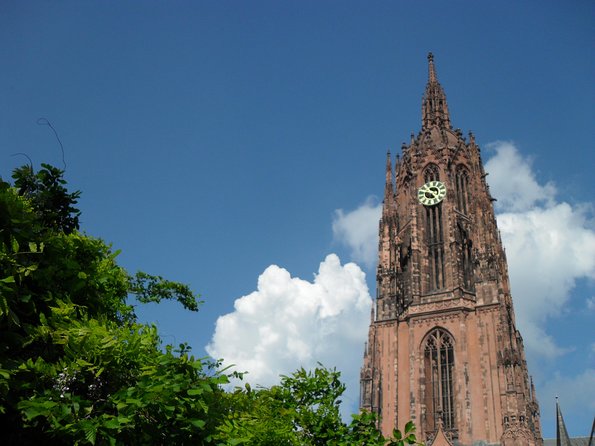
The walk begins at Frankfurt Cathedral, or Kaiserdom, with about 20 minutes devoted to the exterior and its story. This is not simply another old church. It was the site of elections and coronations for Holy Roman Emperors, giving Frankfurt a central role in European political history.
The cathedral stop sets the tone for the rest of the tour. You are not just looking at a façade and taking a photograph. You are learning why this particular city mattered to rulers, merchants, and religious authorities.
On Sundays, the church is viewed from the outside only. That is important if you are hoping to enter. The tour still explains the building’s role, but the experience is more about the surrounding square and the historical setting than the interior.
Römerberg, the old city hall, and a difficult memorial
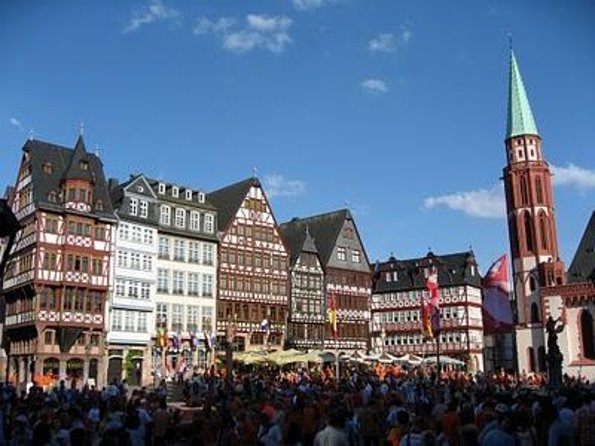
Römerberg is the visual heart of Frankfurt’s reconstructed Old Town. Here you see the Römer, the city hall, along with Justicia and the Book Burning Memorial. The stop lasts about 15 minutes, so expect focused explanation rather than a long pause for independent wandering.
The Römer is one of the city’s best-known buildings, but the more valuable part of the stop is the context. The square connects civic power, public ceremony, and the darker chapters of German history. The Book Burning Memorial requires a moment of attention. It is easy to walk across the square without noticing how much history is concentrated beneath your feet.
This is also a practical place to orient yourself. You are near several major sights, and the guide’s advice can help you decide what deserves a return visit after the tour.
Old Nicholas Church and the rebuilt Altstadt
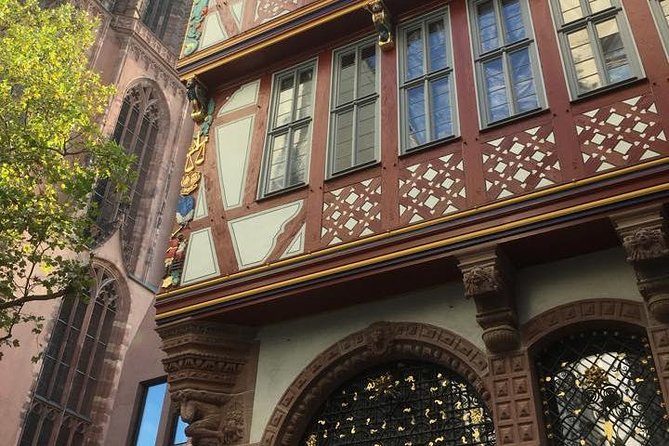
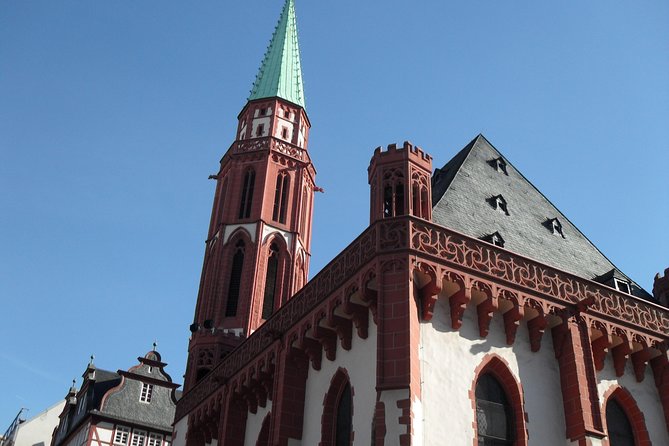
Old Nicholas Church, or Alte Nikolaikirche, is one of Frankfurt’s oldest churches. The scheduled stop is short, around 10 minutes, and focuses on the exterior on Sundays.
From there, the route later returns to the New Old Town, the rebuilt Altstadt that follows much of the former coronation path used by Holy Roman Emperors. This newer section can confuse first-time visitors. It looks old, but much of it was reconstructed rather than preserved intact.
That distinction is worth understanding. Frankfurt’s historic center was heavily damaged during the Second World War, and the city has spent decades deciding what to rebuild and how closely to follow the past. The tour treats the New Old Town as part of that ongoing conversation, not as a perfectly untouched medieval quarter.
I like this part because it helps you read the city critically. Some buildings are original, some reconstructed, and some designed for modern life in an older visual language. You get more from the walk if you pay attention to those contrasts.
Still Frankfurt, at a slower pace:
- Frankfurt: River Main Sightseeing Cruise with Commentary
★ 4.3 · 5,127 reviews - Frankfurt: Hop-On, Hop-Off Grand or Express Bus Ticket
★ 3.9 · 2,088 reviews - Frankfurt: 1-Hour Panorama Boat Cruise on the river Main
★ 4.4 · 1,822 reviews - From Frankfurt: Rhine Valley Day Trip
★ 4.4 · 1,317 reviews
Karmeliterkloster and the art that survived
Karmeliterkloster receives about 15 minutes. The monastery is known for wall paintings made between 1513 and 1521, making it one of the quieter cultural stops on the route.
This stop adds art and religious life to the political story introduced at the cathedral. It also gives you a break from the most photographed squares. The wall paintings provide a direct link to the early sixteenth century, when religious buildings were important centers of art, education, and community life.
The schedule does not promise an extended interior visit, so treat this as a guided introduction rather than a museum session. If you are particularly interested in the paintings, ask the guide what you can see during your specific visit.
Kleinmarkthalle, Frankfurt’s edible pause
Kleinmarkthalle is an indoor market filled with produce, chocolate, cheeses, meats, pastries, and other food. The scheduled visit is about 15 minutes, enough to see the range and perhaps make a quick purchase if the timing allows.
I consider this one of the most useful stops for a first visit. Historic buildings tell you what Frankfurt was, but a market shows you part of how the city eats now. It also gives the group a welcome change of pace after several church and civic landmarks.
The market is closed on Sundays and German holidays, so the route changes on those days. Do not build your entire food plan around buying lunch here unless your tour takes place on an open day. Guides have also offered suggestions for local foods and drinks, which can help you choose what to try later.
The Old Jewish Cemetery and the Holocaust Remembrance Wall
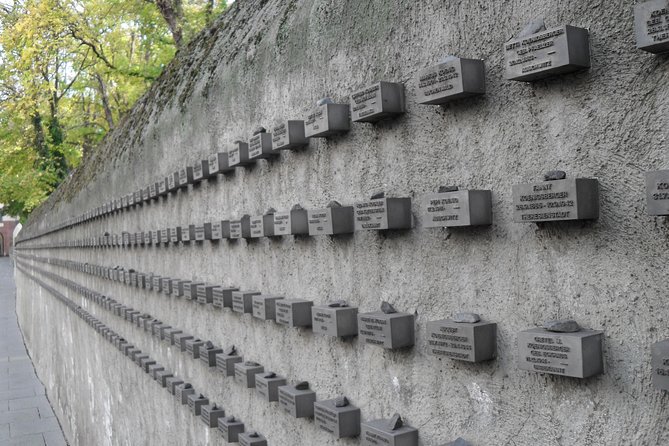
The Old Jewish Cemetery is given about 30 minutes, making it the longest stop. You view the medieval cemetery through the gate, while the Holocaust Remembrance Wall surrounds it.
This is one of the most important parts of the walk. Frankfurt’s Jewish community has been present since the 1100s, and the guide explains both that long history and the medieval Jewish Ghetto. The cemetery is not presented as a decorative old site. Its setting asks you to consider continuity, persecution, loss, and remembrance.
You should expect a more serious tone here. The stop may be emotionally difficult, but it gives the tour moral and historical weight. Without it, the walk could become a pleasant survey of buildings. With it, Frankfurt’s story becomes more honest.
Because the cemetery is viewed through the gate, you are not getting a full cemetery visit. The value lies in the explanation, the wall, and the connection to the former Jewish quarter.
Stadtplanungsamt and the city in miniature
At Stadtplanungsamt, the city planning department, you see a large scale model of present-day Frankfurt. The visit takes about 15 minutes and is not available on weekends or German holidays.
This is an unusually good inclusion. Many city walks stop at old buildings and leave the modern city unexplained. The model helps you understand how Frankfurt fits together today, including the relationship between its historic center, river, museums, and high-rise districts.
It also reinforces one of the tour’s strongest themes: Frankfurt is not frozen in the past. The city is still being planned, rebuilt, and debated. If you enjoy architecture, public spaces, or urban design, this may be one of the most revealing stops.
On a weekend, you will miss it, so the tour will naturally place more emphasis on the outdoor parts of the route.
Eiserner Steg and the best open views
Eiserner Steg is Frankfurt’s pedestrian bridge across the Main, often called the Love-lock Bridge. The stop is brief, about 10 minutes, but the views earn their place.
From the bridge, you can look toward the European Central Bank, the museum riverbank, and Sachsenhausen. This is where the modern city comes into view. The older center behind you and the river corridor ahead create a useful visual summary of Frankfurt’s different identities.
The bridge is also a good photography stop, though the tour is not built around long photo sessions. If you want extra time for pictures, note the route and return after the walk.
Staufenmauer and the city’s medieval edge
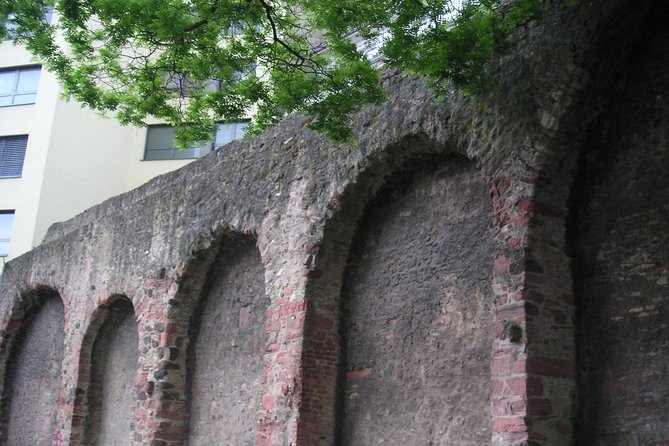
The final listed stop is Staufenmauer, a city wall dating to the 1100s and part of the medieval Jewish Wall. It provides a fitting close because it brings you back to the physical limits of medieval Frankfurt.
Walls are easy to overlook in a modern city. Here, the guide explains what this surviving section meant for the city and how it relates to the Jewish quarter. After seeing the cathedral, civic square, market, cemetery, and river, you finish with a reminder that Frankfurt once had a much smaller footprint.
The tour ends back at the meeting point. That makes it convenient for collecting your bearings and then choosing your next stop.
Guides, pace, and what the experience feels like
The strongest praise is directed at the guides. Jennifer is described as funny, interactive, and able to hold attention for the full three hours. Hannes and Hennes are praised for answering questions beyond a memorized script and for connecting old streets, museums, urban planning, and present-day life.
Anne, Anna, Annika, Justin, and Philip also receive praise for clear delivery, friendly manners, strong local knowledge, and useful advice about food and drinks. One guide was specifically noted for projecting her voice well, an underrated advantage on a city walk.
The pace is usually described as good and manageable, with frequent stops. Still, you should not assume easy means effortless. One person found the pace fast, and another said the route was not suitable for an elderly participant. There are intermittent steps, although a guide may be able to accommodate different needs.
The tour is described as stroller-friendly, and service animals are allowed. Most people can participate, but anyone with back pain, limited stamina, or difficulty standing should plan realistically. One participant completed only two hours because of back pain and still found the shortened experience worthwhile.
Weather matters. The walk operates in cold and rainy conditions, and guides have adapted when the weather was poor. Wear shoes with good grip and bring rain protection. Frankfurt’s weather can change the feel of a three-hour outdoor program quickly.
Booking details and one meeting-point warning
The start time is 10:00 am at Braubachstraße 41, 60311 Frankfurt am Main, Germany. The activity returns to that meeting point.
The written address matters. One person missed the tour after relying on a map marker that appeared to be about one block from the printed location. I would check the address in your confirmation and arrive early enough to compare the written details with the map.
Booking provides instant confirmation, and free cancellation is available until 24 hours before the local start time. Cancellations or changes inside that window are not accepted for a refund.
Who should book this Frankfurt walking tour?
I would choose this tour if you want a clear first look at central Frankfurt and prefer stories over a checklist of photographs. It suits first-time visitors, history fans, architecture-minded walkers, and anyone with only a short stay who wants several major areas connected in one outing.
It is also a good choice if you want practical local suggestions. Guides have recommended places for food, drinks, free sights, and paid attractions, and the market stop can help you plan a meal afterward.
You may want a shorter alternative if three hours on foot sounds tiring, if you need a slow pace, or if your main goal is entering churches and spending time inside museums. Sunday visitors should also understand that several stops are altered or closed.
Should you book it?
Yes, if you want Frankfurt explained rather than merely photographed. The tour’s best qualities are its broad range, serious treatment of Jewish history, lively guides, and connection between medieval Frankfurt and the modern city.
Book it early if your schedule is fixed, since it is commonly reserved about 27 days ahead. Pick a weekday if Kleinmarkthalle and the city planning model matter to you, and avoid Sunday if interior access to the cathedral and Old Nicholas Church is important. For most first-time visitors, $36.28 is a reasonable price for three hours of context and orientation, provided you are ready for a genuine walking tour rather than a quick stroll.
FAQ
How long does the Frankfurt Highlights English Walking Tour last?
The tour lasts approximately two to three hours. Many participants complete the full three-hour route, though some finish earlier because of weather or physical limitations.
What time does the tour start?
The scheduled start time is 10:00 am.
Where does the tour begin and end?
It begins at Braubachstraße 41, 60311 Frankfurt am Main, Germany, and ends back at the same meeting point.
Is the tour offered in English?
Yes. The experience is offered in English and uses a mobile ticket.
Is the walking route suitable for strollers?
The route is described as stroller-friendly. However, there are intermittent steps, so you may want to contact the provider if your stroller or mobility needs require a fully step-free route.
What happens on Sundays?
On Sundays, Frankfurt Cathedral and Old Nicholas Church are viewed from the exterior only. Kleinmarkthalle and Stadtplanungsamt are not open on Sundays or German holidays.
Can I cancel for a refund?
Yes. You can cancel up to 24 hours before the local start time for a full refund. Cancellations or changes made less than 24 hours before the start are not accepted for a refund.
Just added around Frankfurt
- Day Trip to Rothenburg from Frankfurt★ 4.6 · 25 reviews
- Rhine Valley: Half Day Tour from Frankfurt★ 3.7 · 66 reviews
- Private Tour with Native English speaking Local★ 4.9 · 60 reviews
- Darmstadt: Mathildenhöhe UNESCO Site Guided Visit★ 4.7 · 124 reviews
- Mainz: Private custom tour with a local guide★ 3.8 · 11 reviews
- Mainz: guided evening tour of the Rhine embankment/old town in German and English★ 4.9 · 38 reviews
- Mainz Highlights, private walking tour★ 4.9 · 15 reviews
- Hohenzollern Castle: Full-Day Tour from Frankfurt★ 4.3 · 11 reviews
Walking Tours, compared.
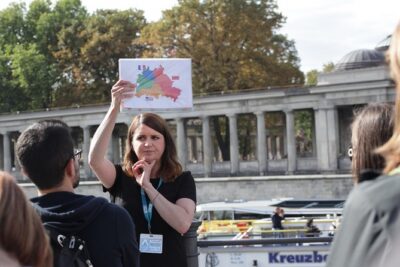
Old Town & Viktualienmarkt City Walk in German
Read our review →Browse the lists this tour appears in