
Reviewed · WALKING TOURS
Frankfurt: Private or Shared Walking Tour
Frankfurt wears its past and present side by side. I like the way this 1.5-hour walking tour links the old city center with the skyscrapers of modern Frankfurt, and I especially like that it includes both the famous Römer and the rebuilt Neue Altstadt. The $17 price also offers good value for a short introduction to the city.
The main point to consider is the language: the live guide is listed as German. A private option gives you more flexibility, and one private group had its timing adjusted by the guide, but the shared tour may feel less personal. You also return to the same meeting point, so this is best used early in your stay, before you wander off on your own.
In This Review
- Key points to know before you book
- Why this short Frankfurt tour works well
- Meeting at Justitia-Brunnen on Römerberg
- Crossing the Eiserner Steg, Frankfurt’s 1868 iron bridge
- The story of destruction and the 2008 to 2009 renovation
- The Römer and Frankfurt’s most familiar image
- Paulskirche and the first German national assembly
- Walking through the Neue Altstadt
- Shared or private: which version makes sense?
- The German-language guide and the role of Sanel
- How much time should you allow?
- Who will get the most from this Frankfurt walk?
- Is the $17 price good value?
- Should you book the Frankfurt walking tour?
- FAQ
- Where does the Frankfurt walking tour start?
- Where does the walking tour end?
- How long does the tour last?
- What language is the tour conducted in?
- Is a private tour option available?
- Can I cancel the tour for a refund?
Key points to know before you book
- Start at the Justitia-Brunnen: Meet beside the statue on Römerberg, one of Frankfurt’s most central squares.
- Cross the Eiserner Steg: The iron footbridge dates from 1868 and gives the tour a clear link between city views, riverfront history, and urban change.
- See Frankfurt’s rebuilt center: The Neue Altstadt project is the city’s modern attempt to restore the feel of its old center.
- Visit Paulskirche from the outside: This is where the first German national assembly took place, giving the walk real political weight.
- Choose between shared and private: The private version can be useful if you want a more flexible pace or have a small group.
- Plan around German-language guiding: The activity lists German as the tour language, so this matters when deciding if the guide will work for you.
Why this short Frankfurt tour works well
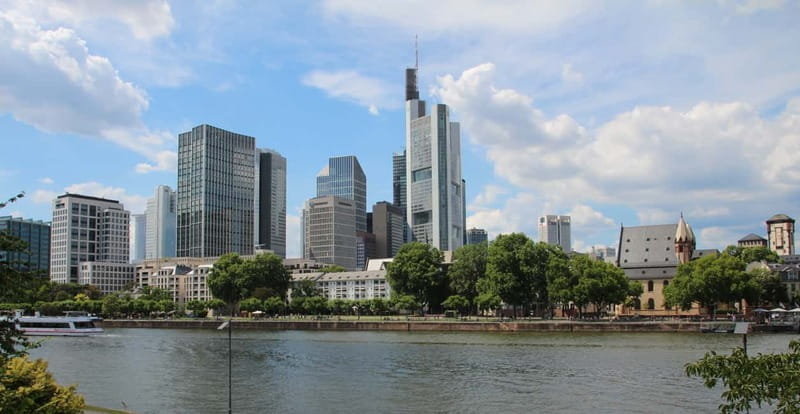
Frankfurt can be a confusing first stop. One minute you are looking at medieval-style facades, and a few streets later you are beneath a cluster of tall glass towers. This tour gives that contrast a clear shape instead of leaving you to piece it together from scattered sights.
The walk is short enough to fit into a busy schedule. At 1.5 hours, you can take it on your first afternoon, between train connections, or before dinner. You are not committing to a half-day outing, yet you still get a useful orientation to the central sights.
I see the biggest value in the way the guide connects buildings to events. You do not simply pass the Römer, Paulskirche, and Eiserner Steg for a photograph. You hear how war, reconstruction, and Frankfurt’s changing role shaped what you see today.
The tour also begins and ends at the same place. That is practical if you are staying near the center or want to continue exploring Römerberg after the walk. It is less useful if you hoped to finish near another neighborhood, but for a first look at central Frankfurt, the loop is sensible.
More Walking Tours in Frankfurt
- Frankfurt Highlights English Walking Tour
★ 5.0 · 1,203 reviews - Frankfurt on Foot Daily Walking Tour in English
★ 4.9 · 323 reviews - Frankfurt Self-Guided Historical Walking Tour
★ 4.0 · 58 reviews
Meeting at Justitia-Brunnen on Römerberg
Your starting point is the Justitia-Brunnen, the fountain and statue on Römerberg. This is an easy place to recognize once you are in the square, and it puts you directly in the middle of Frankfurt’s historic center.
The location matters. You begin among the buildings that define the city’s old identity, rather than at a remote meeting point or outside a transport station. From here, the guide can set up the main theme immediately: Frankfurt is a city where old forms were destroyed, rebuilt, adapted, and placed beside very modern architecture.
Römerberg is also a useful spot for getting your bearings. If you arrive early, use the extra minutes to look across the square and note how much of the scene is reconstructed or renewed. The tour’s later discussion of wartime destruction and the 2008 to 2009 renovation will make more sense if you first take in the setting without rushing.
Because the meeting point is central, give yourself time to find the statue. The activity does not include transport, so you need to reach Römerberg on your own. For most people interested in Frankfurt’s central sights, that is not a serious obstacle, but it is worth planning rather than arriving at the last moment.
Crossing the Eiserner Steg, Frankfurt’s 1868 iron bridge
One of the first major stops is the Eiserner Steg, the iron footbridge built in 1868. This gives the walk a change of scale. You move from the tight historic center to an open crossing where the city can be understood as a whole.
The bridge is not included simply as a handy route. It helps explain Frankfurt’s relationship with the river and its later growth. From a footbridge, you can look back toward the older center and then compare it with the newer city beyond. That visual contrast is one of the tour’s strongest features.
The bridge also adds a physical break to the walk. Instead of hearing a string of facts while moving from one square to another, you get a place where you can pause, look around, and connect the guide’s comments with the buildings in front of you.
You should expect the bridge to be part of a walking route, not a long scenic stop with a separate viewing platform. The supplied details do not promise a particular amount of time there or describe specific views. Still, its position in the route makes it a useful point for understanding Frankfurt’s old and modern sides together.
The story of destruction and the 2008 to 2009 renovation
A key part of the tour is the explanation of how many grand buildings were destroyed during World War II. This is important context for Frankfurt, especially because the central area can appear older and more intact than its recent past would suggest.
The guide then discusses the major renovation of 2008 and 2009. That detail gives you a better way to read the city. You are not seeing one untouched old town. You are seeing a center shaped by loss, rebuilding, and a modern decision about how much of the past to recreate.
I find this historical layer more useful than a simple list of dates. When you look at a traditional facade, you can ask what survived, what was reconstructed, and what was designed to recall an earlier Frankfurt. The tour encourages that kind of careful looking.
This subject may also make the walk feel more serious than a standard city introduction. If you want only light sightseeing and photo stops, some of the historical explanation may seem dense. If you want to understand why Frankfurt looks the way it does, it is one of the most valuable parts.
Still Frankfurt, at a slower pace:
- Frankfurt: River Main Sightseeing Cruise with Commentary
★ 4.3 · 5,127 reviews - Frankfurt: Hop-On, Hop-Off Grand or Express Bus Ticket
★ 3.9 · 2,088 reviews - Frankfurt: 1-Hour Panorama Boat Cruise on the river Main
★ 4.4 · 1,822 reviews - From Frankfurt: Rhine Valley Day Trip
★ 4.4 · 1,317 reviews
The Römer and Frankfurt’s most familiar image
The Römer is one of the central sights on the route. Its distinctive facade and location on Römerberg make it an obvious symbol of Frankfurt, but the tour helps place it within the larger story of the old town.
The important benefit here is interpretation. You can easily photograph the building without knowing why it matters. With a guide, the Römer becomes part of the city’s civic history and part of the rebuilding story described along the route.
Since the tour begins at Römerberg, the Römer is also one of the easiest stops to revisit later. I would pay attention during the explanation, then return on your own if you want more time for photos. A 1.5-hour walk has to keep moving, and famous sights often deserve a second look after the guide has given you the basics.
The information provided does not include entry to the Römer or any interior visit. Plan on seeing and discussing the building from the walking route rather than treating this as an indoor museum tour.
Paulskirche and the first German national assembly
Paulskirche gives this outing a strong political and national dimension. The first German national assembly took place here, making the church more than another attractive building in the center.
This is a useful stop for anyone who wants to connect Frankfurt with German political history. The guide can explain why this location matters, while you see the building as part of the city rather than as an isolated monument.
The tour information does not say that you enter Paulskirche, so you should expect an exterior explanation unless the guide confirms otherwise. That is not a flaw in a short walking tour, but it is worth knowing if you were hoping for a detailed interior visit.
I especially like the balance between this stop and the skyscraper comparison. Frankfurt is often reduced to finance and tall buildings. Paulskirche reminds you that the city also played an important role in Germany’s civic and political story.
Walking through the Neue Altstadt
The Neue Altstadt is the newest major project on the route. The name means New Old Town, and the idea is clear: Frankfurt has created a recently renewed central quarter that draws on traditional forms.
This is where the tour’s old-versus-new theme becomes most interesting. You can compare the rebuilt historic center with the modern towers that make Frankfurt look unlike many other German cities. The guide’s comments should help you notice that a new old town raises questions about memory, design, and authenticity.
I would not approach this district expecting an untouched medieval neighborhood. The title itself tells you that it is new. Its value is in seeing how a modern city chooses to present its past after so much earlier destruction and rebuilding.
That makes the Neue Altstadt a good stop for visitors who enjoy architecture and city planning. You get to think about why traditional-looking buildings were brought back, how they fit into the wider center, and what a city gains or loses when it recreates an older image.
The details provided do not list individual houses, shops, or interiors, so the focus is on the project as a whole. The guide supplies useful information about the attractions along the way, but you should not expect a specialist architectural tour covering every facade.
Shared or private: which version makes sense?
The shared option is likely the best deal if you want a low-cost introduction and do not need the guide’s full attention. At $17 per person, it costs less than many longer guided activities and covers several of Frankfurt’s most important central sights in a compact format.
The private option makes more sense for a family, couple, or small group that wants a more direct exchange with the guide. It may also suit you if your schedule is tight. One private booking had its time adjusted by the guide, even with rainy conditions and a shorter visit, and still received strong praise for the insight and flexibility.
That example does not mean every private booking will be changed on request. It does show why a private group can be useful: you have a better chance of discussing timing and emphasis with the guide.
The tradeoff is simple. Shared tours are cheaper per person but can feel less tailored. Private tours give you more control, but the total cost may be higher even though the listed starting price is $17 per person. Check the exact option and final price before paying.
The German-language guide and the role of Sanel
The live tour guide language is German. This is the most important practical point for many people. If you are comfortable listening to German, the walk should give you a direct connection to the local setting. If you are not, the historical explanations may be difficult to follow even though the route itself is easy to understand.
The guide is central to the value here. The activity promises useful information at each attraction, not just directions from one landmark to the next. Sanel has been praised for giving a Frankfurter an especially detailed account of the city’s history, which suggests that the experience can work for local residents as well as first-time visitors.
That is a notable strength. A good city walk should offer more than basic facts you could read on a sign. The strongest response connected Sanel with a thorough explanation and an enjoyable experience. Another private group appreciated the guide’s flexibility and insight despite a rainy evening.
Those points suggest that the quality of the tour depends heavily on the person leading it. The available information identifies German as the language but does not promise English, multilingual guiding, or a specific guide for every departure. Ask before booking if language is important to you.
How much time should you allow?
The walking portion lasts 1.5 hours. That is enough for a focused introduction, but not enough for long visits inside several buildings, extended photography, and a detailed explanation of every street.
I would schedule it near the start of your Frankfurt stay. You will learn the shape of the central area, hear the key historical themes, and then know where to return for a slower look. It also works well on a short city break when every hour counts.
The walk ends back at Justitia-Brunnen. That makes it easy to continue around Römerberg, revisit the Römer, or make your own plans after the guide says goodbye. It also means the tour does not function as a one-way transfer between two neighborhoods.
Starting times vary, so check availability for the day you want. The activity does not provide one fixed departure time. Free cancellation is available up to 24 hours ahead for a full refund, and you can reserve now and pay later, which helps if your schedule is still moving.
Who will get the most from this Frankfurt walk?
I would recommend this tour to first-time visitors who want a quick sense of Frankfurt before exploring independently. It is also a good fit if you care about the relationship between historic buildings, wartime destruction, reconstruction, and modern development.
Architecture fans should enjoy the contrast between the Neue Altstadt and the skyscrapers. History-minded visitors will find the Paulskirche and World War II discussion especially useful. A local resident might also appreciate the chance to hear a more connected account of the city, as the praise for Sanel indicates.
Families and older visitors may like the short duration, though the activity is still a walking tour and no special transport arrangement is listed. People who dislike group activities should consider the private option.
I would hesitate to book it if you need an English-language guide and cannot follow German. I would also choose a longer or more specialized activity if your main goal is extensive interior access, museum visits, or a detailed study of individual architectural features.
Is the $17 price good value?
Yes, for the right purpose. You are paying $17 per person for a guide, a 1.5-hour route, and explanations at several major Frankfurt sights. That is a fair price for orientation, especially if you use the tour to plan the rest of your time.
The value comes from the connections between stops. A self-guided walk can take you to the Römer, Paulskirche, Eiserner Steg, and Neue Altstadt, but it may not explain how wartime destruction and the 2008 to 2009 renovation changed the meaning of the center.
The price does not include a meal, transport, or clearly stated interior admissions. That keeps the cost low, but it also means you should see this as a guided introduction rather than a full-day cultural package.
Should you book the Frankfurt walking tour?
Book it if you want a short, central, history-focused introduction and German works for you. The route brings together the Eiserner Steg, Römer, Paulskirche, Neue Altstadt, and modern Frankfurt in one compact outing, while the private option offers more flexibility.
I would make it an early activity, then use the rest of your visit to return to the sights that catch your interest. Choose private if personal attention matters, and confirm the guide language before booking. At $17 per person and with a strong 4.8 rating from 156 ratings, it is a sensible way to get your Frankfurt bearings without spending half a day.
FAQ
Where does the Frankfurt walking tour start?
The tour starts at the Justitia-Brunnen on Römerberg in Frankfurt.
Where does the walking tour end?
The activity ends back at the meeting point, the Justitia-Brunnen.
How long does the tour last?
The walking tour lasts 1.5 hours. Starting times vary, so check availability for your preferred date.
What language is the tour conducted in?
The live tour guide language is German.
Is a private tour option available?
Yes. You can choose a shared tour or a private group, depending on the option selected.
Can I cancel the tour for a refund?
Yes. You can cancel up to 24 hours in advance for a full refund. You can also reserve now and pay later.
Just added around Frankfurt
- Day Trip to Rothenburg from Frankfurt★ 4.6 · 25 reviews
- Rhine Valley: Half Day Tour from Frankfurt★ 3.7 · 66 reviews
- Private Tour with Native English speaking Local★ 4.9 · 60 reviews
- Darmstadt: Mathildenhöhe UNESCO Site Guided Visit★ 4.7 · 124 reviews
- Mainz: Private custom tour with a local guide★ 3.8 · 11 reviews
- Mainz: guided evening tour of the Rhine embankment/old town in German and English★ 4.9 · 38 reviews
- Mainz Highlights, private walking tour★ 4.9 · 15 reviews
- Hohenzollern Castle: Full-Day Tour from Frankfurt★ 4.3 · 11 reviews
Walking Tours, compared.
Old Town & Viktualienmarkt City Walk in German
Read our review →Browse the lists this tour appears in