
Reviewed · WALKING TOURS
Frankfurt on Foot Daily Walking Tour in English
Frankfurt reveals itself on foot. I like the tour’s wide historical range, from the medieval Römer to the city’s Nazi-era memorials, and I like the way guides such as Justin, Jennifer, Philip, Anne, and Hannes mix facts with local advice. The main drawback is the distance: about 7 kilometers over three hours, with cobblestones and limited time at Klein Markt Halle.
This is a strong first morning in Frankfurt, especially if you want the city explained rather than simply photographed. The tour is in English, runs daily at 10:00, costs $35 per person, and includes no transportation, so you see the center at street level. Wear comfortable shoes, and bring a rain jacket or umbrella because the walk goes ahead in wet weather.
In This Review
- Key points at a glance
- Starting at Frankfurt’s postcard center
- The New Altstadt and the problem of reconstruction
- From the Book Burning Memorial to St. Nikolai Church
- A rare surviving house and a bridge with skyline views
- The Karmeliter Cloister and paintings from the 1500s
- Frankfurt’s Jewish quarter and memorials
- Klein Markt Halle, the tour’s edible pause
- How the three hours feel on foot
- What $35 buys you in Frankfurt
- Who should book this walking tour?
- Should you book Frankfurt on Foot?
- FAQ
- How long is the Frankfurt on Foot tour?
- What time does the tour start?
- Is the tour conducted in English?
- Where is the meeting point?
- How much does the tour cost?
- Are children allowed to join?
- Is the tour wheelchair and stroller accessible?
- Are food and drinks included?
- Is Klein Markt Halle visited every day?
- What should I bring?
Key points at a glance
- Three hours and about 7 kilometers: A useful first look at Frankfurt, but not a short stroll.
- History beyond the postcard sights: The route covers the Holy Roman Empire, wartime destruction, Nazi persecution, Jewish Frankfurt, and modern rebuilding.
- The Römer and rebuilt Altstadt: You learn why the old town looks historic even though much of it is new.
- Strong guides are central to the experience: Justin, Jennifer, Philip, Anne, Jo, Hans, and Hannes have been praised for clear explanations, humor, warmth, and practical tips.
- A thoughtful Jewish heritage section: Stolpersteine, the Holocaust memorial wall, the medieval cemetery, and the former ghetto wall bring difficult history into the open.
- Klein Markt Halle adds local flavor: Food stalls, produce, pastries, cheese, meat, fish, chocolate, and international delicacies make a welcome snack stop, though Sunday access is excluded.
Starting at Frankfurt’s postcard center
The walk begins at the Römerberg, Frankfurt’s old town square, near the Tourist Information and in front of the Binding Schirn Pub. The guide carries a Frankfurt on Foot Walking Tours sign. The supplied meeting details also name Braubach Strasse 41, so I would check the exact meeting instructions before setting out, especially if you are arriving from the Hauptbahnhof or a hotel outside the center.
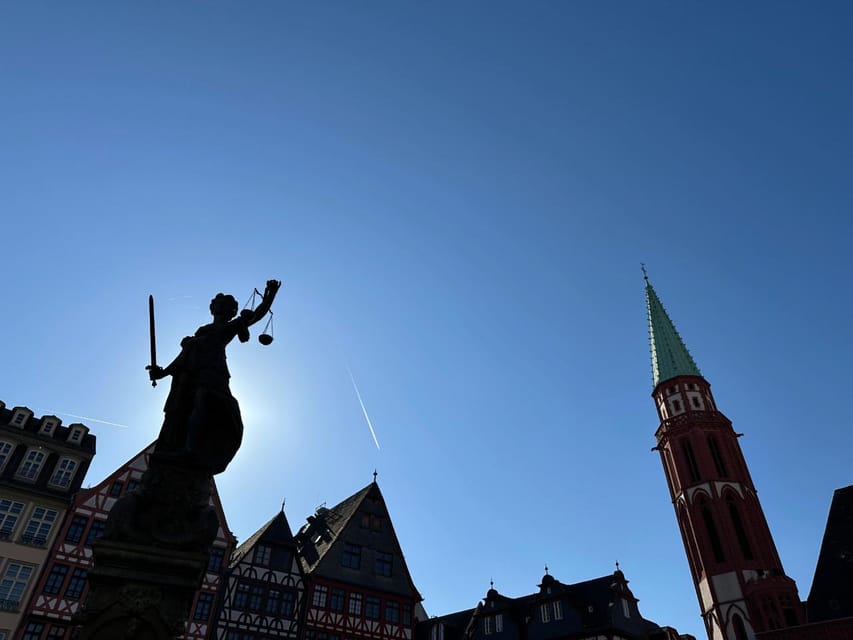
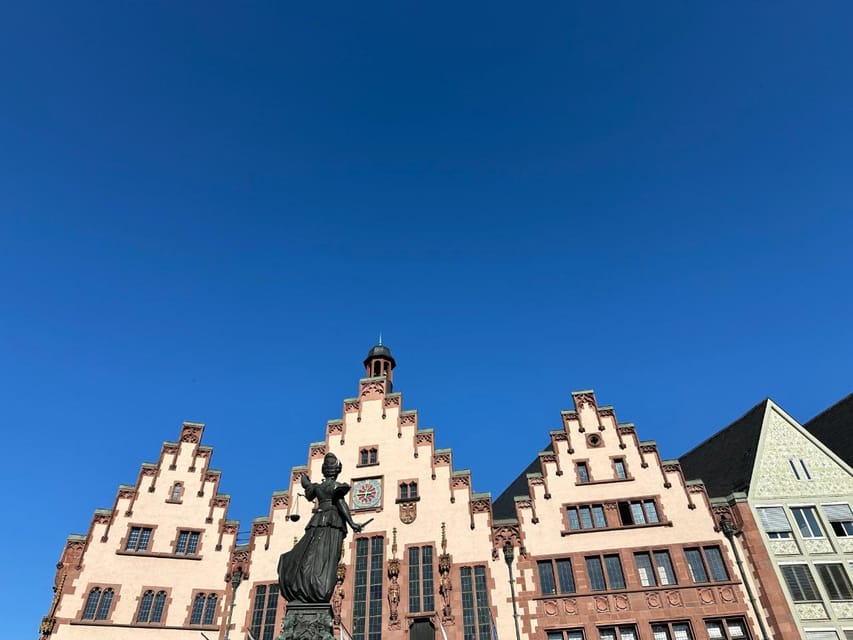
This is a sensible starting point. The Römerberg gives you Frankfurt in one glance: reconstructed timber-framed buildings, the Römer city hall, the church towers, and the modern skyline peeking beyond the old center. It is the sort of place that can look like a simple photo stop until someone explains what you are seeing.
The Römer has served as Frankfurt’s city hall since 1405. Its stepped facade and linked medieval buildings are among the city’s best-known images, but the important point is its civic role. This was not just a pretty building. It was the working heart of a major trading city and remains one of the clearest links between Frankfurt’s medieval past and its present-day identity.
The guide uses the square to set the scene before the group moves on. That approach matters. You get a framework for the city first, so later stops are not isolated monuments but parts of one long story.
More Walking Tours in Frankfurt
- Frankfurt Highlights English Walking Tour
★ 5.0 · 1,203 reviews - Frankfurt: Private or Shared Walking Tour
★ 4.8 · 156 reviews - Frankfurt Self-Guided Historical Walking Tour
★ 4.0 · 58 reviews
The New Altstadt and the problem of reconstruction
Frankfurt’s New Altstadt can fool you. Its narrow lanes and traditional facades suggest an untouched medieval quarter, but much of this area was rebuilt after the destruction of World War II. The tour explains how and why the reconstruction happened, which is one of the most useful parts of the morning.
You will see the tension between old and new Frankfurt here. Some buildings are faithful recreations, while others use modern construction behind historic-looking fronts. That raises a worthwhile question: is a rebuilt old town less meaningful than an original one? The guide’s explanation helps you read the district with more care instead of treating it as a stage set.
The tour’s wartime material is not limited to a quick mention of bomb damage. Guides use photographs showing Frankfurt before and after World War II, helping you understand just how much of the center was lost. This visual comparison received special praise because it turns an abstract date into something you can grasp while standing in the rebuilt streets.
There is a practical limit. The route covers many subjects, so you should not expect a long architectural lecture at every building. The value is the connection between places, events, and present-day Frankfurt.
From the Book Burning Memorial to St. Nikolai Church
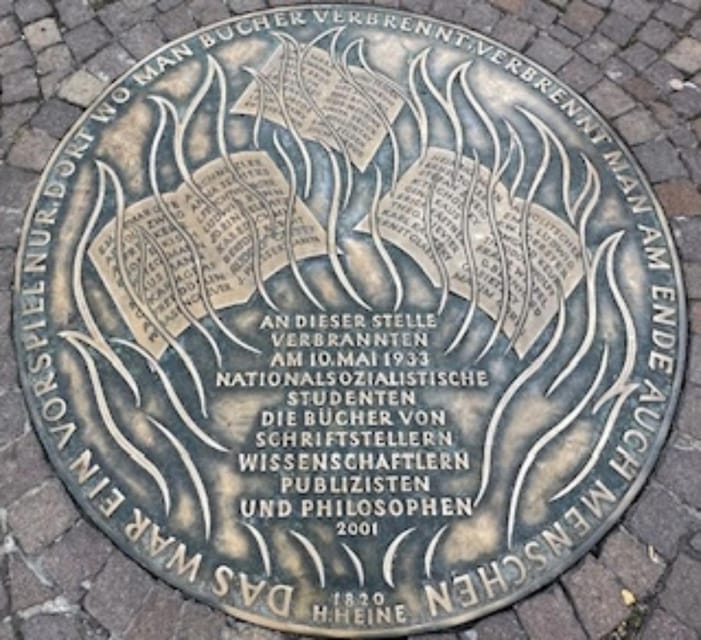
The Book Burning Memorial is a small but serious stop. It marks the site associated with the Nazi book burning, when works considered politically or culturally unacceptable were destroyed. The memorial is easy to miss on your own, which is exactly why a walking guide helps here.
This part of the tour shifts the mood. Frankfurt is often introduced through finance, shopping, and its reconstructed old town, but the city’s 20th-century story cannot be separated from Nazi rule and the destruction of Jewish life. The walk does not avoid that difficult past.
The nearby Alt Nikolai Church adds a much older layer. This Gothic church dates to 1290 and helps show how long Frankfurt’s religious and civic center has been developing. On Sundays, the interior is exterior-only according to the tour information, so you should not book this walk expecting regular access inside every church.
St. Bartholomew’s Cathedral, commonly called the Kaiserdom, is another major landmark. For centuries, Holy Roman Emperors were elected and crowned here. The exterior alone is impressive, but the political history is the real reason to pay attention. This was one of the places where Frankfurt’s importance reached far beyond the city itself.
The cathedral is also exterior-only on Sundays and religious holidays. That restriction does not ruin the route, but it is worth knowing if interior access is high on your list.
A rare surviving house and a bridge with skyline views
House Wertheim is one of the tour’s small discoveries. It is described as the only original half-timbered house left in the inner city at the end of World War II. In a center that suffered such widespread damage, one surviving structure can tell you more than a row of polished reconstructions.
I like stops such as this because they reward careful looking. The house is not as grand as the Römer or cathedral, but its survival gives the destruction and rebuilding story a physical focus.
The route then reaches the Eisener Steg, Frankfurt’s pedestrian bridge over the Main. This is the tour’s best broad view. From the bridge, you can look back toward the old town skyline and along the museum-lined riverbanks.
It is also a natural photo break. The tour makes a point of showing good photo opportunities, and the bridge delivers without requiring a separate viewpoint ticket or a detour by public transport. You get a sense of Frankfurt’s unusual mix: medieval towers, postwar buildings, museums, and modern high-rises sharing one compact view.
The bridge can feel exposed in cold or wet weather. One December participant appreciated that a guide took extra care when a visitor had forgotten a coat and gloves, but you should still dress for the conditions. The tour operates rain or shine, and wet cobblestones can be slippery.
Still Frankfurt, at a slower pace:
- Frankfurt: River Main Sightseeing Cruise with Commentary
★ 4.3 · 5,127 reviews - Frankfurt: Hop-On, Hop-Off Grand or Express Bus Ticket
★ 3.9 · 2,088 reviews - Frankfurt: 1-Hour Panorama Boat Cruise on the river Main
★ 4.4 · 1,822 reviews - From Frankfurt: Rhine Valley Day Trip
★ 4.4 · 1,317 reviews
The Karmeliter Cloister and paintings from the 1500s
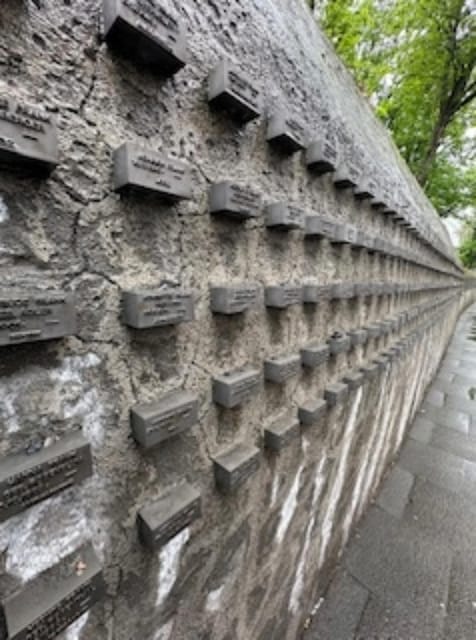
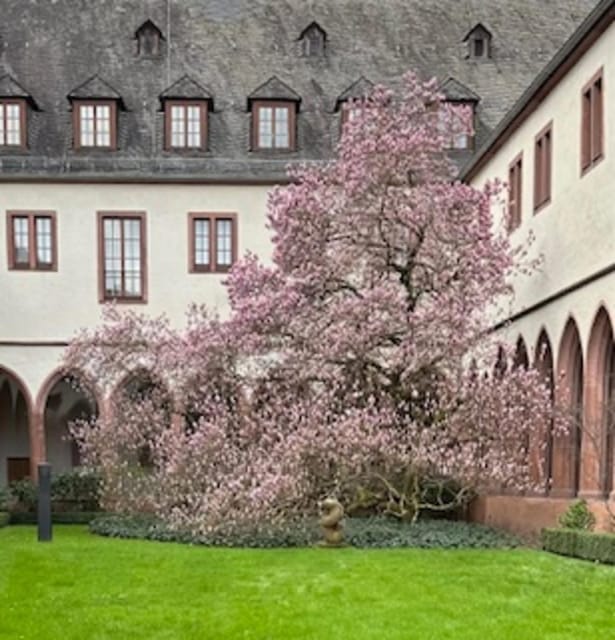
The Karmeliter Cloister gives the walk an artistic pause. Its Jörge Ratgeb wall paintings date from the early 1500s and are described as the largest religious wall paintings north of the Alps.
This is the sort of sight that benefits from a guide’s explanation. Large historic paintings can be hard to read quickly, especially when you do not know what details matter. The stop adds art and religious history to a route that might otherwise focus mainly on politics and war.
Access is not guaranteed on some holidays. The tour also warns that certain church interiors are restricted on Sundays and religious holidays, so check the calendar if your visit is built around indoor sights.
The cloister is one reason the walk feels broader than a standard old town circuit. You are not just moving between famous facades. You are getting architecture, art, religion, memory, food, and city planning in one morning.
Frankfurt’s Jewish quarter and memorials
The Jewish history section is among the most important parts of the tour. You see Stolpersteine, the small brass memorial stones set into pavements to remember people persecuted and murdered under the Nazi regime. The concept is simple and personal: names and lives are recalled at the places where people once lived.
The Jewish Holocaust Memorial Wall honors approximately 12,000 Jewish citizens of Frankfurt murdered in the Shoah. Anne Frank, along with Margot and Edith Frank, is included among the names. This is not a grand monument designed for a quick photograph. It is a place for slowing down and reading.
The route also views the medieval Jewish Cemetery from outside. It is one of the oldest and largest Jewish cemeteries in Germany. Since the visit is from the exterior, you should see this as a historical orientation stop rather than a cemetery tour.
The Jewish Ghetto Wall adds still more context. It began as part of the city defenses in 1180 and later became one of the walls surrounding the medieval Jewish ghetto. The same structure therefore connects military defenses, urban growth, and the history of a community that was forced into a defined area.
I value the way these stops sit within the ordinary city. You are walking through streets where people live, shop, and work, then coming upon a memorial stone or wall with a painful story. That makes the past feel close without turning the entire walk into a museum lecture.
Guides have been praised for handling this material clearly and respectfully. One particularly positive account described the tour as covering culture and history without avoiding the dark years of World War II. That balance is important. Frankfurt’s story is not only imperial ceremony and handsome reconstruction.
Klein Markt Halle, the tour’s edible pause

Klein Markt Halle is a favorite stop for good reason. The produce hall is filled with fruits, vegetables, chocolate, pastries, cheeses, breads, meats, fish, and specialty foods from around the world.
The tour includes a snack break, but food and drinks are not included in the $35 price. You can buy something if you wish. Treat the stop as a chance to sample a small item or note where you want to return later, not as a full sit-down meal.
Timing matters here. One person found the market break too short for sitting longer than five minutes, particularly if you want to browse and eat. I would plan to grab something quickly and save a more relaxed market visit for another part of your day.
Klein Markt Halle is not open as part of the tour on Sundays and holidays. If food stops are a priority, choose a weekday or Saturday when possible.
How the three hours feel on foot
The advertised duration is three hours, though one account described a 3.5-hour experience. Either way, this is a substantial morning walk. The route covers about 7 kilometers, with restroom and snack breaks included.
Several useful details come through clearly. The pace is generally comfortable, and one local resident who had lived in Frankfurt for ten years still found the tour easy to follow and full of new information. Another participant described the walk as long enough to feel worthwhile but not overly strenuous.
Still, do not confuse easy walking with no walking. You will be on your feet for much of the morning. Comfortable shoes are essential, and supportive footwear is especially helpful on old paving and cobblestones. A stroller and wheelchair are welcome, but the route’s distance and historic surfaces may still require patience.
The group’s enjoyment depends heavily on the guide. Justin is repeatedly praised for explaining Frankfurt’s past and its connection to modern life in clear language. Jennifer is described as warm, lively, and easy to listen to. Philip is praised for preparation, enthusiasm, and strong historical detail. Anne is noted for personal stories and an energetic style, while Jo, Hans, and Hannes receive praise for practical advice, humor, and clear delivery.
That variety is worth noting. You are not buying a prerecorded script. The guide can shape the morning through questions, local tips, and personal stories. One guide even helped direct a participant toward a hotel afterward when their route happened to match.
The only mild caution is that an especially passionate guide can sometimes give more facts than you can absorb. One participant felt that Philip occasionally spoke with nervous energy, although the overall experience remained very positive. If you prefer a silent photo walk with only occasional commentary, this tour may feel busy. If you want context, that energy is usually a plus.
What $35 buys you in Frankfurt
At $35, this tour offers solid value. You get three hours with an English-speaking guide, a route through the main old town, several less obvious historical sites, photo stops, restroom access, and a snack break. There are no admission charges added along the route, and no transport is used.
The value comes from the links between the stops. You could find the Römer, cathedral, bridge, and market on your own. It is harder to understand how medieval power, Jewish Frankfurt, Nazi persecution, wartime destruction, and modern rebuilding fit together in one compact area.
The tour is also useful for planning the rest of your stay. Guides give suggestions for eating, shopping, and additional places to visit. Several people used the morning as an introduction, then returned to sites that deserved more time.
Children age 12 and under join free and are welcome, provided they can manage roughly 7 kilometers. That can make the price especially fair for families, though younger children may find the memorial and political sections demanding.
Free cancellation up to 24 hours before the tour and reserve-now, pay-later booking add flexibility. Those terms are useful if your Frankfurt stop depends on a train connection or shifting travel plans.
Who should book this walking tour?
I would choose Frankfurt on Foot if you are visiting for the first time, have one full morning in the center, and want a clear explanation of what you are seeing. It is also a good choice if you have a longer stay and want orientation before exploring museums, markets, and neighborhoods on your own.
History-focused visitors will get the most from it. The tour does not stop at attractive buildings. It addresses the Nazi book burning, the Shoah, the Jewish ghetto, wartime destruction, and the difficult question of how a city reconstructs its old center.
It also suits people who like practical help. The route gives you photo locations, food ideas, neighborhood context, and suggestions for later. English speakers are the target audience, since the tour is offered only in English.
I would hesitate if you dislike walking, need long meal breaks, or want extensive interior visits. Sunday and holiday restrictions also reduce access to some churches and Klein Markt Halle. In bad weather, the bridge and cobblestones may be uncomfortable, though the walk still goes ahead.
Should you book Frankfurt on Foot?
Yes, if you want a serious but friendly introduction to Frankfurt. The strongest features are the route’s range, the careful treatment of 20th-century history, the Main River views, and the consistently warm guide style associated with Justin, Jennifer, Philip, Anne, Jo, Hans, and Hannes.
Book it early in your visit, wear good shoes, and bring weather protection. Keep your expectations realistic: this is a 7-kilometer city walk, not a quick old town loop. If that sounds like a fair morning of walking for $35, it is a useful buy and one of the better ways to understand Frankfurt before setting off on your own.
FAQ
How long is the Frankfurt on Foot tour?
The tour is advertised as three hours. The walking distance is about 7 kilometers, and one account described the experience as lasting 3.5 hours.
What time does the tour start?
The tour starts at 10:00 according to the supplied tour information.
Is the tour conducted in English?
Yes. The tour is offered only in English and includes a live English-speaking guide.
Where is the meeting point?
The meeting point is directly across from the Tourist Information on Römerberg, in front of the Binding Schirn Pub, on the street. The guide carries a Frankfurt on Foot Walking Tours sign. Braubach Strasse 41 is also given as the starting address, so confirm the exact meeting instructions before departure.
How much does the tour cost?
The price is $35 per person.
Are children allowed to join?
Yes. Children age 12 and under are free and welcome, but they should be able to walk about 7 kilometers.
Is the tour wheelchair and stroller accessible?
Yes. The tour information says it is wheelchair and stroller friendly.
Are food and drinks included?
No. Snacks and drinks are optional purchases. The tour includes a snack break, but you pay separately for anything you buy.
Is Klein Markt Halle visited every day?
No. The market stop is not included on Sundays and holidays.
What should I bring?
Bring comfortable shoes. An umbrella or suitable rain protection is also sensible because the tour operates in wet weather, and the cobblestones can become slippery.
Just added around Frankfurt
- Day Trip to Rothenburg from Frankfurt★ 4.6 · 25 reviews
- Rhine Valley: Half Day Tour from Frankfurt★ 3.7 · 66 reviews
- Private Tour with Native English speaking Local★ 4.9 · 60 reviews
- Darmstadt: Mathildenhöhe UNESCO Site Guided Visit★ 4.7 · 124 reviews
- Mainz: Private custom tour with a local guide★ 3.8 · 11 reviews
- Mainz: guided evening tour of the Rhine embankment/old town in German and English★ 4.9 · 38 reviews
- Mainz Highlights, private walking tour★ 4.9 · 15 reviews
- Hohenzollern Castle: Full-Day Tour from Frankfurt★ 4.3 · 11 reviews
Walking Tours, compared.

Old Town & Viktualienmarkt City Walk in German
Read our review →Browse the lists this tour appears in