
Reviewed · WALKING TOURS
Leipzig: 2-Hour Guided Walking Tour in German
Leipzig rewards a good walking route. This two-hour German-language tour packs the city center’s big names into a tidy introduction, linking music, trade, architecture, and the peaceful revolution of 1989. I like the efficient route and the mix of famous sights with lively lanes such as Barfußgässchen.
I also like the price: at $18 per person, you get a guide-led orientation without giving up half a day. The main consideration is language, since the tour is conducted in German, and church interiors are not included.
Recent tours have been praised for their humor and clear explanations. Guides including Herr Hannemann and an especially engaging guide praised by Ursula have helped make the walk both relaxed and informative. Bring warm clothing in winter, since one January participant found the route very cold.
In This Review
- Key points to know before you book
- Why this two-hour Leipzig walk works well
- Starting at Katharinenstrasse 8
- Augustus Square: Leipzig’s grand opening scene
- Specks Hof and the old commercial center
- Mädler arcade and Auerbachs Keller
- The Old Town Hall at the Market Square
- Barthels Hof and the turn toward Barfußgässchen
- St. Thomas Church and Leipzig’s musical identity
- The guide makes the difference
- Winter weather and practical comfort
- Who should book this Leipzig tour?
- Should you book it?
- FAQ
- How long does the Leipzig walking tour last?
- What language is the tour conducted in?
- Where does the tour meet?
- What sights are included on the route?
- Are church interiors included?
- Is the tour wheelchair accessible?
- How much does the tour cost?
- Can I cancel the booking?
Key points to know before you book
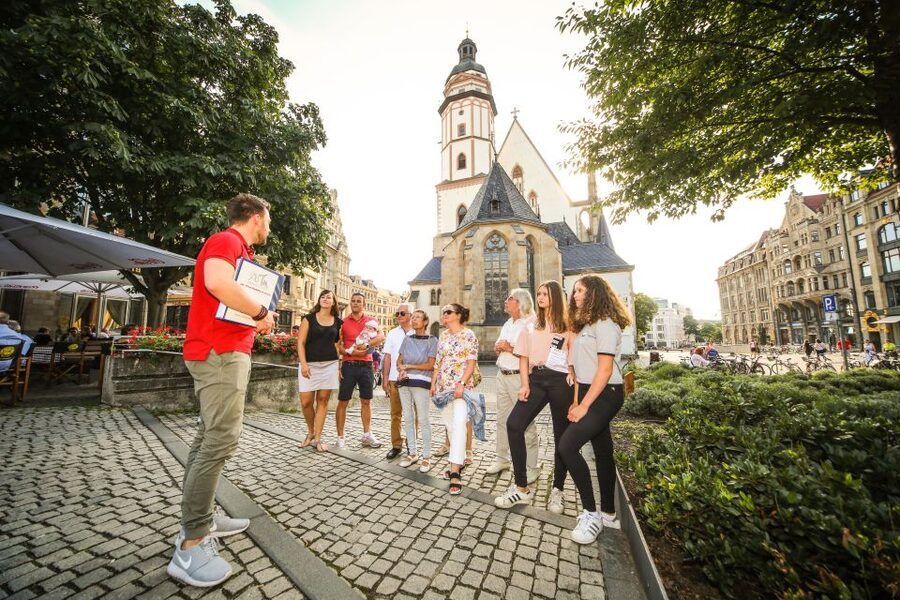
- A compact city-center route: In two hours, you see Augustus Square, Nikolai Church, the Old Town Hall, Auerbachs Keller, St. Thomas Church, and more.
- German is the only tour language: This is best for German speakers or for visitors comfortable following a guided explanation in German.
- Music and modern history meet: The route connects the Gewandhaus, St. Thomas Church, and Nikolai Church, the center of events surrounding German reunification in 1989.
- Arcades add architectural variety: Specks Hof and the Mädler arcade show Leipzig’s long connection with commerce and city life.
- The finish is atmospheric: Barfußgässchen is lined with restaurants and pubs, making it a useful place to continue your evening.
- Church interiors are not included: You can see the buildings as part of the walk, but an interior visit is not part of the tour.
Why this two-hour Leipzig walk works well
Leipzig’s center is compact, but its story is not. A first-time visitor can easily see a concert hall, a medieval church, a Renaissance town hall, a historic restaurant, shopping arcades, and a major site of German reunification without understanding how they connect.
That is the real value of this tour. You are not simply ticking off buildings. A guide gives you a basic framework for reading the center: Leipzig as a trading city, a musical center, a place shaped by religious and political change, and a modern city that has adapted its old buildings for restaurants, shops, and public life.
Two hours is a sensible length. You get enough context to make the center more meaningful, but the tour does not take over your day. I would use it early in a Leipzig stay, then return to the places that caught your attention.
The $18 price is also fair for a guided introduction. It is not a museum tour and does not include paid entries, so you should judge the value by the route and the guide’s storytelling. If you want a fast orientation with historical explanation, the cost is modest. If you want long interior visits or a specialized music tour, this is not the right product.
More Walking Tours in Leipzig
- Leipzig: 1.5-Hour Historical Walking Tour in German
★ 4.7 · 2,217 reviews - Leipzig: Bus Tour with Walking Tour
★ 4.5 · 1,384 reviews - 1.5 hour walking tour through beautiful Leipzig
★ 4.6 · 292 reviews
Starting at Katharinenstrasse 8
The meeting point is the Tourist-Information at Katharinenstr. 8. That puts you in the city center from the first minute, with no need for a separate transfer to the sights.
A central starting point matters in Leipzig. The route moves through a series of nearby squares, arcades, churches, and historic buildings rather than spending time on transport. You should arrive ready to walk on city streets and pause outdoors.
The stated duration is two hours, though the pace can feel brisk if you want to photograph every facade. This is a guided overview, not a slow architectural study. Keep your phone or camera handy, but listen closely when the guide explains how the different parts of the center fit together.
German is the tour language. That point deserves more attention than it often gets. If you understand German well, you should get the full benefit of the humor, historical detail, and spontaneous comments. If your German is limited, the buildings will still be worth seeing, but the tour may be less satisfying because the experience depends heavily on spoken explanation.
Augustus Square: Leipzig’s grand opening scene
The walk begins with Augustus Square, one of the city center’s broadest and most important spaces. Here you see the opera house, the Gewandhaus concert hall, and Nikolai Church.
This opening works because it introduces three different sides of Leipzig at once. The opera house points to the city’s performing arts tradition. The Gewandhaus connects Leipzig with major concert culture. Nikolai Church brings the story back to religion and civic life.
You do not need to be a classical music expert to appreciate this part of the route. The guide can help you understand why Leipzig’s identity is so closely tied to music. The square also gives you a useful sense of scale before the walk turns into narrower streets and covered passages.
Nikolai Church is especially important for modern German history. It was at the center of events around German reunification in 1989. That gives the building a meaning beyond its architecture. You are looking at a place connected with public pressure, political change, and the end of a divided Germany.
The tour does not include church interior visits. That limits the architectural detail you receive, but the outside view and historical setting still make Nikolai Church one of the essential stops.
Specks Hof and the old commercial center
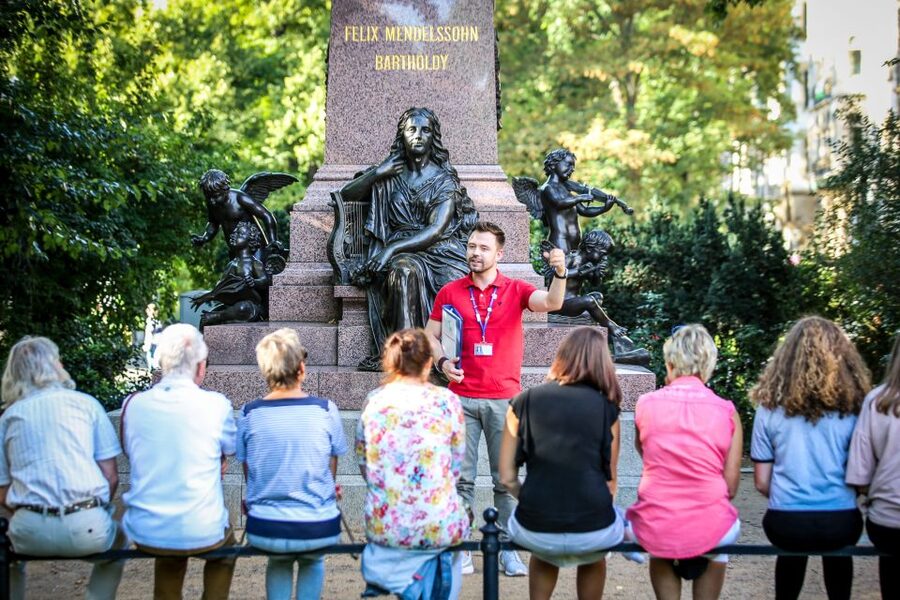
From Augustus Square, the route continues through the modern Specks Hof arcade toward Naschmarkt Square and the Old Exchange.
The arcade is a useful change of pace. Instead of another open square, you walk through a covered commercial passage that shows how Leipzig’s center has adapted older urban forms for present-day use. The setting helps explain Leipzig’s long relationship with trade and shopping.
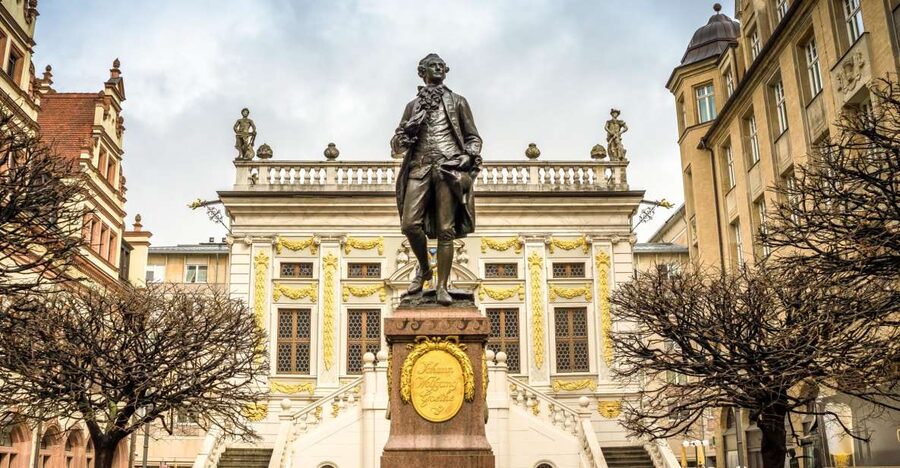
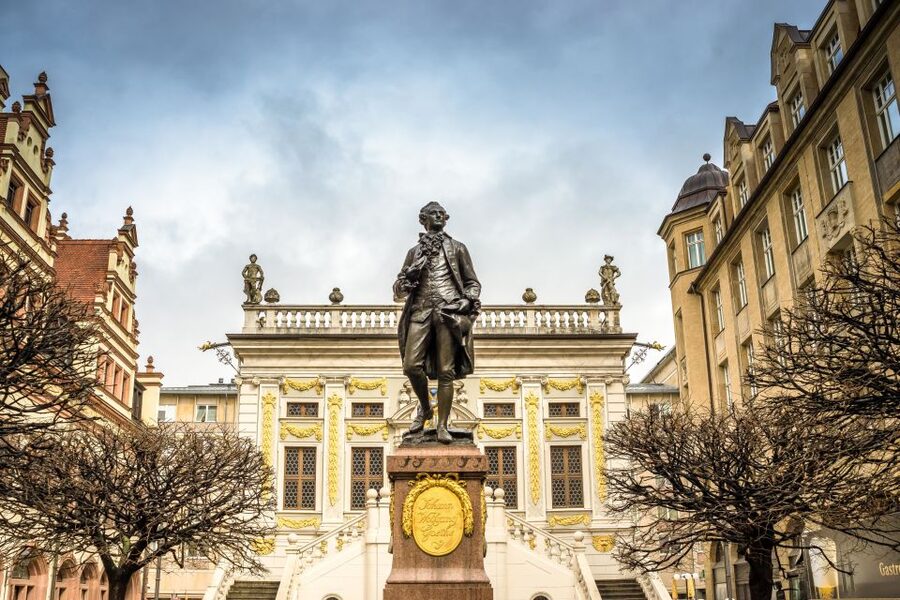
Naschmarkt Square brings you back into open space. Directly nearby is the Old Exchange, another reminder that Leipzig’s central streets were shaped by business as much as by religion or government.
I like this part because it avoids a single-note tour. You are not moving only from church to church or from grand facade to grand facade. Arcades, squares, shops, and historic civic buildings all appear in a short stretch. For you, that means a more useful picture of how the center functions today.
There is a small tradeoff. The route gives you an introduction rather than a detailed account of Leipzig’s commercial history. If you are especially interested in architecture, you may want to pause here after the tour and inspect the passages at your own speed.
Still Leipzig, at a slower pace:
- Leipzig: City History Canal Sightseeing Tour on a Motorboat
★ 4.7 · 6,232 reviews - Leipzig: 1.5-Hour Public Tour with Night Watchman Bremme
★ 4.6 · 3,116 reviews - Combo Tour in Leipzig: Guided City Tour & City Sightseeing
★ 4.7 · 2,317 reviews - Leipzig: 13-Stop Hop-on/Hop-off Bus Ticket
★ 4.6 · 1,468 reviews
Mädler arcade and Auerbachs Keller
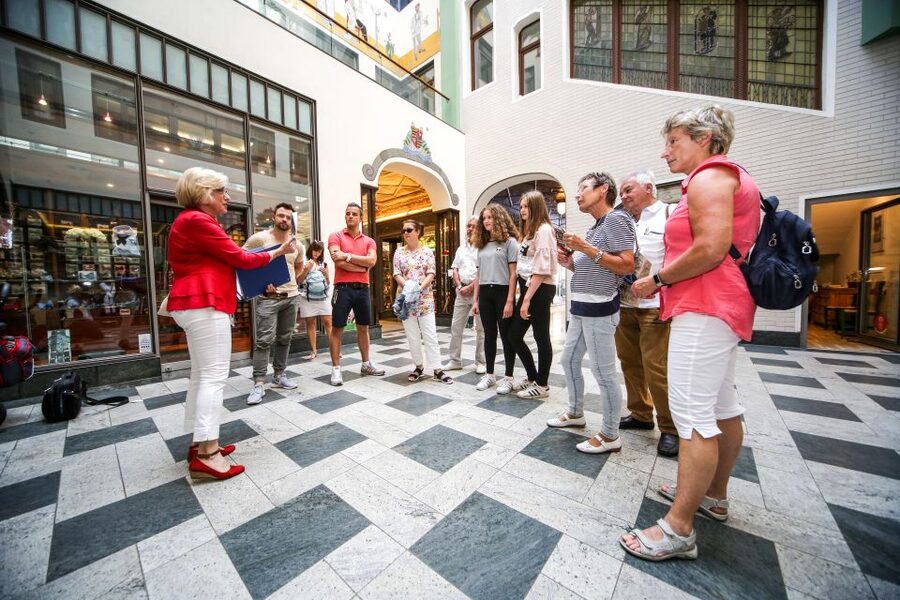
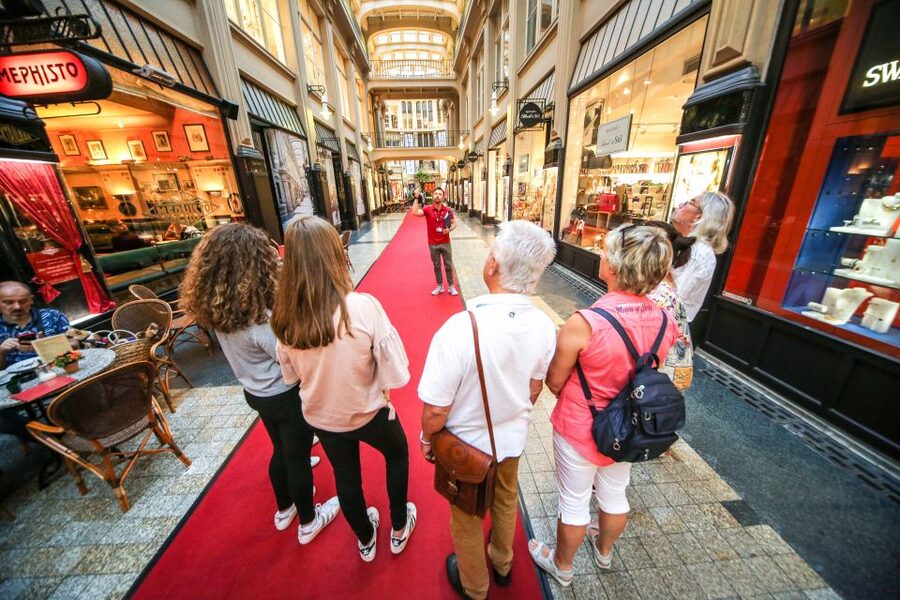
Opposite the Old Exchange is the Mädler arcade. A little farther along, you reach Auerbachs Keller, the historic restaurant.
These stops are among the most recognizable on the route because they show Leipzig’s social and literary side. Auerbachs Keller is not simply another old restaurant on a sightseeing list. It is one of the city’s best-known historic dining places and gives the walking tour a clear connection to Leipzig’s tradition of public meeting places.
You should think of this stop as an exterior orientation unless you arrange a separate meal or visit. The tour description does not include a restaurant meal or an interior admission. That is useful to know so you do not expect a seated break during the two-hour walk.
The Mädler arcade also gives you a good chance to see how Leipzig’s historic center mixes old commercial architecture with modern city use. I would pay attention to the transition between the arcade and the surrounding square. The charm here comes from the sequence, not just from one building.
The Old Town Hall at the Market Square
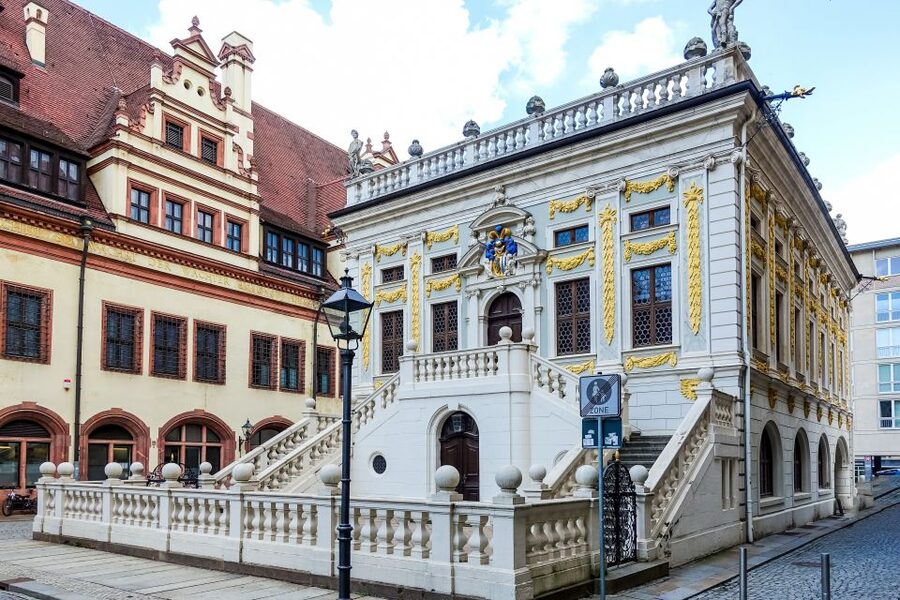
The route then reaches the Market Square and Leipzig’s Old Town Hall. This is one of the strongest architectural moments of the walk.
The Old Town Hall is described as one of Germany’s most beautiful Renaissance buildings. Even without an interior visit, the facade gives you a clear focal point for the square. The building’s proportions and civic role help explain why the Market Square remains one of the center’s defining spaces.
This is the kind of stop where a guide adds real value. You can admire the building on your own, but a short explanation can point out architectural details and place the town hall within Leipzig’s changing political and economic life.
The route also gives you a helpful contrast. Earlier, you saw music institutions and churches. Here, the focus shifts to municipal authority and the public business of the city. That movement makes the itinerary feel purposeful rather than random.
If you enjoy photography, the Market Square is likely to be one of your best chances for a clear, memorable city-center view. Give yourself time to look up. Leipzig’s details are easy to miss when you hurry from one named sight to the next.
Barthels Hof and the turn toward Barfußgässchen
After the Old Town Hall, the walk continues to Barthels Hof. This historic courtyard and tavern setting adds another piece to Leipzig’s urban story.
The tour then leads you toward Barfußgässchen, the city’s best-known street. Its character comes from restaurants and pubs, so this section feels more casual than the formal squares and civic buildings earlier in the route.
That change is welcome. A city tour should show you where people eat and meet, not just where important events happened. Barfußgässchen gives you a practical choice at the end of the walk: you can stay nearby for food or drinks, or use the street as a starting point for your own evening.
The lane is also a reminder that Leipzig’s center is meant to be experienced on foot. You move from broad public spaces into a more intimate street lined with places to stop. I would note a few restaurants that interest you, then return after the tour rather than trying to make a meal fit into the guided route.
St. Thomas Church and Leipzig’s musical identity
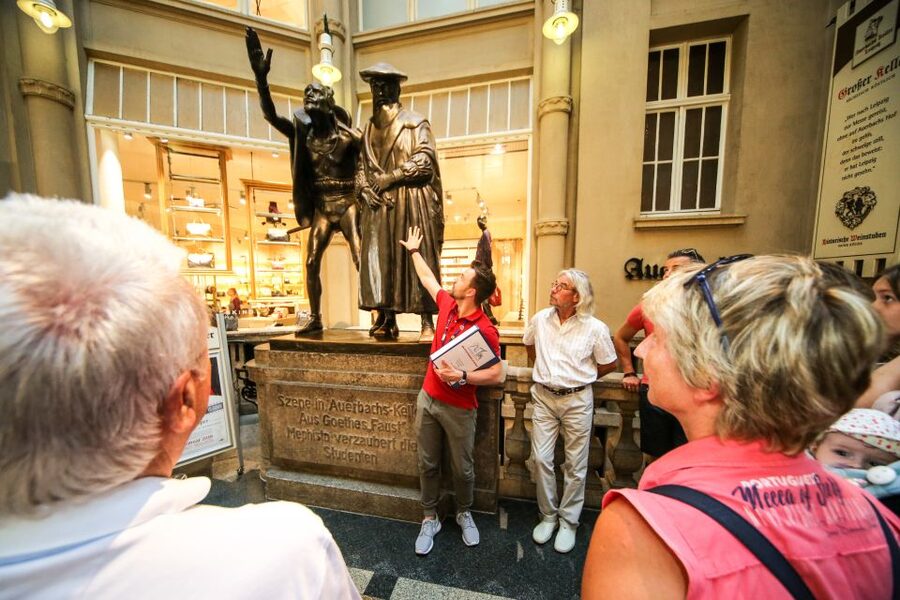
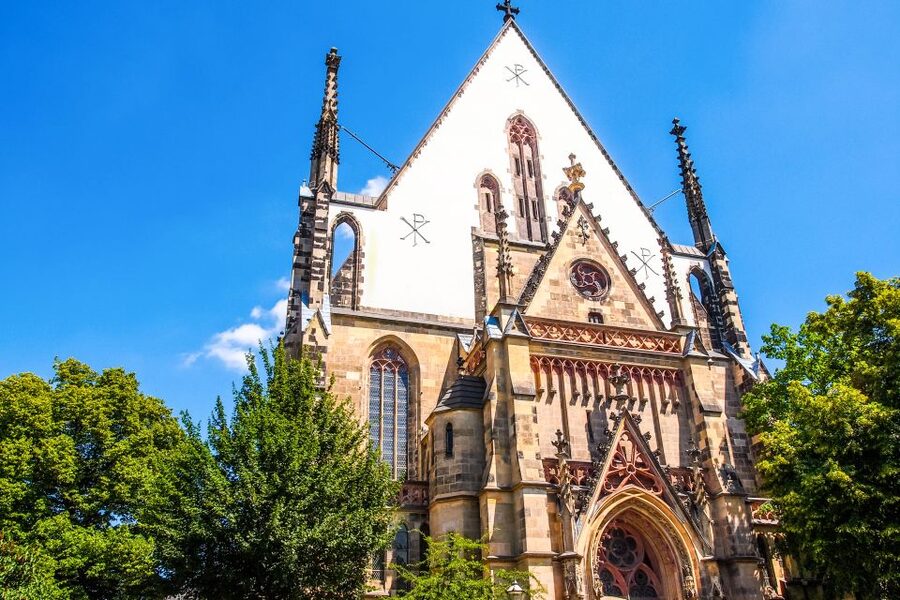
The final major highlight is St. Thomas Church, home to the globally renowned St. Thomas Choir of Leipzig.
This is a fitting end because it brings the musical thread back into focus. The Gewandhaus and opera house introduced Leipzig’s concert life at the start. St. Thomas Church closes the loop with its long-standing choir tradition and a different kind of musical setting.
The church is also one of the places where you may want more time than the tour allows. Interior visits are not included, so you should not count on a full look inside or a dedicated music program. Still, the exterior stop gives the guide a chance to explain why this church matters to Leipzig’s cultural life.
One particularly nice possibility came from a January tour, when the group heard a few concert sounds in the church. Treat that as a fortunate moment, not a promised feature. The tour does not include a concert, but the setting can sometimes offer an unexpected musical touch.
The guide makes the difference
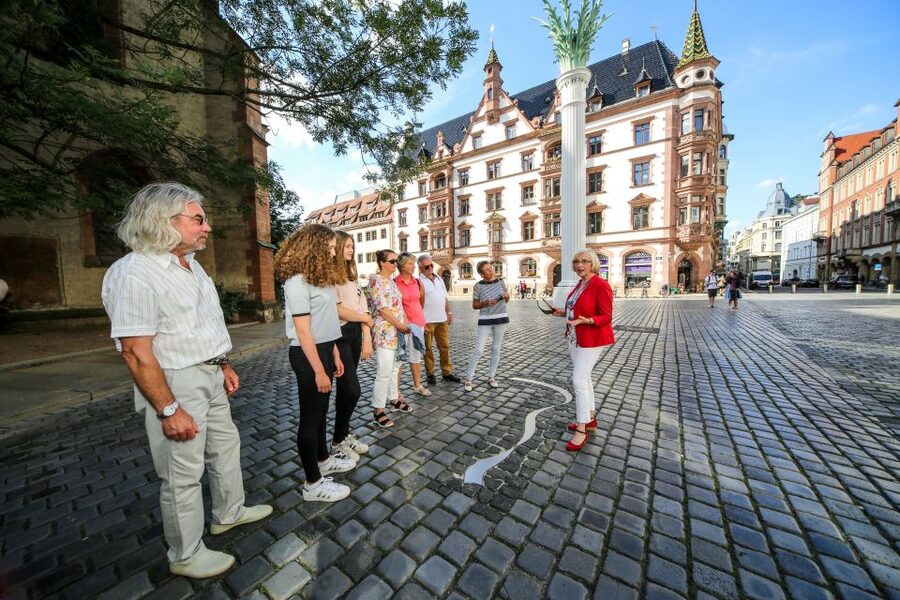
A route like this depends on the guide. The buildings are close together, but the story can feel flat if the explanations are rushed or generic.
The strongest feedback points to guides who combine information with an easy manner. One guide, Herr Hannemann, was praised for making the walk entertaining and engaging. Another guide was described as relaxed, humorous, and good at explaining architectural features, older and newer history, and Leipzig’s changing economic role.
That range is important. Leipzig is not only a city of old facades. Its story includes architecture, music, trade, political change, and economic shifts. A good guide can connect those subjects without turning the walk into a lecture.
You should also expect the experience to vary slightly with the individual guide and the group. The tour is in German, and humor is often part of the appeal. If you enjoy learning through conversation and a lively presentation, you are likely to appreciate this format more than a recorded audio guide.
Winter weather and practical comfort
Most of the walk takes place outdoors, with some time in arcades and urban passages. In January, one participant found the weather extremely cold. That is a simple but useful warning: Leipzig’s winter can make a two-hour walk feel much longer.
Wear warm layers and comfortable shoes. The route itself is not described as difficult, but you will be on your feet for the full tour. A cold day can distract from even the best architecture, so check the forecast and dress for standing outside.
The tour is listed as wheelchair accessible, but the information also says it is not suitable for wheelchair users. That is a direct contradiction. If you use a wheelchair, contact the provider before booking and ask for a clear answer about the exact route, surfaces, arcades, and access at each stop. Do not rely on the general accessibility label alone.
Free cancellation up to 24 hours before the start and the option to reserve now and pay later make the booking less rigid. Those policies are useful if your Leipzig plans are still moving, but the main decision should remain the German language and the outdoor walking format.
Who should book this Leipzig tour?
I would recommend it most strongly to first-time visitors who want a city-center orientation in German. It suits you if you want the main sights explained in a sensible order and prefer a live guide to exploring every building alone.
It is also a good fit for visitors with only a short stay. In two hours, you can see several of Leipzig’s key places and mark the ones you want to revisit. The central route leaves the rest of your day open for a museum, a concert, shopping, or a meal.
Music lovers should find the route especially useful because it includes the Gewandhaus, opera house, St. Thomas Church, and the St. Thomas Choir tradition. History-minded visitors will value Nikolai Church and the 1989 reunification story.
I would hesitate if you need an English-language tour, want extensive interior access, or dislike walking outdoors in poor weather. I would also avoid booking without clarification if wheelchair access is important to you.
Should you book it?
Book this tour if you want a reasonably priced, two-hour introduction to Leipzig’s central sights and you understand German comfortably. The route is well chosen, the guide can add real context, and the final stop near Barfußgässchen leaves you in a useful part of town for the evening.
Skip it if you are seeking a specialist music tour, a full church visit, or a tour with guaranteed English commentary. For everyone else, $18 is a sensible price for a focused first look at Leipzig, especially early in your visit when you still need to get your bearings.
FAQ
How long does the Leipzig walking tour last?
The tour lasts two hours.
What language is the tour conducted in?
The live tour is conducted in German, and the guide speaks German.
Where does the tour meet?
The meeting point is the Tourist-Information at Katharinenstr. 8 in Leipzig.
What sights are included on the route?
The route includes Augustus Square, the opera house, the Gewandhaus concert hall, Nikolai Church, Specks Hof, Naschmarkt Square, the Old Exchange, the Mädler arcade, Auerbachs Keller, the Old Town Hall, Barthels Hof, Barfußgässchen, and St. Thomas Church.
Are church interiors included?
No. Interior visits to the churches are not included.
Is the tour wheelchair accessible?
The information describes the activity as wheelchair accessible but also says it is not suitable for wheelchair users. You should contact the provider before booking to clarify the route and access conditions.
How much does the tour cost?
The listed price is $18 per person.
Can I cancel the booking?
You can cancel up to 24 hours in advance for a full refund. You can also reserve now and pay later.
Just added around Leipzig
- City tour on foot, by S-Bahn and tram★ 4.5 · 12 reviews
- Tour on Lake Cospuden★ 4.7 · 58 reviews
- Leipzig: True or false? Walking Tour and Interactive Game★ 4.8 · 28 reviews
- Leipzig: Segway tour to the Battle of the Nations Monument★ 5.0 · 4 reviews
- Leipzig Spirits Manufacture: Guided Tour and Tasting★ 4.8 · 79 reviews
- Leipzig: Scavenger Hunt Self-Guided Tour★ 4.7 · 11 reviews
- Leipzig: Segway City Tour – Discover Sights, Parks & History★ 5.0 · 7 reviews
- Leipzig: Private pub crawl with insider-guide & free shots★ 4.5 · 4 reviews
Walking Tours, compared.
Old Town & Viktualienmarkt City Walk in German
Read our review →Browse the lists this tour appears in