
Reviewed · THIRD REICH HISTORY TOURS
Third Reich & WWII Walking Tour
Munich’s past is impossible to ignore. This Third Reich walking tour connects the city’s Nazi-era sites with the political chaos that helped Hitler rise, and I like its clear route from Marienplatz to Königsplatz. I also value the guides’ thoughtful handling of painful material, especially the work of Josh, Michael, Alex, and Ulrich, who are praised for strong storytelling and careful answers.
The main drawback is physical: you will walk and stand for nearly three hours with only a short break. Bring water and a snack, dress for the weather, and be prepared for a serious subject rather than a light city stroll.
In This Review
- Key points at a glance
- Why Munich is the right place for this history
- Starting near Marienplatz
- Hofbräuhaus and the early Nazi movement
- Feldherrnhalle and the failed seizure of power
- Hofgarten and the courage of the White Rose
- Königsplatz and the power of public space
- What the guides do best
- A serious walk with a demanding pace
- Is $35.09 a fair price?
- Who should book this Munich history walk?
- Final verdict: book it for context, not sightseeing
- FAQ
- How long does the Third Reich and WWII Walking Tour last?
- Where does the tour start?
- Where does the tour end?
- Which Munich sites are included?
- Is the tour suitable for children?
- Can I cancel for a full refund?
Key points at a glance
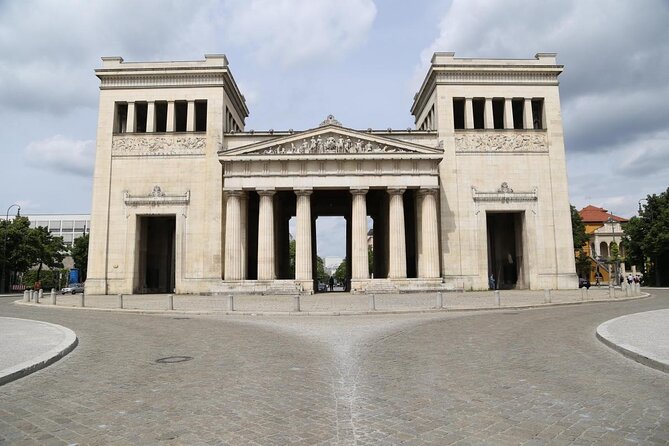
- Königsplatz gives the tour a powerful ending: The former Nazi rally ground now helps show how public space was used for propaganda and power.
- The route links major Munich sites: You visit or discuss Marienplatz, Hofbräuhaus, Feldherrnhalle, the Hofgarten, and Königsplatz.
- The White Rose adds an important counterpoint: The tour includes Munich’s student resistance movement, not only the Nazi rise.
- Guides receive exceptional praise: Josh, Michael, Alex, Ulrich, Danielle, Bridget, and others are described as clear, passionate, and considerate.
- The walk lasts about 2 hours 45 minutes: Expect steady movement, long periods on your feet, and little time to rest.
- The group size needs checking: The experience is promoted as a small group limited to 10, while the booking information also gives a maximum of 30.
Why Munich is the right place for this history
Munich is not simply a backdrop for this tour. It was the birthplace of the Nazi movement and later became known as the capital city of the party. The walk helps you see how ordinary streets, beer halls, squares, government buildings, and public monuments became tied to a brutal political project.
The story begins in 1919, after Germany’s defeat in World War I. Munich and Bavaria were struggling with revolution, political violence, assassination, and severe economic trouble. That instability created space for radical movements, and the tour follows how Hitler and the Nazi Party used fear, anger, nationalism, and mass politics to gain influence.
I like this approach because it does not treat the Third Reich as a sudden disaster that appeared from nowhere. You are shown the conditions that helped it grow, while still keeping responsibility firmly on the people and movements that chose violence, racism, dictatorship, and war.
This is also a useful tour for understanding Munich’s modern attitude toward the past. The guides place Nazi sites alongside resistance stories and present-day remembrance. That makes the walk more than a list of old addresses. You are asked to think about how a society remembers, explains, and learns from political crimes.
More Third Reich History Tours in Munich
- Munich: Third Reich & WWII Walking Tour
★ 4.6 · 6,181 reviews - Third Reich Walking Tour Munich
★ 4.5 · 4,291 reviews - Munich: Birthplace of the Third Reich Guided Walking Tour
★ 4.6 · 771 reviews
Starting near Marienplatz
The advertised meeting point is Marienplatz in central Munich, at 80331 München. This is a convenient area to reach by public transportation, but you should read the meeting instructions carefully after booking. The precise directions have caused confusion for some people, and the map pin has reportedly not always matched the location near the Munich tourist office.
I would arrive early and check the meeting details rather than relying only on the first map image. Marienplatz is a busy part of town, particularly during the Christmas market season, so finding a guide in a crowd can take extra time.
Starting in the center also gives the guide a chance to set the political scene before the group moves toward the main Nazi-era locations. The tour is not designed as a museum lecture. You hear the explanation outdoors, standing in the same urban setting where some of these events took place.
That setting can make the material easier to grasp, but it also means weather matters. People have taken the walk in freezing conditions and on cold afternoons. Guides have been praised for keeping the group engaged and, in one case, allowing people to warm up indoors for a short period. Still, you should plan for exposure to the weather.
Hofbräuhaus and the early Nazi movement
One of the most important points on the route is Hofbräuhaus, where the Nazi movement held its first mass meeting. The famous beer hall is now one of Munich’s best-known sights, which can make its political past easy to overlook.
The guide explains how the Nazi Party used public meetings to build support, spread its message, and create a sense of belonging around its ideology. Hearing this in a place associated with food, beer, and tourism creates an uncomfortable but useful contrast. The site is not presented as a relic to admire. Instead, you are shown how a familiar public venue became part of a political campaign.
I appreciate that the tour focuses on the mechanics of power. You learn about speeches and mass gatherings, but also about the emotions and social pressures that helped radical politics take hold. The story becomes easier to follow when you can connect large national events with a specific room and a specific city.
The route covers a lot of ground without turning every stop into a long academic talk. Guides such as Michael and Josh are praised for giving detailed answers while keeping the explanation easy to follow. Alex is especially praised for welcoming questions and discussion, which helps if you know little about German history or want to test your understanding as you go.
Feldherrnhalle and the failed seizure of power
The tour continues to Feldherrnhalle, the site of Hitler’s failed attempt to seize power in Munich. This event is essential to understanding how the Nazi movement changed after an early setback.
Your guide explains the confrontation and why the event mattered to Hitler’s later political strategy. The failed putsch did not end his career. Instead, the movement adjusted its methods and continued working toward power through political organization, propaganda, and legal institutions before destroying those institutions from within.
Feldherrnhalle is a good place to discuss how political myths are built. The Nazis later used the event to honor their dead and strengthen the movement’s sense of sacrifice. The physical location became part of the party’s visual language, helping turn a failed uprising into a story of heroism.
The guide’s explanation is valuable here because it puts the event in sequence. Without that context, Feldherrnhalle can look like another handsome monument in central Munich. With the story, it becomes a place where the movement’s early ambitions, failures, and later propaganda all meet.
The walk may be difficult to hear at some stops, especially in noisy parts of the city. One person found the guide hard to hear despite the strong content. If you have hearing difficulties, stay close to the guide and position yourself where you can see the speaker clearly.
More Walking Tours in Munich
- Munich: Old Town & Viktualienmarkt City Walk in German
★ 4.7 · 2,304 reviews - Munich: Night Watchman Walking Tour
★ 4.7 · 2,092 reviews - Munich Ghosts and Spirits Evening Walking Tour
★ 5.0 · 1,900 reviews - Munich Old Town Walking Tour
★ 4.5 · 1,287 reviews
Hofgarten and the courage of the White Rose
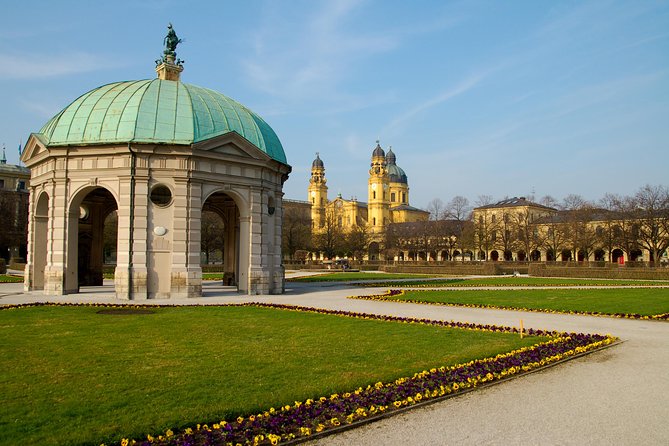
The Hofgarten stop shifts the focus from Nazi power to opposition. Here, the tour discusses the White Rose, a student resistance movement that spoke against the Nazi regime.
This is one of the most important parts of the route because it prevents the story from becoming a simple account of Nazi leaders and party machinery. The White Rose reminds you that some Germans did resist, even when doing so carried enormous personal danger.
The guide treats this material with restraint. Several guides are praised for allowing quiet moments after tragic events and for giving the group room to reflect before opening discussion. That tone matters. The subject calls for facts, but it also calls for respect.
I find this section particularly useful for anyone who already knows the broad outline of World War II but wants a more local connection. The White Rose story shows what resistance looked like in Munich and gives a human scale to the larger political history.
It also provides a necessary moral balance. The tour does not suggest that resistance was widespread enough to excuse the wider society. Instead, it shows both the courage of those who opposed the regime and the danger of speaking out in a dictatorship.
Königsplatz and the power of public space
Königsplatz is the major destination and the advertised end of the walk. It was used for mass Nazi party rallies, and the open space helps you understand how architecture and crowd control were used to create political theater.
The guide explains how the Nazis turned a civic square into a stage for ceremony, discipline, symbols, and mass loyalty. You can stand in the same broad area and consider how scale affects a crowd. The setting was meant to make individuals feel part of something much larger and more powerful than themselves.
Today, the square is also a reminder that public places can carry several layers of meaning. Its present appearance does not erase the events associated with it. The guide helps you read the site without treating it as a shrine to the regime.
The tour ends at Königsplatz 1, near Hitler’s former headquarters. The final location gives the walk a clear endpoint, though it may not be the most convenient place if you want to return to Marienplatz immediately. You should be ready to arrange your own way back after the tour.
The location also puts you near the Documentation Center for the History of National Socialism. One guide, Ulrich, suggested entering the museum after the walk, and that is a practical idea if you have time. The tour itself is not a substitute for a full museum visit, but the two experiences can work well together.
What the guides do best
The guide is the heart of this experience. The strongest praise goes to guides who combine factual command with a calm, human delivery.
Josh is repeatedly praised for clear explanations, passion, historical storytelling, and an ability to make a dark subject engaging without making it entertaining in the wrong way. He also used historical photographs and visual material during some tours, helping you compare Munich’s past with the city you see today.
Michael is described as informative, interactive, and easy to follow. He is also praised for answering questions in detail beyond the main route. Alex receives similar praise for his personable manner, careful treatment of tragic events, and helpful suggestions for museums and places to visit after the tour.
Ulrich is noted for answering questions, checking that the group was following, and suggesting the Documentation Center at the end. Danielle kept explaining through freezing weather, while Bridget added practical advice about places to eat, explore, and relax.
The exact guide depends on your departure date, so you should not book solely on the hope of getting one particular person. Still, the range of strong names suggests that the tour’s quality is not tied to a single guide.
A serious walk with a demanding pace
The duration is listed as approximately 2 hours 45 minutes. That sounds manageable, but the reviews make clear that much of the time is spent walking or standing. One assessment described only a short sit-down break during a longer outing, and another advised bringing a drink and snack because there is little time to stop.
I would wear comfortable shoes and avoid scheduling a demanding activity immediately afterward. The route is in central Munich, but the subject matter requires concentration, and the guide moves between several locations. You want enough energy to listen, not just keep up.
The experience is not recommended for children under 12. That age guidance makes sense because the tour covers dictatorship, persecution, war, resistance, and mass death. Older children and teenagers may find it meaningful, but parents should judge their child’s readiness for difficult material.
Most people can participate, and service animals are allowed. Food, drinks, and hotel pickup are not included. Public transportation is nearby, so you can reach the start without private transport, but you are responsible for getting to Marienplatz and leaving Königsplatz afterward.
Is $35.09 a fair price?
At $35.09 per person, I consider this a fair price for a nearly three-hour guided walk, especially if your guide is as strong as Josh, Michael, Alex, or Ulrich. You are paying for interpretation, not admission to a major museum or a special vehicle. The value comes from learning how the sites connect.
A self-guided walk would cost less, but it would also leave you to assemble the chronology, identify the relevant locations, and judge the meaning of each place. A guide can explain why Hofbräuhaus, Feldherrnhalle, Hofgarten, and Königsplatz belong in one story.
The price is strongest for you if you have a real interest in modern German history or want to understand Munich beyond its palaces, churches, and beer halls. It is less compelling if you only want a quick look at famous buildings or prefer to learn indoors at your own pace.
The tour is advertised as a small group limited to 10 people, which should make questions and conversation easier. The additional booking information gives a maximum of 30 participants, so I would confirm the expected group size before booking if that detail matters to you.
Who should book this Munich history walk?
I would recommend it to first-time visitors who want a clear introduction to Munich’s Nazi past. The route gives beginners enough background to follow the story, while people with stronger knowledge can use the stops to place familiar events in the city itself.
It also suits anyone interested in how political movements gain power. The focus is not only on wartime destruction. You learn about postwar instability, public meetings, propaganda, failed rebellion, resistance, and the use of urban space.
I would be more cautious about booking it for young children, anyone who dislikes long periods outdoors, or anyone with limited ability to walk and stand. The tour has a steady pace and only a limited chance to rest.
You should also choose your timing with care. Cold weather can make the walk tiring, and crowded periods such as the Christmas market season require the guide to maneuver through busy streets. Guides appear to handle this well, but the conditions can still affect your comfort.
Final verdict: book it for context, not sightseeing
I would book this tour if you want Munich’s Nazi history explained in a connected, respectful way. Its best features are the route between major sites, the inclusion of the White Rose, and guides who handle difficult facts without softening them or turning them into spectacle.
The drawbacks are real: nearly three hours on foot, limited rest, possible hearing problems in noisy areas, and some uncertainty about the final group size and meeting point. None cancels out the value, but each matters when you plan.
Bring water, a small snack, sturdy shoes, and weather-appropriate clothing. If you can add the Documentation Center after the tour, you will have a stronger follow-up to the outdoor history. At $35.09, this is a worthwhile choice for a serious, well-paced introduction to the Munich origins of the Third Reich.
FAQ
How long does the Third Reich and WWII Walking Tour last?
The tour lasts approximately 2 hours and 45 minutes.
Where does the tour start?
It starts at Marienplatz, 80331 München, Germany. Check the detailed meeting instructions after booking because the map pin may not always show the precise meeting spot.
Where does the tour end?
The walk ends at Königsplatz 1, 80333 München, near Hitler’s former headquarters.
Which Munich sites are included?
The route covers or discusses Marienplatz, Hofbräuhaus, Feldherrnhalle, Hofgarten, and Königsplatz. The tour also includes the White Rose resistance movement.
Is the tour suitable for children?
The tour is not recommended for children under 12 because it covers serious subjects connected with Nazism, World War II, resistance, and tragedy.
Can I cancel for a full refund?
Yes. You can cancel at least 24 hours before the experience starts for a full refund. Cancellations or changes made less than 24 hours before the start time are not accepted for a refund.
Just added around Munich
- Pub crawl incl. Oktoberfest museum guided tour with beer tasting (private)★ 5.0 · 5 reviews
- South Tyrolean specialties and wine tasting★ 5.0 · 5 reviews
- Size Matters Beer Tour Munich★ 4.6 · 105 reviews
- Short & sweet: Tasting the Viktualienmarkt★ 4.8 · 37 reviews
- Secret Food Tours Munich★ 4.8 · 5 reviews
- Munich: Romantic Wine Experience for Two at Viktualienmarkt★ 4.2 · 14 reviews
- Residence of Munich private tour with skip the line ticket★ 5.0 · 4 reviews
- Munich: Resistance against Hitler – Historical Walking Tour★ 5.0 · 5 reviews