Reviewed · PRIVATE
Private Taxi Tour of Berlin East and West and Neighbourhood approx. 4-6h
Berlin’s story is best read in layers. This private taxi tour connects the old imperial center, Cold War borders, rebuilt squares, and lively neighborhoods in about four to six hours. Guide Gunter Bauer brings years of Berlin experience, and his smooth driving lets you cover far more ground than a walking tour.
I like the personal pickup within Berlin’s S-Bahn ring and the chance to shape the day around your interests. I also like the mix of famous sights and lesser-known details, from escape attempts at Friedrichstrasse Station to the history behind Berlin’s waterways. The main consideration is pace: you see many places from the car, but only selected stops allow time to walk around.
In This Review
- Key points to know before booking
- Why a private taxi works well in Berlin
- Brandenburg Gate and the reunited center
- Government buildings along the Spree
- Potsdamer Platz and modern Berlin
- Unter den Linden and the old royal center
- Gendarmenmarkt, Jewish Berlin, and museum country
- Hackesche Höfe, Humboldt Forum, and old Berlin
- Tiergarten, Victory Column, and West Berlin
- Wall history from Checkpoint Charlie to the East Side Gallery
- What the four to six hours feel like
- Who should book this Berlin taxi tour?
- FAQ
- How long does the private Berlin taxi tour last?
- Where is pickup included?
- Is this a private tour?
- Is the tour offered in English?
- Are child seats available?
- Can the itinerary change?
Key points to know before booking
- A private car covers both sides of Berlin: You travel with only your own group, moving efficiently between former East and West Berlin.
- Gunter Bauer is the heart of the experience: He is praised for his city knowledge, punctuality, humor, smooth driving, and personal attention.
- The tour can include roughly 60 sights: The route covers famous landmarks, government buildings, museums, Wall remains, embassies, and residential districts.
- Several stops are made for photos and short walks: Brandenburg Gate, the Topography of Terror, Hackesche Höfe, Humboldt Forum, Checkpoint Charlie, and the East Side Gallery are among the key possibilities.
- It works well for limited mobility: You can stay in the air-conditioned vehicle much of the time, with parking arranged close to many sights.
- The vehicle may feel tight for four people: One person specifically found the car too small for a group of four, so ask about vehicle size before booking if comfort matters greatly.
Why a private taxi works well in Berlin
Berlin is spread out. The Brandenburg Gate, Museum Island, East Side Gallery, Charlottenburg area, Kulturforum, and Kreuzberg are not all next door to one another. Public transportation is excellent, but changing trains and walking between stations can eat up a large part of a short visit.
A private taxi solves that problem. You can look out the window as Berlin changes from grand imperial avenues to socialist apartment blocks, from Wall sites to renovated courtyards and modern glass towers. The car is not just transport. It becomes a moving classroom.
Gunter’s strongest skill is connecting what you see with why it matters. A building may have been a palace, a Nazi office, an East German ministry, or a modern government department. That layered story is the real value of this tour.
The format also suits people who cannot walk or stand for long periods. You still get out at important places, but you are not required to cross the city on foot in winter rain or summer heat. Child seats are available for toddlers from six months to three years, with booster seats for older children. A Maxi-Cosi baby seat can be requested.
A few more Berlin trips worth comparing
- Berlin: Reichstag, Dome and Government District Guided Tour
★ 4.7 · 18,288 reviews - Berlin: 1-Hour City Tour by Boat with Guaranteed Seating
★ 4.3 · 16,993 reviews - Berlin: Boat Tour Along the River Spree
★ 4.4 · 11,252 reviews
Brandenburg Gate and the reunited center
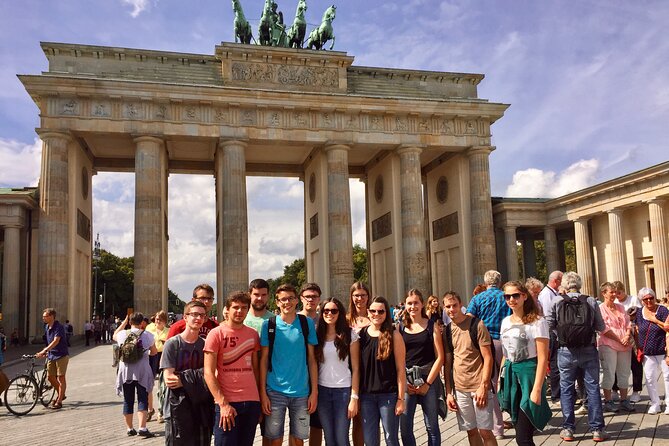
The tour commonly begins around the Brandenburg Gate, Berlin’s most recognizable symbol. It sits at Pariser Platz, a formal square that once felt strangely empty because war, demolition, and the Berlin Wall left the gate almost alone.
Today the square has been rebuilt in a careful modern style. The Liebermann House, Academy of the Arts, French Embassy, and American Embassy again frame the approach. The nearby Hotel Adlon adds a dose of old-world glamour, though the present building is a reconstruction rather than the original hotel.
You usually have a short walk here for photographs and a closer look. This is one of the places where the taxi format pays off. You get the broad city story from Gunter, then time to see the gate without worrying about finding your way to the next stop.
The Reichstag is close by. Its Wilhelminian exterior carries a complicated past. Soviet soldiers raised a flag there in 1945 as a symbol of victory, though the famous image was later recreated for photography. During the Cold War, the building sat only a few meters from the Wall on the West Berlin side and was not used for regular Bundestag sessions.
After reunification, the Reichstag was gutted and redesigned for the German parliament. Christo’s temporary wrapping project made it an international art event, while the glass dome now represents a more open Germany. If access to the dome matters to you, ask about arrangements in advance. The general taxi tour does not promise entry to every building.
Government buildings along the Spree
From the Reichstag area, the route passes the modern parliamentary buildings along the river. One large structure is often described as the engine of parliament because committee work takes place there. Its curved forms and glass walls reflect the idea of a parliament that can be seen by the public.
The Federal Chancellery is another memorable sight. Its size is almost comical, with ten floors, about 500 offices, and room for more than 300 employees. The official apartment above the rotunda is rarely used, a reminder that grand government spaces are not always practical homes.
You also pass the modern press and government buildings, including a structure with a huge central window where accredited journalists attend regular briefings. These stops are not museum visits. They are best understood as part of Gunter’s explanation of how the reunited German government functions.
Potsdamer Platz and modern Berlin
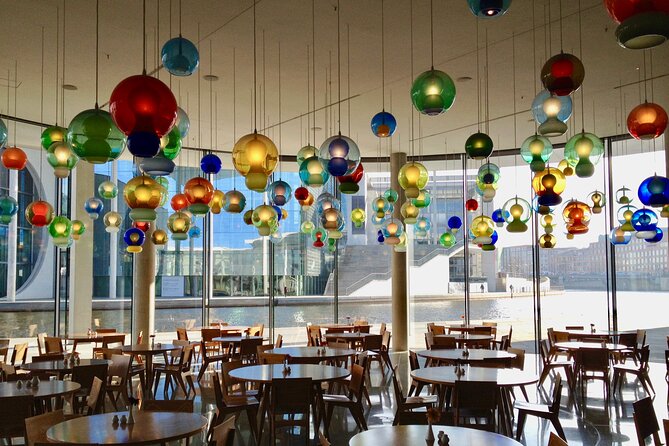
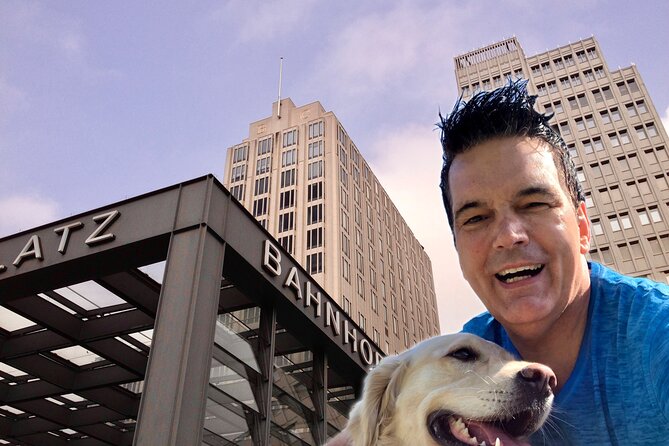
Potsdamer Platz once handled an extraordinary amount of traffic and nightlife. In the 1920s, about 100,000 vehicles passed through daily, while entertainment venues drew crowds after dark. War and the Wall erased much of that urban energy.
After reunification, major companies helped rebuild the district. The Sony Center, Mercedes complex, Deutsche Bahn tower, hotels, restaurants, and entertainment venues filled the former no-man’s-land with modern architecture. The result is impressive, though it can feel planned rather than naturally grown.
The Sony Center is worth a close look. Helmut Jahn’s glass and steel complex is covered by a dramatic roof that appears to float above the buildings. During construction, planners had to preserve part of the old Hotel Esplanade. Rather than destroy it, engineers moved a section about 75 meters and incorporated it into the new development.
This is a good example of Berlin’s habit of building forward while keeping pieces of the past. It is also a place where your expectations matter. If you want street life and old cafés, Potsdamer Platz may feel too polished. If you enjoy modern design and the story of urban reconstruction, it earns its place on the route.
Still Berlin, at a slower pace:
- Discover Berlin Half-Day Walking Tour
★ 5.0 · 9,624 reviews - Berlin: Hop-on Hop-off Bus Tour with Live Commentary
★ 4.3 · 8,579 reviews - Berlin: Government District around the Reichstag Guided Tour
★ 4.7 · 8,447 reviews - Berlin: Reichstag, Plenary Chamber, Cupola & Government Tour
★ 4.6 · 8,422 reviews
Unter den Linden and the old royal center
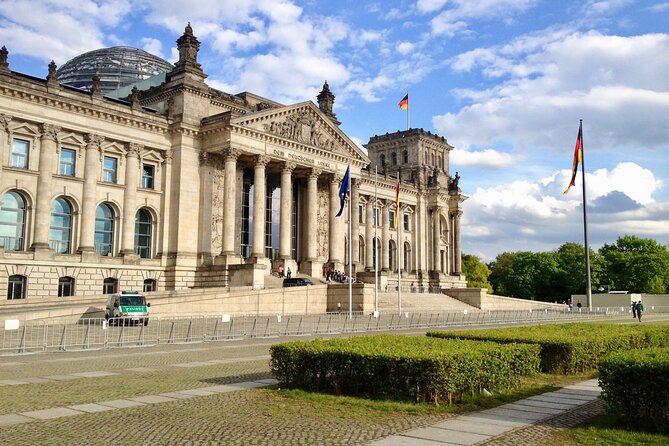
Unter den Linden is Berlin’s grand ceremonial boulevard. It began as a riding path from the Berlin Palace toward the royal hunting grounds. Linden trees eventually won the planting debate, saving Berlin from the less elegant name Unter den Nüssen.
The avenue passes the State Library, Humboldt University, State Opera, and other major buildings. At the Forum Fridericianum, the Royal Court Library, St. Hedwig Cathedral, opera house, and university form a handsome public square.
A small glass panel set into the pavement marks the site of the Nazi book burning on May 10, 1933. It reveals an empty library below ground. The memorial is easy to miss, which is precisely why a guide is useful here.
The Neue Wache, or New Guardhouse, once drew crowds for its East German goose-step ceremony. Today it is a memorial to victims of war and tyranny, centered on Käthe Kollwitz’s enlarged sculpture of a grieving mother. The building is small, quiet, and powerful.
Nearby, the former Soviet Embassy occupies an enormous palace-like complex. Built after World War II, its scale was meant to show Soviet power in the center of Berlin. It remains connected with the successor states of the former Soviet Union.
Gendarmenmarkt, Jewish Berlin, and museum country
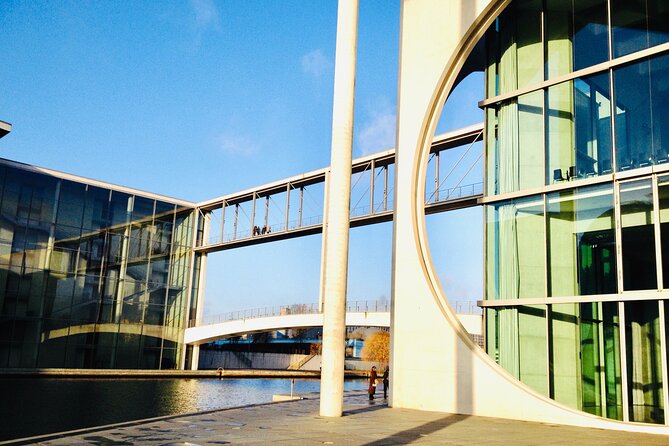
Gendarmenmarkt is one of Berlin’s most elegant squares. The German Cathedral and French Cathedral flank the concert hall, which was originally built as a theater. Despite their names, the two domed churches are not cathedrals in the usual sense.
The French Cathedral still serves a French Reformed congregation. The German Cathedral houses an exhibition on Germany’s parliamentary history. The square was rebuilt during the East German period, another example of Berlin restoring old forms after wartime destruction.
The New Synagogue is easy to recognize by its Moorish details and golden dome. It once held up to 3,000 worshippers and was inaugurated in 1866, when Prussia had granted Jews equal civil rights. The building was badly damaged during the war, and its remaining front section now houses an exhibition on Jewish life in Berlin.
Security is strict. Expect airport-style checks before entering. The tour may only pause outside, but Gunter’s account gives the building a place in the city’s social and political story.
The German Historical Museum occupies the former armory. Its exterior decoration includes replicas of death masks of dying warriors, a grim reminder of the building’s original military purpose. The museum’s history also reflects the divided city, since plans for a national German history museum once existed in the area where the Chancellery now sits.
Hackesche Höfe, Humboldt Forum, and old Berlin
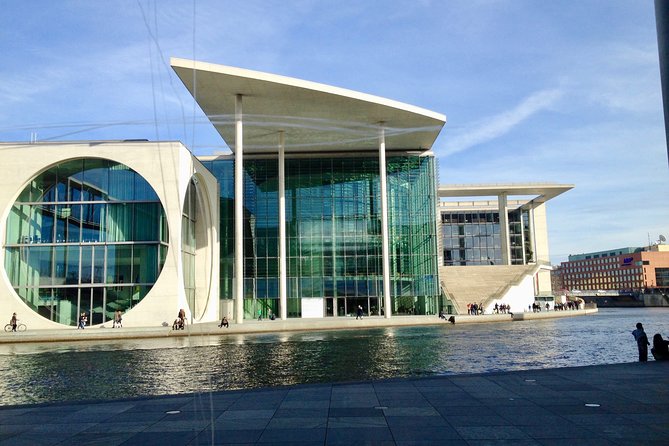
Hackesche Höfe offers a welcome change from monumental government buildings. Built in 1908, the interconnected courtyards mixed workshops, small factories, printing businesses, and homes. The spaces were designed to let people work and live in the same complex.
After years of neglect, they were restored with Art Nouveau details. Today, shops replace most workshops, including outlets for handmade goods, Royal Porcelain Manufactory displays, and Berlin’s famous Ampelmännchen traffic-light figure.
You get a short walk here, usually enough to admire the courtyards and take photographs. If you want to shop, eat, or inspect every passage, you will need more time than the standard stop allows.
The Humboldt Forum occupies the site of the former Berlin Palace. The palace was damaged in the war and later demolished by East German authorities, despite objections. The new complex recreates the historic exterior and part of the Schlüter courtyard while using a modern interior for non-European collections and Humboldt University holdings.
The roof terrace is a major attraction, offering broad city views. One tour guest particularly valued the palace viewpoint, and Gunter has sometimes arranged tickets in advance. Confirm this before the tour if the view is a priority, since entry and opening times can affect the schedule.
Nikolaiviertel offers another version of old Berlin. Most of what you see here was reconstructed during the 1980s, when only a few original houses and parts of Nikolaikirche remained. The goal was to recreate a compact historic quarter with around 2,000 apartments.
The Knoblauchhaus is original and furnished in Biedermeier style. Restaurants line the streets, and the Nikolaikirche now serves as a city museum. It is a pleasant place for a short walk, though you should understand that much of the quarter is a carefully made reconstruction.
Tiergarten, Victory Column, and West Berlin
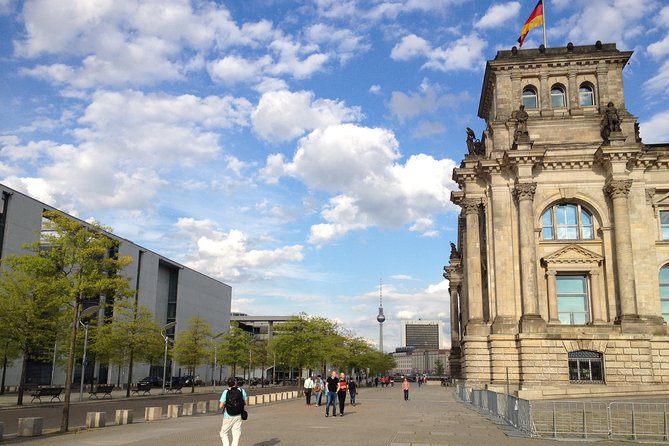
The Tiergarten began as a royal hunting ground. Later, Peter Lenné reshaped it into an English-style garden with paths, lakes, views, and the Landwehr Canal. World War II destroyed much of the vegetation, and potatoes were grown near the Reichstag before postwar replanting restored the park.
The Victory Column originally stood near the Reichstag and had only three sections, honoring victories over Denmark, Austria, and France. Hitler moved it to its present position and added another section after the 1930s victories. Its golden figure and broad traffic circle make it one of Berlin’s most familiar views.
The route also passes the Nordic embassies, housed in connected wooden buildings behind a green copper screen. There are five countries represented, including often-forgotten Iceland.
Charlottenburg Palace is usually too far for the standard route unless you choose it instead of other sights. The tour instead gives you a taste of West Berlin along the Kurfürstendamm and Tauentzienstrasse.
The Kaiser Wilhelm Memorial Church remains one of the city’s clearest war memorials. Its damaged tower was preserved beside a modern church and bell tower designed by Egon Eiermann. Inside, thousands of blue glass blocks create a calm, unusual light, while the double-wall construction keeps out much of the traffic noise.
Tauentzien leads toward KaDeWe, the famous department store. The upper food floor is a destination in itself, with luxury foods, bread, cheese, chocolate, oysters, and champagne. It is a good place to return after the tour if you want lunch or a snack with a view over Berlin.
Wall history from Checkpoint Charlie to the East Side Gallery
The tour’s strongest historical thread follows the former border between East and West. At the harbor, you hear about Günter Litfin, who was shot while trying to swim across after the Wall was built. One remaining watchtower near Invalidenfriedhof helps make this personal rather than abstract.
Berlin Central Station shows the opposite side of the city story. It is a vast interchange with underground and elevated tracks spread across five levels. It replaced the old terminal-station pattern and helped create a more connected Berlin after reunification.
Friedrichstrasse Station once allowed the only regular rail connection between East and West Berlin. Departures could mean permanent separation for East Berliners. The nearby Palace of Tears recreates the station’s barriers and Stasi observation areas, showing how ordinary farewells became scenes of fear.
Checkpoint Charlie is more famous than it is visually impressive today. The original checkpoint buildings are gone, and the current guardhouse is a replica. The site still matters because American and Soviet tanks faced each other here in October 1961, bringing the Cold War close to open conflict.
The Topography of Terror is more substantial. Excavated cellars mark the former offices of the Gestapo, SS, and other Nazi security agencies. An indoor and outdoor exhibition explains how persecution was organized, including the targeting of political opponents, Jewish people, Sinti and Roma, and gay men.
At Niederkirchnerstrasse, a perforated Wall remnant sits beside the documentation center. The short stop gives you a direct look at the concrete barrier, while the larger historical material requires extra time on foot.
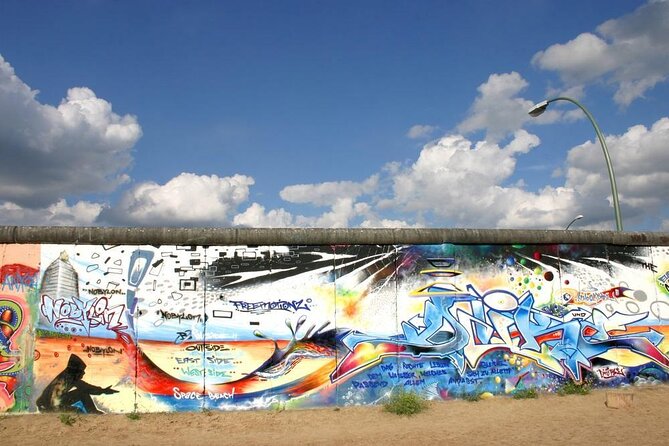
The East Side Gallery preserves about 1,600 meters of Wall. It is the longest surviving section, covered after reunification by works including the Trabant breaking through the Wall and the famous Honecker-Brezhnev kiss. The paintings have been restored more than once, so the gallery is both an art site and a repaired historical object.
Oberbaum Bridge follows naturally. Its medieval-looking towers mark a former city and customs boundary, while the bridge now links Friedrichshain and Kreuzberg. Trains run above road traffic, with boats passing below. It is one of the best places to see Berlin’s old divisions become a normal part of city life.
What the four to six hours feel like
This is an information-heavy outing. Gunter often speaks at length about history, architecture, politics, and Berlin’s personal stories. That is a major strength if you enjoy context, but it can be tiring if you prefer quiet sightseeing.
Traffic controls the timetable. Stops at the Wall, Checkpoint Charlie, East Side Gallery, Alexanderplatz, Oberbaum Bridge, and Friedrichstrasse Station may be shortened or skipped if earlier visits take too long. Extra time can be booked locally, but you should discuss your priorities before setting out.
The tour can be tailored, yet it helps to be direct. Send Gunter a short list of must-see locations and say clearly what you are willing to skip. Some people found that the standard route included more institutional buildings and universities than they wanted, while others appreciated seeing those parts of Berlin.
The car includes air conditioning, WiFi, parking fees, and private transportation. Pickup within the S-Bahn ring is included, roughly five kilometers around Brandenburg Gate. Airport pickup from BER and locations outside the ring cost extra.
At $179.82 per person, the value depends heavily on group size. For one or two people, it is a costly way to sightsee. For four people, the total may compare favorably with several private transfers and a guide, though the vehicle size should be confirmed. The best value comes when you have limited time, limited mobility, or a strong interest in hearing the story behind each place.
Free cancellation is available up to 24 hours before the start time. English is offered, and the service is private, so only your group participates.
Who should book this Berlin taxi tour?
Book it if you want a broad first look at Berlin, need to avoid long walks, or want a guide who can explain the city’s divided past while driving you between far-flung sites. It is especially useful on your first day, since the route helps you decide which museums, neighborhoods, and memorials deserve a longer return visit.
You may want a different format if you prefer spending an hour inside each museum, shopping at each neighborhood stop, or setting your own route minute by minute. The tour gives you breadth first, detail second.
For most people, the smartest plan is to reserve this early in your stay and use it as a city orientation. Tell Gunter your top three priorities, ask about the vehicle for your party, and confirm the Humboldt Forum roof terrace or any other timed entry before departure. If those details suit you, this is an efficient and unusually personal way to understand Berlin.
FAQ
How long does the private Berlin taxi tour last?
The tour lasts approximately four to six hours. Traffic, weather, and the amount of time spent at stops can affect the final length.
Where is pickup included?
Pickup is included within Berlin’s S-Bahn ring, approximately five kilometers around the Brandenburg Gate. Pickup from BER Airport or outside the S-Bahn ring costs extra.
Is this a private tour?
Yes. Only your own group participates in the tour.
Is the tour offered in English?
Yes. English is one of the languages offered.
Are child seats available?
A child seat is available for toddlers from six months to three years, and a booster seat is available for older children. A Maxi-Cosi baby seat can be brought on request.
Can the itinerary change?
Yes. Stops may be shortened or omitted because of traffic or limited time. You can also discuss personal interests with Gunter before the tour, and additional time may be booked locally.
Just added around Berlin
- Private Walking Tour in Berlin: Hitler’s Germany & WWII★ 5.0 · 7 reviews
- The History of Berlin: WWII PRIVATE Walking Tour With Locals★ 5.0 · 209 reviews
- Private Berlin WWII and Cold War History Tour with Local Expert Guide★ 5.0 · 28 reviews
- Private Walking Tour Berlin 3 hours: Brandenburg, Historic Center★ 5.0 · 7 reviews
- Berlin: Private Bike Tour of the Berlin Wall and Third Reich★ 5.0 · 23 reviews
- Berlin: Guided Private Bike Tour to Explore the Highlights★ 5.0 · 12 reviews
- Berlin Photography Masterclass – Private Photography Lesson★ 4.5 · 23 reviews
- Group Driving Tour 1 to 6 people. Berlin Shore Excursion incl pick-up at Port★ 5.0 · 8 reviews
Private, compared.
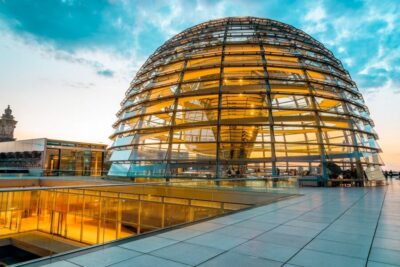

Berlin Private Complete History All Day Walking Tour
Read our review →
Munich Private Tour with a Local – Highlights & Hidden Gems
Read our review →
Your private 3-hour Hamburg driving tour with a former policeman
Read our review →
Strasbourg: Private City Sightseeing Boat Tour
Read our review →
1.5-Hour Private Tour through Historical Old Town
Read our review →
Berlin Private Half-Day Walking Tour: Discover the German Capital’s History
Read our review →