
Reviewed · WALKING TOURS
Schwerin: Private Guided Walking Tour
Schwerin rewards a closer look. This 90-minute private walk links the island palace, medieval cathedral, and largely intact old town into one clear story. I like the personal format, with one guide focused only on your group, and I like the chance to shape the route around your interests. The main drawback is simple: at $280 per group, it is good value for a larger party but costly for two people.
The meeting point needs care. The address is in front of Schwerin Castle, yet one group had trouble finding the intended entrance and waited at the museum doorway rather than by the courtyard entrance. Ask for a precise landmark before setting out, especially on a weekday.
In This Review
- Key points at a glance
- Why Schwerin works so well on foot
- Starting beside Schwerin Palace on Lake Schwerin
- Reading Schwerin’s medieval chapter
- Schwerin Cathedral and the medieval pilgrimage story
- From Protestant change to the Thirty Years’ War
- Napoleon, German Unification, and a changing Schwerin
- What the private format really adds
- Value at $280 for up to 15 people
- Timing, language, and the best match for this walk
- Should you book the Schwerin walking tour?
- FAQ
- Where does the Schwerin walking tour meet?
- How long does the private tour last?
- What languages are available?
- Is this a private group experience?
- Are entrance fees included?
- Can I cancel the booking for a refund?
Key points at a glance
- Schwerin Palace on an island: See the romantic castle often called the Neuschwanstein of the North and learn why it became the city’s defining sight.
- A private group of up to 15: You get a guide assigned to your party, rather than joining a large public walk.
- A city with 1,000 years of story: The route connects Schwerin’s origins in the 10th century with the Reformation, the Thirty Years’ War, Napoleon, and German Unification.
- Cathedral and pilgrimage history: Schwerin Cathedral once drew attention across Europe because it was reputed to hold a drop of Christ’s blood.
- Flexible guiding: Guides such as Jürgen and Theresa have earned especially warm praise, and the route can adjust to your interests.
- Castle admission costs extra: The walking tour includes the guide, but entrance fees are not included.
Why Schwerin works so well on foot
Schwerin is an easy city to place on a map, yet its story is far larger than its size suggests. It is Germany’s smallest state capital by land area and is surrounded by seven lakes. That setting gives the city a calm, watery character, while the old streets provide plenty of historical layers within a compact area.
The city has existed since at least 1018 and received city status in 1160. Those dates give your guide a useful framework, but the real value of this tour is how the facts connect. Instead of seeing a cathedral, palace, and old street as separate photo stops, you can understand how religious power, ducal ambition, war, and national politics shaped the same small place.
I would choose a walking tour here rather than a fast sightseeing loop. Schwerin’s appeal is in the relationship between its buildings. The palace sits dramatically on Lake Schwerin, the cathedral anchors the older town, and the streets between them retain much of their historic character. A guide can point out those links while you are still standing in the middle of them.
More Walking Tours in the Baltic Coast
- Rostock: City Walking Tour
★ 4.9 · 198 reviews - Lubeck Private Walking Tour With A Professional Guide
★ 4.5 · 10 reviews - Surprise Walk of Rostock with a Local
★ 5.0 · 7 reviews
Starting beside Schwerin Palace on Lake Schwerin
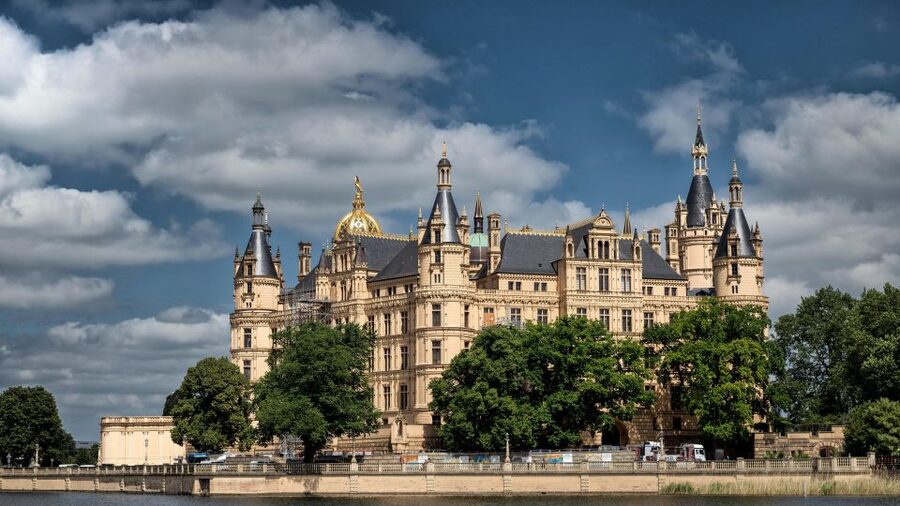
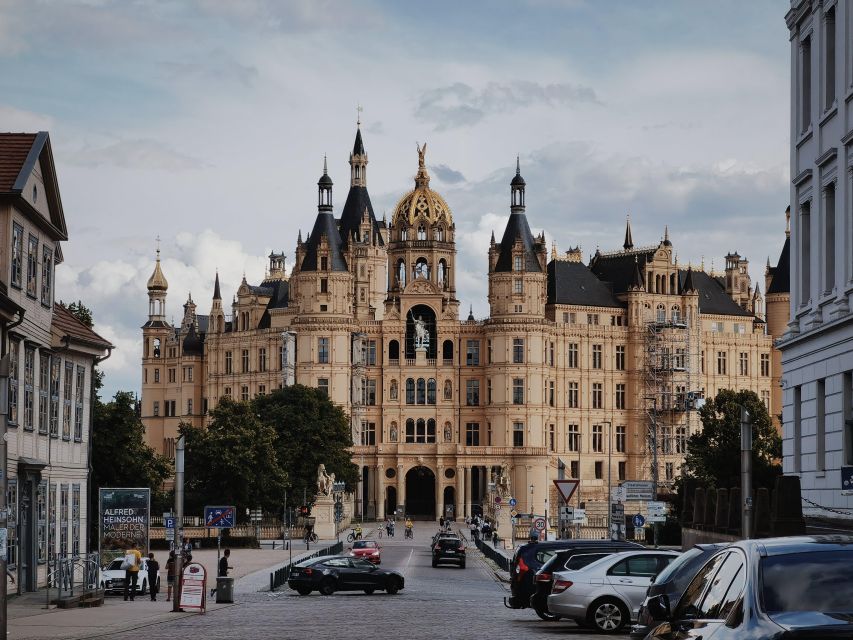
The tour begins at Schwerin Castle, at Lennéstraße 1, 19053 Schwerin. This is a strong starting point because the palace immediately gives you a sense of Schwerin’s scale and style. It is not tucked away on an ordinary city block. It occupies an island in Lake Schwerin, with water helping create the romantic setting that earned it the nickname Neuschwanstein of the North.
You should expect the palace to receive the most attention. Your guide can explain its place in Schwerin’s political story and help you read the building as more than a pretty castle. The island setting, the lake, and the approach all matter. They explain why this sight has become the city’s calling card.
The description says the tour includes a visit to the impressive Schwerin Castle, but entrance fees are not part of the price. That distinction matters. You should confirm with the guide whether your 90 minutes focus on the exterior, grounds, or an interior visit requiring a separate ticket. Do not assume the admission charge is covered.
The meeting details deserve a practical warning. The published point is in front of the castle, but one party followed signs toward the castle and waited at the entrance that also leads to the museum. The guide was eventually found at the courtyard entrance, which was not open during that weekday visit. To avoid losing the first part of a short tour, contact the provider or guide in advance and agree on the exact spot.
Reading Schwerin’s medieval chapter
From the palace area, the walk introduces Schwerin’s early medieval beginnings. The city’s roots reach back to the 10th century, with records placing its existence at least as early as 1018. By 1160, it was recognized as a city.
These dates are useful because they shift your attention away from the palace alone. Schwerin is not simply a 19th-century castle town. Its streets grew from a much older settlement, and the city’s religious center became especially important during the Middle Ages.
A private guide has room to explain the timeline in plain language and answer questions as they arise. That can be more useful than a fixed public script, especially if you already know something about northern German history. One group with local knowledge still found the tour informative and came away seeing Schwerin differently.
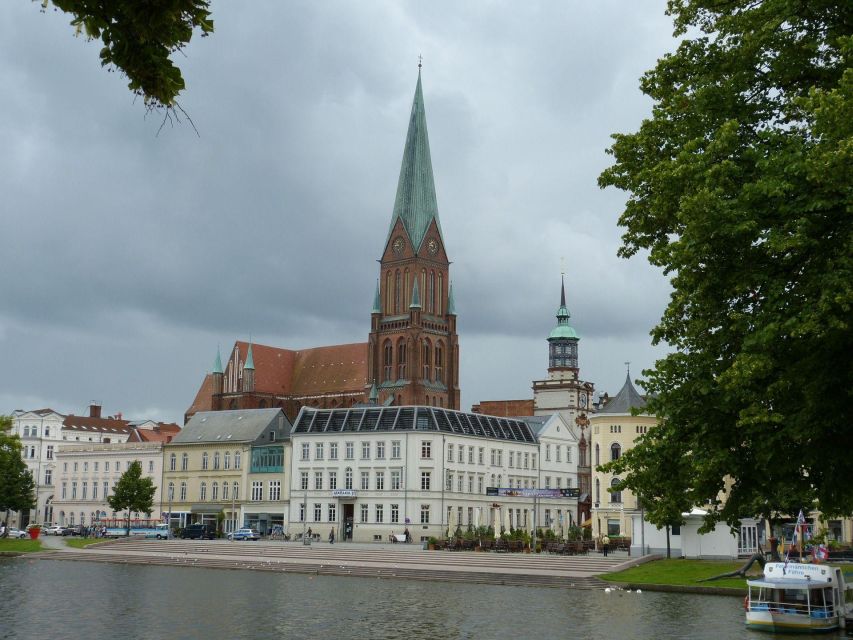
The old town also benefits from a slower pace. Schwerin suffered only minor damage during World War II, so much of its historic fabric remains. You can expect the guide to point out the character of the streets and explain how the city developed around its central institutions. The pleasure here is less about checking off famous buildings and more about seeing how the old town holds together.
Schwerin Cathedral and the medieval pilgrimage story
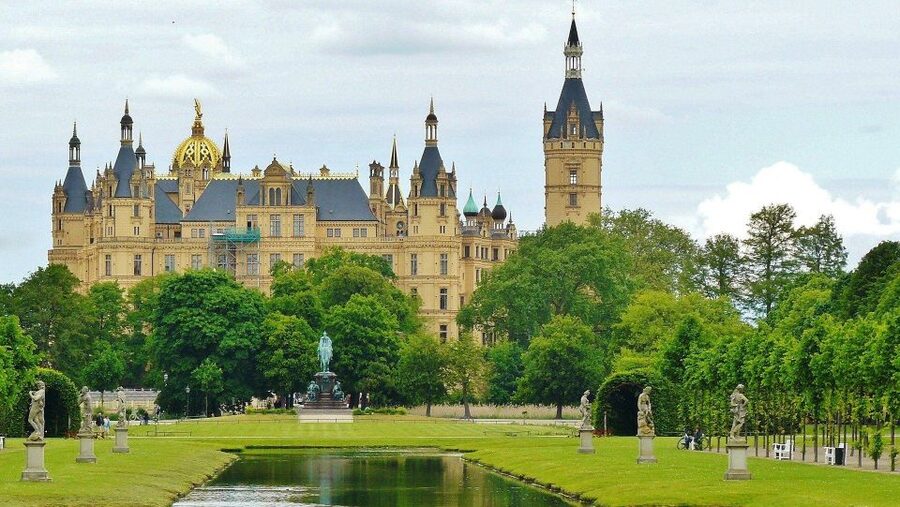
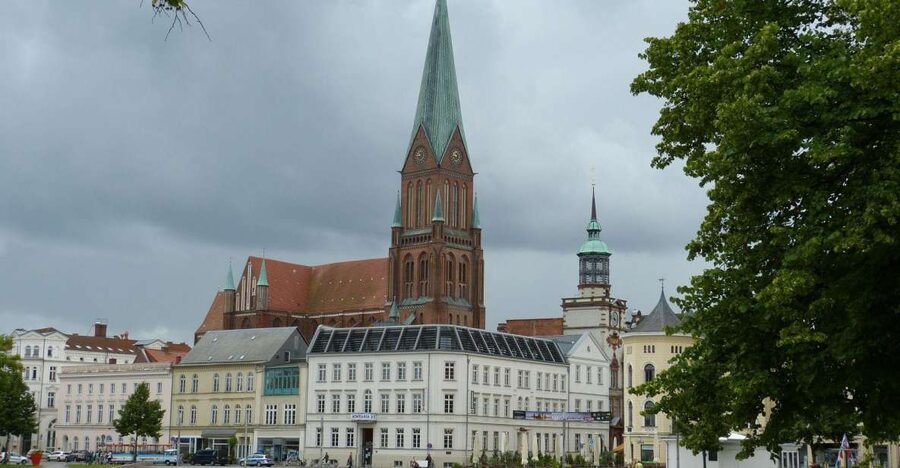
Schwerin Cathedral is the clearest religious landmark on the route. During the Middle Ages, it was known across Europe because it reputedly held a drop of Christ’s blood. That claim made the cathedral a destination for pilgrimage and gave Schwerin a place in a much wider religious network.
I find this part of the tour especially useful because it explains why a city of modest size could matter far beyond its immediate region. The cathedral was not only a house of worship. It was also tied to faith, reputation, movement, and money. Pilgrims brought attention and activity, and the cathedral helped make Schwerin a recognized medieval center.
The story also sets up the later changes brought by the Protestant Reformation. A good guide can show how the city’s religious life did not remain fixed. The shift from Catholic practice to Protestant influence changed the meaning and role of churches across northern Germany, and Schwerin was part of that wider transformation.
You should not expect a lengthy cathedral service or a separate religious program. This is a city walk, not a dedicated church tour. The value lies in the historical explanation and in understanding why the cathedral mattered so much to the town.
Still Baltic Coast, at a slower pace:
- Schwerin: City Highlights Guided Tour
★ 4.7 · 541 reviews - Schwerin: Tour with the Night Watchman
★ 4.5 · 366 reviews - Stralsund: 1-Hour Harbor Cruise
★ 4.6 · 365 reviews - Rostock: Guided tour of the historic city center
★ 4.5 · 311 reviews
From Protestant change to the Thirty Years’ War
The tour also covers the Protestant revolution and the Thirty Years’ War. These subjects can sound like a heavy block of school history, but they are important for understanding why Schwerin changed direction over time.
The Reformation challenged the old Catholic order and altered political relationships as well as worship. In a city where the cathedral had once drawn pilgrims, that was a major break with the past. The Thirty Years’ War then brought a broader period of upheaval across central Europe, affecting rulers, territories, religion, and ordinary life.
This is one place where a private format can help. You can ask your guide to slow down, explain unfamiliar names, or focus on the local effects rather than a long list of battles. If you have already planned a night watchman tour, you might ask for less overlap in general legends and more attention to subjects that will not be covered later.
That kind of adjustment has worked well for this experience. One group told the guide about an evening night watchman walk, and the guide deliberately focused on material outside that planned tour. The result was a more personal route, not simply a standard speech delivered at every stop.
Napoleon, German Unification, and a changing Schwerin
The final historical section reaches into the Napoleonic period and the Unification of Germany. These eras show Schwerin responding to forces much larger than the city itself.
Napoleon’s reshaping of Europe affected borders, governments, and alliances. German Unification later changed the political framework again. Your guide’s job is to connect those broad events with what you are seeing in Schwerin, so the city does not feel cut off from the rest of European history.
I would especially value this part if you are visiting several cities in northern Germany. Schwerin can otherwise seem like a beautiful stop with a palace and lake. The Napoleonic and unification stories give it a larger role and help you understand how local rulers and urban institutions fit into national change.
The tour has only 90 minutes, so do not expect a full political history of Germany. The strength is selection. A good guide chooses the details that explain the city, rather than trying to cover every ruler and conflict. The most praised guides, including Jürgen and Theresa, seem to make that information clear, relaxed, and easy to follow.
What the private format really adds
The party limit is up to 15 people, but the booking is private. That means your group is not mixed with strangers, and the guide can respond to your pace and questions. If you are a family, a group of friends, or a small association, this can make the walk feel more natural.
The flexibility is not just a marketing line. The guide can customize the tour on the spot. One group was able to visit an old house and even step into a butcher’s shop known for wild meat. Those details show what a flexible city walk can offer: not only major monuments, but also small local places that might otherwise pass unnoticed.
Of course, flexibility depends on time and on what is open. A 90-minute tour cannot include every side street, museum, and interior. If you want a detailed palace visit, a cathedral interior tour, or a long stop inside a shop, ask early so the guide can make sensible choices.
The private setup is most useful when your group has a clear interest. You might request more medieval history, more architecture, less military history, or fewer repeated facts if you have another Schwerin tour planned. The guide can then spend the limited time where it helps you most.
Value at $280 for up to 15 people
At $280 per group, this is not a bargain for a couple. Two people pay $140 each before any entrance fees, which is a serious price for a 90-minute walk. For a group of 10, however, the cost drops to $28 per person. At the full limit of 15, it works out to about $19 per person.
That makes group size the key value question. A family reunion, private tour group, or party arriving by cruise or rail may find the price reasonable, particularly if everyone wants the same pace and language. A couple may prefer a standard public walk or a shorter self-guided visit unless the private attention is important.
You are paying for more than the number of minutes. The guide is reserved for your group, the language options are English and German, and the route can adjust to your interests. The strongest evidence of value is the quality of the guiding. Jürgen is praised for presenting important material in a relaxed, understandable way, while Theresa receives direct praise for her friendly work.
Still, keep the extra cost in mind. Castle or other site admission is excluded, and the exact interior access should be confirmed. If your budget is tight, use the walk for orientation and exterior history, then decide on paid entries afterward.
Timing, language, and the best match for this walk
The activity lasts 90 minutes, with starting times based on availability. That length suits a first look at Schwerin. You can learn the basic story, see the main sights, and still have time afterward for your own palace visit, museum stop, meal, or second walk.
I would book it early in your Schwerin day if possible. The guide can help you understand the city before you explore alone, and you can use the rest of the day to return to anything that caught your attention. If you already have an evening night watchman tour, tell the guide so the historical focus can be adjusted.
English and German are available. The private arrangement is useful if your group wants one language throughout, although the available language must match the guide assigned to your booking.
This tour suits you best if you:
- Want a clear introduction to Schwerin rather than a quick photo stop
- Care about medieval, religious, and political history
- Prefer a private guide to a fixed large-group route
- Are visiting with enough people to spread the $280 cost
- Like the option to adjust the content during the walk
- Want to connect the palace with the old town and cathedral
It may suit you less if you want a long palace interior visit, have only a few minutes in town, or are traveling as a couple on a strict budget.
Should you book the Schwerin walking tour?
I would book this tour for a group that wants context, not just castle photographs. Schwerin’s palace is the obvious draw, but the cathedral, old town, medieval pilgrimage story, Reformation, wars, Napoleon, and German Unification give the city far more substance.
The strongest reasons to choose it are the private format, the flexible route, and the guides praised for being clear, friendly, and attentive. The main cautions are the $280 group price, the extra entrance fees, and the unclear castle meeting details.
For a large group, the price can make sense. For two people, I would book only if personal guiding and historical depth matter more to you than keeping costs low. Confirm the exact meeting spot and ask how castle access will work. With those points settled, this is a focused and useful way to get your bearings in one of northern Germany’s most appealing small capitals.
FAQ
Where does the Schwerin walking tour meet?
The meeting point is in front of Schwerin Castle at Lennéstraße 1, 19053 Schwerin.
How long does the private tour last?
The tour lasts 90 minutes. Starting times depend on availability.
What languages are available?
The live guide can conduct the tour in English or German.
Is this a private group experience?
Yes. The tour is private and can include up to 15 people in your group.
Are entrance fees included?
No. Entrance fees are not included in the tour price.
Can I cancel the booking for a refund?
Yes. You can cancel up to 24 hours in advance for a full refund. You can also reserve now and pay later.
Just added around Baltic Coast
- Stralsund: Stadtrundfahrt durch die historische Altstadt★ 4.0 · 45 reviews
- Stralsund: Factory Tour with Fermented and Organic Tastings★ 4.3 · 15 reviews
- Stralsund: Old Town Highlights Private Walking Tour★ 5.0 · 5 reviews
- Stralsund: Old Town Evening Tour with a Night Watchman★ 4.7 · 20 reviews
- Rostock: Tour with the Rostocker Executioner★ 4.7 · 28 reviews
- Rostock: Private Guided Walking Tour★ 5.0 · 4 reviews
- Rostock: Electric Boat Rental on the Warnow River★ 4.8 · 106 reviews
- Rostock: Full-Day, Half-Day, or Sunset Sailing Experience★ 4.7 · 174 reviews
Walking Tours, compared.
Old Town & Viktualienmarkt City Walk in German
Read our review →Browse the lists this tour appears in