Reviewed · BERLIN TOURS
Explore Berlin: See All The Iconic Sights & Some Hidden Gems
Berlin’s past is never far away. This three-hour walking tour links Brandenburg Gate, Checkpoint Charlie, the Berlin Wall, Hitler’s bunker site, the Holocaust Memorial, and the Reichstag area in one brisk route. I like that it tackles both the Nazi period and the Cold War instead of treating Berlin as a collection of pretty buildings. I also like the low $24.07 price and the chance to ask questions of a live English-speaking guide.
The main caution is distance. You may walk about three miles, and the tour moves through many subjects quickly. One guest became separated from the group after feeling rushed, while another found the group too large and the guide too quiet. Those are useful warnings: arrive early, stay close, and speak up if you cannot hear.
In This Review
- Key points to know before you book
- Why this Berlin walk works as a first introduction
- Friedrichstrasse and the Palace of Tears
- War memorials and Berlin’s intellectual center
- Museum Island from the outside
- Bebelplatz and the book-burning memorial
- Checkpoint Charlie and the Wall
- The former Air Ministry and Hitler’s bunker site
- The Holocaust Memorial and the final approach
- Pace, group size, and guide style
- Who will get the most from this tour
- What to bring and how to plan the rest of your day
- Is the $24.07 price good value?
- Should you book this Berlin history walk?
- FAQ
- How long does the Berlin walking tour last?
- What language is the tour offered in?
- What sights are included?
- Are museum admission tickets included?
- Where does the tour end?
- How far in advance can I cancel for a full refund?
Key points to know before you book
- Three miles of Berlin in three hours: Expect a brisk city walk with frequent short stops rather than long visits inside attractions.
- Nazi and Cold War history share equal billing: You will see Hitler’s bunker site, the Holocaust Memorial, Checkpoint Charlie, the Palace of Tears, and a remaining section of the Wall.
- Mostly outdoor sightseeing: Admission to interior museums, churches, and other buildings is not included, so plan separate visits if you want to go inside.
- A strong first-day orientation: The route covers many central landmarks and helps you decide where to return for a longer visit.
- Guide quality matters: Guides including Joseph, Klaus, Hannah, Tina, Paul, Rohan, Jimmy, Jef, Tom T, Pete F, Jasper, Brian, Georgia, and others have been praised for clear explanations, humor, patience, and good answers to questions.
- Meet early and keep the group in sight: You are asked to arrive 15 minutes before the start, and the group can include up to 25 people.
Why this Berlin walk works as a first introduction
Berlin can be hard to read at street level. A modern government building may sit beside a wartime ruin, and a quiet patch of pavement may mark a major turning point in European history. This tour gives those places a story and connects them in a logical walk through central Berlin.
At $24.07 per person, the value is strong. You are paying mainly for the guide’s time and interpretation, not for entry tickets. A good guide can save you hours of trying to piece together the city’s past on your own. The tradeoff is that you get a broad view rather than detailed time at each site.
The tour is offered in English and lasts about three hours. It is designed for a maximum of 25 people, which is manageable, though not intimate. The strongest guide comments praise clear speaking, a friendly manner, and an ability to make difficult subjects understandable. Tina, for example, was praised for explaining several centuries of history while keeping the group on schedule. Joseph welcomed questions, and guides such as Jimmy and Brian were singled out for making the walk both informative and entertaining.
You should think of this as a moving history class with Berlin itself as the classroom. Wear comfortable shoes, keep water handy, and leave room in your schedule afterward. You will probably want more time at the Holocaust Memorial, the Wall documentation center, or Museum Island.
A few more Berlin trips worth comparing
- Berlin: Reichstag, Dome and Government District Guided Tour
★ 4.7 · 18,288 reviews - Berlin: 1-Hour City Tour by Boat with Guaranteed Seating
★ 4.3 · 16,993 reviews - Berlin: Boat Tour Along the River Spree
★ 4.4 · 11,252 reviews
Friedrichstrasse and the Palace of Tears
The walk begins in central Berlin near Friedrichstrasse Station. The supplied meeting information also gives Reichstagufer 17 as the starting point, so check the exact instructions attached to your booking carefully. One past guest found the meeting point unclear, making an early arrival especially sensible.
The first major stop is the Palace of Tears, or Tränenpalast. This former border facility handled departures between East and West Berlin. Its name comes from the farewells that took place there, as families and friends were forced to separate after visits.
You only spend about five minutes here, so do not expect a full museum visit. The value is in understanding how an ordinary transit building became part of the machinery of division. It gives the Cold War a human scale before you reach the better-known checkpoint sites.
War memorials and Berlin’s intellectual center
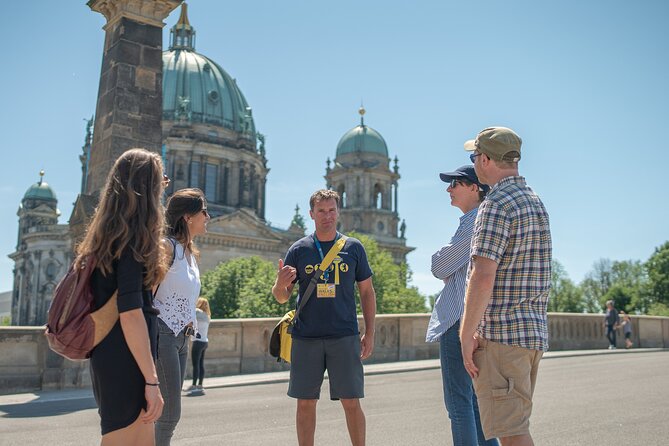
At Neue Wache, you pause at a national memorial devoted to war and tyranny. The building is quiet and solemn, and the stop helps shift the tour from political power to the human cost of conflict.
Nearby, Humboldt University adds a different note. Marx, Engels, and Einstein studied or taught here, and the building brings Berlin’s academic life into the story. The stop is brief, but it reminds you that the city was also a center of science, philosophy, and debate.
These early stops show one of the tour’s strengths. Berlin’s story is not presented as a single era. You move from border controls to memorials, then to education and public life, with the guide explaining how those layers fit together.
Museum Island from the outside
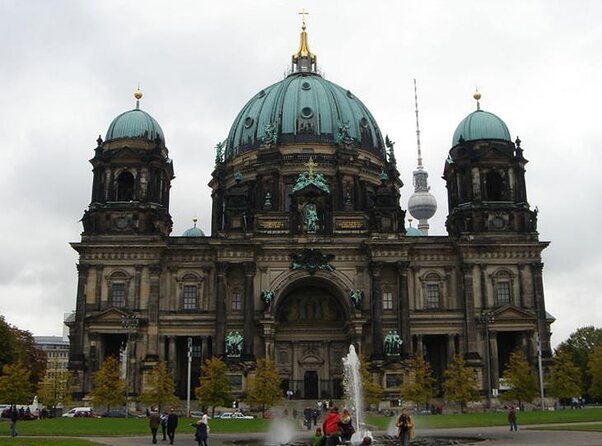
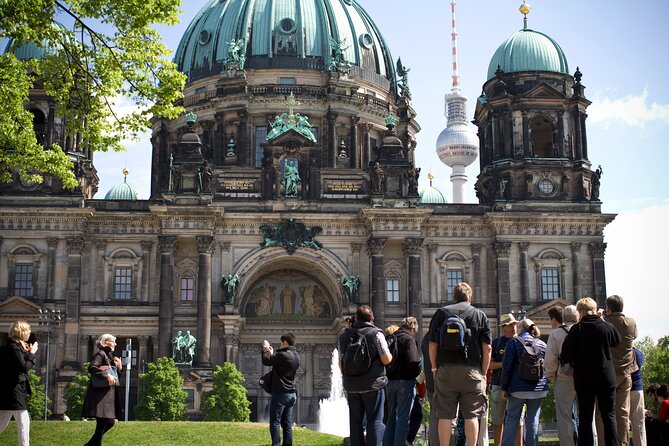
The route passes Berlin Cathedral, the Lustgarten, the former City Palace, and the Humboldt Forum. You also see the major Museum Island buildings, including the Pergamon Museum, Neues Museum, and Altes Museum.
This is sightseeing from the street. Entry tickets are not included, and the short stops are not long enough for a proper museum visit. That is not a flaw if you use the walk as planning help. You can note which buildings deserve a separate afternoon.
The Pergamon Museum is presented through major works associated with its collections, including Islamic art, the Ishtar Gate, and the Market Gate of Miletus. The Neues Museum is linked to its Ancient Egyptian collection, while the Altes Museum is tied to Berlin’s early museum tradition and architect Karl Schinkel.
The Humboldt Forum occupies the reconstructed Hohenzollern palace site. From outside, you can see how Berlin continues to argue with its own past. The new building recalls royal power, while its present use reflects a modern city trying to explain and question that inheritance.
You will not become a museum expert in five minutes. You will, however, leave with a useful map of Museum Island and a better sense of why this small area matters.
Still Berlin, at a slower pace:
- Discover Berlin Half-Day Walking Tour
★ 5.0 · 9,624 reviews - Berlin: Hop-on Hop-off Bus Tour with Live Commentary
★ 4.3 · 8,579 reviews - Berlin: Government District around the Reichstag Guided Tour
★ 4.7 · 8,447 reviews - Berlin: Reichstag, Plenary Chamber, Cupola & Government Tour
★ 4.6 · 8,422 reviews
Bebelplatz and the book-burning memorial
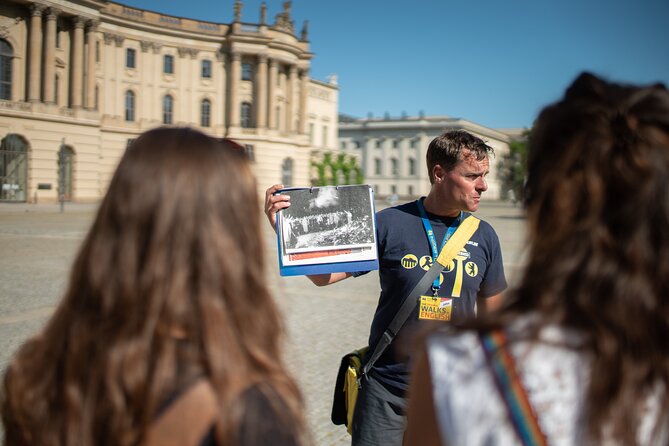
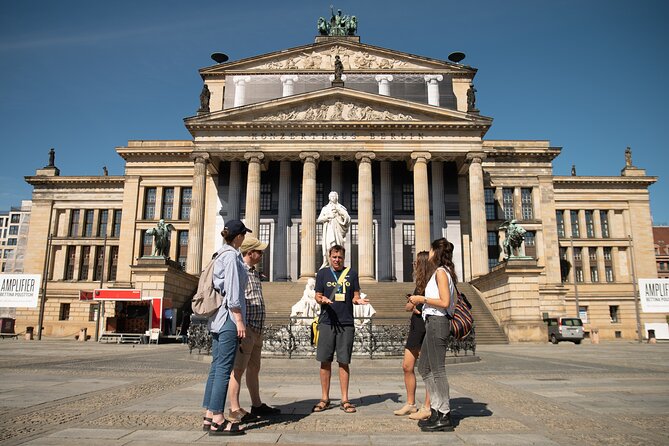
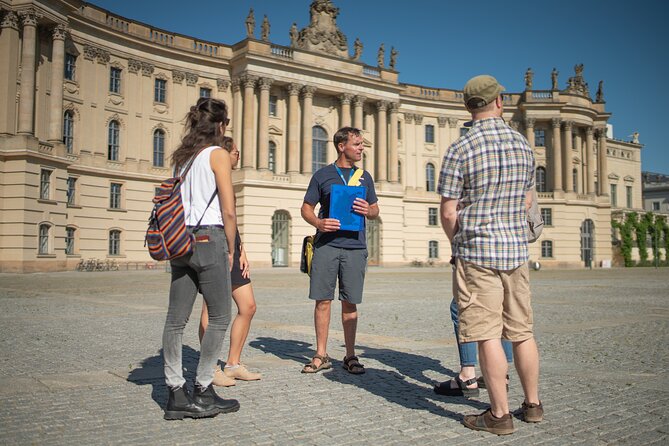
Bebelplatz is one of the most striking squares on the route. Its elegant 18th-century architecture includes the Staatsoper, built under Frederick the Great in 1743, and the Konzerthaus, completed in 1821 and associated with Schinkel.
The square’s beauty makes its history harder to forget. In 1933, Nazis burned tens of thousands of books here. The Book Burning Memorial marks the event in an underground room of empty bookshelves, visible through a glass panel in the pavement.
The tour spends only a few minutes at the memorial, but the stop is powerful because it shows how public spaces can be used for both culture and intimidation. Your guide can explain the political climate that allowed the destruction of books, ideas, and eventually human lives.
From Bebelplatz, the route continues to Gendarmenmarkt. The French Cathedral and German Cathedral face the Konzerthaus, reflecting a period when Berlin made room for different Christian communities. This is one of the prettiest sections of the walk, but its appeal is not only architectural. It also introduces the idea of religious tolerance as a political choice.
Checkpoint Charlie and the Wall
Checkpoint Charlie is the tour’s clearest Cold War landmark. It was a civilian and military crossing between East and West Berlin, and in 1961 it became the scene of a tense tank confrontation between Soviet and American forces.
Today, the site is crowded with history, photography, and modern city traffic. The tour helps you separate the genuine historical importance from the later tourist presentation. You should expect an outdoor stop, not a preserved border crossing in its original form.
The Topography of Terror adds more physical evidence. Here you see a roughly 200-meter section of the Berlin Wall beside documentation about Nazi persecution. This combination can feel heavy, but it is useful. The site connects the Nazi police state to the later dictatorship in East Germany without pretending the two systems were identical.
The Wall is not merely a piece of concrete. It divided neighborhoods, families, workplaces, and daily routines. A guide who explains life before and after its construction can make the Cold War easier to understand than a date-filled lecture ever could.
The former Air Ministry and Hitler’s bunker site
The route passes the former Aviation Ministry, built for Hermann Göring’s air force. The building later served as the East German House of Ministers and now houses the German Finance Ministry.
Its changing use makes it an excellent Berlin stop. The architecture survived while governments changed around it. You can see how political power often moves into existing offices, leaving the physical city as a record of competing regimes.
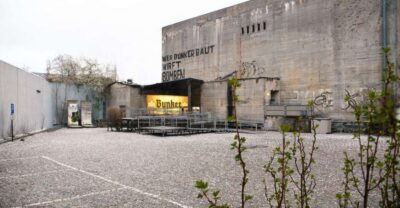
The next stop is the site of Hitler’s former bunker. You stand above the location where he spent the final days of the Second World War. There is no grand entrance or dramatic ruin to inspect, and that is deliberate. The site is largely unmarked, preventing it from becoming a shrine.
This is a place where the guide’s explanation matters more than what you see. The ground appears ordinary, but the events associated with it shaped the end of the war and the destruction of central Berlin. Expect roughly ten minutes here, enough for context and questions rather than a long visit.
The Holocaust Memorial and the final approach
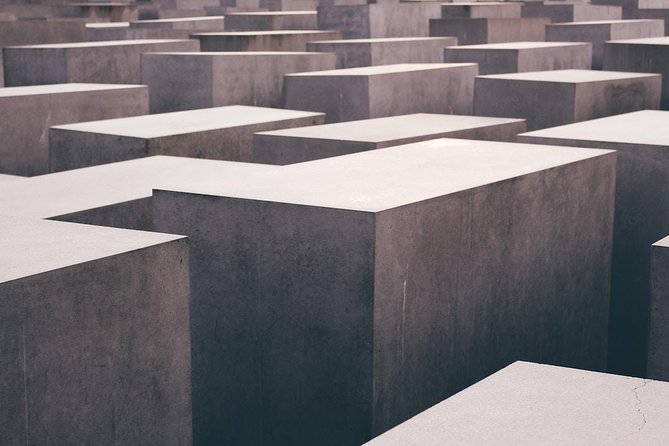
The Memorial to the Murdered Jews of Europe is one of the tour’s most important stops. Its field of concrete blocks changes as you walk through it, creating a physical sense of unease and disorientation.
You are given time to walk among the blocks, but remember that this is a memorial, not a playground or ordinary public square. A thoughtful guide can explain the purpose of the design while giving you space to form your own response. Grayson was especially praised for his sensitive explanation of the Holocaust, an important strength for a tour covering such painful material.
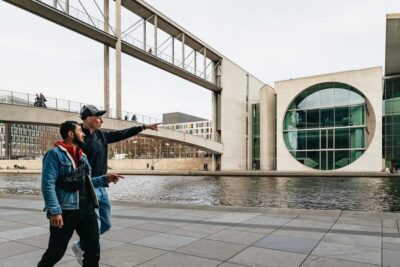
The route then reaches the government quarter and the Reichstag area. The Reichstag Building is Germany’s parliamentary home, and the surrounding district shows the country’s present-day political identity. The building’s history is closely tied to war, dictatorship, division, and reunification, making it a fitting late stop.
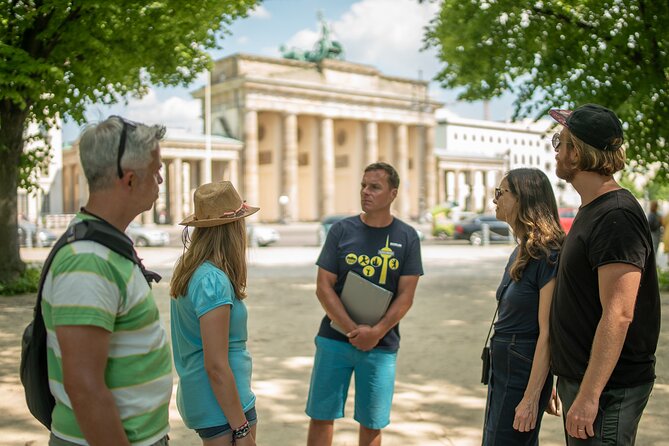
The tour finishes at Brandenburg Gate and Pariser Platz. The gate once symbolized division, especially during the Cold War. Today it represents German unity and peace, while the square around it includes the American and French embassies, the Hotel Adlon, and the Academy of Fine Arts.
This ending gives the walk a clear shape. You begin with a divided city and finish at one of its strongest symbols of reunification.
Pace, group size, and guide style
The walk covers a lot. You stop often, but most stops last only five to ten minutes. That keeps the tour moving and lets you see a broad portion of central Berlin, yet it also means you cannot linger at every monument.
Several guides have been praised for pacing the tour well. Hannah adjusted the rhythm with short warming stops during cold weather. Another guide allowed enough time for a tea break, while Jimmy was praised for making three hours pass quickly. These details matter because weather and walking speed can change the experience.
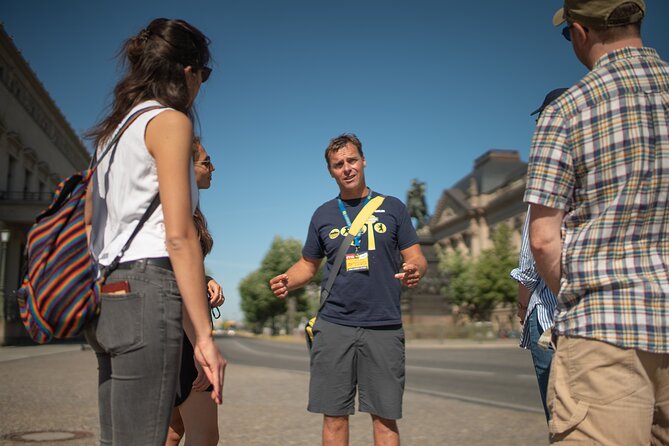
The group limit is 25 people. That is small enough for a guide to answer questions, but large enough that you may need to stand close to hear. One guest felt the guide spoke too softly and began talking before the whole group had gathered. If you have hearing concerns, position yourself near the guide and say so early.
One serious caution comes from a solo participant who became separated from the group and eventually left. This appears to be an isolated experience among many positive comments, but it is still practical advice. Keep the guide in sight at crossings, confirm the meeting point, and do not stop far behind for photographs without telling someone.
Who will get the most from this tour
I would choose this walk for a first full day in Berlin, especially if you want a strong outline before exploring museums on your own. It suits people who enjoy political history, architecture, and stories about how ordinary life changed under dictatorship and division.
It is also a good fit for families with older children or teenagers who need the city’s landmarks explained in plain language. The route has enough variety to hold attention: palace buildings, memorials, museums, border crossings, the Wall, and government sites.
You may want another option if long walks are difficult for you. The route is around three miles, and the tour does not promise extensive sitting time. Older visitors can still enjoy it, but the pace should be considered carefully.
This is not the right choice if you want to enter several museums or spend twenty minutes photographing each monument. The tour is built around orientation and explanation. You can return later for the interiors.
What to bring and how to plan the rest of your day
Arrive 15 minutes early. The starting details should be checked closely because the meeting information refers to Reichstagufer 17 while the route description begins near Friedrichstrasse Station.
Wear shoes suited to steady city walking. Berlin’s central sights are spread across several districts, and the pace can be tiring even though there are frequent stops. In cold weather, the short pauses may not be enough to stay warm without proper layers.
Save your museum visits for afterward or another day. The route gives you a useful shortlist: the Pergamon Museum, Neues Museum, Altes Museum, and Humboldt Forum. You may also want extra time at the Topography of Terror or the Holocaust Memorial.
The walk ends at Brandenburg Gate and Pariser Platz, a convenient place to continue sightseeing. From there, you can explore the government quarter, return to a museum, or simply use the tour’s route as a guide for your own second pass through central Berlin.
Is the $24.07 price good value?
Yes, if you want interpretation rather than entry tickets. For $24.07, you receive about three hours with an English-speaking local guide and see a long list of central landmarks. The price is especially fair for a first visit because it reduces the chance of missing major sites or misunderstanding what you are seeing.
The value depends heavily on the guide. A clear speaker who welcomes questions can turn a fast walk into a memorable lesson. The strongest experiences here come from guides such as Joseph, Klaus, Tina, Rohan, Jimmy, Jef, Brian, Georgia, Tom T, and Pete F, all praised for different strengths including humor, patience, clarity, personal stories, and strong historical explanations.
The tour does not include paid admission, food, or transport. That keeps the cost low, but you should budget separately for museums if you decide to enter them.
Free cancellation is available when you cancel at least 24 hours before the start time. Changes or cancellations inside that window are not refunded.
Should you book this Berlin history walk?
Book it if you want to see Berlin’s major central sights while learning how the Nazi era, the Cold War, and reunification shaped the city. The route is broad, affordable, and especially useful at the start of a visit.
Skip it if you dislike walking, prefer very small groups, or want lengthy indoor visits. You will be moving for most of the three hours, and the short stops require attention.
My practical advice is simple: book for your first or second day, arrive early, stay near the guide, and treat the walk as a foundation for the rest of your Berlin plans. At $24.07, it offers a lot of city and serious history for a modest price.
FAQ
How long does the Berlin walking tour last?
The tour lasts approximately three hours.
What language is the tour offered in?
The tour is offered in English with a local English-speaking guide.
What sights are included?
The route includes the Palace of Tears, Neue Wache, Humboldt University, Berlin Cathedral, Museum Island, Bebelplatz, Gendarmenmarkt, Checkpoint Charlie, the Topography of Terror, the former Aviation Ministry, Hitler’s bunker site, the Holocaust Memorial, the Reichstag area, Brandenburg Gate, and Pariser Platz.
Are museum admission tickets included?
No. Admission to places such as the Pergamon Museum, Neues Museum, Altes Museum, Berlin Cathedral, and other interiors is not included.
Where does the tour end?
The tour ends at Brandenburg Gate in Pariser Platz.
How far in advance can I cancel for a full refund?
You can cancel at least 24 hours before the experience starts for a full refund. Cancellations made less than 24 hours before the start time are not refunded.
Just added around Berlin
- Private Walking Tour in Berlin: Hitler’s Germany & WWII★ 5.0 · 7 reviews
- The History of Berlin: WWII PRIVATE Walking Tour With Locals★ 5.0 · 209 reviews
- Private Berlin WWII and Cold War History Tour with Local Expert Guide★ 5.0 · 28 reviews
- Private Walking Tour Berlin 3 hours: Brandenburg, Historic Center★ 5.0 · 7 reviews
- Berlin: Private Bike Tour of the Berlin Wall and Third Reich★ 5.0 · 23 reviews
- Berlin Photography Masterclass – Private Photography Lesson★ 4.5 · 23 reviews
- Group Driving Tour 1 to 6 people. Berlin Shore Excursion incl pick-up at Port★ 5.0 · 8 reviews
- Berlin: Guided Private Bike Tour to Explore the Highlights★ 5.0 · 12 reviews
Berlin Tours, compared.
Reichstag, Dome and Government District Guided Tour
Read our review →
1-Hour City Tour by Boat with Guaranteed Seating
Read our review →
Government District around the Reichstag Guided Tour
Read our review →
Reichstag, Plenary Chamber, Cupola & Government Tour
Read our review →