
Reviewed · HISTORICAL TOURS
Half-Day Bike Tour of Berlin’s Lesser Known And Historical Sites
Berlin keeps its best stories off the postcard route. This four-hour bike tour takes you through Prenzlauer Berg, Lichtenberg, and Weißensee, where Cold War apartment blocks, former Stasi sites, old industrial grounds, and inner-city lakes reveal a quieter side of the capital. I like that it avoids the usual Brandenburg Gate circuit, and I like the small maximum of eight people, which gives the guide room to adjust the pace and answer questions. The trade-off is simple: if you want Berlin’s famous landmarks, this is not the right tour.
I also like the way the route connects ordinary places to major events. You see where people lived, worked, exercised, crossed the Berlin Wall, and dealt with the East German state. The tour is led by a local guide, with Katrin, Markus, and Ferenz praised for their humor, personal stories, and ability to shape the route around what the group already knows.
Cycling covers a lot of ground without turning the outing into a race. Still, you should be comfortable spending several hours on a bicycle, and you should not expect food, drinks, hotel pickup, or a museum-heavy schedule. The focus is on places viewed from the bike and explained along the way.
In This Review
- Key points at a glance
- Why this bike tour feels different from central Berlin
- Starting near Bornholmer Strasse and Prenzlauer Berg
- Ernst-Thälmann-Park and the planned GDR city
- Former slaughterhouses, breweries, and working Berlin
- The Stasi headquarters and former prison
- A border crossing at Platz des 9. November 1989
- Lakes and green spaces around Weißensee
- The sports connection at Weißensee
- What the small group changes
- Pace, bicycles, and practical comfort
- Is $36.88 a fair price?
- Who should book this ride?
- Booking, cancellation, and the final call
- FAQ
- How long does the bike tour last?
- What time does the tour start?
- Where does the tour begin?
- Where does the tour end?
- How many people can join the tour?
- Is bicycle use included?
- Are food and drinks included?
- Can I cancel for a full refund?
Key points at a glance
- Cold War life in Prenzlauer Berg: See typical East Berlin housing and hear how daily life worked beyond the grand political headlines.
- The former Stasi headquarters: Pass the huge state-security complex and learn about the secret police, prison system, and network of informers.
- Berlin’s industrial past: Ride by former slaughterhouse and brewery sites that help explain how eastern districts developed.
- A former Berlin Wall border point: Stop at Platz des 9. November 1989, linked to the border crossing era and the opening of the Wall.
- Green eastern Berlin: The route includes Ernst-Thälmann-Park, Orankesee, Obersee, and Weißensee, so the city feels less dense than you might expect.
- A genuinely small group: The tour allows no more than eight people, and it may operate with only two participants.
Why this bike tour feels different from central Berlin
Most first-time visitors spend their days around Museum Island, the Reichstag, the Wall Memorial, and Checkpoint Charlie. Those places matter, but they can make Berlin seem like a collection of famous addresses. This tour asks a more useful question: what did the city feel like for people who lived here?
The answer comes through housing areas, former workplaces, parks, lakes, sports facilities, and government buildings. You are not simply ticking off monuments. You are seeing the physical setting of everyday East Berlin and learning how politics shaped streets far from the big tourist sights.
That is the main reason I would choose this ride after seeing central Berlin. One guide, Markus, adjusted the focus for participants who had already visited the major historical sights. That kind of flexibility matters. You get more from a four-hour tour when the guide can spend time on subjects that are new to you instead of repeating the standard introduction.
The experience is described as lasting about three and a half to four hours. It starts at 10:00 a.m. and returns to the same meeting point. The price is $36.88 per person, including the bicycle and guide. For Berlin, that is a fair price for a half-day outing, especially with a group capped at eight and no separate bike rental to arrange.
More Bike Tours in Berlin
- Berlin: Sights and Highlights Bike Tour with a Local Guide
★ 4.8 · 2,698 reviews - Berlin Highlights 3-Hour Bike Tour
★ 5.0 · 948 reviews - Berlin City Bike Tour with Beer Garden Stop
★ 5.0 · 917 reviews
Starting near Bornholmer Strasse and Prenzlauer Berg
The meeting point is Bornholmer Str. 75A in Berlin’s 10439 postal area. It is near public transportation, which makes the start practical, though you should allow enough time to find the exact address and arrive ready to ride.
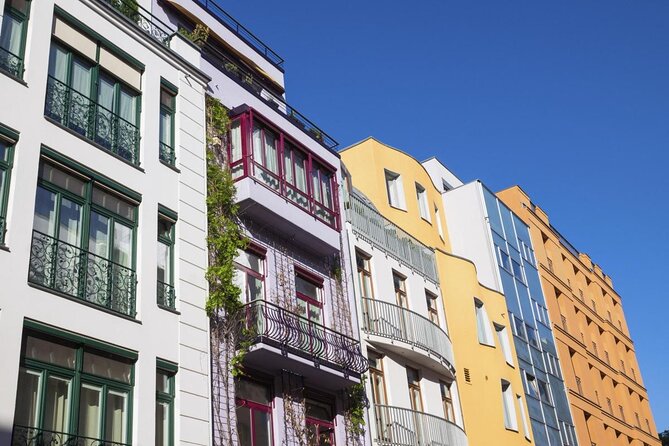
The first major section takes place in Prenzlauer Berg. The district is now one of Berlin’s better-known residential areas, but the tour uses it to explain its East Berlin past rather than simply show attractive streets.
You can expect the guide to point out typical communist-era apartment blocks and discuss daily life during the Cold War. This is valuable context because large housing areas tell a different story from official buildings. They show how people were housed, how neighborhoods were planned, and what ordinary life looked like under the German Democratic Republic.
The stop lasts about an hour, making it the longest part of the route. That gives the guide time to explain the district instead of rushing through it. I would pay close attention here if you want social history rather than a list of dates.
Prenzlauer Berg also helps set the tone for the rest of the ride. The point is not to pretend every street is untouched by change. It is to compare the district you see today with the system that shaped it decades ago.
Ernst-Thälmann-Park and the planned GDR city
The route continues to Ernst-Thälmann-Park, a GDR-era park and housing area with a planetarium. The stop is brief, about ten minutes, but it adds another piece to the story of planned urban life.
Here, the interest comes from the combination of housing, public space, and a major leisure facility. The park was not only decoration. It formed part of a planned district and reflected the state’s approach to housing and recreation.
Do not expect a long park walk or a planetarium visit as part of the tour. The stated stop is a short viewing and explanation from the route. That is typical of this experience: you get a broad sweep of places, but the main value comes from the guide’s comments rather than extended admissions or indoor visits.
Former slaughterhouses, breweries, and working Berlin
One of the more unusual themes is Berlin’s industrial past. The ride passes sites connected with former slaughterhouses and breweries, places many visitors would never add to a sightseeing plan.
These stops help explain why the eastern districts developed as working parts of the city. Food production, brewing, housing, transport, and state administration all shaped the area. The remains or former sites may not look dramatic in the same way as a palace or cathedral, but they make Berlin’s growth easier to understand.
I enjoy this sort of stop because it gives you something to look for after the tour. A city is not only its monuments. It is also the places where people made, processed, stored, and moved goods.
The guide’s role matters here. Without explanation, an old industrial site can look like just another urban block. With context, it becomes evidence of how the city functioned.
More History Tours in Berlin
- Berlin: Natural History Museum Entrance Ticket
★ 4.6 · 3,382 reviews - Berlin: World Heritage Cruise to Potsdam
★ 4.5 · 1,435 reviews - Berlin Historical Highlights Walking Tour
★ 4.9 · 657 reviews - Berlin Private Complete History All Day Walking Tour
★ 5.0 · 474 reviews
The Stasi headquarters and former prison
The Stasi section is one of the strongest historical parts of the tour. You pass the former Stasi headquarters and learn about East Germany’s secret police, its network of informers, and the system used to monitor citizens.
The scale of the former headquarters is important. The site was enormous, and that physical size helps communicate how much attention the state devoted to surveillance and control. The tour also includes the former Stasi prison, though the listed stop at the memorial is only about five minutes.
That short timing is worth noting. This is not a full guided visit inside a museum or prison. You should think of it as an outdoor introduction and a chance to place the Stasi within the geography of East Berlin.
If the Stasi is your main interest, you may want to visit a dedicated museum separately. The bike tour gives you useful background, but its strength is connection. You see the headquarters in relation to the housing areas, parks, and streets around it.
A border crossing at Platz des 9. November 1989
The stop at Platz des 9. November 1989 concerns a former border station and Berlin Wall site. The name itself points to November 9, 1989, the date associated with the Wall’s opening.
The stop lasts about fifteen minutes. That is enough for a clear explanation and a pause, but not for an extended memorial visit. It fits the tour’s broader approach: instead of spending hours at one famous Wall location, you encounter a less central place connected to the same divided-city story.
This is a useful contrast with the better-known Wall sites. You are seeing a former crossing point in the eastern part of Berlin, where the history feels tied to local streets rather than a major museum district.
The guide can also connect this stop to the earlier discussion of surveillance and everyday life. The Wall was not an isolated structure. It affected where people could go, whom they could visit, and how the city worked.
Lakes and green spaces around Weißensee
After the heavier political subjects, the route becomes greener. It passes Orankesee, Obersee, and Weißensee, three bodies of water within the eastern city.
Orankesee is described as an inner-city lake, while Obersee is an artificial inner-city lake. These stops are short, about five minutes each, so you should not expect a long break or a swim. Their value is visual and geographic: they show how much open space exists beyond Berlin’s central avenues.
The route then spends about forty-five minutes in the Weißensee district, followed by roughly ten minutes at Strandbad Weißensee. The district section is long enough to give the area more attention than a quick pass-through.
Weißensee adds a calmer finish to the historical route. You move from state buildings and border controls to water, parks, and neighborhood streets. That change is one of the tour’s best features. It keeps the day from feeling like four straight hours of political history.
The exact use of the lake stops is not described as swimming or a meal break, so plan on sightseeing rather than recreation. Food and drinks are not included, and there is no stated café stop.
The sports connection at Weißensee
The tour also includes the athletic facility where famous Olympic athletes trained. The available details do not name the facility or promise an interior visit, so you should expect to see it as part of the cycling route and hear about its role from the guide.
This stop broadens the story beyond politics. Sport was a major part of public life in East Germany, and athletic success carried national importance. A training facility gives you another way to understand how the former state presented achievement and identity.
It also suits the tour’s practical style. You do not just move between memorials. You see places tied to work, housing, leisure, sport, and government.
What the small group changes
The maximum group size is eight people. That is a real advantage on a bicycle tour, where a large line can be awkward and questions are easy to lose.
Small groups also make the guide’s personality more important. Katrin was praised for being fun, informative, and accommodating. Markus was described as easy to talk with, humorous, and able to adjust the content to the group. Ferenz received particular praise for running the tour even when only two people booked, with no minimum participant requirement noted in that experience.
The official information says a minimum number may apply in some circumstances, so you should still read the booking conditions carefully. But the very small maximum remains a strong feature.
You may get more direct conversation than on a standard coach tour. You can ask about a building, a former border point, or a neighborhood without waiting for a large crowd to catch up. The downside is that the experience depends heavily on the guide assigned that day, though the available feedback names three guides in especially positive terms.
Pace, bicycles, and practical comfort
Bicycle use is included, along with a driver-guide and local guide. The bicycles were described as top quality in one account, but the supplied details do not specify the models, sizes, or whether electric bicycles are available.
The ride is described as manageable from a cycling standpoint, including for teenagers and students. That does not mean you should treat it as effortless. You will be riding for several hours, with repeated stops and starts, so basic comfort on a bicycle matters.
Wear smart casual clothing, as requested by the operator, and dress for the weather. Since the tour remains outdoors, practical clothing is more useful than a formal outfit. Children must be accompanied by an adult.
Most people can participate, and the meeting point is near public transportation. Hotel pickup and drop-off are not included, so you must reach Bornholmer Strasse independently and return there at the end.
Is $36.88 a fair price?
At $36.88, the tour offers solid value if you want guided context and bicycle use in one package. You are paying for about half a day, a local guide, a small group, and access to areas that can be difficult to connect on foot.
The value is less obvious if you only want major attractions or admission-based sightseeing. The tour does not include food, drinks, hotel transfers, or stated entry into the Stasi museum, prison, planetarium, or athletic facility.
I would compare it with the cost of renting a bicycle and planning this route yourself. A self-guided ride could be cheaper, but you would lose the explanations that turn apartment blocks, industrial sites, and state offices into meaningful historical stops.
For someone who has already seen central Berlin, the price makes particular sense. You get a different part of the city without spending a full day on a formal museum program.
Who should book this ride?
I would recommend it to visitors who:
- Have already seen Berlin’s main central sights
- Want Cold War history told through ordinary neighborhoods
- Like combining light exercise with sightseeing
- Prefer groups no larger than eight
- Enjoy local stories, industrial history, and less famous places
- Are comfortable cycling for three and a half to four hours
I would be more cautious if you have limited cycling ability, want a major museum visit, or need hotel transportation. It is also not ideal if your only day in Berlin must cover the Brandenburg Gate, Reichstag, Museum Island, and Berlin Wall Memorial.
The route appears especially suitable for families with older children and for students or teenagers, provided an adult accompanies children. The accounts also describe it as relaxing rather than punishing, with good bikes and plenty of information.
Booking, cancellation, and the final call
You receive confirmation when booking. Free cancellation is available if you cancel at least 24 hours before the 10:00 a.m. start time. Cancellations or changes inside that window are not refunded, and the experience may be rescheduled or refunded if a required minimum is not met.
Should you book it? Yes, if you want Berlin beyond the headline sights. The strongest reasons are the small group, the eastern districts, and the way the guide links Cold War politics to housing, work, sport, and local scenery.
Choose another tour if this is your first and only Berlin sightseeing activity. But after the central landmarks, this ride gives you a more grounded picture of the city, with enough history to think about and enough green space to keep the afternoon pleasant.
FAQ
How long does the bike tour last?
The tour lasts approximately four hours, with the main description giving a duration of about three and a half hours.
What time does the tour start?
The tour starts at 10:00 a.m.
Where does the tour begin?
It begins at Bornholmer Str. 75A, 10439 Berlin, Germany.
Where does the tour end?
The tour ends back at the same meeting point.
How many people can join the tour?
The maximum is eight people per booking and eight people overall for the activity.
Is bicycle use included?
Yes. Use of a bicycle is included, along with a driver-guide and local guide.
Are food and drinks included?
No. Food and drinks are not included.
Can I cancel for a full refund?
Yes, if you cancel at least 24 hours before the experience start time. Cancellations made less than 24 hours before the start are not refunded.
Just added around Berlin
- Private Walking Tour in Berlin: Hitler’s Germany & WWII★ 5.0 · 7 reviews
- The History of Berlin: WWII PRIVATE Walking Tour With Locals★ 5.0 · 209 reviews
- Berlin: Private Bike Tour of the Berlin Wall and Third Reich★ 5.0 · 23 reviews
- Private Berlin WWII and Cold War History Tour with Local Expert Guide★ 5.0 · 28 reviews
- Private Walking Tour Berlin 3 hours: Brandenburg, Historic Center★ 5.0 · 7 reviews
- Berlin: Guided Private Bike Tour to Explore the Highlights★ 5.0 · 12 reviews
- Berlin Photography Masterclass – Private Photography Lesson★ 4.5 · 23 reviews
- Group Driving Tour 1 to 6 people. Berlin Shore Excursion incl pick-up at Port★ 5.0 · 8 reviews
Historical Tours, compared.
City History Canal Sightseeing Tour on a Motorboat
Read our review →
Browse the lists this tour appears in