Reviewed · BERLIN TOURS
Path of Resistance: Berlin’s Hidden Holocaust Stories
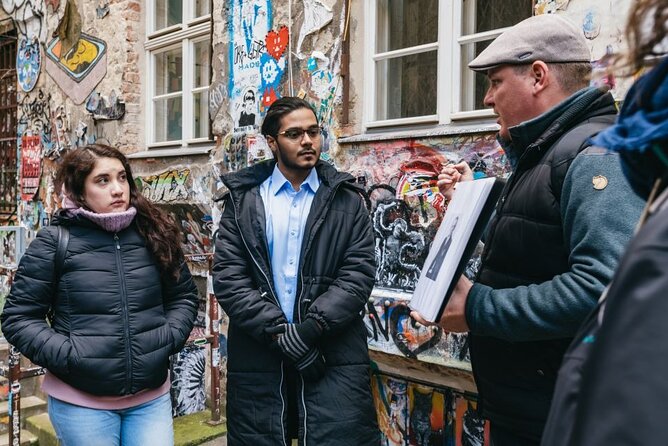
Berlin remembers in unexpected corners. This 2.5-hour walking tour links Jewish history, German resistance, memorials, and wartime sites across central Berlin. I like the small group of up to 15 people, which leaves room for questions, and the use of Then & Now photographs and maps, which help you picture streets before and during Nazi rule. The main drawback is simple: you will spend much of the tour standing outdoors, so weather and comfortable shoes matter.
I also like that the tour does not treat resistance as one single story. You hear about Jewish survival, non-Jewish German protesters, a courageous workshop owner, a Wehrmacht officer who planned to kill Hitler, and children whose lives took sharply different paths. At $48.01, the price is fair for an expert-led walk, though you should know that food, drinks, and hotel transport are not included.
In This Review
- Key points to know before you book
- Why this Berlin walking tour feels different
- Starting at the New Synagogue on Oranienburger Strasse
- A school, a transit camp, and the loss of safety
- The Jewish Cemetery and a difficult memorial site
- Otto Weidt’s workshop in a hidden courtyard
- Rosenstrasse and the power of public protest
- Lustgarten and the closing of public life
- The Zeughaus and a planned attack on Hitler
- Neue Wache and remembrance in the middle of the city
- Bebelplatz and the book burning memorial
- Trains to Life, Trains to Death near Friedrichstrasse
- Price, pace, and what you get for $48.01
- Who should book this walk?
- Should you book Path of Resistance?
- FAQ
- How long does the Path of Resistance tour last?
- Where does the tour begin?
- Where does the tour finish?
- Is the tour offered in English?
- How large is the tour group?
- Is admission to the sites included?
- Can I cancel for a full refund?
Key points to know before you book
- A 15-person maximum keeps the walk personal, with more chance to ask questions and keep close to the guide.
- The route covers ten important places, from the New Synagogue to the Trains to Life, Trains to Death sculpture near Friedrichstraße.
- The focus is resistance, not only persecution, so the tour gives space to protest, rescue, military opposition, and individual courage.
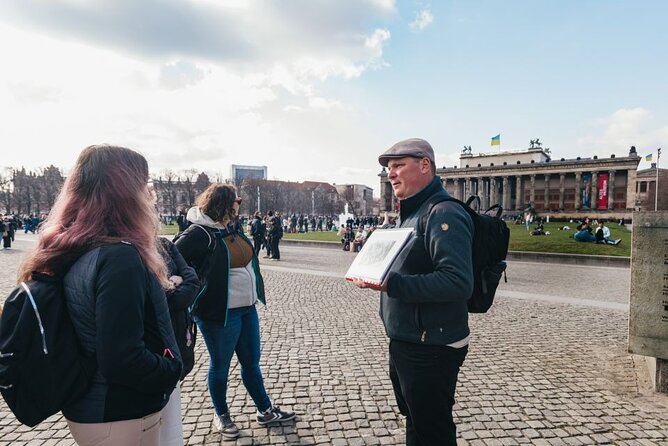
- Guides bring visual context, using photographs and maps to connect today’s Berlin with the city of the 1930s and 1940s.
- Expect plenty of standing and walking, with no meal break and no hotel pickup.
- The tour is often booked well ahead, with an average booking lead time of about 37 days.
Why this Berlin walking tour feels different
Berlin has no shortage of museums and memorials about the Nazi era. This walk takes a different route. Instead of placing the entire subject inside one large museum, it moves through streets, courtyards, squares, churches, former schools, and memorial sites.
That approach matters because the history happened in ordinary city spaces. A school became a transit camp. A workshop became a place of protection. A public square once used for speeches became a setting for Nazi rallies. As you walk, the distance between past and present keeps changing.
The tour also puts resistance at the center. That does not mean it softens the scale of Nazi crimes. It means you learn about people who made difficult choices inside a brutal system, often with limited hope and great personal risk.
The experience is offered in English and includes an expert guide, maps, and historical photographs. Guides named in past feedback include Johan, Jochen, Scott, Jorg, and Benjamin. The strongest praise has focused on clear explanations, strong subject knowledge, friendly presentation, and the ability to answer questions. One guide had even led walks for seven years, while another handled questions from someone with a university degree in Holocaust studies.
That gives you a useful sense of the tour’s level. It is not just a quick walk past plaques. Still, the quality depends on the guide leading your departure, and the tour’s compact length means some subjects receive only a short introduction.
A few more Berlin trips worth comparing
- Berlin: Reichstag, Dome and Government District Guided Tour
★ 4.7 · 18,288 reviews - Berlin: 1-Hour City Tour by Boat with Guaranteed Seating
★ 4.3 · 16,993 reviews - Berlin: Boat Tour Along the River Spree
★ 4.4 · 11,252 reviews
Starting at the New Synagogue on Oranienburger Strasse
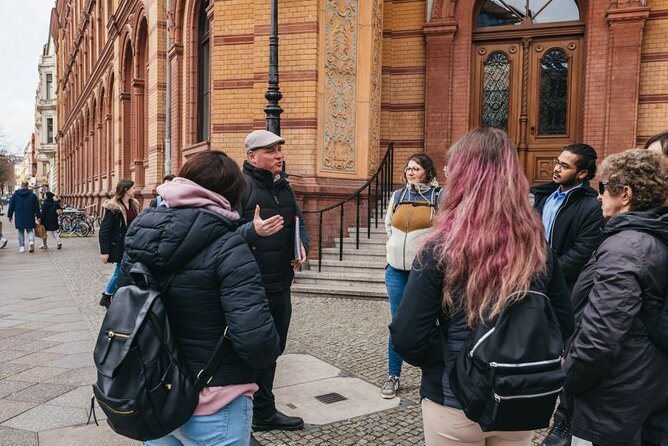
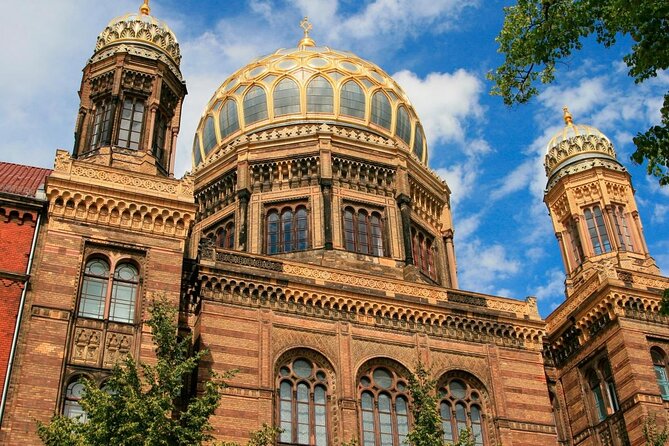
The meeting point is outside the Stiftung Neue Synagoge Berlin, also known as the Centrum Judaicum, at Oranienburger Strasse 36. The building is an important place to begin because it reflects both the strength of Berlin’s Jewish community and the destruction brought by Nazi rule.
Built in 1866, the New Synagogue was the largest and most magnificent synagogue in Berlin. Its size reflected a Jewish community of about 160,000 people. The building was not a small or marginal institution. It was a major part of the city’s public life.
During Kristallnacht, the synagogue was saved from vandals. It continued in use until 1940, when the Army confiscated it and used the building to store military uniforms. Allied bombing in November 1943 caused severe damage, and the main hall was later torn down in 1958.
Parts of the synagogue were rebuilt in 1988, and the site officially reopened in 1995. Today, the Centrum Judaicum works to preserve Jewish memory and tradition.
You spend about ten minutes here, and admission to the stop is included. Do not expect a long indoor museum visit as part of the walk. The value comes from the guide’s explanation of what the building represented, what happened to it, and why its present form matters.
A school, a transit camp, and the loss of safety
The next stop is the Jüdisches Gymnasium Moses Mendelssohn, a short visit of about five minutes. Founded in 1779, this Jewish boys’ school was the first Jewish school in Germany without fees.
Its history challenges simple assumptions about Jewish institutions at the time. Although it was a Jewish school, it welcomed pupils of all faiths. It promoted liberal Jewish ideas and accepted female students beginning in 1931.
The Nazi period turned that openness into a cruel contrast. In the autumn of 1941, Jewish schools were banned as deportations began. In 1942, the Reich Main Security Office under the SS converted the building into a transit camp.
Windows were barred, and Jewish people were forced into the building while awaiting deportation. The short stop works best when you let the change in purpose sink in. A school associated with education and opportunity became a holding place before people were sent east.
Because the visit lasts only five minutes, you will want to listen closely. This is not a site with a long gallery or many objects. Its power comes from the building’s changing role and the guide’s ability to explain that shift.
The Jewish Cemetery and a difficult memorial site
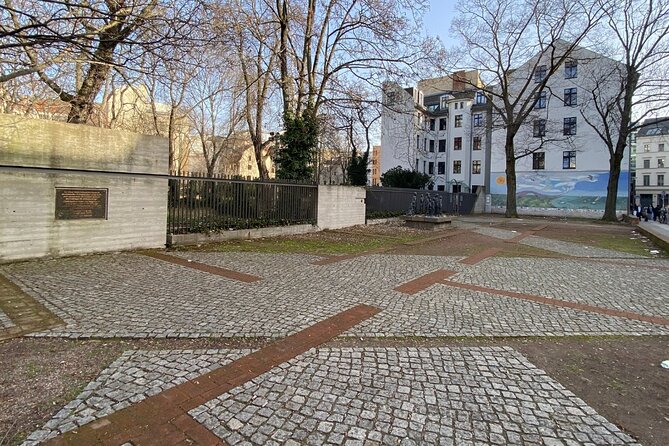
At the Jewish Cemetery and Holocaust Memorial, the tour spends about fifteen minutes, one of the longer pauses along the route. Between 1672 and 1827, roughly 12,000 members of Berlin’s Jewish community were buried here.
In 1943, the Gestapo ordered the SS to destroy the cemetery. Thousands of gravestones were smashed, remains were thrown away, and the site was treated with shocking disrespect. The account of soldiers playing football with skulls is especially grim, and the guide may present it as part of the wider destruction of Jewish memory.
The location also carries another layer of wartime history. Burials resumed in April 1945. Almost 2,500 German soldiers and Berlin civilians killed during the fighting are buried in mass graves. Some civilians were shot by the SS after hanging white flags from their windows.
This stop asks you to hold several stories together: the destruction of a Jewish cemetery, the final violence of the war, and the deaths of civilians who tried to signal surrender. It is a heavy section of the walk, and the outdoor format means you may spend much of it standing quietly while the guide speaks.
Still Berlin, at a slower pace:
- Discover Berlin Half-Day Walking Tour
★ 5.0 · 9,624 reviews - Berlin: Hop-on Hop-off Bus Tour with Live Commentary
★ 4.3 · 8,579 reviews - Berlin: Government District around the Reichstag Guided Tour
★ 4.7 · 8,447 reviews - Berlin: Reichstag, Plenary Chamber, Cupola & Government Tour
★ 4.6 · 8,422 reviews
Otto Weidt’s workshop in a hidden courtyard
The Museum Blindenwerkstatt Otto Weidt offers one of the tour’s most personal stories. The workshop sits in a courtyard and is linked to Otto Weidt, who employed more than 30 blind and deaf Jewish workers between 1940 and 1945.
Weidt and his wife, Else, tried to protect their employees as persecution increased. He bribed Gestapo officers, falsified documents, and worked to delay or prevent deportations. The most remarkable detail is his journey to Auschwitz in an attempt to get one of his employees out.
This story gives the word resistance a human scale. It is not only about military plots or public demonstrations. It can also mean using a business, personal contacts, money, lies, and nerve to protect people standing directly in front of you.
The stop lasts about ten minutes and admission is free. Since the workshop is in a hidden courtyard, pay attention when the group moves away from the main street. This is a good place to ask questions, particularly if you want to understand how everyday acts of help could become criminal offenses under Nazi rule.
Rosenstrasse and the power of public protest
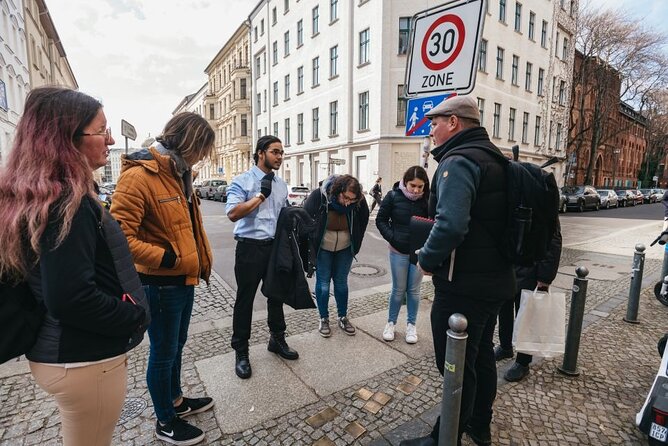
The Rosenstrasse Memorial recalls a rare success against Nazi persecution. On February 27, 1943, the Gestapo, Waffen-SS, and Berlin police arrested about 2,000 Jewish men married to non-Jewish German women.
The wives of those detained gathered to protest. Their numbers grew into the hundreds. Police threatened to shoot them if they refused to disperse, but the women briefly scattered and then returned in larger numbers.
As pressure mounted, Joseph Goebbels authorized the prisoners’ release. The event does not erase the wider pattern of deportation and murder, but it shows that public action could sometimes force a change, especially when the regime feared damaging public order or support.
You spend about ten minutes at the memorial. This is one of the clearest examples of why the tour’s theme matters. The story concerns organized resistance, but it is also about ordinary people refusing to leave when the authorities demanded silence.
Lustgarten and the closing of public life
Lustgarten is framed by Berlin Cathedral, the Altes Museum, and the Zeughaus. Before the Nazi period, it was a favored place for speeches and protests.
One week after Hitler became Chancellor, about 200,000 Berliners gathered here to protest the new government. Soon after, Nazi regulations restricted the right to protest. Fines and arrests made opposition dangerous.
In 1934, the Nazis paved over Lustgarten for propaganda rallies, military parades, and swearing-in ceremonies. The physical change to the square reflects a larger political change. A place where people had gathered to challenge power was redesigned to display power.
The stop takes about ten minutes. Look around at the buildings while the guide explains how the square functioned before and during the dictatorship. It is also a useful point for understanding that Nazi control was not limited to secret police and prisons. Public space itself was managed and reshaped for political theater.
The Zeughaus and a planned attack on Hitler
The Zeughaus is the oldest building on Unter den Linden, dating to 1730 when it served as an artillery arsenal. Here the tour tells one of its most dramatic resistance stories.
On March 21, 1943, the building hosted an exhibition of captured Soviet weapons. Major General Rudolf Christoph Freiherr von Gersdorff, a member of the Wehrmacht resistance, was selected to lead the exhibition.
By this point, 27 assassination attempts against Adolf Hitler had failed. Gersdorff agreed to carry out a suicide attack during the visit, using two concealed British clam mines. His plan was to get close to Hitler, embrace him, and detonate the explosives.
The plan was prepared alongside a larger coup attempt. The crucial question is what happened when the moment came. The guide uses this stop to explain the outcome and the wider military resistance network.
You spend about ten minutes here. The story is gripping, but it also needs careful explanation. A short retelling can make the plot sound like a film scene, while the real history involved uncertainty, timing, fear, and the possibility of failure at every step.
Neue Wache and remembrance in the middle of the city
Neue Wache is a memorial for victims of war and tyranny. Located along Unter den Linden, it offers a quiet pause amid one of central Berlin’s busiest areas.
The tour spends about ten minutes here. The site helps connect the specific stories from earlier stops with the broader human cost of war, dictatorship, and political violence.
This is not simply a place to snap a photo and move on. Give yourself a moment to consider the different groups already discussed: Jewish Berliners, people sent to camps, civilians killed in the final fighting, soldiers who joined resistance efforts, and families separated by Nazi persecution.
The guide’s role is important here because the memorial can carry several meanings depending on the period being discussed. The walk gives you a framework for reading the site rather than treating it as another quick landmark.
Bebelplatz and the book burning memorial
At Bebelplatz, the tour turns to the Nazi book burning of May 10, 1933. Members of the Nazi German Student Union and their professors gathered beside Humboldt University for a nationwide action against ideas they called un-German.
More than 25,000 books were burned. The event showed that censorship was not only imposed by police or government offices. Students and professors took part, helping turn intellectual persecution into a public spectacle.
The memorial is especially effective because it connects a physical square with an attack on thought, teaching, and public debate. The guide can also place the event within the early months of Nazi rule, when regulations and intimidation were rapidly narrowing the space for opposition.
You spend about ten minutes here. The stop is valuable for anyone interested in how authoritarian governments attack culture before violence reaches its full scale. It also gives younger visitors a clear starting point for understanding why books and universities became targets.
Trains to Life, Trains to Death near Friedrichstrasse
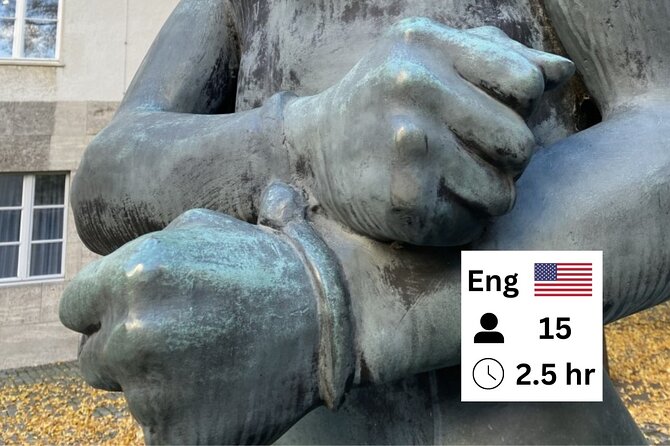
The route finishes with the Trains to Life, Trains to Death sculpture near Friedrichstrasse. The almost life-size figures represent two opposing fates for Jewish children during the Nazi era.
One group represents children saved by the Kindertransport to England. The other represents children deported to concentration camps. The figures look in different directions, a simple visual choice that makes the split in their lives easy to understand.
The sculptor, Frank Meisler, was among the children rescued by a Kindertransport from this area to England in 1939. His personal connection gives the memorial added force, but the sculpture also asks you to think about the children who did not get out.
This final stop lasts about ten minutes and brings the tour to S+U Friedrichstrasse, a major rail hub. That is practical as well as meaningful. You can continue to another part of Berlin by public transport, or ask the guide for help reaching your next destination.
Price, pace, and what you get for $48.01
At $48.01 per person, this is not the cheapest way to see central Berlin. You can pass many of these sites on your own for free. The fee pays for the structure, historical connections, maps, photographs, and a guide who can explain why each place matters.
I think the price is reasonable if you want more than a list of memorial names. The stops are spread across several central districts, and the route builds a clear story about resistance and repression. A self-guided walk could cover the same streets, but it would require research and careful planning.
The small group helps protect the value. With a maximum of 15 people, you are less likely to lose the guide in a crowded square, and questions are easier to handle. Past guides such as Scott, Jochen, Johan, Jorg, and Benjamin have been praised for clear explanations and a friendly manner.
The tour is about 2.5 hours. Food and drinks are not included, and there is no hotel pickup or drop-off. Wear comfortable shoes and dress for the forecast. The walk requires good weather, and a cancellation for poor weather brings either another date or a full refund.
Who should book this walk?
I would choose this tour if you want a focused introduction to Jewish life, Nazi persecution, and German resistance in Berlin. It suits adults, families with older children, and people who prefer a guide to connect sites rather than spend hours inside one museum.
It is also a good choice for people who already know the basic history. One past participant with a degree in Holocaust studies still found the guide’s command of the subject impressive. That suggests the walk can work at more than one level, provided you stay engaged and ask questions.
The experience may be less suitable if you need frequent seating, dislike serious historical subjects, or want extensive indoor access. Several stops last only five or ten minutes, so the tour gives you a broad route rather than long visits at each location.
Should you book Path of Resistance?
Book it if you want to understand how resistance appeared in many forms: a protest in Rosenstrasse, a workshop owner protecting employees, a military officer preparing an attack, students opposing Nazi rule, and children saved or lost through wartime escape.
Skip it if you mainly want grand architecture, shopping streets, or a relaxed sightseeing stroll. This is a serious walk with a lot of standing and emotionally difficult material.
For most visitors who want a meaningful first look at Berlin’s Nazi-era history, the combination of expert guiding, small-group size, free site access, and a convenient Friedrichstrasse finish makes the $48.01 worthwhile. Reserve ahead if your dates are fixed, since the average booking lead time is about 37 days.
FAQ
How long does the Path of Resistance tour last?
The tour lasts approximately 2 hours and 30 minutes.
Where does the tour begin?
The meeting point is Oranienburger Strasse 36, 10117 Berlin, Germany, at the New Synagogue and Centrum Judaicum.
Where does the tour finish?
The tour ends at S+U Friedrichstrasse in Berlin, a major train hub with connections across the city.
Is the tour offered in English?
Yes. The tour is offered in English.
How large is the tour group?
The maximum group size is 15 people.
Is admission to the sites included?
Admission tickets are listed as free for the tour stops. Food, drinks, hotel pickup, and hotel drop-off are not included.
Can I cancel for a full refund?
Yes. You can cancel at least 24 hours before the local start time for a full refund. Cancellations or changes made less than 24 hours before the start time are not accepted for a refund.
Just added around Berlin
- Private Walking Tour in Berlin: Hitler’s Germany & WWII★ 5.0 · 7 reviews
- The History of Berlin: WWII PRIVATE Walking Tour With Locals★ 5.0 · 209 reviews
- Private Berlin WWII and Cold War History Tour with Local Expert Guide★ 5.0 · 28 reviews
- Private Walking Tour Berlin 3 hours: Brandenburg, Historic Center★ 5.0 · 7 reviews
- Berlin: Private Bike Tour of the Berlin Wall and Third Reich★ 5.0 · 23 reviews
- Berlin: Guided Private Bike Tour to Explore the Highlights★ 5.0 · 12 reviews
- Berlin Photography Masterclass – Private Photography Lesson★ 4.5 · 23 reviews
- Group Driving Tour 1 to 6 people. Berlin Shore Excursion incl pick-up at Port★ 5.0 · 8 reviews
Berlin Tours, compared.
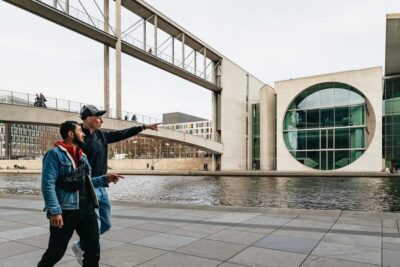
Reichstag, Dome and Government District Guided Tour
Read our review →
1-Hour City Tour by Boat with Guaranteed Seating
Read our review →
Government District around the Reichstag Guided Tour
Read our review →
Reichstag, Plenary Chamber, Cupola & Government Tour
Read our review →