
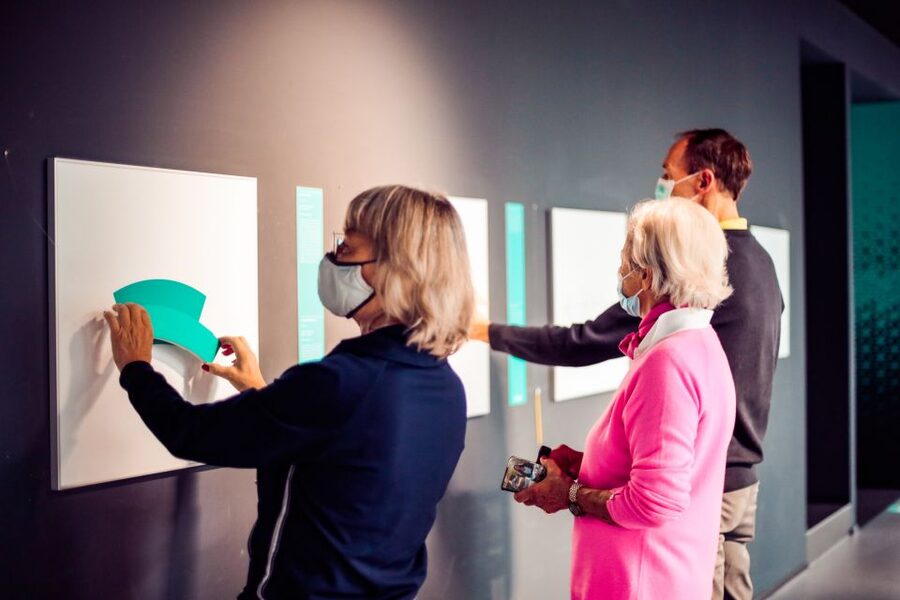
Reviewed · MUSEUMS
Stuttgart: Museum of Illusions Entry Ticket
Reality gets wobbly here. I like the Mirror Room, where your reflection becomes a photo-ready puzzle, and the Vortex Tunnel, which makes a flat floor feel unsteady. The exhibits mix silly fun with real explanations of vision and perception, so you get more than a quick round of funny pictures.
The main drawback is that some attractions are not suitable for people with epilepsy, including the Vortex Tunnel, Zoetrope, and Tilted Room. This is also an indoor stop rather than a major museum visit, so plan it for hands-on amusement and family play, not a long cultural afternoon.
In This Review
- Key points to know before you go
- What the Stuttgart Museum of Illusions is really like
- Start with the Mirror Room and altered reflections
- Step into the Infinity Room
- Test your balance in the Vortex Tunnel
- Meet the Anti-Gravity Room and Tilted Room
- Try the Clone Table and Head on the Platter
- Watch holograms appear and disappear
- Find the rhythm at the Turntables and Zoetrope
- Why the science makes the fun more worthwhile
- Who will get the most from a $16 ticket
- Practical details that affect your visit
- Should you book the Museum of Illusions Stuttgart?
- FAQ
- How much does admission to the Museum of Illusions Stuttgart cost?
- How long is the ticket valid?
- What is included in the ticket?
- Are transportation, food, and drinks included?
- Is the museum wheelchair accessible?
- What should I bring?
- Which attractions are not suitable for people with epilepsy?
- Can I cancel the booking?
Key points to know before you go

- The Vortex Tunnel tricks your balance: You remain on a stable, flat surface while a rotating cylinder creates the feeling that the room is moving.
- The Mirror Room is made for photos: Distorted reflections give you plenty of chances to pose, stretch, and laugh at your altered shape.
- The Infinity Room changes your sense of space: Mirrors make the room seem much larger than it is.
- The exhibits explain the science: You can learn how the eye and brain process images that do not seem to make sense.
- A charged smartphone is essential: Photos are a major part of the fun, so arrive with enough battery.
- The $16 price favors short, playful visits: It can be good value for families and groups, though less so if you want a full-day museum.
What the Stuttgart Museum of Illusions is really like

The Museum of Illusions Stuttgart is built around a simple idea: your eyes can report one thing while your brain tries to make sense of another. Instead of walking past display cases, you test each effect with your own body, reflection, and camera.
That makes the visit active from the start. You will pose, step into unusual rooms, watch images shift, and compare what you see with what your friends see. The experience works best when you treat it as a place to experiment rather than a quiet gallery.
You can also learn the reason behind each trick. The explanations cover human vision, perception, and how the intellect interprets visual information. That educational layer matters, especially for families. Children can enjoy the joke first, then understand why the illusion works.
The listed ticket costs $16 per person. Since transportation, food, and drinks are not included, the price is easiest to justify if you plan to spend time trying several exhibits and taking photos. It is not a full-day attraction by itself, but it can fill a useful portion of a Stuttgart sightseeing day.
The experience has a 4.2 out of 5 rating from 507 ratings. The strongest appeal is clear: people come for the funny, hands-on effects, especially the chance to try them with family and friends.
A few more Stuttgart trips worth comparing
- Stuttgart: Mercedes-Benz Museum Entry Ticket
★ 4.8 · 1,400 reviews - Tickets SWR Fernsehturm Stuttgart
★ 4.5 · 674 reviews - Stuttgart: Wilhelma Zoological-Botanical Garden Ticket
★ 4.7 · 121 reviews
Start with the Mirror Room and altered reflections
The Mirror Room is one of the clearest reasons to bring a charged smartphone. Mirrors multiply and warp your reflection, turning a normal pose into something strange. You might look stretched, repeated, or placed in a room that seems to turn in an impossible direction.
This is not a room where you simply glance around and move on. Take a moment to test different positions. Stand still, change your angle, and use the mirrors to create distorted photos. The effect is especially good with two or more people because you can see how the same space changes each person’s appearance.
The room also introduces the museum’s main lesson: vision is not just a camera recording the world. Your brain interprets lines, depth, reflections, and distance. When those signals conflict, the result can look impossible even though the physical room is perfectly ordinary.
I like this opening style because it gives you an immediate visual payoff. You do not need technical background, and you do not need to wait for a special presentation. You simply look, pose, and begin asking why the room seems wrong.
Step into the Infinity Room

The Infinity Room uses mirrors to create the feeling of endless space. A small enclosed area can appear to continue far beyond its actual walls, with repeated reflections stretching into the distance.
The effect depends on your viewpoint, so move slowly and look at the repeated shapes around you. Your eyes try to locate the room’s edges, but the reflections keep sending the same visual information back. That is what makes the room feel larger and more confusing than it really is.
This exhibit is a good example of the museum’s balance between entertainment and explanation. The photo is the obvious reward, but the more useful part is noticing how quickly your brain accepts repeated images as a larger space.
If you are visiting with children, this room gives them an easy way to understand the difference between appearance and physical size. If you are visiting with friends, it becomes a group photo stop. Either way, your smartphone earns its place in your pocket.
Test your balance in the Vortex Tunnel
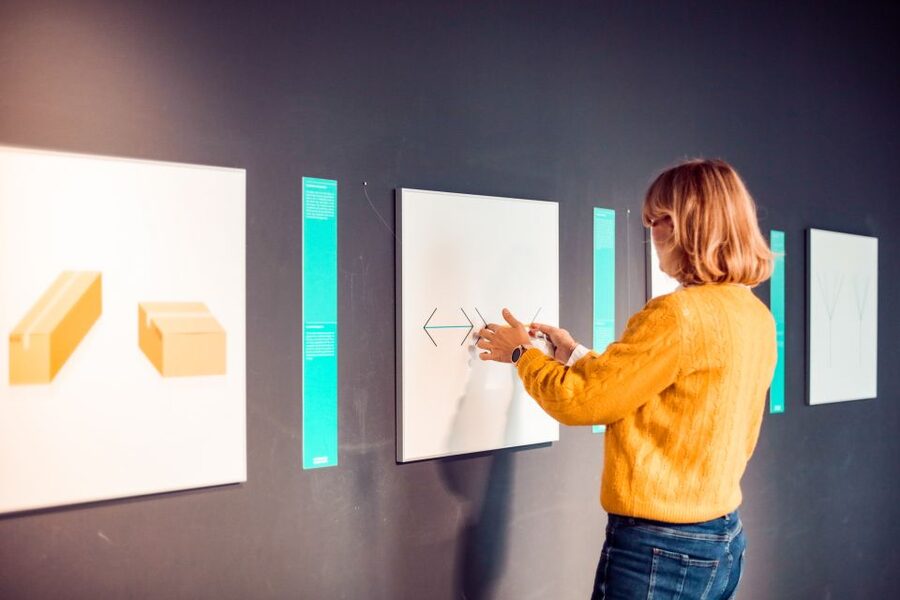
The Vortex Tunnel is likely to be the most physically disorienting exhibit. It uses a rotating cylinder to make you feel as if the floor or room is shifting, even though you are walking on a stable, flat surface.
That mismatch between what your body feels and what your feet know is the whole point. Your eyes send movement signals to your brain, and your sense of balance reacts. The result can make a short crossing feel surprisingly difficult.
You do not need to move fast. Take care, pay attention to your footing, and stop if the sensation becomes uncomfortable. This attraction is not suitable for people with epilepsy, so check the safety information before entering.
The Vortex Tunnel also shows why this museum is different from a standard photo attraction. You are not only looking at an illusion. You are feeling one through your balance and movement.
More Museums in Stuttgart:
- Stuttgart: Stuttgart Wine Museum Wine Tasting
★ 4.7 · 55 reviews - Berlin: Jewish Museum Berlin Entrance Ticket
★ 4.5 · 8,393 reviews - Berlin: DDR Museum Tickets
★ 4.3 · 3,443 reviews - Berlin: Natural History Museum Entrance Ticket
★ 4.6 · 3,382 reviews
Meet the Anti-Gravity Room and Tilted Room
The Anti-Gravity Room plays with your expectations about weight and direction. Its name suggests the kind of visual confusion to expect, though the supplied information does not specify the exact mechanism. You can expect an exhibit designed to make ordinary body positions and room angles seem unusual.
The Tilted Room works in a similar spirit by challenging your sense of what is level. When the room’s visual lines disagree with your body’s usual reference points, a simple pose can look exaggerated or unstable.
These exhibits are most enjoyable when you do not rush. Look at the walls, stand in different places, and notice how the room changes the way your body appears in a photo. The attraction is not just the final image. It is the moment when your brain tries to correct something that looks wrong.
The Tilted Room is not suitable for people with epilepsy. That warning also applies to the Zoetrope, so anyone with epilepsy should avoid those attractions.
Try the Clone Table and Head on the Platter
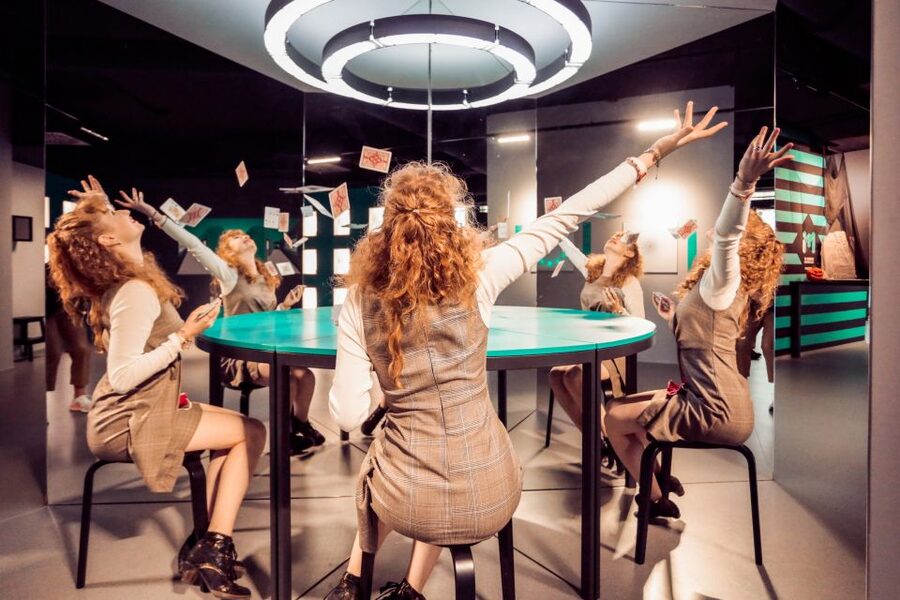
The Clone Table is designed for playful visual duplication. It gives you the chance to create the impression of multiple versions of yourself at one table. With friends or family, this can become one of the most amusing stops because the illusion works best when people take part together.
The Head on the Platter is another comic photo setup. Its name tells you the basic joke: the exhibit creates the appearance that a person’s head is separated from the rest of the body. The humor is simple, quick, and easy to understand.
These displays are less about learning a difficult optical principle and more about participation. They give you a reason to pose instead of only observing. That is useful if you are traveling with children or with people who prefer doing something to reading exhibit text.
The tradeoff is that these photo stations can feel brief. You may spend only a short time at each one, especially if you are visiting without companions. The museum’s value comes from trying the collection as a whole.
Watch holograms appear and disappear
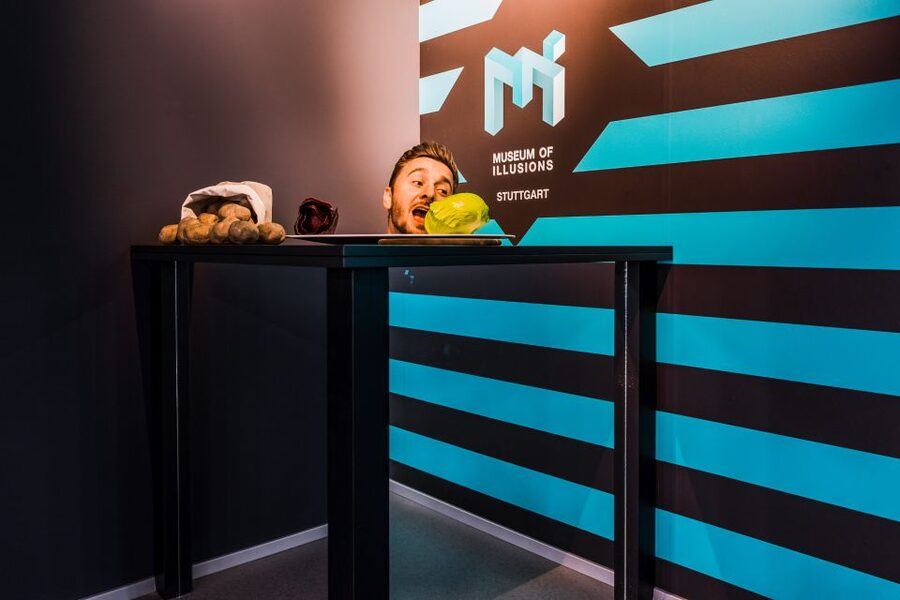
The hologram collection adds a quieter kind of surprise. Images appear to transform, emerge, and vanish as you look at them. Instead of physically entering an illusion, you watch an image change in front of you.
This section helps broaden the visit beyond mirrors and funny body poses. You can think about how the eye handles movement, light, and changing shapes. The effect may seem mysterious at first, but the museum connects it to the way images are created and perceived.
I would slow down here rather than treating the holograms as a fast photo stop. Watch an image for a few moments and notice which details your brain fills in. The point is not only to see something change, but to notice how quickly your mind forms a stable picture from unstable information.
Find the rhythm at the Turntables and Zoetrope
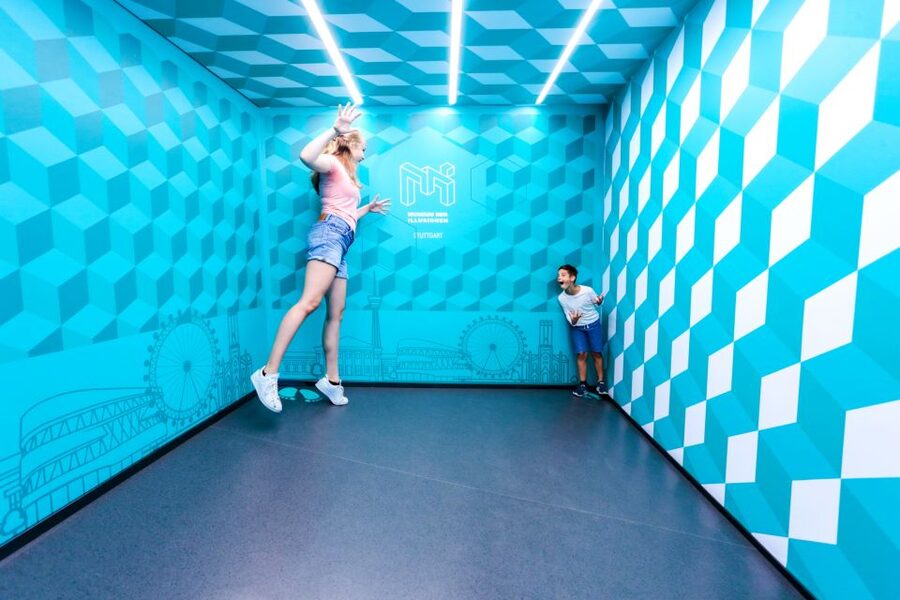
The Turntables create a hypnotic illusion through rotating patterns. Different turning motions can make the shapes seem to alter speed, direction, or form. This is a good place to pay attention to movement rather than reflection.
The Zoetrope also belongs to the museum’s motion-based side. The supplied safety information specifically lists it as unsuitable for people with epilepsy. If that applies to you, skip it and focus on the other exhibits.
The Turntables can be especially useful for understanding how repeated patterns affect perception. Your eyes detect motion, but your brain has to organize that motion into a sensible pattern. When the pattern is designed to confuse that process, the result feels strangely compelling.
You do not need to know the science in advance. The exhibit gives you a direct example, then the surrounding explanations help make sense of it.
Why the science makes the fun more worthwhile
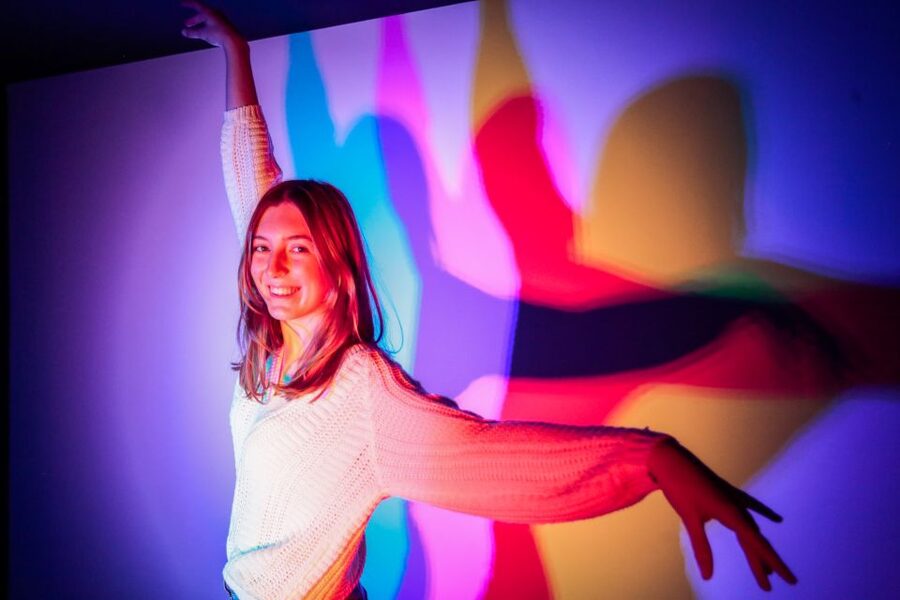
A museum of optical effects could easily become a series of gimmicks. The explanations about vision and perception give this visit more purpose. They show why your eyes and brain can disagree, and why a stable object can appear to move or change shape.
I find that this context makes the photographs better, not worse. Once you understand that your brain is making fast guesses about depth, balance, and space, you begin to notice the trick instead of simply accepting it.
This is also where the museum can suit school-age children and curious adults. You can enjoy the joke at one level and discuss the science at another. The experience does not require a long attention span, but it rewards you for looking twice.
Do not expect a formal guided lecture based on the information available. The learning comes as you walk around the exhibits and read or absorb their rational explanations.
Who will get the most from a $16 ticket
I think the ticket is best for families, friends, couples, and anyone who likes taking playful photos. The interactive design gives everyone something to do, and several exhibits work better when another person is there to pose with you.
It can also suit a rainy-day plan or a short break from outdoor sightseeing. The ticket is valid for one day, with starting times shown when you check availability. That gives you a little planning flexibility, but you should still check the available time before building the rest of your day around it.
Solo visitors can enjoy the science and holograms, but some of the biggest laughs come from group participation. The Clone Table, Head on the Platter, and distorted mirror areas are more rewarding when someone else can take the photo.
I would be less likely to recommend it to someone seeking art, local history, or a long, quiet museum visit. This is a compact, playful attraction. Its success depends on how willing you are to pose, test your balance, and try several effects.
Practical details that affect your visit
The entry ticket includes admission only. You need to arrange your own transportation, and food and drinks are not included. Bring a charged smartphone because photography is one of the central activities.
The museum is wheelchair accessible. The supplied information does not provide a visit length beyond the ticket being valid for one day, so check the available starting times and allow enough room in your schedule to try the exhibits without rushing.
You can cancel up to 24 hours in advance for a full refund. The reserve-now, pay-later option lets you hold a place without paying immediately, which may help if your Stuttgart plans are still shifting.
Safety deserves more attention here than at an ordinary museum. People with epilepsy should avoid the Vortex Tunnel, Zoetrope, and Tilted Room. If you are unsure about a particular effect, ask before entering.
Should you book the Museum of Illusions Stuttgart?
Book it if you want a hands-on attraction with funny photographs, physical sensations, and simple science. At $16, it offers fair value for a family or group that will try many exhibits and use the explanations as part of the experience.
Skip it if you want a major cultural museum or an activity that fills an entire day. Also think twice if rotating visual effects are unsuitable for you. For the right audience, the Mirror Room, Infinity Room, holograms, Vortex Tunnel, and photo stations make this an easy, lighthearted addition to a Stuttgart itinerary.
FAQ
How much does admission to the Museum of Illusions Stuttgart cost?
The entry ticket costs $16 per person.
How long is the ticket valid?
The ticket is valid for one day. Check availability for the available starting times.
What is included in the ticket?
The ticket includes entry to the Museum of Illusions Stuttgart.
Are transportation, food, and drinks included?
No. Transportation, food, and drinks are not included.
Is the museum wheelchair accessible?
Yes, the Museum of Illusions Stuttgart is wheelchair accessible.
What should I bring?
Bring a charged smartphone, especially if you want to take photos in the mirror rooms and other exhibits.
Which attractions are not suitable for people with epilepsy?
The Vortex Tunnel, Zoetrope, and Tilted Room are not suitable for people with epilepsy.
Can I cancel the booking?
Yes. You can cancel up to 24 hours in advance for a full refund. You can also reserve now and pay later.
Just added around Stuttgart
- Stuttgart: Exklusive Floßboote Finne & Fischle★ 4.5 · 23 reviews
- Stuttgart: Landesmuseum Württemberg Old Castle Entry Ticket★ 4.5 · 15 reviews
- Stuttgart: Wilhelma Zoological-Botanical Garden Ticket★ 4.7 · 121 reviews
- Stuttgart: Winter Sunday Brunch Buffet★ 4.6 · 16 reviews
- SUP Yoga with Guide★ 4.1 · 4 reviews
- Stuttgart: Walking Custom Tour with a Local Guide★ 3.8 · 4 reviews
- Stuttgart: Wine Tour with wines of the best winemakers★ 4.0 · 7 reviews
- Stuttgart: Stand Up Paddling Rental★ 4.6 · 55 reviews
Museums, compared.



Skip-the-Line: Berlin Wall Museum at Checkpoint Charlie
Read our review →
Browse the lists this tour appears in