Reviewed · BERLIN TOURS
The Old Berlin Tour: Travel Through Time With a Historian
Berlin rewards readers of the past. This two-hour walk with historian Sean Stewart links medieval ruins, royal power, wartime destruction, and the Berlin Wall, helping you understand why the city looks so patched together today. I like that the route moves at an easy pace, and I like the small maximum of eight people.
The tour costs $23, a fair price for a private-feeling history walk led by a professional historian. The main consideration is its focus: you will spend your time around central Berlin rather than covering every major sight, and the tour requires good weather.
In This Review
- Key points to know before you book
- Why this small Berlin history walk works
- Alexanderplatz: begin with a city that disappeared
- Franziskaner Klosterkirche: Berlin’s medieval fragment
- St. Mary’s Church: a surviving medieval anchor
- Nikolaiviertel: reconstruction with a touch of irony
- From medieval Berlin to the Berlin Wall
- What Sean Stewart adds to the experience
- Is $23 a good value for two hours?
- Timing, meeting point, and practical planning
- Who should book this Berlin history tour?
- Should you book The Old Berlin Tour?
- FAQ
- How long does The Old Berlin Tour last?
- What time does the tour start?
- Where does the tour begin?
- Where does the tour end?
- What places are included on the route?
- How many people can join the tour?
- Are food and drinks included?
- Can I cancel for a full refund?
Key points to know before you book
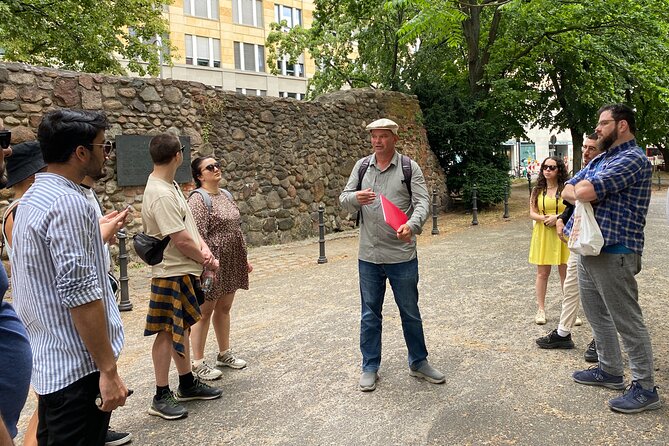
- A history-first route: The walk traces Berlin from the Middle Ages through the imperial era and into modern times.
- A small group of eight: The maximum group size should make it easier to hear Sean Stewart and ask questions.
- Four central stops: Alexanderplatz, Franziskaner Klosterkirche, St. Mary’s Church, and Nikolaiviertel form the main route.
- A useful starting point: The meeting place is Espresso HouseAlea 101 at Alexanderplatz Station, near public transportation.
- A practical finish: The walk ends at Berlin Cathedral, placing you near several major central Berlin sights.
- A historian’s way of looking: The aim is not simply to collect photographs. You learn how to read Berlin through vanished streets, rebuilt buildings, ruins, and political change.
Why this small Berlin history walk works
Berlin can be hard to read at first. Its grand avenues, empty spaces, rebuilt churches, Soviet-era traces, and modern glass buildings do not always explain themselves. A guide who can connect those pieces gives you more than a list of names and dates.
That is the promise of this walk. It begins at Alexanderplatz and finishes near Berlin Cathedral, using a compact part of the city to tell a long story. You move from medieval Berlin to the modern capital, with the imperial period, war, division, and the Berlin Wall included in the larger account.
I especially like the emphasis on learning how to interpret the city. Sean Stewart’s approach, based on the available comments about the experience, seems less concerned with stopping for photographs at every corner and more concerned with explaining what Berlin has to say. That matters here. Many of Berlin’s most useful clues are not polished monuments. They are gaps, odd alignments, fragments, and reconstructions.
The small group is another real advantage. With no more than eight people, you should have a better chance to hear explanations clearly and ask about details that catch your eye. One particularly useful strength is Sean’s local familiarity. One person who lives in Berlin found places along the route that were new even to them, which suggests this walk can offer more than the standard postcard circuit.
Still, keep your expectations in check. This is an outdoor walking experience, not a museum tour or a full survey of Berlin. The supplied route lists four main stops, each with about 15 minutes, so the walking time between them is part of the experience. You will see important places, but the value comes mainly from Sean’s interpretation.
A few more Berlin trips worth comparing
- Berlin: Reichstag, Dome and Government District Guided Tour
★ 4.7 · 18,288 reviews - Berlin: 1-Hour City Tour by Boat with Guaranteed Seating
★ 4.3 · 16,993 reviews - Berlin: Boat Tour Along the River Spree
★ 4.4 · 11,252 reviews
Alexanderplatz: begin with a city that disappeared
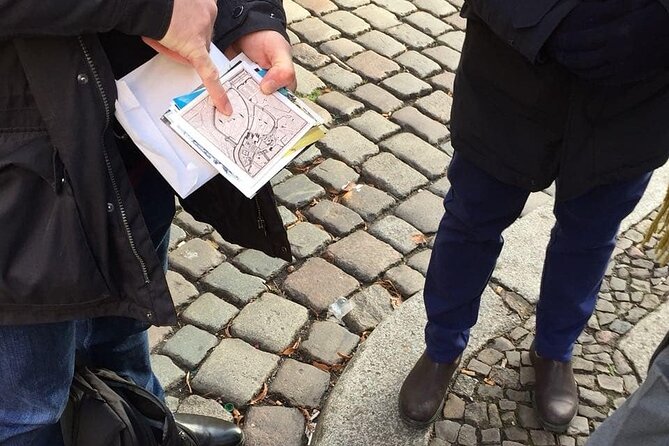
The meeting point is Espresso HouseAlea 101, Rathausstraße 6, at Alexanderplatz. The start time is 11:00 am. Alexanderplatz Station is convenient for reaching the tour, and the area is near public transportation, which makes this an easy appointment to fit into a day of sightseeing.
The first stop deals with vanished streets and buildings. That is a smart place to begin because Alexanderplatz is not a simple picture of old Berlin. It is a place where layers of the city have been removed, rebuilt, and rearranged.
You can expect Sean to use the site to explain how Berlin changed over time rather than treating the square as a single monument. The idea of moving pieces is especially useful here. Buildings, streets, political systems, and public spaces have all shifted, leaving a city that can feel historically uneven.
I like this opening because it teaches you how to look. Instead of asking only what remains, you start asking what used to be here, why it vanished, and what replaced it. That habit will help you at every later stop.
Alexanderplatz is also a practical place to get your bearings. Because the tour begins at a major transit point, you do not need to cross the city before the history lesson starts. Arrive with enough time to find the café meeting point and check your mobile ticket.
Franziskaner Klosterkirche: Berlin’s medieval fragment
The second stop is Franziskaner Klosterkirche, described as Berlin’s only medieval romantic ruin. The word ruin is important. This is not a perfectly restored medieval church presented as if time had left it untouched.
A surviving ruin can say more than a polished reconstruction. It shows loss, damage, and the limits of restoration. In Berlin, where war and political change reshaped whole districts, a fragment like this helps you see that the old city was not simply preserved for modern visitors.
The stop is planned for about 15 minutes, so you should expect a focused explanation rather than a long visit inside a church. Admission is listed as free. The experience is about the site and its meaning, not an included entry program.
I would pay close attention to how Sean handles the contrast between the medieval building and the modern city around it. That contrast is one of the central pleasures of Berlin. A ruin here is not isolated from city life. It becomes part of a debate about what should be remembered, rebuilt, or left visible.
If you prefer grand interiors and long museum visits, this brief stop may feel too short. If you like seeing physical evidence of change, it should be one of the most useful moments on the route.
St. Mary’s Church: a surviving medieval anchor
St. Mary’s Church is the third stop. It is described as an important church from medieval times, giving the route another chance to look at Berlin before the city became the imperial and divided capital most people know today.
The church helps widen the story beyond royal buildings and political events. Religious institutions were part of the early city’s structure, and a medieval church gives you a physical link to that period. The stop also helps show how much of Berlin’s older center has survived, changed, or disappeared.
Again, the planned visit is about 15 minutes. You should think of this as a guided orientation, not a full church tour. The exact amount of time you spend inside or around the building is not specified, so I would treat Sean’s explanation as the main feature.
This is where a historian’s training can make a difference. Dates alone will not explain why a medieval church still matters in a modern capital. The useful questions are larger: Who used it? What did it mean to the early city? How did later governments and wars alter its setting?
The route’s order makes sense. After beginning with a place marked by vanished buildings and then visiting a ruin, you encounter a medieval church that remains part of the city’s public story. Berlin’s past begins to feel less like a straight line and more like a series of interruptions.
Still Berlin, at a slower pace:
- Discover Berlin Half-Day Walking Tour
★ 5.0 · 9,624 reviews - Berlin: Hop-on Hop-off Bus Tour with Live Commentary
★ 4.3 · 8,579 reviews - Berlin: Government District around the Reichstag Guided Tour
★ 4.7 · 8,447 reviews - Berlin: Reichstag, Plenary Chamber, Cupola & Government Tour
★ 4.6 · 8,422 reviews
Nikolaiviertel: reconstruction with a touch of irony
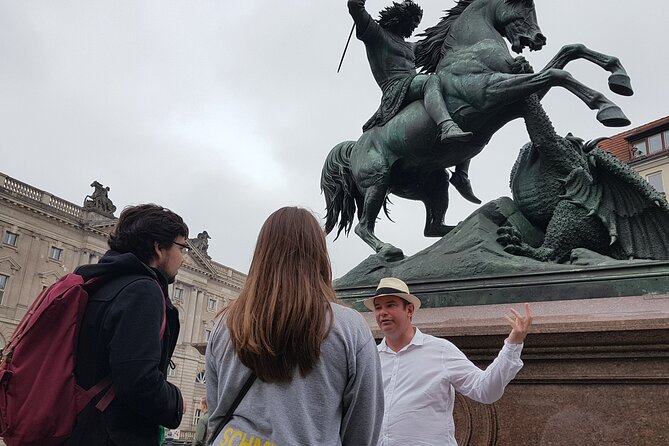
Nikolaiviertel is the final listed stop and perhaps the most complicated. It is described as Berlin’s reconstructed medieval Disneyland, a deliberately playful phrase that signals the area’s artificial quality.
That does not make it worthless. Reconstruction can preserve a memory of a district, create a sense of place, and help you understand how modern Berlin chooses to present its past. But it can also blur the line between old fabric and new design.
This is exactly the kind of contradiction that suits Berlin. You are not simply looking at an untouched medieval quarter. You are looking at a modern interpretation of one, and that interpretation tells you something about politics, memory, and the desire to give the capital an old center.
The stop is scheduled for about 15 minutes and admission is free. You will likely gain the most from listening carefully to the explanation of what is original, what was rebuilt, and why the district looks the way it does. The provided information does not specify which individual buildings or courtyards you enter, so do not book this expecting a detailed architectural inspection of every corner.
I like that the route ends here before continuing to Berlin Cathedral. Nikolaiviertel leaves you with a useful question: can a reconstructed place still tell the truth about the past? In Berlin, the answer is often complicated, and that is part of the point.
From medieval Berlin to the Berlin Wall
The four named stops concentrate on the old center, but the tour is presented as a history of Berlin from the Middle Ages to the Berlin Wall. That means the walk is not only about church walls and medieval streets.
You should expect the guide to connect the older city with the imperial period, the destruction and rebuilding of the twentieth century, and the division of Berlin. The walk’s value lies in those connections. A medieval ruin is not treated as a separate curiosity. It becomes part of the larger story of how Berlin gained power, suffered destruction, split into opposing systems, and reunited.
The available route details do not identify a separate Berlin Wall stop, nor do they give the exact points used to discuss the wall. I would therefore view the Berlin Wall as part of the historical framework rather than assume you will visit a famous wall memorial.
That distinction matters when planning your day. If you want a dedicated Berlin Wall tour, check the route details before booking another activity. This walk is better suited to building a timeline and understanding how different periods overlap in the city center.
What Sean Stewart adds to the experience
Sean Stewart is identified as the professional historian and guide. The strongest praise centers on his ability to explain Berlin rather than merely point at it.
One useful detail is that he has been described as someone who knows Berlin’s courtyards well. That suggests an eye for spaces that are easy to miss from the street. The route details do not promise a courtyard visit, so I would not count on one specific hidden passage, but you can reasonably expect attention to the less obvious parts of the city.
The comments also point to a willingness to adapt. On one half-day outing, Sean first asked about a person’s previous time in Berlin and what they wanted to see, then shaped the experience toward less familiar parts of the city. The advertised walk is approximately two hours, so that kind of flexibility may depend on the group and the day. Still, it is worth telling him at the start if you have already seen the major sights.
His style appears to include contradictions and irony. That is valuable in Berlin because simple explanations often fail. A rebuilt medieval quarter may look old without being old. A ruin may be more honest than a reconstruction. A grand political space may hide the ordinary streets that came before it.
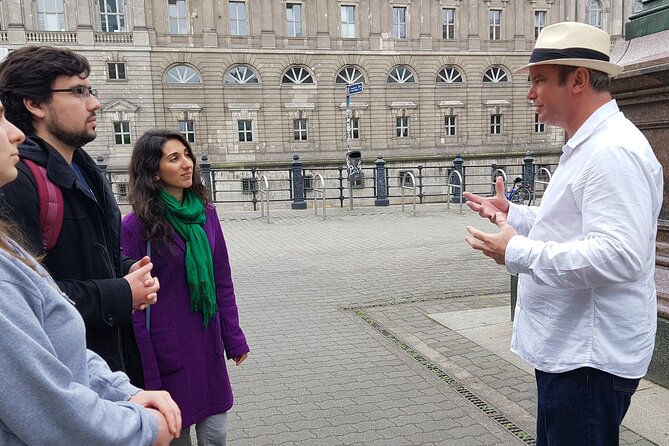
The best approach is to listen actively. Ask why a building survived, why another vanished, and how Berlin’s past is presented today. A small group gives you a good setting for that kind of conversation.
Is $23 a good value for two hours?
At $23, this is a reasonable buy if history is your main interest. You are paying for about two hours with a professional historian, not for food, drinks, or entry to a paid attraction. The listed stops have free admission, so the guide’s knowledge and the structure of the walk are the main products.
That is a fair arrangement for someone who wants context. You could walk through the same central area alone, but you might miss why the gaps, ruins, and reconstructions matter. The fee is especially sensible for a first day in Berlin, when a strong orientation can help you understand later sightseeing.
The value is weaker if you want a fast checklist of famous monuments. Four listed stops may sound limited, and the route does not promise interior visits, transport, refreshments, or a large number of attractions.
The maximum of eight helps protect the value. A small group usually makes a history walk feel more like a conversation than a speech, although the actual quality still depends on the day and the guide. The mobile ticket also keeps the booking simple.
Timing, meeting point, and practical planning
The walk starts at 11:00 am at Espresso HouseAlea 101, Rathausstraße 6, 10178 Berlin. It ends at Berlin Cathedral, Am Lustgarten, also in the 10178 postal area. This point-to-point design is useful because you finish near a major central sight instead of returning to the starting station.
The advertised duration is approximately two hours. The four stops are each listed at about 15 minutes, with walking time between them. Wear shoes suitable for city walking and plan around the weather, since the experience requires good weather.
Food and drinks are not included. Have breakfast beforehand or plan a meal after the walk. Because the end is at Berlin Cathedral, you can continue your day from the central area, though the tour itself does not include cathedral admission.
Most people can participate, and service animals are allowed. The tour is near public transportation. No special fitness requirement is stated, but it is still a walking tour, so you should be comfortable spending about two hours on foot.
Confirmation is provided when you book. Free cancellation is available if you cancel at least 24 hours before the local start time. Inside that window, the payment is not refunded and changes are not accepted. If bad weather or an insufficient number of bookings cancels the experience, you are offered another date or experience, or a full refund.
Who should book this Berlin history tour?
I would choose this walk if you like history, urban change, and guides who explain the odd details. It should suit first-time visitors who want a strong introduction, as well as people who already know Berlin’s main sights and want to look at the city in a different way.
It is also a good match for anyone who enjoys questions without simple answers. Nikolaiviertel’s reconstructed medieval character, Franziskaner Klosterkirche’s ruined form, and Alexanderplatz’s vanished streets all invite discussion rather than quick photography.
You may want something else if your priority is the Berlin Wall alone, museum interiors, food, or a large list of famous landmarks. The walk is also weather-dependent, and its short stops mean you should not expect a long visit at each location.
Should you book The Old Berlin Tour?
Book it if you want Berlin explained, not just displayed. The $23 price is sensible for a small-group walk led by Sean Stewart, especially if you value historical context and unusual details over a rapid photo tour.
I would make it one of the first activities of a Berlin visit if you want a framework for the city. If you already know central Berlin well, tell Sean what you have seen and ask for the less familiar angle. Skip it only if you need a dedicated Berlin Wall route or a longer, attraction-heavy tour.
FAQ
How long does The Old Berlin Tour last?
The tour lasts approximately two hours.
What time does the tour start?
It starts at 11:00 am.
Where does the tour begin?
The meeting point is Espresso HouseAlea 101, Rathausstraße 6, 10178 Berlin, Germany, near Alexanderplatz Station.
Where does the tour end?
The tour ends at Berlin Cathedral, Am Lustgarten, 10178 Berlin, Germany.
What places are included on the route?
The listed stops are Alexanderplatz, Franziskaner Klosterkirche, St. Mary’s Church, and Nikolaiviertel.
How many people can join the tour?
The group has a maximum of eight people.
Are food and drinks included?
No. Food and drinks are not included.
Can I cancel for a full refund?
Yes, if you cancel at least 24 hours before the experience start time. Cancellations made less than 24 hours in advance are not refunded. If poor weather or an insufficient number of bookings causes the tour to be canceled, you are offered another date or experience, or a full refund.
Just added around Berlin
- Private Walking Tour in Berlin: Hitler’s Germany & WWII★ 5.0 · 7 reviews
- The History of Berlin: WWII PRIVATE Walking Tour With Locals★ 5.0 · 209 reviews
- Private Berlin WWII and Cold War History Tour with Local Expert Guide★ 5.0 · 28 reviews
- Private Walking Tour Berlin 3 hours: Brandenburg, Historic Center★ 5.0 · 7 reviews
- Berlin: Private Bike Tour of the Berlin Wall and Third Reich★ 5.0 · 23 reviews
- Berlin: Guided Private Bike Tour to Explore the Highlights★ 5.0 · 12 reviews
- Berlin Photography Masterclass – Private Photography Lesson★ 4.5 · 23 reviews
- Group Driving Tour 1 to 6 people. Berlin Shore Excursion incl pick-up at Port★ 5.0 · 8 reviews
Berlin Tours, compared.
Reichstag, Dome and Government District Guided Tour
Read our review →
1-Hour City Tour by Boat with Guaranteed Seating
Read our review →

Government District around the Reichstag Guided Tour
Read our review →
Reichstag, Plenary Chamber, Cupola & Government Tour
Read our review →