Reviewed · BERLIN TOURS
Wall Tour Berlin – Fates, Heroes & Love Stories
History feels different when you can see where it happened. This two-hour walking tour follows the Berlin Wall along Bernauer Strasse, where escapes, deaths, divided families, and small acts of courage took place. I like the human stories, especially the accounts of border guard Conrad Schumann, tunnel escapes, window jumps, and the church trapped inside the border strip. I also like the route’s clear shape, beginning near Nordbahnhof and ending at Mauerpark.
The tour costs about $19.66 per person, a fair price for two hours with a guide and no admission fees. The main concern is reliability: two separate groups reported that no guide appeared at the meeting point, while other bookings praised the experience highly. Confirming the meeting details before departure is sensible.
In This Review
- Key Points Before You Book
- Why Bernauer Strasse Is the Right Place to Learn About the Wall
- Stops 1 to 3: Ghost Stations and the Sudden Wall
- Stops 4 and 5: The Memorial Window and the Border Strip
- Stops 6 and 7: A Church Inside the Border
- Stops 8 and 9: Window Escapes and a Famous Tunnel
- Stops 10 and 11: Conrad Schumann and State-Sponsored Kidnapping
- Stop 12: Berlin’s Loudspeaker War
- Stop 13: Mauerpark and the End of the Walk
- What You Get for $19.66
- The Important Booking Risk
- Who Should Take This Walk?
- Should You Book Wall Tour Berlin?
- FAQ
- Where does the Wall Tour Berlin begin?
- Where does the tour end?
- How long does the tour last?
- How much does the experience cost?
- Is the tour conducted with a mobile ticket?
- How many people can join the tour?
- Is the tour near public transportation?
- Does the tour include admission fees?
- Can I cancel for a full refund?
- What happens if bad weather cancels the tour?
Key Points Before You Book
- Bernauer Strasse is the main stage: The route uses the Berlin Wall Memorial, viewing platform, border strip, Chapel of Reconciliation, and former escape locations.
- The focus is personal rather than purely political: You hear about deaths, desperate escapes, propaganda, kidnappings, love stories, and the daily cruelty of a sealed border.
- It lasts about two hours: Thirteen short stops keep the walk moving, but the schedule allows only brief explanations at several places.
- The route ends at Mauerpark: From Bernauer Strasse and Oderberger Strasse, you can take the M10 tram toward Berlin Central Station.
- The group can reach 25 people: That is small enough for a walking tour, though the guide’s ability to answer questions may depend on the final group size.
- Booking security deserves attention: The score is 4.1 from nine ratings, with strong praise for the storytelling but serious complaints about missed departures.
Why Bernauer Strasse Is the Right Place to Learn About the Wall
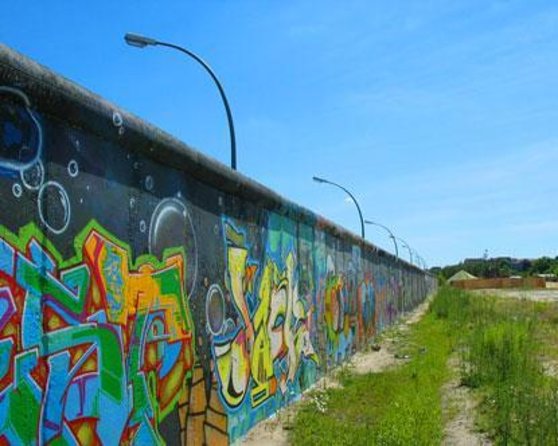
The Berlin Wall once cut through the city for more than 40 kilometers and divided East and West Germany for 28 years. At Bernauer Strasse, the division was especially stark because apartment buildings stood in East Berlin while their windows and doorways opened toward West Berlin.
That physical arrangement created a cruel border. Residents could look into the West from their homes, yet crossing the street could mean imprisonment or death. The memorial area preserves enough of the former border strip to help you understand that this was not simply a concrete wall. It included fences, watchtowers, patrol routes, barriers, and open ground designed to stop people from escaping.
I value this setting because it makes the system easier to grasp. A museum display can explain border controls, but here you can see how the border ran through ordinary streets and between ordinary homes. The route also avoids treating the Wall as a single dramatic object. Instead, it shows how the division affected churches, railway stations, families, young people, border guards, and people who tried to flee.
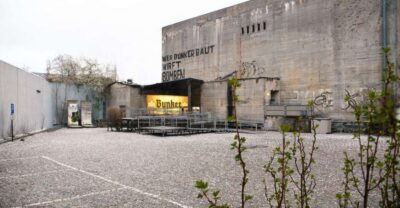
The tour begins at Elisabeth-Schwarzhaupt-Platz, near the entrance to the Nordbahnhof S-Bahn station on Gartenstrasse. The first short stop concerns the old ghost stations. During the GDR period, some trains in West Berlin passed through stations located in East Berlin without stopping. Those platforms were sealed and heavily guarded, creating eerie underground spaces that passengers could see but not use.
This is a smart opening because it introduces the Wall as a system of control, not just a barrier above ground. You begin with public transport, then move into the wider story of the border.
A few more Berlin trips worth comparing
- Berlin: Reichstag, Dome and Government District Guided Tour
★ 4.7 · 18,288 reviews - Berlin: 1-Hour City Tour by Boat with Guaranteed Seating
★ 4.3 · 16,993 reviews - Berlin: Boat Tour Along the River Spree
★ 4.4 · 11,252 reviews
Stops 1 to 3: Ghost Stations and the Sudden Wall
At the first stop, the guide explains the ghost stations and the meaning of the nearby crossing point. The description of the tour uses the idea of jumping over the Wall at the station entrance, a symbolic beginning to a walk about a border that once seemed impossible to cross.
The next stop gives a short explanation of how the Wall could be built at all. The time allotted is only five minutes, so do not expect a full political lecture here. You get the essential framework before moving to the larger memorial site.
The third stop focuses on August 13, 1961, when the border was sealed. The guide explains Walter Ulbricht’s false assurance in June that nobody intended to build a wall, followed less than two months later by the closure of the border.
That contrast is one of the most useful pieces of context on the route. The Wall did not appear after years of open discussion for ordinary Berliners. It arrived quickly, cutting off routes to work, relatives, schools, and homes. The guide also explains how the border strip was constructed, helping you see the stages involved rather than imagining one wall going up overnight.
Because the stop lasts about ten minutes, this section is likely to be concise. If you want a detailed study of Cold War politics, you will need more time elsewhere. If you want a clear introduction before walking through the memorial, the pacing works well.
Stops 4 and 5: The Memorial Window and the Border Strip
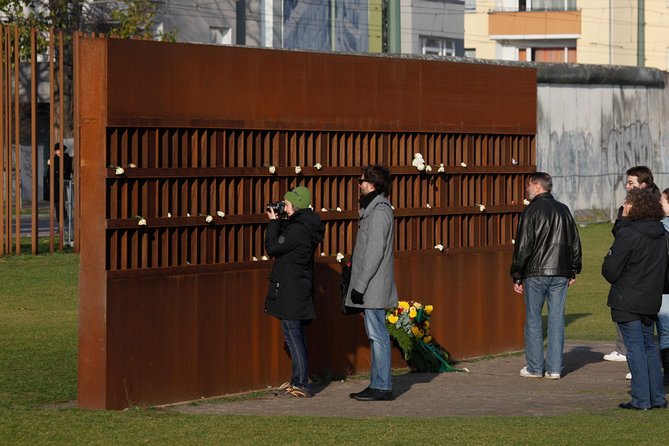
The tour then turns to the people who died trying to cross. At least 140 people died at the Berlin Wall between 1961 and 1989, although the exact number of victims remains uncertain. At the memorial window, the guide tells individual stories connected to those deaths.
This is where the tour takes on its emotional weight. Statistics explain the scale of the border, but names and personal choices explain its human cost. You hear about people who wanted freedom badly enough to risk everything, and about those who died through gunfire, falls, or desperate attempts to escape.
The subject is heavy. The tour description includes people who jumped from windows out of fear and despair, and the experience does not soften the cruelty of those events. You should be comfortable with difficult material before booking. Parents may want to decide in advance whether this level of detail is right for younger children.
At the viewing platform, you get an overview of the former border strip on Bernauer Strasse. This is one of the most useful physical pauses on the walk. From above, the arrangement becomes easier to read: the memorial remains, open ground, reconstructed barriers, and the route of the former border.
I would pay close attention here instead of treating the platform as a quick photo stop. The whole point is to understand the distance between the two sides and the layers of security in between. The guide accompanies you to the platform, but the stated stop lasts about 15 minutes, so the explanation will still be focused.
Stops 6 and 7: A Church Inside the Border
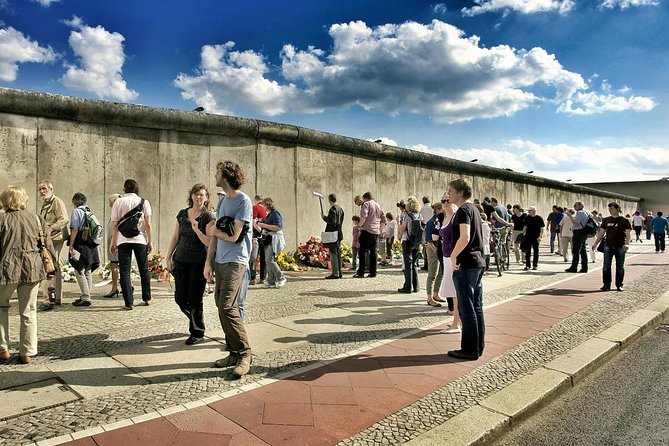
Near Ackerstrasse, the tour reaches the Chapel of Reconciliation. It stands where the Church of Reconciliation once stood, directly in the border strip. Before the border closed, people from East and West Berlin worshipped together there. After the Wall went up, the church became an obstacle inside the restricted zone.
The guide explains what happened to the building after the closure. This stop adds an important religious and social dimension to the story. The Wall did not only divide political systems. It disrupted communities that had gathered for ordinary reasons, including worship.
The following stop covers passenger agreements between West Berlin’s Senate and the GDR. These arrangements were intended to make the Wall somewhat more permeable under controlled conditions. That detail matters because the border was not equally open or closed at all times. Rules changed, access was negotiated, and every exception remained subject to the GDR’s authority.
The guide also discusses how the GDR used children and young people for propaganda. That subject gives the tour a broader reach. The story is not only about people who tried to escape. It is also about how a state shaped public attitudes and used young citizens to support its political message.
Each of these stops lasts around five to ten minutes. That keeps the walk from becoming slow, but the short timing means you may want to visit the memorial independently afterward if a particular topic catches your interest.
Still Berlin, at a slower pace:
- Discover Berlin Half-Day Walking Tour
★ 5.0 · 9,624 reviews - Berlin: Hop-on Hop-off Bus Tour with Live Commentary
★ 4.3 · 8,579 reviews - Berlin: Government District around the Reichstag Guided Tour
★ 4.7 · 8,447 reviews - Berlin: Reichstag, Plenary Chamber, Cupola & Government Tour
★ 4.6 · 8,422 reviews
Stops 8 and 9: Window Escapes and a Famous Tunnel
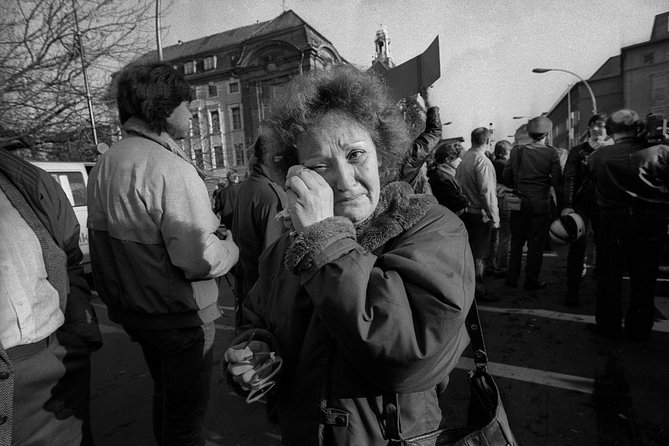
The residential buildings along Bernauer Strasse produced some of the most desperate scenes connected with the Wall. Their windows faced West Berlin while the buildings themselves stood in East Berlin. When the border closed, residents faced a terrible choice: remain trapped or attempt an escape through windows watched by the authorities.
The guide explains the tragedies that took place here, including the people who jumped from upper floors and died. The route then gives you time to look at photographs and videos at your own pace. That pause is welcome. A guide’s account gives the scene meaning, while the images let you process the details quietly.
The ninth stop concerns the tunnel escapes of the 1960s. Several escape tunnels were dug during that decade, and one near the former border house became especially famous. You walk to the tunnel site and hear how the GDR used the event for propaganda.
This is a good example of the tour’s broader approach. It presents escape attempts not only as daring stories, but also as battles over information. The people who dug tunnels wanted freedom. The state wanted to control how those attempts were understood by the public.
The exact tunnel story is presented in about ten minutes, so you should not expect a technical account of construction, engineering, and every participant. You will get the main human and political significance, with the advantage of standing close to the location.
Stops 10 and 11: Conrad Schumann and State-Sponsored Kidnapping
One of the shortest stops concerns border guard Conrad Schumann. His jump over the barbed wire became one of the most famous images of escape at the Berlin Wall. The guide discusses Schumann’s life and explains that he remained wanted until the GDR fell.
The power of this story comes from its speed. A single jump, captured in a photograph, became a lasting symbol of refusal. Yet the tour does not treat the image as the whole story. By discussing Schumann’s later life and continued status as a wanted man, it shows the personal consequences that followed the moment of escape.
The next stop covers kidnappings carried out on behalf of the GDR. Former members of the National People’s Army and the People’s Police were among those targeted by criminal groups operating from the West. One kidnapping ended in death.
This is a less familiar part of the Wall’s story, and I appreciate its inclusion. It shows that the conflict did not stop at the concrete border. Pressure, intimidation, and retaliation could reach across the divided city and into West Berlin.
The subject is grim, and the stop lasts only about five minutes. Think of it as an introduction to a disturbing chapter rather than a complete investigation.
Stop 12: Berlin’s Loudspeaker War
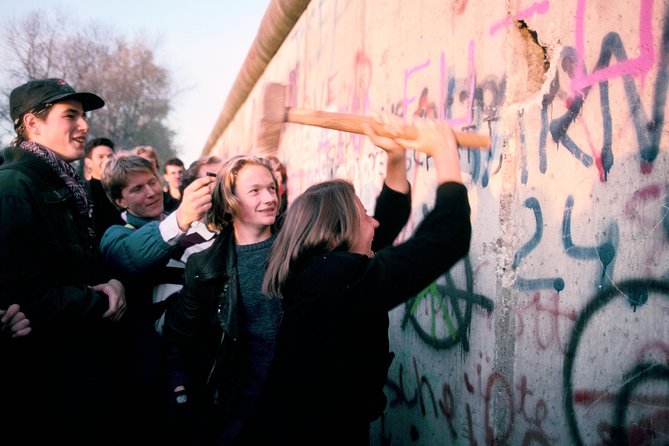
The Cold War was fought with more than soldiers, barriers, and escape attempts. East and West Berlin also used loudspeakers against each other. The guide explains how this sound battle worked and how both sides made daily life more difficult for the other.
It may seem like a minor detail beside deaths and imprisonment, but it helps you picture the atmosphere of divided Berlin. A border can be seen, but propaganda can also be heard. Public space became another place where each side tried to claim authority.
This stop lasts about five minutes, so expect a sharp explanation rather than a long discussion. It adds texture to the route and breaks up the most tragic stories before the final section about the Wall’s fall.
Stop 13: Mauerpark and the End of the Walk
The tour ends at Mauerpark, near Bernauer Strasse and Oderberger Strasse. The guide discusses the fall of the Wall and explains that its collapse also had a story, rather than being one sudden, simple moment.
Ending here is practical. Mauerpark gives the route a clear finish, and from Bernauer Strasse and Oderberger Strasse you can take the M10 tram toward Berlin Central Station. The end point also leaves you in a part of Berlin with other things to see, though the tour itself does not include additional admissions.
The final stop lasts about five minutes. That is enough for a closing account, but not enough for a full study of the political events of 1989. If the fall of the Wall is your main interest, plan extra time at another museum or memorial after the walk.
What You Get for $19.66
At roughly $19.66 per person, this is inexpensive for a two-hour guided walk in central Berlin. There are no admission charges at the listed stops, so most of what you pay goes toward the guide’s time, organization, and storytelling.
The value depends on what you want. If you mainly want photographs of remaining Wall sections, you can visit much of Bernauer Strasse on your own. If you want the sites connected into a story, the price is reasonable. The route links ghost stations, the border strip, escape tunnels, church history, deaths, propaganda, and the fall of the Wall in one compact outing.
The group limit is 25 people. That is not an intimate private walk, but it is still a manageable size for an outdoor route. A full group may make it harder to hear or ask extended questions, especially at busy memorial areas.
The experience uses a mobile ticket and confirmation is provided at booking. It is near public transport, and most people can participate. The tour requires good weather, and it can also be canceled if the minimum number of participants is not reached. In either case, you are offered another date or experience, or a full refund.
Free cancellation is available up to 24 hours before the start time. Inside that 24-hour window, you receive no refund, and changes are not accepted. Plan carefully, particularly since this is an outdoor walk.
The Important Booking Risk
The strongest praise focuses on the storytelling. One German-language booking describes the walk as exciting and entertaining, with time passing quickly. Another calls it a must for a visit to Berlin and says the serious subject matter still brought real value and a better understanding of the Wall and the division of Germany.
Those comments fit the route. The stops are short, varied, and built around personal stories rather than a long classroom-style talk. The inclusion of love stories is also notable. Even in a history marked by fear and death, people formed relationships, made plans, and tried to hold on to ordinary life.
But you should not ignore the serious complaints. Two separate groups reported waiting at the agreed meeting place while no guide appeared. One account describes a late and rude response after the group tried to make contact. Another uses very strong language and threatens legal action.
That creates a sharp contrast with the positive accounts. The published rating is 4.1 from nine ratings, which suggests a generally favorable experience but also a small sample and a meaningful operational risk. I would save the confirmation, check the meeting point on a map, arrive early, and make sure you have a way to contact the provider, Freizeit-und Reiseclub Berlin, on the day.
The available information does not identify individual guides by name. That means you cannot choose a particular storyteller based on the guide. The quality may depend heavily on who leads the walk.
Who Should Take This Walk?
I would recommend it to first-time Berlin visitors who want a clear introduction to the Wall without spending half a day inside a museum. It suits people who learn best by walking through real places and hearing how political decisions affected individuals.
It is also a good choice if you already know the basic story but want less familiar subjects, such as ghost stations, loudspeaker warfare, kidnappings, youth propaganda, and the Church of Reconciliation. Those details give the route more range than a simple account of construction and collapse.
You should think twice if you dislike difficult historical material. The stories include deaths, suicide, imprisonment, forced separation, and state abuse. The route is not a light sightseeing stroll, even though the pace is brisk.
It may also disappoint you if you want an in-depth political history or long stops at every memorial. Thirteen stops in two hours means the guide must keep moving. You get a broad, personal account, not a specialist seminar.
Should You Book Wall Tour Berlin?
Book it if the meeting arrangements are confirmed and you want a short, affordable walk built around personal stories. Bernauer Strasse is one of the best places in Berlin to understand how the Wall divided real homes and communities, and this route connects the physical remains with individual acts of courage and despair.
I would not book it blindly. The no-show complaints are too specific to dismiss, especially since the group size and review sample are small. Confirm the start time and location shortly before setting out, then keep the provider’s contact details available.
For about $19.66, the experience offers good potential value. Its best feature is not the number of stops, but the choice of stories: a border guard’s jump, tunnel escapes, people at the windows, a church caught in the border strip, and a city shouting across itself. If reliable operation matters more to you than price, consider that risk before paying.
FAQ
Where does the Wall Tour Berlin begin?
It begins at Elisabeth-Schwarzhaupt-Platz, 10115 Berlin, near the entrance to the Nordbahnhof S-Bahn station on Gartenstrasse.
Where does the tour end?
The tour ends near Bernauer Strasse and Oderberger Strasse at Mauerpark, in Berlin’s Pankow district.
How long does the tour last?
The walking tour lasts approximately two hours.
How much does the experience cost?
The listed price is about $19.66 per person.
Is the tour conducted with a mobile ticket?
Yes. A mobile ticket is available, and confirmation is provided at the time of booking.
How many people can join the tour?
The maximum group size is 25 people.
Is the tour near public transportation?
Yes. The route begins near the Nordbahnhof S-Bahn station. From the end point near Bernauer Strasse and Oderberger Strasse, you can take the M10 tram toward Berlin Central Station.
Does the tour include admission fees?
The listed stops have no admission charge. The experience is an outdoor walking tour through the memorial area and nearby streets.
Can I cancel for a full refund?
Yes, if you cancel at least 24 hours before the experience begins. Cancellations within 24 hours are not refundable.
What happens if bad weather cancels the tour?
If poor weather causes a cancellation, you are offered a different date or a full refund. The tour can also be canceled if its minimum number of participants is not reached, with a different date or experience, or a full refund, offered instead.
Just added around Berlin
- Private Walking Tour in Berlin: Hitler’s Germany & WWII★ 5.0 · 7 reviews
- The History of Berlin: WWII PRIVATE Walking Tour With Locals★ 5.0 · 209 reviews
- Private Berlin WWII and Cold War History Tour with Local Expert Guide★ 5.0 · 28 reviews
- Private Walking Tour Berlin 3 hours: Brandenburg, Historic Center★ 5.0 · 7 reviews
- Berlin: Private Bike Tour of the Berlin Wall and Third Reich★ 5.0 · 23 reviews
- Berlin: Guided Private Bike Tour to Explore the Highlights★ 5.0 · 12 reviews
- Berlin Photography Masterclass – Private Photography Lesson★ 4.5 · 23 reviews
- Group Driving Tour 1 to 6 people. Berlin Shore Excursion incl pick-up at Port★ 5.0 · 8 reviews
Berlin Tours, compared.
Reichstag, Dome and Government District Guided Tour
Read our review →
1-Hour City Tour by Boat with Guaranteed Seating
Read our review →
Government District around the Reichstag Guided Tour
Read our review →
Reichstag, Plenary Chamber, Cupola & Government Tour
Read our review →