
Reviewed · HISTORICAL TOURS
Augsburg – Private Historic Tour
Augsburg rewards curious walkers. This private three-hour tour gives you a clear route through one of Germany’s oldest cities, with Fuggerei and the restored Goldener Saal among its strongest stops. I like the private format, which lets you ask questions and adjust the pace, and I like the way the route connects Roman-era roots, medieval churches, Renaissance fountains, and postwar rebuilding. The main drawback is the price for a small party, plus extra admission fees for Schaezlerpalais and the Goldener Saal.
The tour starts at Augsburg Town Hall and ends near Fuggerei, so you cover a useful stretch of the center instead of circling one square. Guides Kristen and Stephanie received especially warm praise for personal service, including meeting at a train station, greeting a group at its hotel, and shaping the visit around its interests. Still, the non-refundable booking policy means you should be certain of your plans before paying.
In This Review
- Key points at a glance
- Why this Augsburg tour works well
- Starting at the Rotes Tor
- Gothic stone at St. Ulrich and Afra
- Baroque style inside Schaezlerpalais
- Hercules and Augsburg’s fountain story
- The Goldener Saal and a hard wartime story
- Perlach Tower and Augustusbrunnen
- St. Anne’s Church and the Fugger connection
- Augsburg Cathedral’s long timeline
- Fuggerei, the tour’s most distinctive ending
- What the guides add to a private visit
- Price, pace, and practical value
- Who should book this Augsburg experience?
- Should you book it?
- FAQ
- How long is the Augsburg private historic tour?
- How much does the tour cost?
- Is this a private tour?
- Where does the tour start?
- Where does the tour end?
- Which entrance fees are not included?
- Can the tour timing be adjusted?
Key points at a glance
- A private route through ten major sights: You visit the Rotes Tor, two churches, three fountains, the town hall, Perlach Tower, Augsburg Cathedral, and Fuggerei.
- Fuggerei gives the tour its most unusual stop: Founded in 1516, this social housing complex is still in use.
- The Goldener Saal adds a powerful rebuilding story: Its decoration was lost in a 1944 air raid and recreated after the war.
- Two paid entrances are separate: Plan on €7 per person for Schaezlerpalais and €2.50 per person for the Goldener Saal.
- A private guide changes the experience: You can ask about the Fugger family, church art, fountains, and Augsburg’s long past without waiting for a group.
- The price favors larger groups: At $417.72 for up to 15 people, the per-person cost drops sharply as your party grows.
Why this Augsburg tour works well
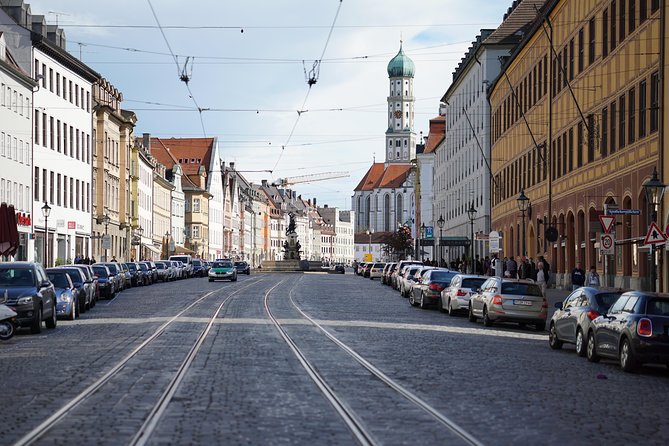
Augsburg is easy to underestimate. Its old center is compact, but the story is not. Roman beginnings, medieval religious power, the Fugger banking family, Renaissance public works, baroque taste, and wartime destruction all appear within a fairly short walk.
That is where a guide earns the fee. You are not simply collecting photographs of a red gate and a gold-painted room. You are getting the links between them. The fountains reflect Augsburg’s wealth and civic pride. The churches show the city’s religious importance. Fuggerei reveals an early attempt to provide housing for people in need.
The private setup is the main advantage. Your party alone takes part, and the stated maximum is 15 people. With a large family or friend group, $417.72 can be reasonable. At the full group size, the cost works out to about $27.85 per person before the two additional entrance fees. For two people, the price is much harder to justify unless you place a high value on a personal guide and focused time.
The duration is about three hours. That is enough for an introduction, not enough for a slow museum visit or a full exploration of every church interior. The listed sightseeing time totals close to three hours, so you should expect a steady walking schedule between stops.
More History Tours in Germany:
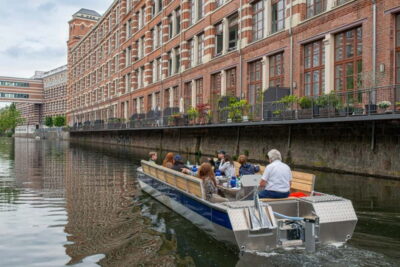
- Leipzig: City History Canal Sightseeing Tour on a Motorboat
★ 4.7 · 6,232 reviews - Berlin: Natural History Museum Entrance Ticket
★ 4.6 · 3,382 reviews - Leipzig: 1.5-Hour Historical Walking Tour in German
★ 4.7 · 2,217 reviews
Starting at the Rotes Tor
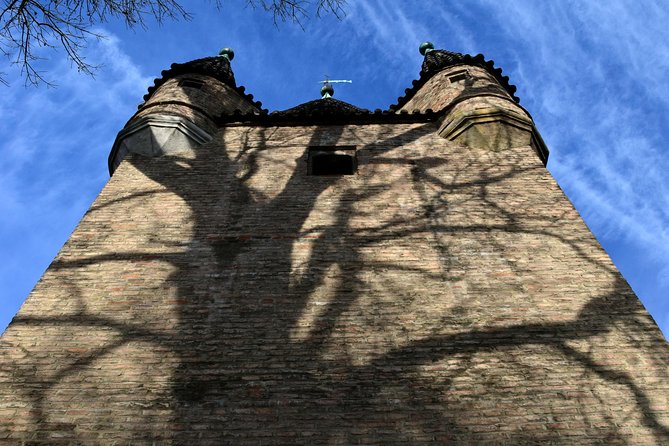
The tour begins at Augsburg Town Hall, but the first listed sight is the Rotes Tor, or Red Gate. This famous tower offers a fitting opening because Augsburg’s old defenses help you picture the city before modern streets and traffic softened its edges.
You spend about 15 minutes here, with no admission fee listed. The gate was renovated in the 20th century, so this is not a perfectly untouched medieval structure. Still, it gives the tour a strong visual starting point and lets your guide explain how the old city was entered and protected.
I like short opening stops such as this one. You get your bearings without spending half an hour on a single building. If you want detailed architectural study, you may find the time brief, but the guide can set the stage for what follows.
Gothic stone at St. Ulrich and Afra
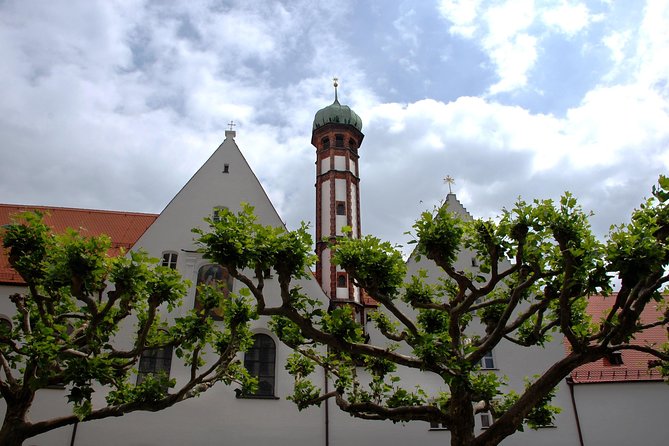
Next comes the Basilica of SS. Ulrich and Afra, a Catholic parish with Gothic architecture. Its story reaches back to the Roman tomb of St. Afra, who was martyred in 304.
The 15-minute visit is free according to the tour details. You can expect the guide to point out the building’s religious importance and its connection to early Christian Augsburg. The stop also adds an important contrast to the civic sights. The fountains and town hall speak of public wealth, while this basilica connects the city to worship, saints, and long religious traditions.
You should keep your expectations measured. Fifteen minutes is enough for an introduction and a look at the exterior or main interior areas, but not for an extended art-historical visit.
Baroque style inside Schaezlerpalais
Schaezlerpalais is the tour’s major paid palace stop. Built in 1765, it is known for baroque architecture and is regarded as an important historic monument.
The listed visit lasts about 30 minutes. Admission is not included, and the stated fee is €7 per person. That extra cost is modest compared with the tour price, but you should add it to your budget. A group of 15 would pay €105 for this entrance alone.
This is one place where a private guide can add useful context. Baroque design is full of visual signals, from formal rooms to elaborate decoration, and a guide can help you notice what you might otherwise walk past. The time is also longer than at several of the outdoor stops, giving you a chance to slow down.
If your main interest is outdoor history and street scenery, you may decide the separate ticket is not essential. If you enjoy palaces and decorative interiors, it is likely worth keeping in the plan.
A few more Germany trips worth comparing
- Augsburg: Walking Tour with Fuggerei
★ 4.6 · 2,245 reviews - Augsburg’s Water Management System – City Walking Tour
★ 4.5 · 168 reviews - Augsburg: Illuminated Guided Evening Walking Tour
★ 4.6 · 67 reviews - Classic city tour in the World Heritage City of Augsburg
★ 4.0 · 41 reviews
Hercules and Augsburg’s fountain story
Hercules’ Fountain takes only about 15 minutes, but it is one of the city’s most memorable public works. Cast in 1597, the fountain includes a bronze Hercules killing the Hydra, the seven-headed monster from Greek mythology.
The fountain is free to view. It is also one of three famous fountains in Augsburg, so this stop works best when your guide explains the group as part of the city’s civic identity rather than treating it as an isolated monument.
The sculpture is dramatic and easy to appreciate even if you are not a specialist in Renaissance art. I would use this stop to look closely at the bronze work, then listen for the larger point: a city that commissions grand fountains is making a public statement about money, confidence, and power.
The Goldener Saal and a hard wartime story
The Goldener Saal, inside Augsburg Town Hall, is the most ornate interior on the route. The ceremonial room is known for ceiling paintings and golden wall decoration. It was completed in 1643.
The room also carries a modern story of loss and repair. Augsburg’s town hall and the Goldener Saal were destroyed by an air raid in 1944 and rebuilt after the war. That makes the visit more than a display of glittering decoration. You are looking at a room that survived through reconstruction, not simply a room that escaped damage.
The planned visit lasts about 30 minutes. Admission is separate at €2.50 per person, or €37.50 for a full group of 15. That is a small additional fee, and I consider this one of the better values on the route if you care about interiors, civic architecture, or the way cities recover from war.
The room may be the tour’s visual high point. Give yourself time to look up. The ceiling is easy to miss if you rush through while listening.
Perlach Tower and Augustusbrunnen
Perlach Tower rises about 70 meters in Augsburg’s central district. It began as a watchtower in the 10th century, giving the tour another link to the city’s early defenses and civic growth.
The stop lasts around 10 minutes, with no admission fee listed. You should not expect a tower climb as part of this experience. The value here is the explanation and the view from street level, especially when the tower is considered alongside the nearby town hall and fountains.
Augustusbrunnen follows in Town Hall Square. The fountain was cast between 1588 and 1594, placing it in the same broad period of civic decoration as Hercules’ Fountain.
This is another short, free outdoor stop. Ten minutes is enough to examine the monument and hear why it matters, but the experience depends on the guide connecting the objects. Without context, you might see a fountain, take a picture, and move on. With context, the square becomes a record of Augsburg’s public ambition.
St. Anne’s Church and the Fugger connection
St. Anne’s Church was built in 1321 and began as part of a monastery. Its elaborate interior decoration makes it one of the more rewarding church stops on the route.
You spend about 15 minutes here, with no admission fee listed. The church gives you another change of mood after the open square and monumental fountains. Its medieval origin and decorated interior show how Augsburg’s religious buildings continued to develop across different periods.
This stop may be especially useful if you want to understand the city beyond the best-known public monuments. The private format lets you ask focused questions about the monastery, the decoration, or the church’s place in Augsburg’s story.
The short schedule does impose a limit. If you like sitting quietly in churches or examining small details, you may want to return later on your own.
Augsburg Cathedral’s long timeline
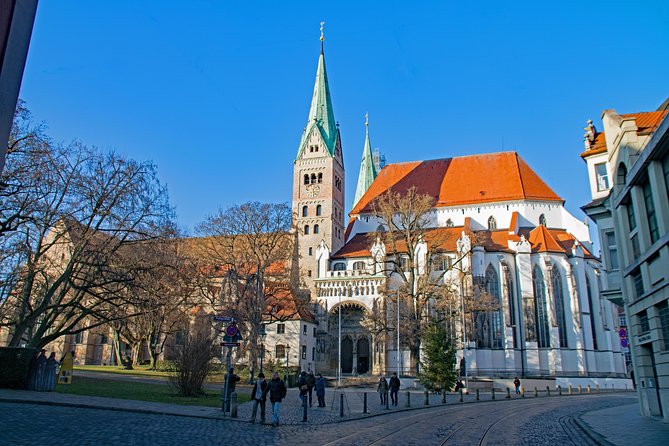
Augsburg Cathedral was founded in the 11th century, with Gothic additions made in the 14th century. Its tower reaches about 62 meters.
The cathedral visit lasts roughly 15 minutes and carries no listed admission fee. The building’s long timeline makes it a useful summary of Augsburg itself. You can see how a religious site changes as tastes, building methods, and civic fortunes shift.
I like the fact that the route includes both the basilica and the cathedral. They are not interchangeable church stops. Seeing both gives you a better sense of the city’s religious scale and variety.
Again, this is an introduction rather than a complete cathedral visit. If the building catches your attention, note its location and return after the tour, assuming opening hours allow. The tour data does not promise extra free time, interior access conditions, or a tower visit.
Fuggerei, the tour’s most distinctive ending
The final stop is Fuggerei, founded in 1516 by the Fugger family. It is described as the world’s oldest social housing complex still in use. The original purpose was to house people in need from Augsburg.
That detail gives Fuggerei a human scale that some grand monuments lack. You are not only looking at an impressive building or fountain. You are seeing an organized housing project with a social purpose that has continued across centuries.
The visit lasts about 15 minutes. The route ends at Fuggerei, near Fuggereib. d. Jakobskirche, rather than returning you to Town Hall. That is useful if you plan to continue exploring the complex or the surrounding area. It is less convenient if you need to collect luggage or return to the starting point immediately.
I would treat Fuggerei as the emotional finish of the tour. The palace and Goldener Saal show wealth. Fuggerei shows an attempt to direct some wealth toward housing. Your guide can help you understand the Fugger family’s role without reducing the story to a simple tale of generosity.
What the guides add to a private visit
The strongest praise for this experience centers on the guides’ personal attention. Kristen was willing to meet at the train station and escort the visitor back there after the tour. That kind of help matters when you are arriving in Augsburg for a short stay and do not yet know the city.
Stephanie received similar praise for meeting a group at its hotel and shaping the route around its needs. Her strength was described as engagement and sensitivity to the group’s wishes. Those details suggest a service style that is more personal than a fixed public walk.
You should still communicate your priorities clearly when booking or at the start. Tell the guide if you care most about churches, architecture, the Fugger family, wartime rebuilding, or photography. The private format creates room for questions, but the three-hour clock remains real.
Price, pace, and practical value
The advertised cost is $417.72 per group of up to 15 people. That makes the tour a poor bargain for one or two people if measured only by sightseeing time. It becomes more attractive for a family, reunion, school group, or gathering of friends.
You also pay separate admission for Schaezlerpalais and the Goldener Saal. Together, those fees total €9.50 per person. The other listed stops have no admission fee, and an official tour guide is included.
The tour is near public transportation, starts at Augsburg Town Hall, and ends at Fuggerei. Most people can participate, and only your group takes part. Confirmation is provided at booking.
The schedule is fairly full. You move through ten stops in about three hours, with most visits lasting 10 to 15 minutes and the two interior highlights receiving 30 minutes each. Wear comfortable shoes and keep your expectations practical. This is a guided city introduction, not a leisurely day with long café breaks.
The booking terms also deserve attention. The experience is non-refundable and cannot be changed for any reason. If your plans are uncertain, this is a serious drawback.
Who should book this Augsburg experience?
I would recommend it to a group that wants a strong first look at Augsburg without spending hours planning a route. It suits families and friends who want to stay together, ask questions freely, and control the pace more than they could on a large group outing.
It also works well for people arriving by train, especially if meeting assistance matters. Kristen’s willingness to meet at the station and escort someone back shows how useful the guide can be beyond simply explaining monuments.
You may want a different plan if you are a solo visitor, a couple on a tight budget, or someone who prefers to linger in museums and churches. You can see many of the outdoor sights independently, though you would lose the connections between them and the convenience of a planned route.
Should you book it?
Book this tour if you are traveling with several people and want Augsburg’s major sights placed into a clear historical story. Fuggerei, the Goldener Saal, and the private guide format give it real value for a first visit.
Skip it if your party is very small, your schedule may change, or you want a slow museum-focused day. If you do book, budget for the two separate entrance fees, begin at Town Hall on time, and tell the guide what interests you most. That is how you turn a fast three-hour route into a visit that feels made for your group.
FAQ
How long is the Augsburg private historic tour?
The tour lasts approximately three hours.
How much does the tour cost?
The price is $417.72 per group, with up to 15 people included.
Is this a private tour?
Yes. Only your group participates in the activity.
Where does the tour start?
The tour starts at Augsburg Town Hall, Rathausplatz 2, 86150 Augsburg, Germany.
Where does the tour end?
The tour ends in Augsburg near Fuggerei, at Fuggereib. d. Jakobskirche, 86152 Augsburg, Germany.
Which entrance fees are not included?
Admission to Schaezlerpalais costs €7 per person, and admission to the Goldener Saal costs €2.50 per person. These fees are separate from the tour price.
Can the tour timing be adjusted?
The tour information says timing is flexible depending on your preferences. The total experience remains approximately three hours.
Just added around Germany
- Private Walking Tour in Berlin: Hitler’s Germany & WWII★ 5.0 · 7 reviews
- The History of Berlin: WWII PRIVATE Walking Tour With Locals★ 5.0 · 209 reviews
- Private Berlin WWII and Cold War History Tour with Local Expert Guide★ 5.0 · 28 reviews
- Private Walking Tour Berlin 3 hours: Brandenburg, Historic Center★ 5.0 · 7 reviews
- Berlin: Private Bike Tour of the Berlin Wall and Third Reich★ 5.0 · 23 reviews
- Berlin: Guided Private Bike Tour to Explore the Highlights★ 5.0 · 12 reviews
- Berlin Photography Masterclass – Private Photography Lesson★ 4.5 · 23 reviews
- Group Driving Tour 1 to 6 people. Berlin Shore Excursion incl pick-up at Port★ 5.0 · 8 reviews
Historical Tours, compared.
City History Canal Sightseeing Tour on a Motorboat
Read our review →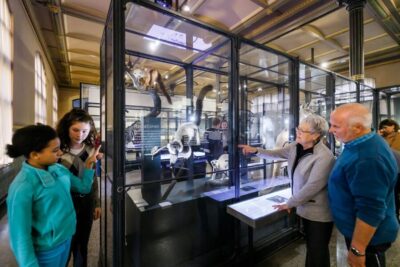
Browse the lists this tour appears in