
Reviewed · 2-HOUR EXPERIENCES
Berlin: Karl-Marx-Allee 2-Hour Tour
Berlin’s grand boulevard has a complicated story. This two-hour walking tour along Karl-Marx-Allee brings together striking socialist architecture and the political changes that shaped East Berlin after World War II. I like the clear focus: you spend your time on one remarkable avenue rather than rushing between unrelated sights. I also like the use of old photographs, posters, and local stories, which help you picture the street in earlier decades.
The tour is especially strong for anyone interested in architecture, urban planning, or the former East Germany. Guides such as Tobias have earned praise for being passionate, clear, and communicative. The main consideration is simple: this is a walking tour, and the subject is quite specialized. If you want Berlin’s famous museums and landmarks, this will not cover them. If you want to understand how a socialist city was designed, $23 is a fair price for two focused hours.
In This Review
- Key points to know before booking
- Why Karl-Marx-Allee deserves two hours
- Frankfurter Tor and the formal gateway to the avenue
- Friedrichshain’s arcades and the practical side of socialist housing
- Kosmos cinema and culture under the socialist system
- Hochhaus an der Weberweise and the changing architectural language
- The Church of the Resurrection and a quieter historical pause
- Strausberger Platz and the entrance to the socialist city center
- What the guide adds to the architecture
- Is $23 a good value for two hours?
- Who will enjoy this walk most?
- Practical advice for making the most of it
- Should you book the Karl-Marx-Allee tour?
- FAQ
- How long does the Karl-Marx-Allee tour last?
- What language is the tour offered in?
- What sights are included on the route?
- Is hotel pickup included?
- How much does the tour cost?
- Can I cancel for a full refund?
Key points to know before booking
- Frankfurter Tor is the visual centerpiece: Its paired towers and formal design make it one of Berlin’s most memorable postwar architectural sights.
- The boulevard changed names with the politics: You’ll follow the story from Frankfurter Allee to Stalinallee and finally Karl-Marx-Allee.
- Architecture is the main event: Arcaded apartment blocks, the Kosmos cinema, Strausberger Platz, and the Hochhaus an der Weberweise each show a different stage of socialist city planning.
- The guide adds material you would miss alone: Historical photographs, old posters, anecdotes, artwork, and less obvious corners give the walk more depth.
- The tour is offered in English or German: The live guide makes it easier to ask questions and connect the buildings with their political setting.
- Allow two hours for a steady city walk: The meeting point can vary by the option you book, so check the exact starting place before setting out.
Why Karl-Marx-Allee deserves two hours
Karl-Marx-Allee is not just a wide road lined with apartment buildings. It is a planned statement about what East Germany wanted its capital to look like. The boulevard stretches for almost two kilometers and is described as the largest monument in Berlin.
That scale matters. On a quick pass by car or tram, you may notice the towers and broad roadway, but you will miss the details in the facades, arcades, entrances, and surrounding spaces. Walking lets you compare buildings from one section to the next and see how the design changes along the route.
I find the avenue useful because it makes history physical. Government ideas are written into the size of the buildings, the placement of the towers, and the way the street opens toward the former socialist city center. The guide’s job is to explain why those choices were made, not simply point out attractive facades.
The tour also follows the boulevard’s changing identity. It began as Frankfurter Allee, became Stalinallee during the East German period, and later took the name Karl-Marx-Allee. Those names are not minor details. Each one reflects a different political chapter, and hearing that story while standing among the buildings gives the walk a clear structure.
A few more Berlin trips worth comparing
- Berlin: Reichstag, Dome and Government District Guided Tour
★ 4.7 · 18,288 reviews - Berlin: 1-Hour City Tour by Boat with Guaranteed Seating
★ 4.3 · 16,993 reviews - Berlin: Boat Tour Along the River Spree
★ 4.4 · 11,252 reviews
Frankfurter Tor and the formal gateway to the avenue
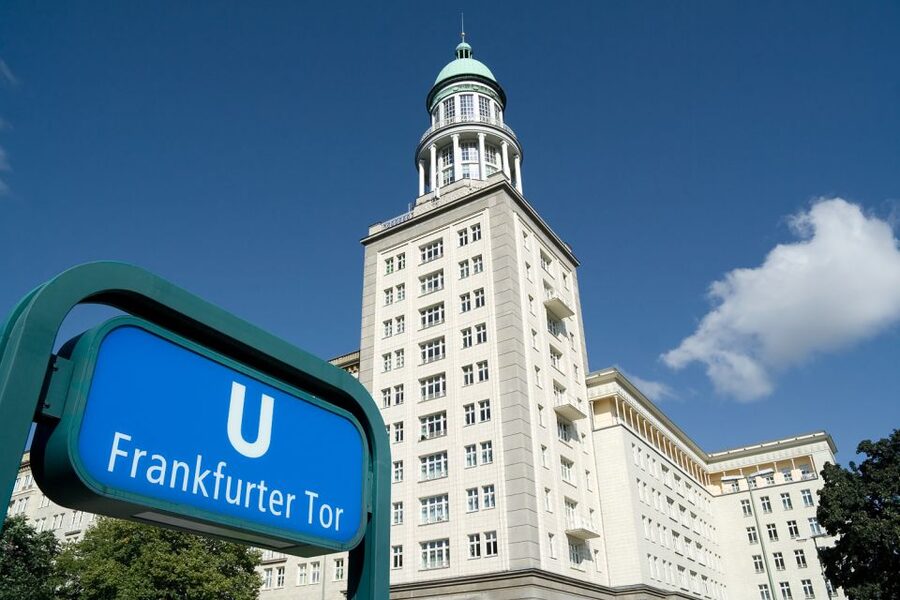
Frankfurter Tor is the stop most likely to impress you at first glance. Its distinctive towers give the area a ceremonial feel, and the paired design makes the intersection easy to recognize. This is architecture meant to be noticed.
The towers also help explain the boulevard’s purpose. Karl-Marx-Allee was planned as more than a transport route or housing project. It was a grand approach to the socialist center of East Berlin, with large-scale buildings that could project order, confidence, and state power.
Your guide may spend time asking you to look beyond the towers themselves. Notice how the buildings frame the street and how the open space around the intersection creates a sense of arrival. This is one reason the tour works better on foot than from a passing vehicle. You can stop, look upward, and compare the proportions without being hurried along.
Frankfurter Tor is also a good place to understand the contrast between everyday life and official design. These were apartment buildings, not just government offices or monuments. The boulevard had to function as a residential district while also presenting an impressive public face.
Friedrichshain’s arcades and the practical side of socialist housing
The apartment buildings in Friedrichshain bring the grand plan down to street level. Their arcades are among the details that reward a slower look. These covered passages and repeated architectural elements give the buildings a formal rhythm, but they also show how housing was shaped as part of a larger urban plan.
I like this section because it keeps the tour from becoming a parade of monumental facades. You get a chance to think about how people lived within this design. The buildings were built as homes, yet their scale and decoration made ordinary housing part of a public message.
The arcades also provide useful visual variety. After the broad spaces near Frankfurter Tor, the covered sections create a more enclosed walking experience. Your guide can point out design features that blend together when you explore without context.
Do not expect a preserved historic quarter with small lanes and decorative medieval buildings. Friedrichshain here is about planned postwar construction. Its appeal comes from repetition, scale, and the tension between practical housing and political display.
Kosmos cinema and culture under the socialist system
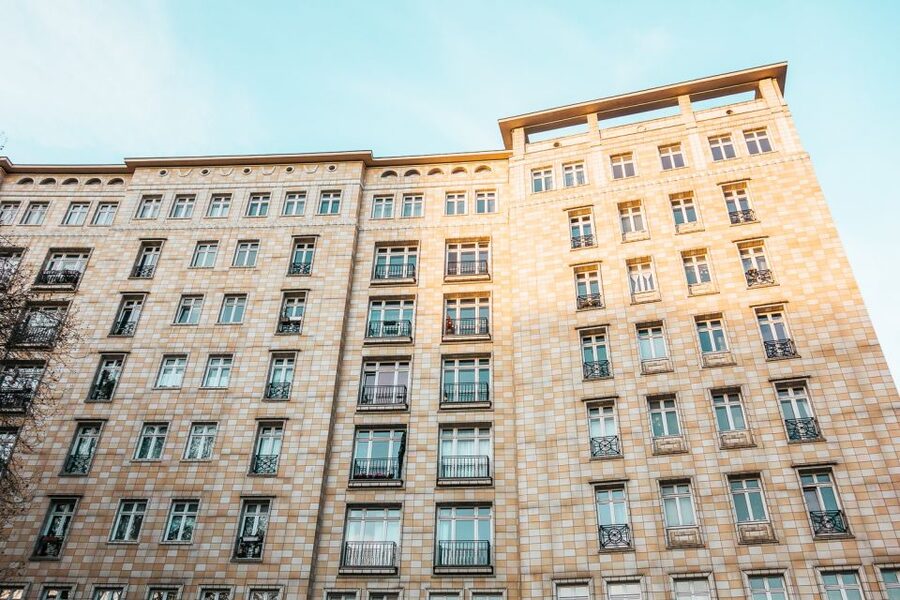
The Kosmos cinema, designed by Josef Kaiser, adds a cultural stop to the route. Its presence shows that Karl-Marx-Allee was intended to support more than housing and official ceremonies. A major boulevard needed places for leisure, film, and public life.
The building is useful for understanding how culture fit into the socialist city. A cinema could serve daily life while also being part of a carefully planned district. The guide can connect its design to the surrounding apartment blocks and explain how the avenue worked as a complete urban setting.
This stop may appeal to you if you enjoy architecture that is tied to social use. You are not only looking at a facade. You are considering how a cinema helped make a large residential district feel like a city center.
The exact amount of time spent at each sight can vary with the guide and group. That is normal on a two-hour walk. If the Kosmos cinema interests you most, ask your guide a question rather than waiting for every detail to come automatically. The tour is live, and that gives you a chance to shape the discussion.
Still Berlin, at a slower pace:
- Discover Berlin Half-Day Walking Tour
★ 5.0 · 9,624 reviews - Berlin: Hop-on Hop-off Bus Tour with Live Commentary
★ 4.3 · 8,579 reviews - Berlin: Government District around the Reichstag Guided Tour
★ 4.7 · 8,447 reviews - Berlin: Reichstag, Plenary Chamber, Cupola & Government Tour
★ 4.6 · 8,422 reviews
Hochhaus an der Weberweise and the changing architectural language
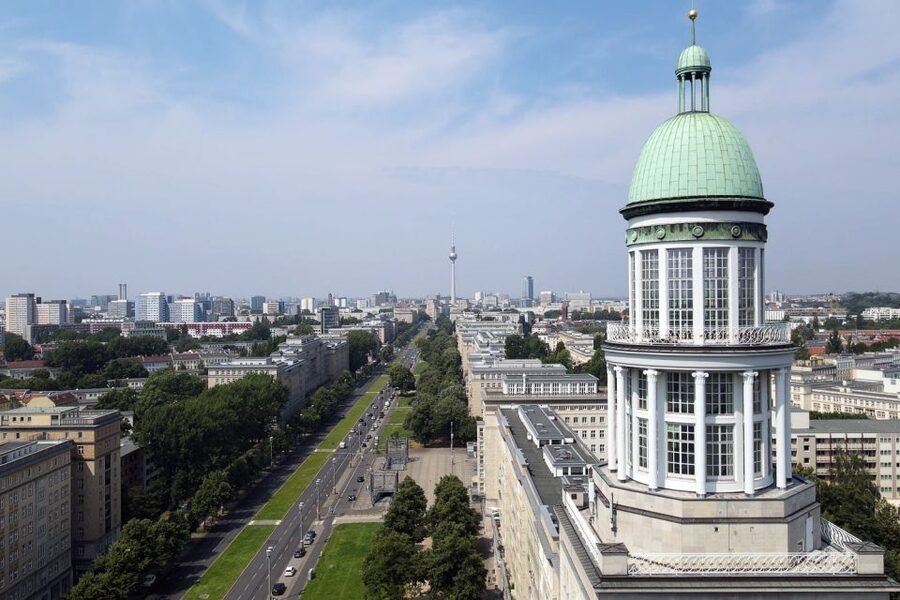
The Hochhaus an der Weberweise offers another angle on the avenue’s development. It is a high-rise building, and its presence helps you compare different approaches to postwar construction. Karl-Marx-Allee is not visually identical from end to end. Its buildings reveal changes in taste, purpose, and planning.
This is where a guide’s historical explanation becomes valuable. Without context, you might see a series of large apartment blocks and assume they were all designed at the same time in the same style. The route shows a more complicated process, with different building forms placed within one major urban project.
Look for the relationship between the high-rise and the open areas around it. Height can mark a corner, frame a view, or signal an important part of the district. The tour encourages you to read the street as a planned composition rather than a collection of unrelated structures.
If you prefer small-scale architecture, this section may feel imposing. That is part of the point. Karl-Marx-Allee was designed to make the state visible, and its buildings rarely whisper.
The Church of the Resurrection and a quieter historical pause
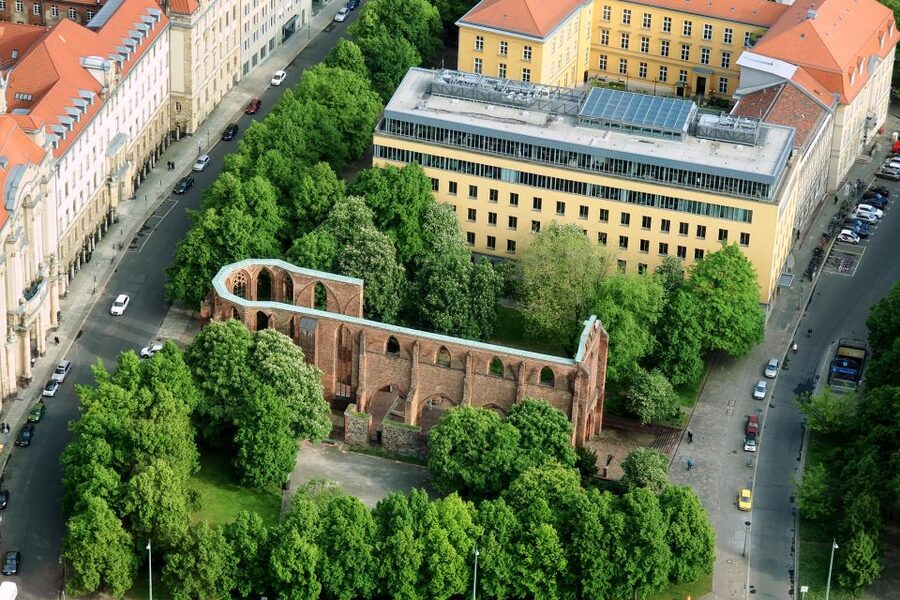
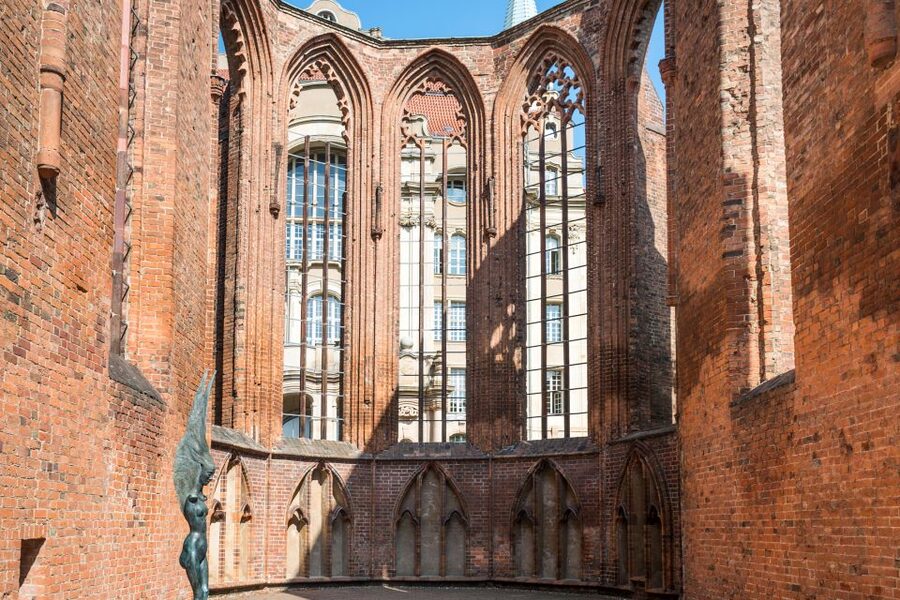
The partial ruins of the Church of the Resurrection provide a sharp contrast with the polished, planned boulevard. Here, the story is not only about postwar construction. The remaining structure points to the damage and disruption that came before the avenue took its present form.
A stop at the church gives the walk a more human scale. Ruins make it easier to think about what was lost, altered, or absorbed into later plans. They also prevent the tour from presenting Karl-Marx-Allee as a complete and untouched socialist creation.
This is likely to be a quieter moment in the route. After the large towers, long facades, and formal public spaces, the partial church ruins remind you that Berlin’s built environment contains several periods at once.
The supplied details do not specify the exact condition of the ruins or how long the group remains there, so you should treat this as a brief architectural and historical stop rather than a full church visit. It is included as part of the walking route, not as a separate admission attraction.
Strausberger Platz and the entrance to the socialist city center
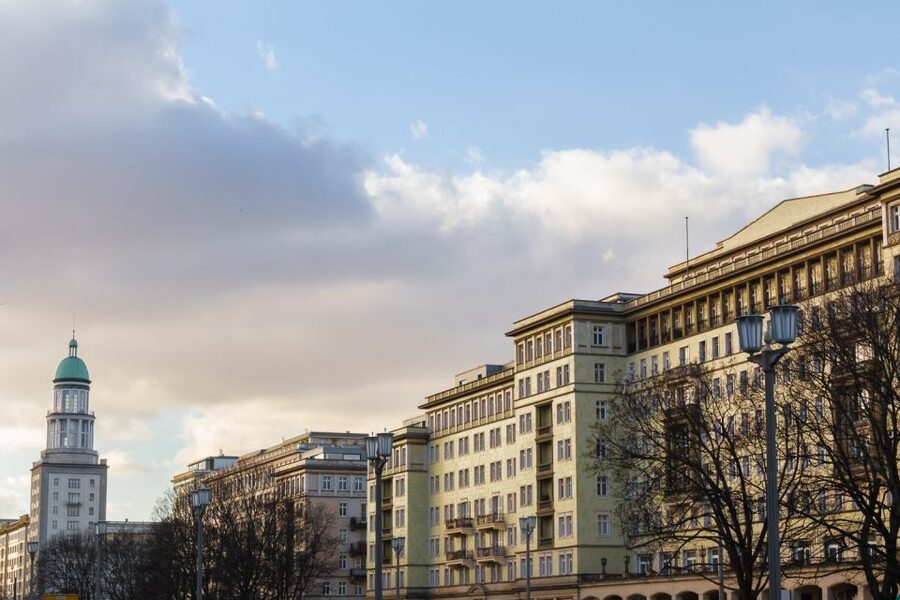
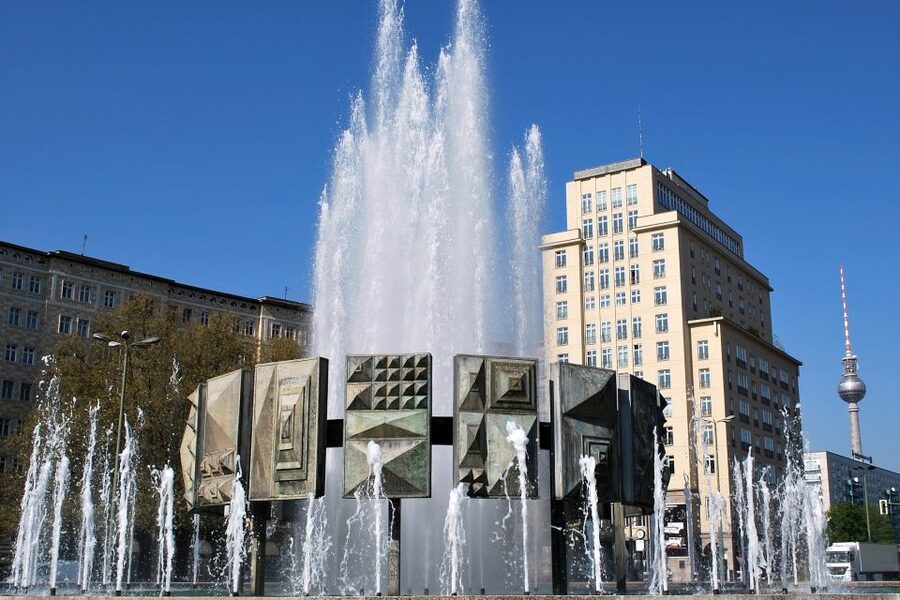
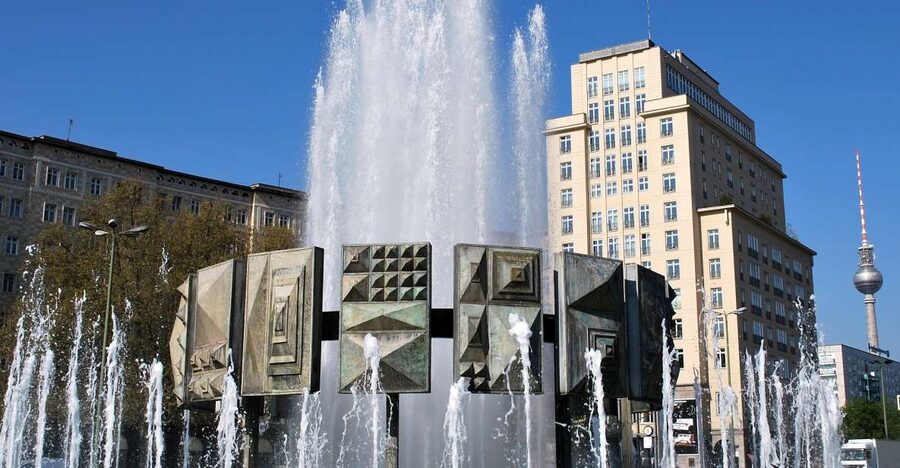
Strausberger Platz is another major visual point. Its distinctive high-rise buildings served as a gateway to the socialist city center, and the open square helps you understand how the boulevard was organized.
Squares like this are easier to appreciate once you have already walked through the residential sections. By the time you reach Strausberger Platz, you can compare its role with Frankfurter Tor. Both places use height, symmetry, and open space to create a sense of importance, but they work at different points along the route.
I find this kind of comparison one of the best reasons to take the full walk. You are not simply collecting photo stops. You are seeing how architects guided movement through the city and marked transitions with towers and high-rise buildings.
The square also makes a good final chapter for the story of Karl-Marx-Allee. From here, the boulevard’s connection to the socialist center becomes easier to grasp. The buildings were housing, but they were also part of a carefully staged urban entrance.
What the guide adds to the architecture
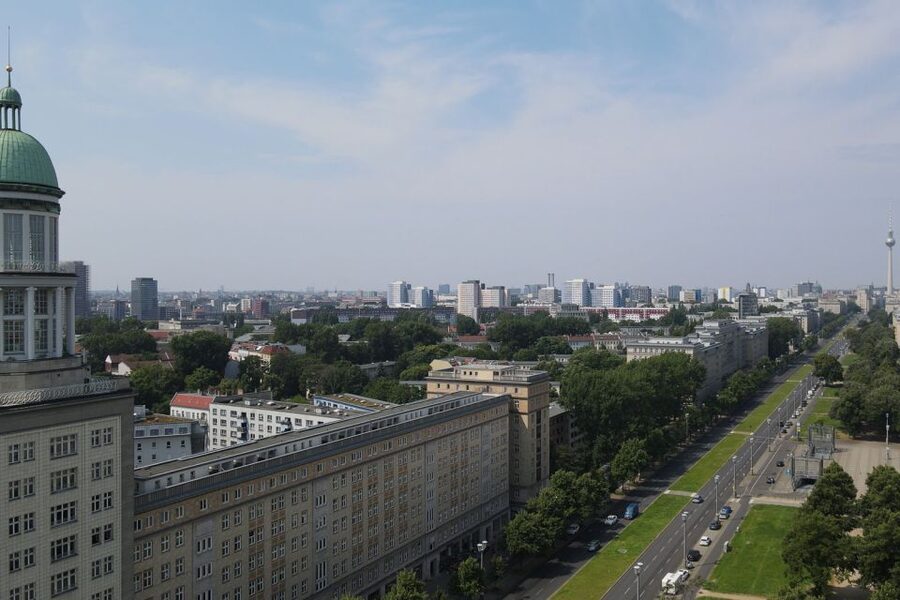
The strongest feature of this tour is the guide-led interpretation. Several highly rated comments single out Tobias for his passion, clear communication, and ability to bring the area to life. Another description praises the use of historical photographs, old posters, artwork, and anecdotes.
That material can change how you see the street. A photograph held beside a current facade can show how much has changed, or how much remains. An old poster can reveal the public message once attached to a building. A small anecdote can make an enormous block feel connected to daily life.
I would pay close attention to the guide’s visual references. Karl-Marx-Allee can initially look repetitive, especially if you are not used to reading architecture. The extra material gives you points of comparison and helps you notice details you might pass without a second look.
The German and English language options are useful for international visitors. If you are comfortable in either language, select the one in which you can ask questions most easily. The tour’s value depends heavily on explanation, so language comfort matters more here than it would on a simple sightseeing stroll.
Is $23 a good value for two hours?
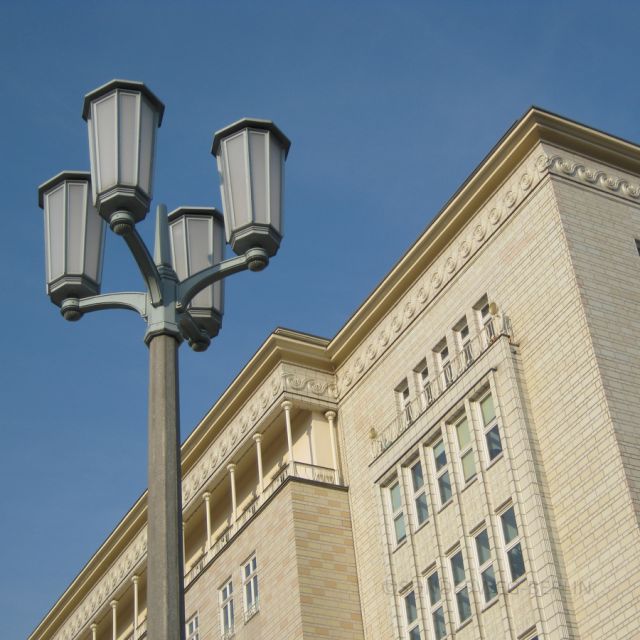
At $23 per person, this is reasonably priced for a specialized two-hour walking tour with a live expert guide. You are paying for interpretation, not entry to a museum or a private vehicle. There is no hotel pickup or drop-off, so your value comes from the route and the quality of the explanation.
I think the price works best if you already have some interest in Berlin’s divided past, architecture, or East German urban planning. You are getting a focused lesson in one of the capital’s most important postwar districts, with several major sights connected into one story.
The value is weaker if you simply want a general introduction to Berlin. This route does not cover the city’s many headline attractions, and it stays centered on Karl-Marx-Allee. You may prefer a broader city tour if this is your first hour in Berlin and you have limited time.
The tour also offers free cancellation up to 24 hours before the start and a reserve-now, pay-later option. Those policies make it easier to fit the walk into a changing schedule. Check availability for the starting time and confirm the meeting point, since it may vary by the option selected.
Who will enjoy this walk most?
I would recommend it to you if you fit one or more of these descriptions:
- You enjoy architecture and want more than a quick photograph at Frankfurter Tor.
- You want a clearer understanding of East Berlin and the socialist period.
- You like urban planning and are curious about how a boulevard can express politics.
- You prefer a focused walking route to a large general sightseeing tour.
- You enjoy old photographs, posters, anecdotes, and visual comparisons.
- You want a two-hour activity that fits neatly into a busy Berlin day.
Families with older children may also find the changing street names and dramatic towers easy to discuss, though the subject is more academic than playful. Art and design fans should pay special attention to the Kosmos cinema, the arcades, and the contrast between the high-rise buildings.
You should think twice if you dislike walking or have no interest in postwar architecture. The route is built around the street itself, and its pleasures come from looking closely rather than rushing from one famous landmark to another.
Practical advice for making the most of it
Wear comfortable shoes and arrive ready for an outdoor walk. The tour lasts two hours, and the route includes several broad public spaces and long stretches of boulevard. Weather can affect your enjoyment because the experience takes place outside.
Before booking, check the meeting point for your selected option. It may change depending on the booking choice, and a clear starting plan will help you avoid wasting part of the tour finding the group.
Bring your curiosity, not just your camera. The most useful questions are likely to be about why the boulevard changed names, how the buildings were used, and how the architecture reflected political aims. The guide can explain those connections far better when you ask about the details that catch your eye.
If Tobias is leading your tour, you can expect a guide who has been praised for passion and strong communication. The available comments also point to guides who use historical images and uncover less obvious parts of the area. Those additions are a good reason to choose the guided walk instead of following a basic map.
Should you book the Karl-Marx-Allee tour?
Book it if you want Berlin’s postwar story explained through buildings you can see and touch. The combination of Frankfurter Tor, the Friedrichshain arcades, Kosmos cinema, Hochhaus an der Weberweise, the Church of the Resurrection ruins, and Strausberger Platz gives the two hours a clear route and plenty of visual variety.
I would not choose it as your only Berlin sightseeing activity, but I would gladly add it to a wider city visit. For $23, it offers strong value to anyone drawn to architecture, culture, or the former East Germany. If old photographs, changing street names, and monumental housing sound more interesting than another quick view of the Brandenburg Gate, this is a smart booking.
FAQ
How long does the Karl-Marx-Allee tour last?
The walking tour lasts two hours.
What language is the tour offered in?
A live guide is available in English or German.
What sights are included on the route?
The route includes Frankfurter Tor, Friedrichshain apartment buildings with arcades, the Kosmos cinema, Karl-Marx-Allee, Hochhaus an der Weberweise, partial ruins of the Church of the Resurrection, and Strausberger Platz.
Is hotel pickup included?
No. Hotel pickup and drop-off are not included.
How much does the tour cost?
The listed price is $23 per person.
Can I cancel for a full refund?
Yes. You can cancel up to 24 hours in advance for a full refund.
Just added around Berlin
- Private Walking Tour in Berlin: Hitler’s Germany & WWII★ 5.0 · 7 reviews
- The History of Berlin: WWII PRIVATE Walking Tour With Locals★ 5.0 · 209 reviews
- Private Berlin WWII and Cold War History Tour with Local Expert Guide★ 5.0 · 28 reviews
- Private Walking Tour Berlin 3 hours: Brandenburg, Historic Center★ 5.0 · 7 reviews
- Berlin: Private Bike Tour of the Berlin Wall and Third Reich★ 5.0 · 23 reviews
- Berlin: Guided Private Bike Tour to Explore the Highlights★ 5.0 · 12 reviews
- Berlin Photography Masterclass – Private Photography Lesson★ 4.5 · 23 reviews
- Group Driving Tour 1 to 6 people. Berlin Shore Excursion incl pick-up at Port★ 5.0 · 8 reviews
2-Hour Experiences, compared.
Browse the lists this tour appears in