
Reviewed · WALKING TOURS
Berlin Walking Tour
Berlin’s big stories fit into one long walk. This roughly three-hour English tour links the Reichstag, Brandenburg Gate, Berlin Wall sites, Checkpoint Charlie, and the Holocaust Memorial, giving you a fast first look at the German capital. I especially like the central route through major landmarks and the chance to hear personal stories, gossip, and historical context from guides such as Ana, Miguel, Katia, and Evan.
The advertised price of $2.90 per person is hard to beat for an orientation walk. I also like that the tour suits a first morning in Berlin, when it can help you decide which places deserve a longer visit. The catch is that guide quality and tour operations appear uneven, and some people reported a no-show, a changed meeting point, or pressure to pay a large tip.
In This Review
- Key points to know before you book
- Why this Berlin walk works best on your first morning
- Starting at Alexanderplatz and setting the pace
- Reichstag Building: government and modern Berlin
- Brandenburg Gate and the Prussian chapter
- Berliner Dom and the city’s older center
- Checkpoint Charlie and the limits of a fast tour
- The Berlin Wall Memorial and the cost of division
- The Holocaust Memorial and Berlin’s darkest years
- Cold War remains and easily missed details
- The guides are the heart of the experience
- The walking demands and weather problem
- What $2.90 really buys you
- Who should book this walk
- Should you book the Berlin Walking Tour?
- FAQ
- How much does the Berlin Walking Tour cost?
- How long does the tour last?
- Is the tour offered in English?
- Where does the tour start?
- Where does the tour finish?
- Which sights are included?
- Is public transportation included?
- What fitness level is required?
- Can I cancel for a refund?
Key points to know before you book
- Seven important Berlin stops in about three hours: Expect a broad introduction rather than long visits inside museums or buildings.
- A strong first-day choice: The route helps you get your bearings and identify places to revisit.
- Guide quality makes the difference: Ana, Miguel, Katia, Evan, Ronja, Francesca, and others received warm praise for clear, lively storytelling.
- Expect a serious amount of walking: Cold weather, snow, ice, rain, and fast pacing have all affected the experience for some people.
- The low price needs clarification: The tour is listed at $2.90, while the operator describes it as free to join with optional tips.
- Operational problems are the main risk: Several people waited at the stated meeting point without finding a guide or receiving timely notice of a change.
Why this Berlin walk works best on your first morning
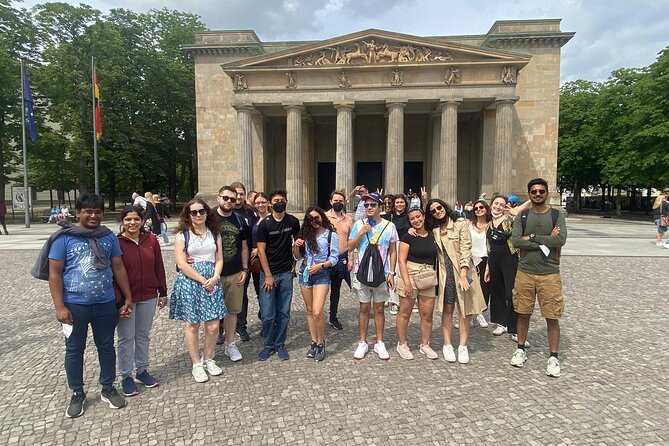
Berlin is not a city you understand from one postcard view. Its landmarks are spread across districts and political eras, and a good guide can connect Prussian power, Nazi terror, the divided city, and present-day Germany in a few hours.
I like this tour as an introduction because it moves from the symbolic center of government to the places where Berlin’s 20th-century story becomes painfully visible. You will not get a full museum visit at each stop, but you can learn what you are looking at before returning on your own.
The route also has a social side. The tour is offered in English and allows you to meet other people while walking, which can be useful if you are exploring Berlin alone or want quick ideas for the rest of your stay.
Do not treat the advertised three hours as a hard limit. One person reported a four-hour outing, while others described roughly three and a half hours. That may reflect the guide, group size, route, or pace. Plan some breathing room afterward.
More Walking Tours in Berlin
- Discover Berlin Half-Day Walking Tour
★ 5.0 · 9,624 reviews - Berlin: Third Reich and Cold War 2 Hour Walking Tour
★ 4.9 · 6,830 reviews - Berlin: Discover Berlin Walking Tour
★ 4.9 · 5,998 reviews
Starting at Alexanderplatz and setting the pace
The meeting point is Generator Berlin Alexanderplatz at Otto-Braun-Straße 65, 10178 Berlin. The activity ends back at this meeting point, according to the supplied details, and the location is near public transportation.
Alexanderplatz is a practical place to begin because it is well connected and easy to fit into a larger day of sightseeing. Still, check the exact meeting instructions before setting out. A serious weakness reported by several people was waiting at the meeting point for 30 minutes or more while no guide arrived. Another person said the meeting location changed without a useful message or directions.
That is not a small inconvenience in Berlin. If you have only one day, losing an hour can throw off your entire plan. I would save the confirmation, check your messages before leaving, and arrive early enough to identify the group clearly.
The group limit is 50 people. That is a fairly large walking group, so you should expect a public tour rather than a quiet private lesson. A good guide needs to speak clearly, keep the group together, and stop often enough for people at the back to hear.
Reichstag Building: government and modern Berlin
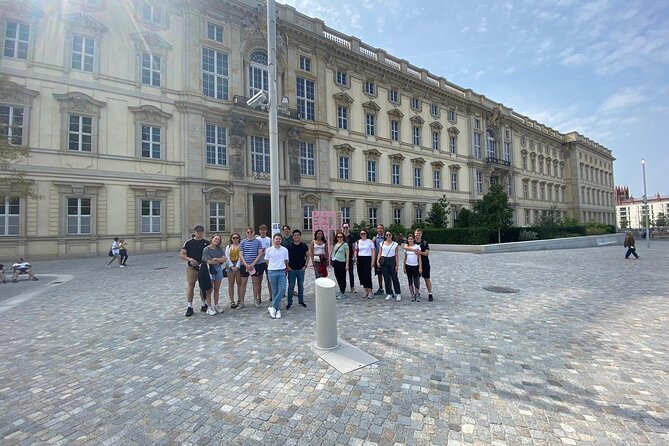
The Reichstag is the first listed stop, with about 20 minutes set aside and no admission charge included. The building houses the Bundestag, Germany’s lower house of parliament, making it a useful opening point for understanding Berlin as the country’s political center.
Here, the guide can give you the building’s larger story and explain why it matters beyond its striking architecture. The short stop is best viewed as an introduction. You should not expect a full interior visit, a parliamentary session, or an extended look around the building.
The Reichstag works well early in the tour because it gives the walk a clear theme: Berlin is not only a city of monuments, but also a working capital. Your guide may connect the building to the political changes that shaped Germany, though the exact detail depends on the person leading your group.
Brandenburg Gate and the Prussian chapter
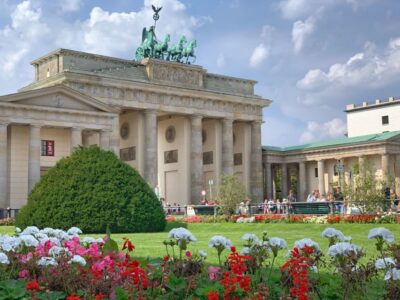
The Brandenburg Gate receives another 20-minute stop. This neoclassical monument was built on the orders of Prussian King Frederick William II after the temporary restoration of order during the Batavian Revolution.
For you, the important point is that the gate is not just a pretty arch for photographs. It represents the older power of Prussia and later became a major symbol of division and reunification. A well-paced explanation can show how one monument took on different meanings as Berlin changed around it.
This is also one of the easiest places for a large group to become scattered. Listen for the guide’s meeting instructions and do not wander off for photos until you know where the group will gather again.
Still Berlin, at a slower pace:
- Berlin: Reichstag, Dome and Government District Guided Tour
★ 4.7 · 18,288 reviews - Berlin: 1-Hour City Tour by Boat with Guaranteed Seating
★ 4.3 · 16,993 reviews - Berlin: Boat Tour Along the River Spree
★ 4.4 · 11,252 reviews - Berlin: Hop-on Hop-off Bus Tour with Live Commentary
★ 4.3 · 8,579 reviews
Berliner Dom and the city’s older center
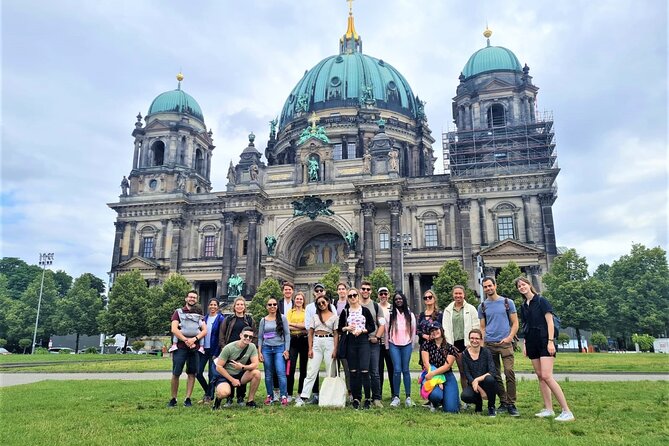
The Berliner Dom is another 20-minute stop. The guide introduces its history and uses the building to explain Berlin’s central area and the development of the German capital.
The cathedral is visually impressive, but this experience is not an interior tour. Admission is listed as free for the stop, yet the details provided do not promise entry inside. Think of this part as an exterior explanation, with time to appreciate the building and its place in the city center.
I like this stop because it breaks up the heavier political material. The walk is not only about war and dictatorship. Berlin’s architecture also reflects monarchy, religion, empire, destruction, and rebuilding, and the Berliner Dom gives the guide a useful way into those subjects.
Checkpoint Charlie and the limits of a fast tour
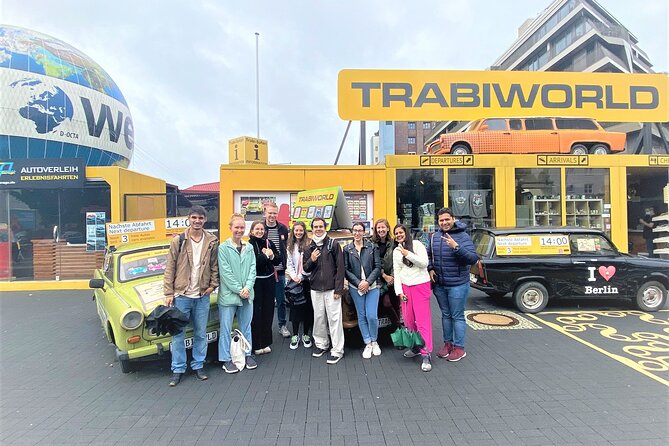
Checkpoint Charlie was the best-known crossing point between East and West Berlin during the Cold War. Its name came from the Western Allies, and its location remains one of the city’s most recognizable reminders of the divided capital.
The supplied timing does not assign a full 20 minutes to this stop. One person said the group spent only about two minutes there, which points to a real limitation: this tour covers a lot of ground, and some landmarks receive only a brief explanation.
If Checkpoint Charlie matters to you, make a note to return later. A short stop can establish why the crossing mattered, but it cannot explain every part of Berlin’s wall, escape attempts, border controls, and daily life in a divided city.
The Berlin Wall Memorial and the cost of division
The Berlin Wall Memorial is listed as a 20-minute stop. This is one of the tour’s most meaningful sections because it focuses on the wall that separated the city and restricted the freedom of millions under Soviet rule.
The value here comes from scale and context. You are not simply looking at a slab of concrete. You are being asked to picture a city cut apart, families separated, and ordinary streets turned into a frontier.
The guide’s quality matters greatly at this stop. The best leaders combine facts with human stories and explain what remains visible today. A quick lecture can feel dry, but a clear account of how the wall affected Berlin residents can make the site far more memorable.
The Holocaust Memorial and Berlin’s darkest years
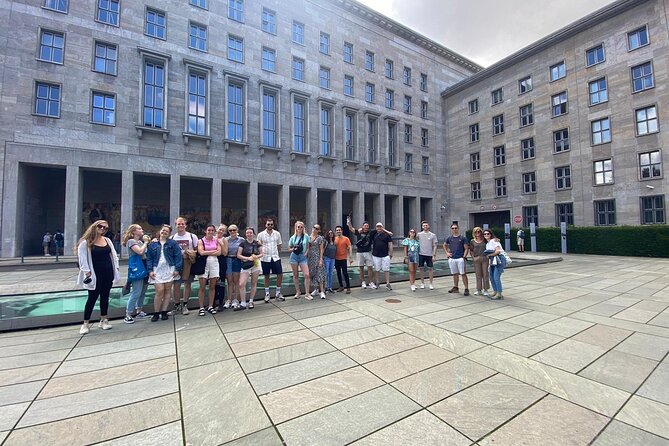
The Memorial to the Murdered Jews of Europe, commonly called the Holocaust Memorial, receives about 20 minutes. The tour uses it to discuss Berlin’s development from a small fishing settlement through Prussian power and into the crimes of the Nazi Third Reich.
This is a place where a guide must be careful and respectful. The memorial’s concrete blocks invite questions, but the site is not a playground or a backdrop for careless behavior. You will get the most from it by listening closely and allowing the subject its proper weight.
The stop is also useful because it places Berlin’s modern identity beside its past. The city does not hide the fact that its most important sights can also be reminders of state violence and moral failure.
Cold War remains and easily missed details
The stop listed as Ausstellung Objektschutzregiment der Luftwaffe Friesland is less familiar than the Brandenburg Gate or Checkpoint Charlie. The description points to guard towers, memorials, and streetlights built under Stalin’s Soviet empire that still survive in the city.
This is the sort of material that can reward close attention. Berlin’s history is often visible in ordinary objects, not just major monuments. A tower, lamp, or piece of street design may seem unremarkable until someone explains its purpose and political setting.
The information supplied does not make clear whether this is an indoor exhibition visit or an exterior viewing point, so you should expect the guide to interpret what is present rather than plan on a full museum experience. This is another section where the guide’s storytelling can turn a quick look into something worthwhile.
The guides are the heart of the experience
The strongest praise centers on the people leading the walk. Ana was described as friendly, funny, and full of useful details about architecture, social history, and Berlin gossip. Miguel was praised for his passion, careful route planning, help with photographs, and attention to keeping the group together.
Katia received high marks for detailed and unusual stories, while Evan was appreciated for balancing facts with anecdotes. Ronja was praised for clear English and patient answers, and Francesca for warmth and enthusiasm. Other positive comments singled out Ester, Nora, Richard, Phillipe, and Rosanna.
That list tells you two things. First, the company has produced some genuinely strong guiding. Second, your experience may vary because the delivery depends heavily on who leads the group.
One person found the guide accurate but too much like a classroom lecture. Another said the guide moved quickly and gave Checkpoint Charlie almost no time. I would book this if you enjoy history and can accept that the presentation may be more factual than theatrical.
The walking demands and weather problem
The tour requires moderate physical fitness. You will spend several hours on foot, with stops across central Berlin and possible stretches between landmarks. The route has been described as around three to four hours, so comfortable shoes are essential.
Dress for the forecast, not for your hotel lobby. One person was underdressed in cold weather, while another managed snow and ice because the paths were safe. Rain has also occurred, with umbrellas making the difference between an enjoyable outing and a miserable one.
The pace may feel fast at certain points. If you walk slowly, need frequent rests, or want long photo sessions, this may not suit you. If you want a broad first look and do not mind moving on before every detail has sunk in, the pace can be useful.
Public transportation is not included if it becomes necessary. One account described taking the metro during the tour, but the supplied details do not promise that transport will be part of every departure. Keep a valid ticket or another way to cover transit if your guide uses it.
What $2.90 really buys you
At $2.90 per person, this is unusually inexpensive for a three-hour guided introduction to Berlin. Even a short explanation at several major landmarks can make the cost worthwhile, especially if you are new to the city and want help choosing what to revisit.
The pricing deserves a careful note. One person described the activity as a free walking tour and objected to being asked for 20 euros upfront. The operator response says the walk is free to join and tipping is optional, while the supplied tour details list a $2.90 price.
That creates a possible mismatch between the booking page, the on-the-ground explanation, and the tipping culture. Before you commit, confirm exactly what your payment covers and understand that any tip should be voluntary. If a guide requests a fixed amount, you should feel comfortable asking why it differs from the booking terms.
Even with that warning, the financial value can be excellent when the guide is strong. It is less attractive if you need guaranteed punctuality, a small group, or detailed time at every landmark.
Who should book this walk
I would recommend it to a first-time visitor who wants to see Berlin’s main central sights quickly. It also suits anyone with only one day, provided you protect enough time for the walk and do not rely on it as your only plan.
Families can benefit from the variety of stops, and one account found the route workable with a child, including a park and a metro ride. Still, the length and history-heavy content may test younger children, especially in cold or wet weather.
History fans should find plenty to consider, particularly if the guide connects the Prussian era to the World Wars, the Nazi period, the Cold War, and present-day Germany. If you already know Berlin well, you may value the lesser-known stories more than the basic landmark facts.
I would skip it if you need a guaranteed start, dislike large groups, or want extended visits at museums and memorials. The reported no-shows and meeting-point problems are the biggest concern, not the walking itself.
Should you book the Berlin Walking Tour?
Book it for a cheap, broad orientation with the possibility of an excellent guide. The strongest outings have been lively, accurate, friendly, and long enough to cover a remarkable stretch of Berlin, with guides such as Ana, Miguel, Katia, Evan, and Ronja earning especially warm praise.
Go in with realistic expectations. This is a fast-moving city introduction, not a private tour or a series of full site visits. Confirm the meeting point, check messages before departure, wear proper shoes and weatherproof clothing, and clarify the payment and tipping arrangements.
If those conditions suit you, the $2.90 price offers very good value. Just keep the rest of your day flexible in case the walk runs longer than three hours or the operator changes the start details.
FAQ
How much does the Berlin Walking Tour cost?
The supplied price is $2.90 per person. The operator also describes the walk as free to join with optional tipping, so confirm the payment and tipping terms before attending.
How long does the tour last?
The listed duration is approximately three hours. Some outings have lasted three and a half to four hours, so allow extra time.
Is the tour offered in English?
Yes. English is the listed language for the experience.
Where does the tour start?
It starts at Generator Berlin Alexanderplatz, Otto-Braun-Straße 65, 10178 Berlin, Germany.
Where does the tour finish?
The activity is scheduled to end back at the meeting point.
Which sights are included?
The route includes the Reichstag Building, Berliner Dom, Brandenburg Gate, Checkpoint Charlie, the Berlin Wall Memorial, the Holocaust Memorial, and the listed Luftwaffe-related exhibition or site.
Is public transportation included?
Public transportation is not included if it is needed. One account described using the metro during the walk, but transport is not guaranteed as part of every tour.
What fitness level is required?
A moderate level of physical fitness is required because the experience involves several hours of walking.
Can I cancel for a refund?
You can cancel up to 24 hours before the start time for a full refund. Cancellations or changes made less than 24 hours before the start are not refunded or accepted.
Just added around Berlin
- The History of Berlin: WWII PRIVATE Walking Tour With Locals★ 5.0 · 209 reviews
- Private Walking Tour in Berlin: Hitler’s Germany & WWII★ 5.0 · 7 reviews
- Private Berlin WWII and Cold War History Tour with Local Expert Guide★ 5.0 · 28 reviews
- Private Walking Tour Berlin 3 hours: Brandenburg, Historic Center★ 5.0 · 7 reviews
- Berlin: Private Bike Tour of the Berlin Wall and Third Reich★ 5.0 · 23 reviews
- Berlin: Guided Private Bike Tour to Explore the Highlights★ 5.0 · 12 reviews
- Berlin Photography Masterclass – Private Photography Lesson★ 4.5 · 23 reviews
- Group Driving Tour 1 to 6 people. Berlin Shore Excursion incl pick-up at Port★ 5.0 · 8 reviews
Walking Tours, compared.

Old Town & Viktualienmarkt City Walk in German
Read our review →Browse the lists this tour appears in