
Reviewed · COLD WAR TOURS
Berlin’s Best: 2 Hour Walking Tour Third Reich and the Cold War
History is under your feet in Berlin. This two-hour walk links the city’s major Nazi and Cold War sites, giving you a clear route from Brandenburg Gate to Checkpoint Charlie without spending the day on a bus. I especially like the compact route and the way it connects famous sights to the events that shaped them. I also value the use of old photographs and the guides’ willingness to answer questions. The main drawback is simple: two hours is tight for such a heavy subject, and you will be outside for the whole tour.
The tour costs $24.07 per person, which is a fair price for an English-speaking guide and a route packed with free outdoor landmarks. You need to meet 15 minutes early at the Tourist Information office by Brandenburg Gate, then look for the guide carrying a pink umbrella. Winter visitors should wear warm layers, gloves, and sensible shoes.
In This Review
- Key points at a glance
- Why this two-hour route works
- Brandenburg Gate and the Reichstag: Berlin’s political center
- Soviet tanks in Tiergarten and the Victory Column
- The Holocaust Memorial and Hitler’s bunker
- The Aviation Ministry and the former Nazi power center
- Topography of Terror: where Nazi institutions operated
- Niederkirchnerstraße and a surviving piece of the Wall
- Checkpoint Charlie and the road to reunification
- Guides, group size, and the style of the walk
- Is $24.07 good value for Berlin?
- Practical advice before you go
- Who should book this Berlin history walk?
- Should you book Berlin’s Best?
- FAQ
- How long does the walking tour last?
- Where does the tour begin?
- Where does the tour finish?
- How do I find the guide?
- Is the tour offered in English?
- Are entrance tickets included?
- What is the cancellation policy?
Key points at a glance
- Starts at Brandenburg Gate: Begin at Berlin’s best-known symbol and finish at Checkpoint Charlie.
- Covers Nazi and Cold War history together: The route links the Reichstag fire, Hitler’s bunker, the Berlin Wall, and German reunification.
- All major stops are viewed from outside: Admission is free, but this is not an indoor museum tour.
- Historical photos add context: Guides such as Mikhail and Glen have used old images to show how places looked during the Nazi and divided-city years.
- Small enough to ask questions: The group can reach up to 30 people, and guides including Maggie, Mikey, James, and Peter F. are praised for clear answers.
- Good value for a short visit: The route gives you a fast orientation before you explore Berlin on your own.
Why this two-hour route works
Berlin can feel scattered at first. The city’s key sights are spread across broad streets and large open spaces, and the history is layered rather than neatly arranged. This walk gives you a useful framework.
You begin with the German capital as a symbol of reunification, move into the Nazi period, then follow the destruction and division that came after the Second World War. The final stops explain the Berlin Wall and the city’s return to one Germany.
That sequence matters. You are not simply checking off Brandenburg Gate, the Holocaust Memorial, and Checkpoint Charlie. You are hearing how each place fits into the next chapter.
The walking format is also a strong choice here. A bus might pass the Reichstag or the Wall, but walking lets you stop over former government districts, see surviving wartime buildings, and look closely at a section of the Wall. The route is not presented as a collection of unrelated monuments.
Still, keep your expectations in check. The tour does not take you inside the Reichstag, Topography of Terror, or any other museum. The admission tickets listed for the stops are free because the experience is based on outdoor interpretation. If you want extended time with exhibits, plan a museum visit afterward.
More Third Reich History Tours in Berlin
- Berlin: Third Reich and Cold War 2 Hour Walking Tour
★ 4.9 · 6,830 reviews - Third Reich Berlin: Hitler and WWII Walking Tour
★ 5.0 · 3,301 reviews - Berlin: Third Reich, Hitler, and WWII Walking Tour
★ 4.9 · 1,133 reviews
Brandenburg Gate and the Reichstag: Berlin’s political center
The tour begins at Brandenburg Gate on Pariser Platz. Meet 15 minutes before the start in front of the Tourist Information office, on the square side of the gate. The pink umbrella makes the group easier to find, especially when several tours gather nearby.
Brandenburg Gate is more than a handsome neoclassical monument. Your guide explains why it became a symbol of reunified Germany. That opening gives the tour a useful present-day reference point before turning to the darker chapters of the past.
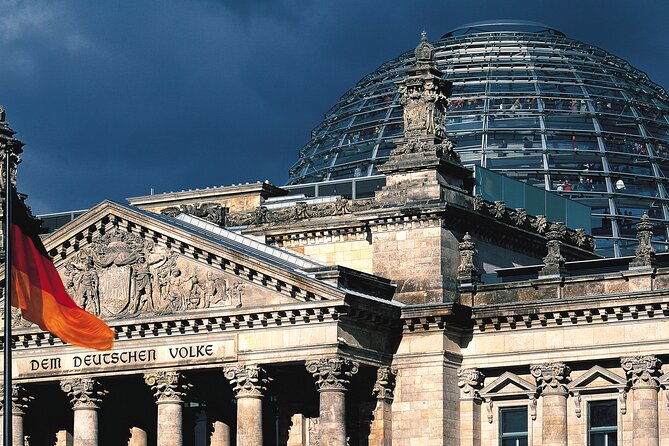
You then walk to the Reichstag Building, home of the German parliament. The stop lasts about 10 minutes and focuses on how this building reflects the country’s political changes over the last century.
The Reichstag fire of 1933 is central to the story. You hear how Hitler used the fire to help destroy political opposition and strengthen his dictatorship. The building itself becomes evidence of how quickly democratic institutions can be weakened.
This is a good early stop because it places the rise of Nazism in a political setting. You are not only hearing about Hitler as a person. You are learning how power was taken and used.
Soviet tanks in Tiergarten and the Victory Column
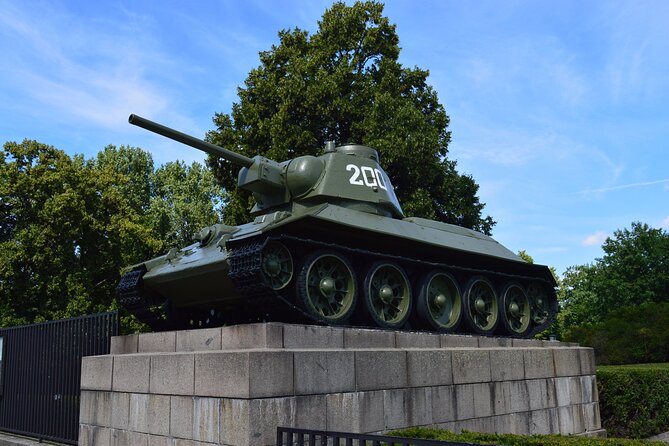
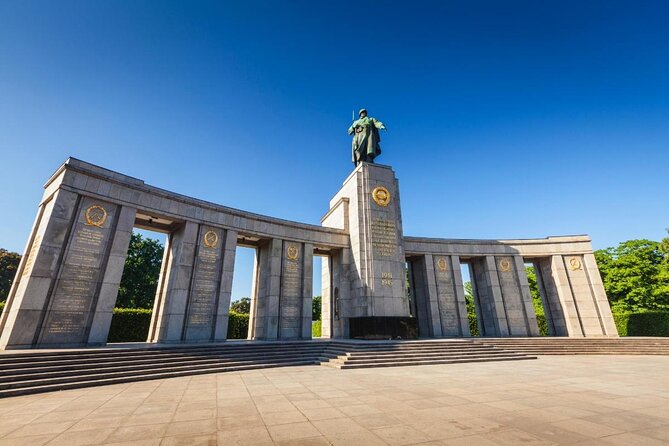
The route continues to the Soviet Memorial in the Tiergarten. You see Soviet T34/76 tanks and field artillery from the Second World War. The stop is brief, about seven minutes, but the equipment makes the end of the war more visible than a plaque or empty square could.
The memorial also helps explain the postwar division of Berlin. The Soviet presence was not just a matter of military history. It shaped the city’s occupation, politics, and later division.
The itinerary also includes the Victory Column, though the listed timing does not give it a separate stop number. Here, the guide explains why Albert Speer moved the column from its original location and describes his plans for Germania, the vast Nazi redesign of Berlin.
That topic is especially useful because it shows the scale of Nazi ambition. Germania was intended to become a new capital for a victorious Nazi empire, with Berlin itself given a new role and name. The plan never became reality, but hearing about it while looking at the Victory Column helps you understand the regime’s grand architectural aims.
The drawback is time. You get the key idea, not a full architectural lecture. If Speer’s plans interest you, note the details and continue the subject at a museum or through your own reading.
The Holocaust Memorial and Hitler’s bunker
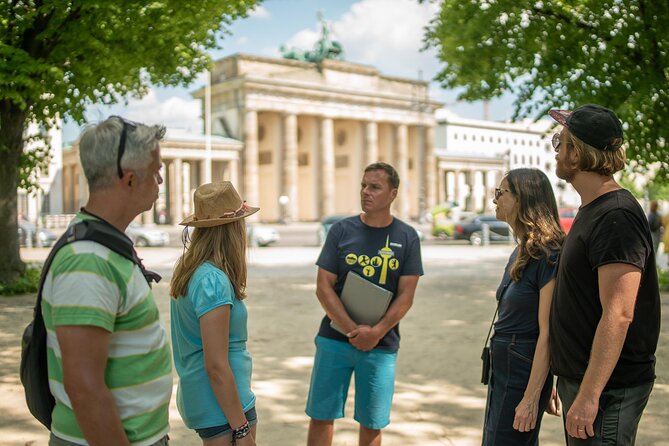
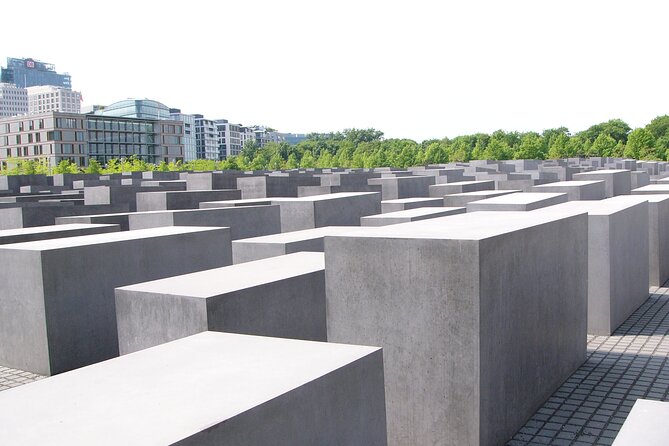
The Memorial to the Murdered Jews of Europe is one of the tour’s most affecting stops. You walk through the large field of concrete blocks dedicated to the murdered Jews of Europe.
The guide gives you time to experience the memorial while explaining its purpose. The setting can feel stark and unsettling, which is appropriate for a place dealing with mass murder. The tour does not treat it as a quick photo stop.
You then stand above the location of Hitler’s bunker. There is no dramatic entrance to visit. The site is deliberately ordinary, and the lack of a grand marker is part of Berlin’s approach to dealing with Hitler’s former headquarters.
Your guide explains the final days of the Second World War, including Hitler’s suicide in the bunker on April 30, 1945. Just as important, you hear how Germans have dealt with this destructive past in the decades since.
This section requires a careful tone. Several guides are praised for handling grim subjects with respect while using light humor at suitable moments elsewhere. That balance can help keep a two-hour outdoor tour engaging, but the subject matter remains serious.
I would not choose this walk if you want a light sightseeing outing. The tour deals directly with Nazi crimes, murder, dictatorship, war, and suicide. For many people, that direct approach is the reason to book it.
More Walking Tours in Berlin
- Discover Berlin Half-Day Walking Tour
★ 5.0 · 9,624 reviews - Berlin: Discover Berlin Walking Tour
★ 4.9 · 5,998 reviews - Berlin: Hidden Backyards Guided Walking Tour
★ 4.8 · 5,360 reviews - Berlin: Alternative Berlin Walking Tour
★ 4.6 · 1,204 reviews
The Aviation Ministry and the former Nazi power center
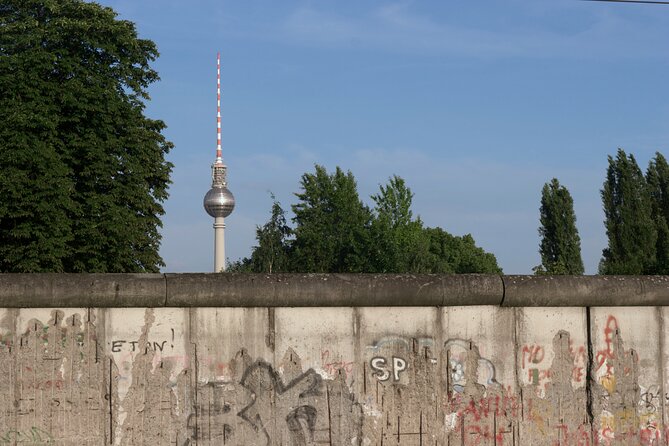
The next part of the route takes you along the former Aviation Ministry of Berlin. The building was associated with Hermann Göring’s air force ministry and later became the place where East Germany, or the GDR, was proclaimed in 1949.
The stop lasts only about five minutes. You will not spend long examining the building, but the location is useful because one structure connects two very different political systems: Nazi Germany and East Germany.
This is one of the tour’s better examples of Berlin’s layered past. The same city did not reset after 1945. Buildings, streets, and government districts were reused by new powers, often with older history still visible beneath the surface.
The guide’s job here is to make that connection clear. Several guides, including Peter F. and Georgia, have received praise for bringing the past into the present and explaining difficult material in an accessible way.
Topography of Terror: where Nazi institutions operated
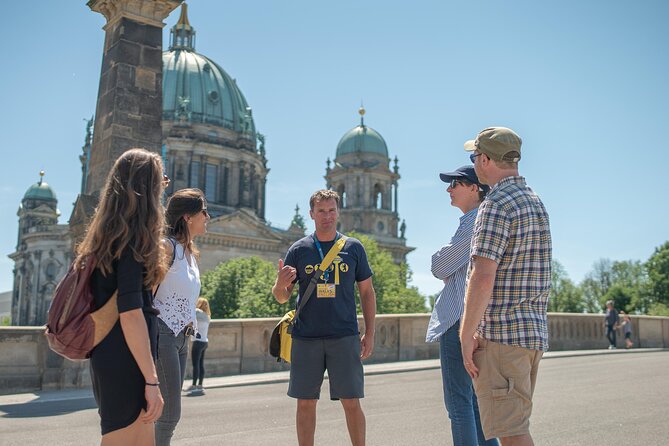
At the Topography of Terror, you see the site where the SS, Gestapo, and SD had their headquarters under the Nazi regime. The modern exhibition teaches about the crimes carried out by these institutions during the war.
The outdoor stop lasts about 15 minutes. You should think of it as an introduction rather than a full museum visit. The exhibition itself deserves more time if you want documents, photographs, and detailed accounts.
This is a key point on the route because it moves the story from Nazi leadership to the machinery that enforced the dictatorship. The Reichstag stop explains political power being seized. Topography of Terror shows how that power was organized and used against people.
If you have time after the walk, returning here is a sensible plan. The outdoor explanation gives you a reason to visit, and the exhibition can add detail that a fast walking tour cannot provide.
Niederkirchnerstraße and a surviving piece of the Wall
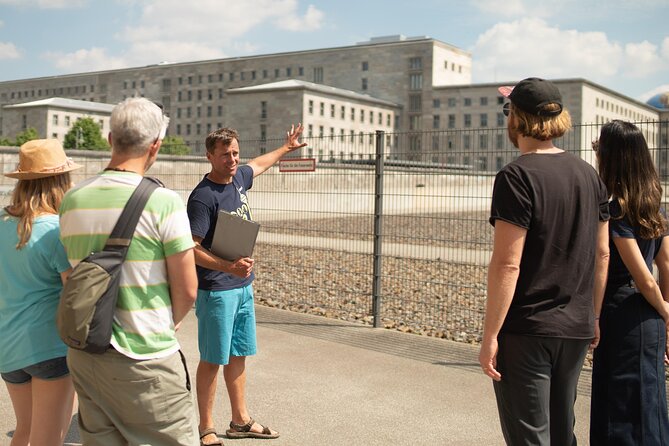
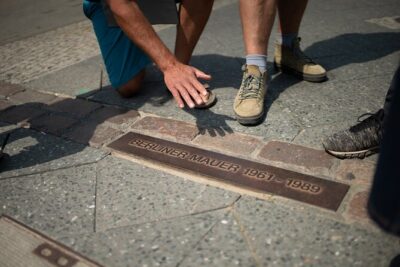
On Niederkirchnerstraße, you see a large section of the Berlin Wall. The guide explains escape attempts, what happened to people who tried to cross, and how life differed on the East and West sides.
This is where the Cold War becomes personal. Instead of hearing only about governments and military tension, you hear about people trying to leave, families divided, and the danger built into an ordinary city street.
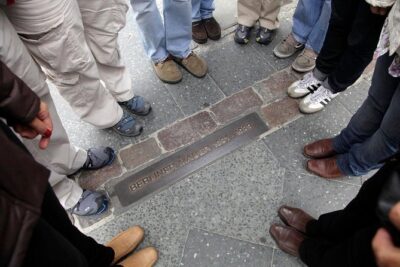
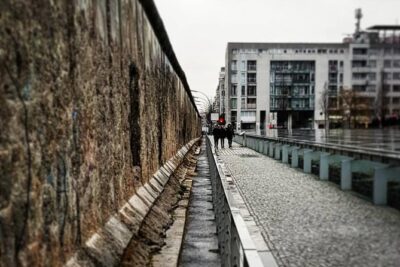
The Wall section also gives you a physical reminder of Berlin’s division. Much of the former border has disappeared into daily city life, so a surviving piece helps you picture the barrier that once cut through neighborhoods and public spaces.
The stop is about seven minutes. That is enough for the central story, but not enough for every escape case or political detail. You may want to write down questions for your guide, since the most praised guides are happy to explain more when time allows.
Families can make good use of this part of the tour. One recent guide, Mikey, was particularly effective at keeping an 11-year-old and a 16-year-old interested and comfortable asking questions. The subject is difficult, but a good guide can make it understandable without talking down to younger people.
Checkpoint Charlie and the road to reunification
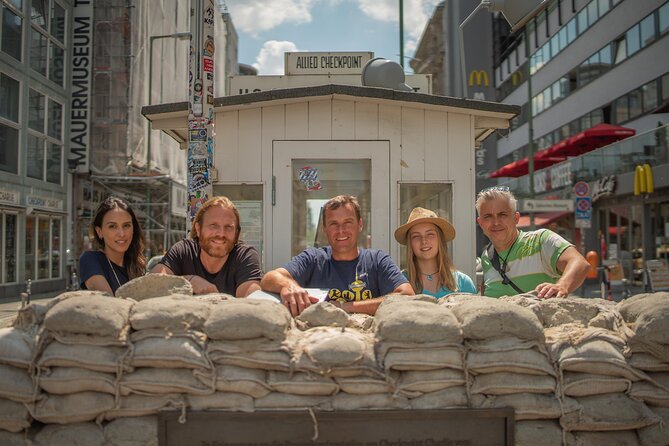
The tour ends at Checkpoint Charlie on Friedrichstraße. This was the best-known crossing point through the Berlin Wall and the setting for a tense Soviet and American tank standoff in 1961.
You hear how the confrontation unfolded, then move forward to the night of November 9, 1989, when the Berlin Wall came down. The tour closes by considering how successful German reunification has been over the more than 30 years since.
That ending works well. Brandenburg Gate introduces reunified Germany as an idea. Checkpoint Charlie brings you to the practical and human story of how division ended.
Checkpoint Charlie itself can feel commercial and busy compared with the memorial sites earlier in the walk. The value is not the modern checkpoint display alone. It is the explanation of what happened here and why this crossing became so famous.
The location is also useful for your next plan. You finish near public transportation, shops, and other central sights, so you can continue exploring without needing a long transfer.
Guides, group size, and the style of the walk
The tour is offered in English only, with a professional local guide. The maximum group size is 30 people. That is not an intimate private walk, but it is still manageable if the guide controls the stops well.
Guide quality matters more than usual on this route. The material includes dictatorship, genocide, war, political repression, and the Wall. A guide who simply recites dates will make the experience feel flat.
The strongest feedback centers on clear explanations, good stories, and an ability to answer questions. Guides named Glen, Ben, Maggie, Rebecca, Tom, Joachim, Simon, Paul, James, Mikhail, Peter F., Georgia, and Mikey are all praised for some combination of those skills.
Mikhail used historical images at certain stops, which can help you compare the street in front of you with its wartime or Cold War appearance. Glen also used old photographs to add context. If your guide has images, they are worth paying attention to because Berlin’s modern buildings can hide what stood there before.
The best style for this tour is serious but not stiff. Feedback about James, Georgia, and Mikey points to a useful balance: respectful treatment of victims, clear facts, and occasional humor that keeps the group alert. Your experience will vary by guide, but the company appears to place real weight on presentation.
Is $24.07 good value for Berlin?
At $24.07, this is a strong-value introduction to central Berlin. Every listed sight has free admission, so you are paying for the route, organization, explanations, and the guide’s ability to connect the locations.
That price makes particular sense if you have only a short stay. In two hours, you cover Brandenburg Gate, the Reichstag, the Soviet Memorial, Victory Column, the Holocaust Memorial, Hitler’s bunker site, the former Aviation Ministry, Topography of Terror, a section of the Wall, and Checkpoint Charlie.
You should not expect the same depth as a private guide or a full-day history program. The value comes from orientation. After the walk, you can decide which places deserve a longer visit.
The tour is often booked about 16 days in advance, so it is sensible to reserve early if your Berlin dates are fixed. Free cancellation is available up to 24 hours before the start time. Inside that window, the payment is not refunded, and changes are not accepted.
Practical advice before you go
Wear shoes you can walk in for two hours. The route is outdoors, and you will pause in open areas rather than sit inside a heated venue.
Winter needs extra planning. Bring a warm coat, gloves, and enough layers to remain comfortable while listening. One practical tip is worth taking seriously: use a restroom before you meet the group, since this is a continuous city walk.
Arrive 15 minutes early at the Brandenburg Gate Tourist Information office on the Pariser Platz side. Look for the pink umbrella. The mobile ticket is confirmed at booking, and the meeting point is close to public transportation.
Most people can take part, and service animals are allowed. The tour is in English only, so choose it only if you are comfortable following detailed historical commentary in English.
Who should book this Berlin history walk?
I would recommend it first to anyone visiting Berlin for two or three days and wanting a clear starting point. It gives you the city’s main political and historical markers without taking half a day.
It also suits families with older children and teenagers who can handle serious subjects. Mikey’s ability to involve younger members of a group suggests the format can work well when the guide keeps explanations lively and welcomes questions.
History fans will appreciate the focus on the Third Reich and Cold War, but you should book with the right mood in mind. This is not a cheerful highlights tour. It asks you to think about state violence, murder, war, division, and the long work of remembrance.
I would look elsewhere if you need wheelchair-specific route details, a private group, museum entry, or a slower pace. The available information confirms that most people can participate, but it does not promise a fully step-free route or extended indoor access.
Should you book Berlin’s Best?
Book it if you want a fast, serious introduction to Berlin’s 20th-century history. The route is logical, the price is modest, and the finish at Checkpoint Charlie leaves you well placed to continue sightseeing.
Its real strength is the link between places. You learn why Brandenburg Gate matters, how the Reichstag fire helped Hitler, where the Nazi security agencies worked, what happened at the bunker, how the Wall divided daily life, and how reunification changed Berlin.
Just remember that the tour is short and outdoors. Wear the right shoes, dress for the weather, arrive early, and save extra time for Topography of Terror or the Holocaust Memorial if you want more than the brief introduction. For many visitors, this is an excellent first step into Berlin’s difficult, essential past.
FAQ
How long does the walking tour last?
The tour lasts approximately two hours.
Where does the tour begin?
It begins at Brandenburg Gate, at the Tourist Information office on the Pariser Platz side.
Where does the tour finish?
It ends at Checkpoint Charlie, at Friedrichstraße 43-45, 10117 Berlin.
How do I find the guide?
Meet 15 minutes before the tour begins and look for the guide with the pink umbrella.
Is the tour offered in English?
Yes. The walking tour is offered in English only.
Are entrance tickets included?
The listed stops have free admission, and the tour is primarily an outdoor walking experience. It does not include entry to indoor exhibitions.
What is the cancellation policy?
You can cancel up to 24 hours before the start time for a full refund. Cancellations or changes made less than 24 hours before the experience are not refunded or accepted.
More Cold War Tours in Berlin
- Cold War, Berlin Wall, Spies and the East Side Gallery
★ 5.0 · 1,024 reviews - Berlin: Cold War Walking Tour on Berlin Wall Route
★ 4.8 · 437 reviews - Berlin: Cold War Era History Guided Bike Tour
★ 4.8 · 413 reviews - Cold War, Berlin Wall, Spies and the East Side Gallery
★ 4.8 · 254 reviews
Just added around Berlin
- Private Walking Tour in Berlin: Hitler’s Germany & WWII★ 5.0 · 7 reviews
- The History of Berlin: WWII PRIVATE Walking Tour With Locals★ 5.0 · 209 reviews
- Private Berlin WWII and Cold War History Tour with Local Expert Guide★ 5.0 · 28 reviews
- Private Walking Tour Berlin 3 hours: Brandenburg, Historic Center★ 5.0 · 7 reviews
- Berlin: Private Bike Tour of the Berlin Wall and Third Reich★ 5.0 · 23 reviews
- Berlin: Guided Private Bike Tour to Explore the Highlights★ 5.0 · 12 reviews
- Berlin Photography Masterclass – Private Photography Lesson★ 4.5 · 23 reviews
- Group Driving Tour 1 to 6 people. Berlin Shore Excursion incl pick-up at Port★ 5.0 · 8 reviews
Cold War Tours, compared.
Cold War, Berlin Wall, Spies and the East Side Gallery
Read our review →

Cold War, Berlin Wall, Spies and the East Side Gallery
Read our review →
Explore The Berlin Wall: Cold War Berlin and Behind the Berlin Wall
Read our review →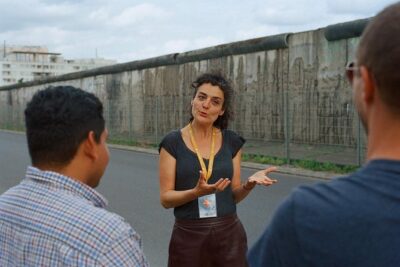
PRIVATE BEHIND THE BERLIN WALL and COLD WAR BERLIN TOUR
Read our review →Browse the lists this tour appears in