
Reviewed · HARBOUR CRUISES
Duisburg: Guided Walking Tour through the inner harbour
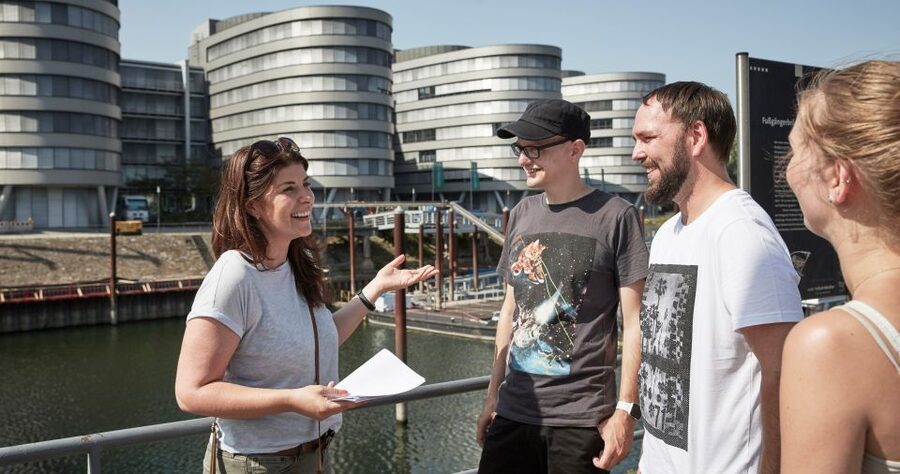
Duisburg’s old docks tell a modern city story. This 1.5-hour walk shows how the inner harbour changed from the Ruhr area’s grain center into a waterside district of yachts, restaurants, museums, and striking offices. I like the clear focus on urban change, and I like that you see the result on foot rather than from behind a bus window.
The tour’s other strength is its informative, good-humored guiding style, praised by Guido, who found the walk both useful and excellent value. You also get a close look at the Foster plan that helped reshape the area. The main consideration is language: the live tour is in German, so it may be less rewarding if you cannot follow German comfortably.
Rain does not stop the tour, so bring suitable clothing and keep your plans flexible. The meeting point is easy to identify, in front of the Mercator fountain by Duisburg town hall. At $16 per person, the walk is a sensible choice if you want context before visiting the museums or sitting down at a harbour restaurant.
In This Review
- Key points about Duisburg’s inner harbour walk
- Why Duisburg’s inner harbour is worth seeing
- Meeting the guide by the Mercator fountain
- Following the old grain trade
- Seeing the Foster plan in real buildings
- From freighters to yachts
- Five Boats, museums, and the new skyline
- Restaurants and the Mediterranean mood
- Is $16 a fair price for 90 minutes?
- Who will enjoy this tour most?
- Weather, access, and timing
- My verdict on the inner harbour walk
- FAQ
- Where does the Duisburg inner harbour tour begin?
- How long does the guided walk last?
- What language is the tour conducted in?
- How much does the tour cost?
- Is the tour wheelchair accessible?
- Does the tour run in rainy weather?
- Can I cancel for a full refund?
- Can I pay later?
Key points about Duisburg’s inner harbour walk
- A former grain port turned city district: Learn why the inner harbour was once called the bread basket of the Ruhr area.
- Sir Norman Foster’s redevelopment plan: See how a major urban design scheme changed the waterfront from the mid-1990s onward.
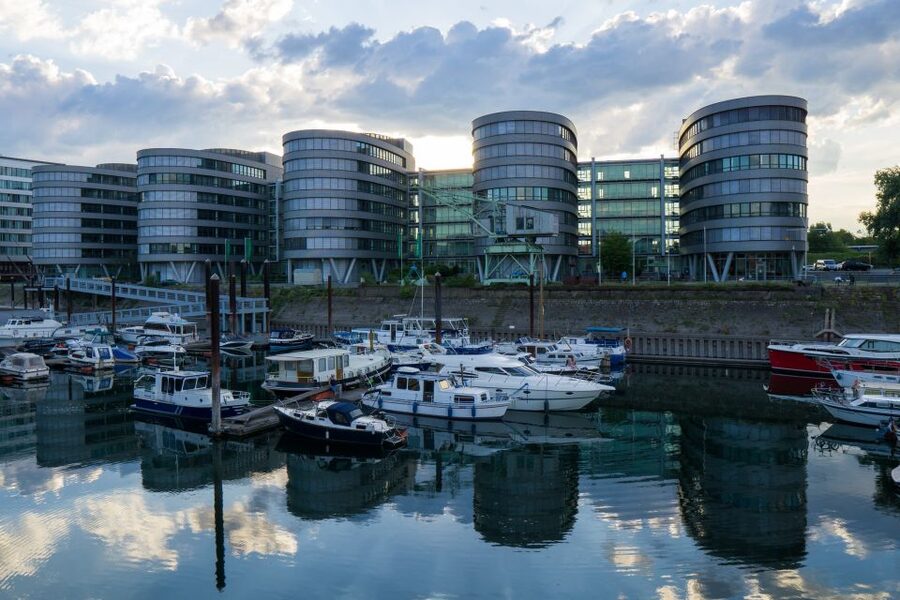
- Five Boats and modern architecture: Look closely at one of the area’s most noticeable contemporary building groups.
- Yachts beside old warehouses: The contrast between working docks, nostalgic storage buildings, and modern offices gives the walk its character.
- A practical 90-minute format: The tour is long enough to explain the area without taking up a full afternoon.
- Museums and restaurants nearby: Add the Küppersmühle Museum, the Cultural and Urban History Museum, or a meal by the water.
Why Duisburg’s inner harbour is worth seeing
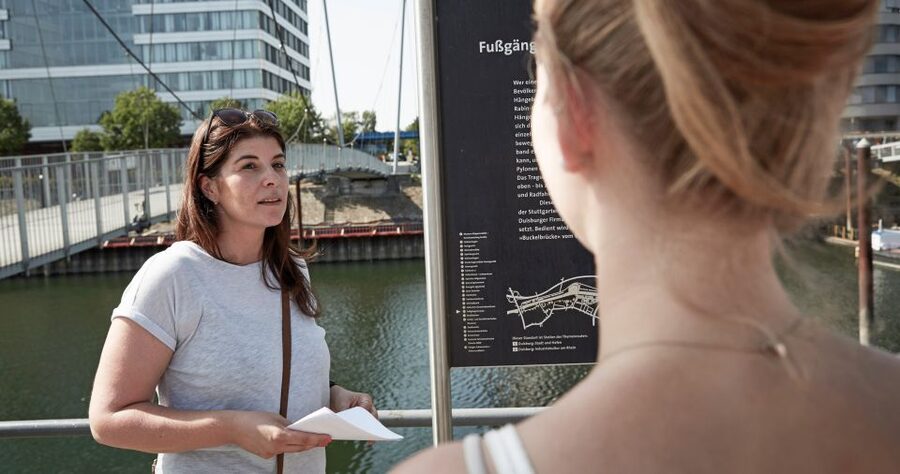
Duisburg is often linked with industry, freight, and the wider Ruhr area. That makes the inner harbour especially interesting. You are not simply looking at attractive waterfront buildings. You are seeing a former working district adapt after its original business faded.
The harbour handled huge quantities of grain and earned the nickname bread basket of the Ruhr area. Grain mills were central to its purpose until the end of the 1960s. Once those mills declined, the old harbour could no longer depend on the trade that had shaped it.
That problem forced a choice. The area could be left to decay, or it could be given a new role. The tour explains how Duisburg chose change, with a plan associated with British architect Sir Norman Foster helping guide the redevelopment from the mid-1990s.
I find this kind of city walk more useful than a standard sightseeing circuit because it gives you a reason for what you see. A modern office building is not just a modern office building. A restored warehouse is not just a photogenic old facade. Together, they show how a city can reuse its industrial past instead of erasing it.
More Harbour Cruises in Germany:
- Hamburg: 1.5-Hour Harbor and Speicherstadt Day Cruise
★ 4.6 · 14,200 reviews - Hamburg: 90-Minute Evening Lights Harbor Cruise
★ 4.5 · 7,728 reviews - Hamburg: 1-Hour Harbor Evening Lights Cruise
★ 4.4 · 4,861 reviews
Meeting the guide by the Mercator fountain
The tour begins in front of the Mercator fountain, outside Duisburg town hall. That gives you a clear central meeting place and lets you begin near the city center before walking toward the harbour district.
You should arrive with enough time to locate the fountain and settle in. The supplied details do not give a group size or the exact walking route, so I would not plan a tight connection immediately afterward. A 90-minute tour can finish on schedule, but a little breathing room is sensible when you are arranging a museum visit or meal.
The guide speaks German. This matters more here than it might on a simple photo walk because the value lies in the explanation of the redevelopment plan, the port’s former role, and the changes in the buildings around you. If your German is good enough for a guided city tour, you should get much more from the experience.
The walk is wheelchair accessible. That is useful for anyone who wants to see the harbour without choosing a tour built around stairs or difficult access. Since the tour continues in rainy weather, accessibility and clothing are both worth considering in advance.
Following the old grain trade
One of the most important parts of the walk is understanding what the harbour used to do. Before the redevelopment, this was a place of loading, unloading, storage, and grain processing. The waterfront had a practical job, not a leisure purpose.
That background changes the way you read the district. The yachts and restaurants may create a relaxed, almost Mediterranean mood today, but the harbour was once tied to heavy commercial work. The contrast is the point.
You will learn how the decline of the grain mills at the end of the 1960s weakened the old inner harbour. The loss was not just economic. It also meant that large parts of the district no longer had a clear reason to remain active.
I appreciate that the tour treats this as a planning problem rather than a simple success story. Urban redevelopment can produce attractive places, but it also has to answer a basic question: what should this district be for now? In Duisburg, the answer included offices, culture, food, events, and recreation alongside the older structures.
Seeing the Foster plan in real buildings
The tour connects the redevelopment plan with the buildings around you. Sir Norman Foster’s role gives the walk a strong architectural thread, especially for anyone interested in how a city changes through design.
The most obvious modern feature mentioned on the route is the Five Boats. You will also see modern office complexes, museums, and newer structures close to older warehouse rows. The attraction is not one isolated building. It is the conversation between different periods of construction.
I would pay attention to how the newer buildings relate to the water and to the older port buildings. The inner harbour works as a visual lesson in contrast: clean modern forms beside reminders of storage and shipping, with boats occupying spaces once used by freighters.
You should not expect a museum-style architectural lecture with technical plans or a long list of famous designers. This is a walking tour, and the emphasis is on seeing the urban change in place. That makes it accessible for a first visit, even if you are not an architecture enthusiast.
More Walking Tours in Germany:
- Discover Berlin Half-Day Walking Tour
★ 5.0 · 9,624 reviews - Berlin: Third Reich and Cold War 2 Hour Walking Tour
★ 4.9 · 6,830 reviews - Munich: Third Reich & WWII Walking Tour
★ 4.6 · 6,181 reviews - Berlin: Discover Berlin Walking Tour
★ 4.9 · 5,998 reviews
From freighters to yachts
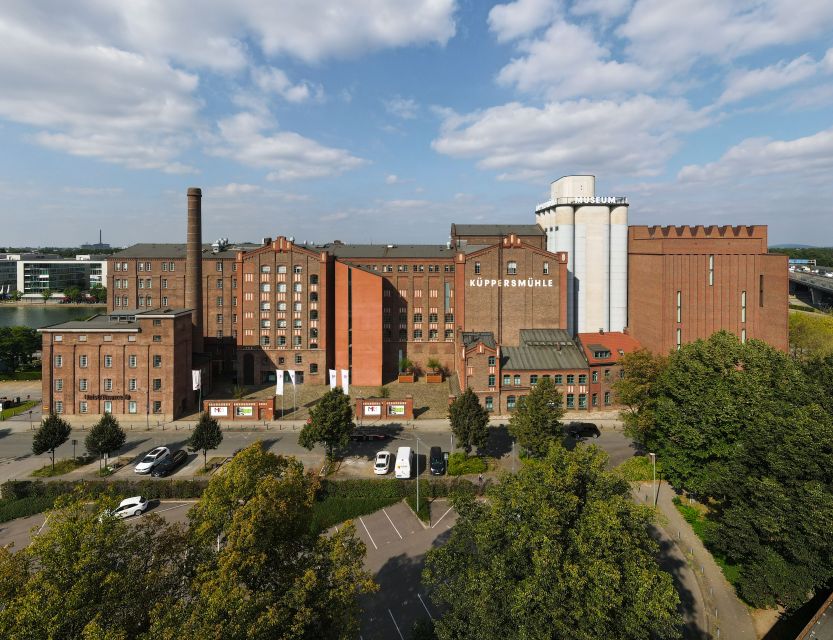
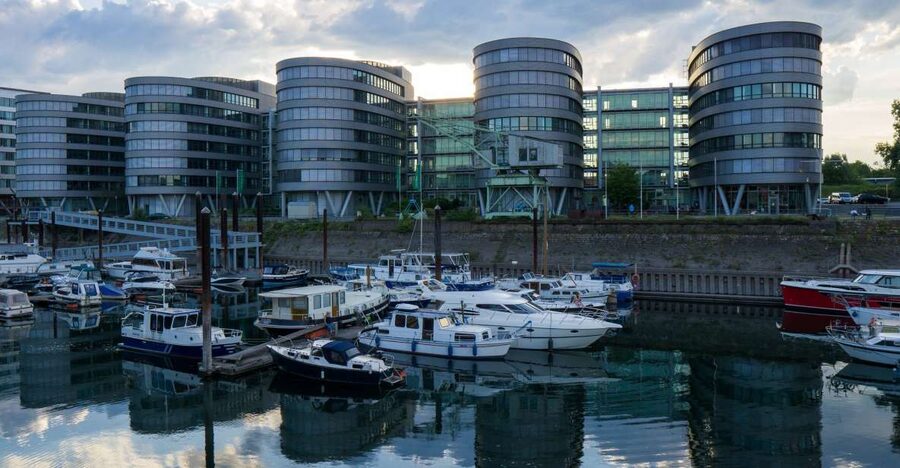
The strongest visual change comes at the water. Where freighters once loaded and unloaded, yachts now sit at anchor. That single contrast explains the new identity of the district better than a brochure could.
The harbour’s present mood comes from the mix of water, boats, restaurants, and buildings. You can walk beside the marina and see how the waterfront now invites people to linger. The area is designed for sitting, eating, meeting, and attending events, not only for moving goods.
This is also where the tour may feel most relaxed. The maritime setting gives you a break from the formal city center, while the guide keeps the focus on how the change happened. You get atmosphere and explanation at the same time.
Still, keep your expectations sensible. This is not a boat cruise, and you are not promised access inside the yachts, offices, or restaurants. The experience is about the public spaces and the story of the district as you walk through it.
Five Boats, museums, and the new skyline
The Five Boats provide one of the tour’s clearest modern architecture stops. Their name alone makes them easy to remember, and their presence helps show how the former harbour was given a new visual identity.
Nearby museums add another layer. The Küppersmühle Museum of modern art is especially worth considering before or after the walk. Its focus complements the contemporary architecture around the harbour, giving you a chance to continue thinking about modern design and cultural reuse indoors.
The Cultural and Urban History Museum offers a different follow-up. If the walking tour explains how one part of Duisburg changed, this museum can help place that change within the wider story of the city.
I would not try to rush through both museums and the walking tour in a single short visit. The tour itself takes 1.5 hours, and each museum needs time if you want more than a quick look. Pick the museum that best matches your interests, then leave room for a meal or coffee beside the water.
Restaurants and the Mediterranean mood
The inner harbour is now also a place to eat and relax. Restaurants sit by the water, and the marina gives the district a leisure feel that would have been impossible when the waterfront was mainly a grain-handling zone.
This is a useful reason to schedule the tour around a meal. You can take the guided walk first, then stay nearby for food while the information is still fresh. Or you can eat beforehand and use the walk to understand the buildings and waterfront you have just seen.
The phrase Mediterranean atmosphere should be taken as a description of mood, not climate. Duisburg is still northern Germany, and the tour runs in rain. Bring a rain jacket or umbrella if the forecast looks uncertain, especially since the experience does not move indoors when the weather turns poor.
One nice detail from the feedback is that bad weather did not ruin the experience for Ursula. She specifically appreciated the guide’s good mood during a rainy tour. That is a small point, but it tells you something practical: the experience depends partly on the guide keeping the group engaged outdoors.
Is $16 a fair price for 90 minutes?
At $16 per person, this is a reasonable price for a live guided walk, especially if you want background that would be difficult to gather by simply strolling around the harbour. The value comes from interpretation, not from an expensive attraction or included admission.
You are paying for 1.5 hours of explanation about the grain trade, the decline of the old harbour, Foster’s plan, and the buildings that followed. Museums, meals, and other activities are separate, so include those costs if you are building a full afternoon around the district.
The price looks strongest for first-time visitors who want orientation. If you already know Duisburg’s planning history or prefer to read plaques at your own pace, you may find the walk less essential. For most visitors with an interest in architecture, urban change, or industrial history, the fee is modest.
The positive feedback also points to value and humor, not just information. That combination matters. A dry explanation of redevelopment can make even an attractive waterfront feel distant, while a lively guide can help the story stick.
Who will enjoy this tour most?
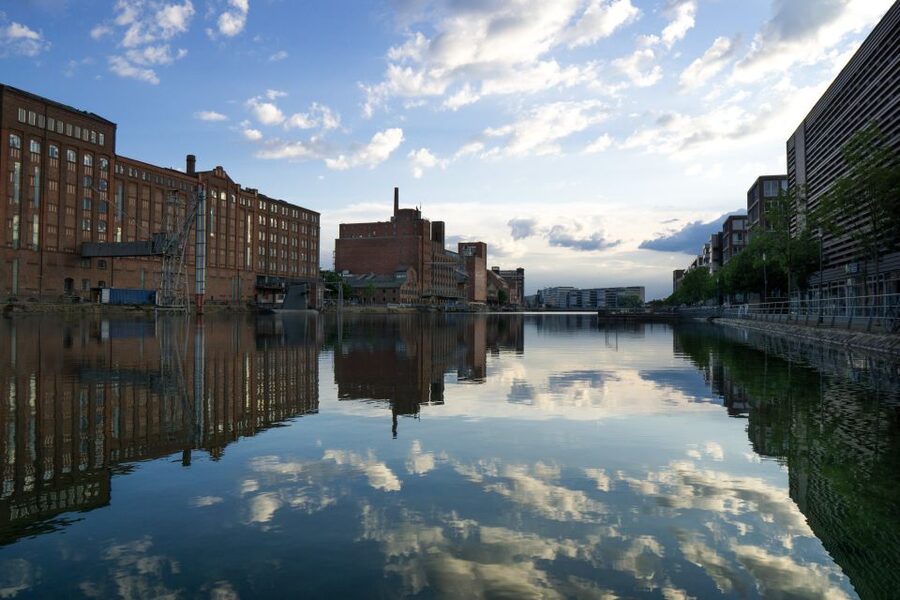
I would choose this walk if you enjoy seeing how cities reuse former industrial areas. It is also a good fit if modern architecture interests you, or if you want a structured introduction before visiting the nearby museums.
Families can benefit from the short duration and the mix of boats, open water, unusual buildings, and restaurants. The tour is not described as a children’s program, so younger children may enjoy the setting more than the planning discussion.
It suits visitors who speak German well enough to follow a live explanation. Since German is the only stated tour language, this is the biggest practical filter.
The walk is also a good choice for anyone who prefers a focused activity rather than a full-day excursion. Ninety minutes gives you a useful introduction while leaving time for the Küppersmühle, the Cultural and Urban History Museum, or lunch by the harbour.
Weather, access, and timing
The tour runs even when it rains. That makes it easier to keep in a fixed itinerary, but it also means you should dress for outdoor walking instead of treating this as a mostly indoor activity.
The duration is 1.5 hours, with starting times dependent on availability. Check the available time before you plan museum admission or a restaurant booking. I would avoid scheduling anything immediately afterward if missing a few minutes would cause trouble.
Wheelchair access is listed for the tour. If you have specific mobility needs, you may still want to confirm the exact route and current conditions when booking, but the activity is intended to be accessible.
You can cancel up to 24 hours in advance for a full refund, and you can reserve now while paying later. Those terms are useful if your German itinerary is still shifting, especially when weather or train plans may affect your day.
My verdict on the inner harbour walk
Book this tour if you want Duisburg’s inner harbour to make sense, not just look attractive. The former grain trade, the loss of the mills, and the Foster-led redevelopment give the waterfront a clear story. The yachts, Five Boats, museums, restaurants, and old warehouses then become parts of that story instead of disconnected sights.
I would skip it only if you do not speak German well enough for a live tour, or if you want a self-guided stroll with no fixed schedule. For $16, the combination of urban history, architecture, and waterside atmosphere is strong value. Add the Küppersmühle or another nearby museum afterward, and you have a worthwhile half-day in one of Duisburg’s most changed districts.
FAQ
Where does the Duisburg inner harbour tour begin?
The guide waits in front of the Mercator fountain, outside Duisburg town hall.
How long does the guided walk last?
The tour lasts 1.5 hours.
What language is the tour conducted in?
The live guided tour is conducted in German.
How much does the tour cost?
The listed price is $16 per person.
Is the tour wheelchair accessible?
Yes, the activity is listed as wheelchair accessible.
Does the tour run in rainy weather?
Yes. The tour takes place even when it is raining, so suitable clothing is recommended.
Can I cancel for a full refund?
Yes. You can cancel up to 24 hours in advance for a full refund.
Can I pay later?
Yes. The reserve-now, pay-later option lets you secure a place without paying immediately.
Just added around Germany
- Private Walking Tour in Berlin: Hitler’s Germany & WWII★ 5.0 · 7 reviews
- The History of Berlin: WWII PRIVATE Walking Tour With Locals★ 5.0 · 209 reviews
- Private Berlin WWII and Cold War History Tour with Local Expert Guide★ 5.0 · 28 reviews
- Private Walking Tour Berlin 3 hours: Brandenburg, Historic Center★ 5.0 · 7 reviews
- Berlin: Private Bike Tour of the Berlin Wall and Third Reich★ 5.0 · 23 reviews
- Berlin: Guided Private Bike Tour to Explore the Highlights★ 5.0 · 12 reviews
- Berlin Photography Masterclass – Private Photography Lesson★ 4.5 · 23 reviews
- Group Driving Tour 1 to 6 people. Berlin Shore Excursion incl pick-up at Port★ 5.0 · 8 reviews
Harbour Cruises, compared.

1.5-Hour Harbor and Speicherstadt Day Cruise
Read our review →
1-Hour Harbor Sightseeing Cruise with HafenCity
Read our review →
Hop-On Hop-Off Bus with Alster or Harbor Cruise
Read our review →
Browse the lists this tour appears in