
Reviewed · FOOD & DRINK
Erfurt: On the road with the Brückenkrämer. Walking tour with anniversary tasting.
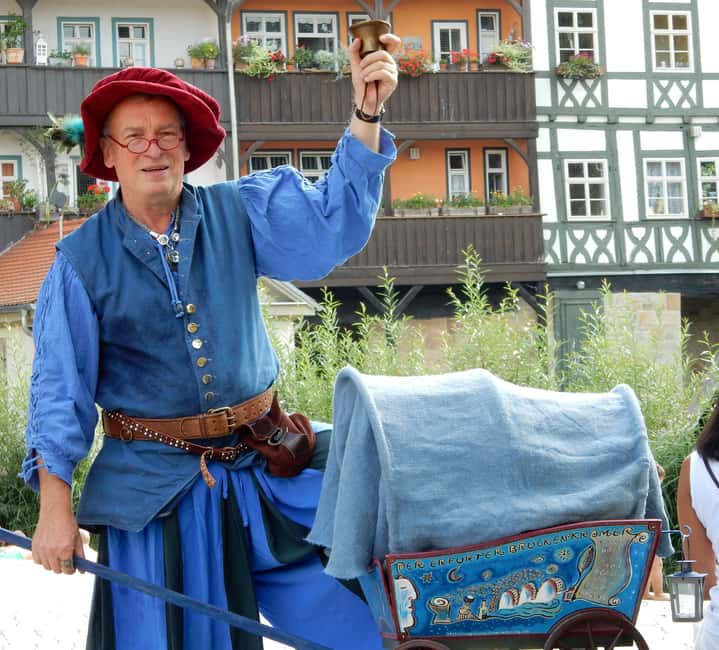
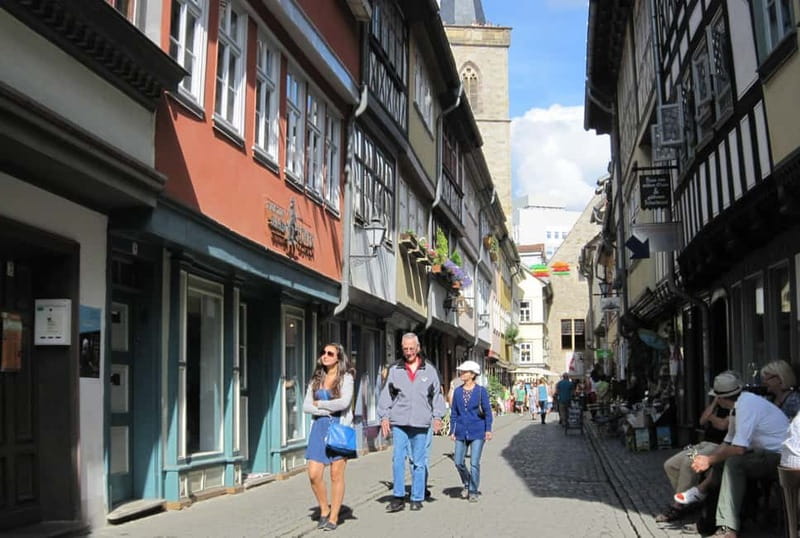
Old Erfurt comes with a punchline. This two-hour walk follows Reinhard Schwalbe’s costumed Brückenkrämer through the lanes around the 700-year-old Krämerbrücke, mixing city history, old Erfurt jokes, merchant life, and two local tastings. I like the small Brückenkeller visit, available for groups under 10, and the way the tour connects famous sights with everyday trade and family life. I also like that the pace is adapted to the group rather than forced into a rigid march.
The main consideration is language: the live tour is in German. The $16 price is fair for a costumed guide, a two-hour route, cellar access, and tastings, but you should not book this as a standard English-language sightseeing tour. It is best for visitors who enjoy character, stories, and local flavor more than a formal list of dates.
In This Review
- Key points at a glance
- Meeting the Brückenkrämer at the town hall
- Crossing the 700-year-old Krämerbrücke
- Going below the Kramladen to the Brückenkeller
- Merchant families, private life, and old Erfurt jokes
- The tasting: chocolate first, herbal liqueur second
- Fish Market, town hall, and Erfurt’s civic center
- University quarter, Old Synagogue, and Waidspeicher
- Cathedral Square, Severi Church, and the citadel
- Is $16 a fair price?
- Who should book the Brückenkrämer tour?
- Should you book it?
- FAQ
- Where does the Brückenkrämer tour start?
- Where does the tour end?
- How long does the tour last?
- What language is the live tour in?
- How much does the tour cost?
- Is the tour wheelchair accessible?
- What tastings are included?
- Does the tour visit a cellar?
- What sights are included on the route?
- Can I add beer tasting or violin music?
- Can I cancel the booking?
- Do I have to pay when I reserve?
Key points at a glance
- The Krämerbrücke is the star: Walk over and under Erfurt’s famous covered bridge during its 700th anniversary period.
- A rare cellar stop: See the Brückenkeller beneath the Kramladen, with groups kept under 10 people for that visit.
- Merchant life takes center stage: Learn about the work and private world of a merchant family, including a typical Bohlenstube.
- Two distinctly local tastings: Try Krämerbrücke truffles made with Peru jungle chocolate and Erfurt Classic, a 40 percent clear herbal liqueur.
- History comes with humor: Stories touch on Martin Luther, Boniface, Dr. Faust, Tetzel, Erfurt’s mayor, students, beans, beer, and old city gossip.
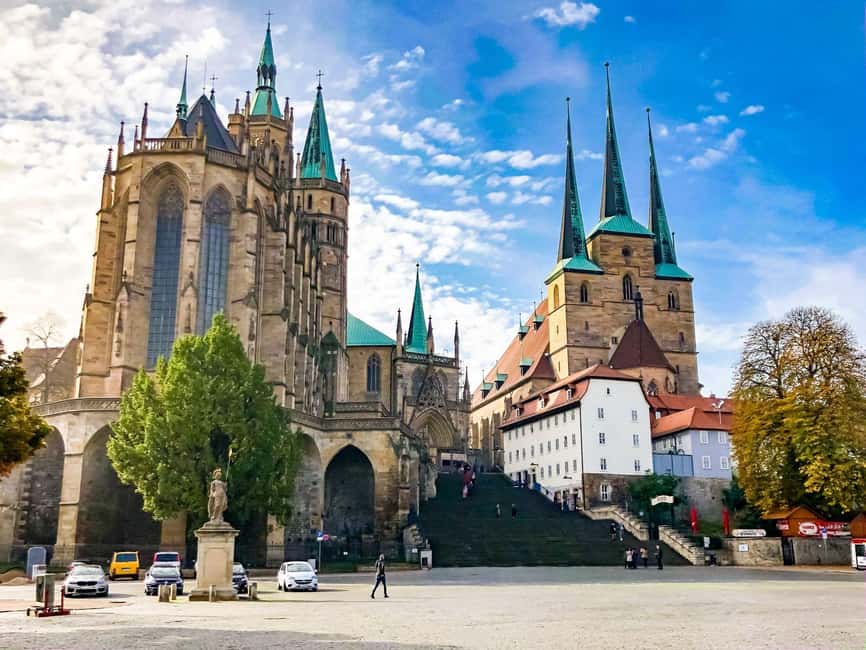
- The route covers major Erfurt sights: Expect the town hall steps, Fish Market, Krämerbrücke, university quarter, Old Synagogue, Waidspeicher, cathedral square, cathedral, Severi Church, and citadel.
Meeting the Brückenkrämer at the town hall
The tour starts at the center of the town hall steps. That is a useful meeting point because you begin in the middle of Erfurt’s historic core, not at a bus stop or on the city edge. Look for the Brückenkrämer costume, which serves as the guide’s identifying marker.
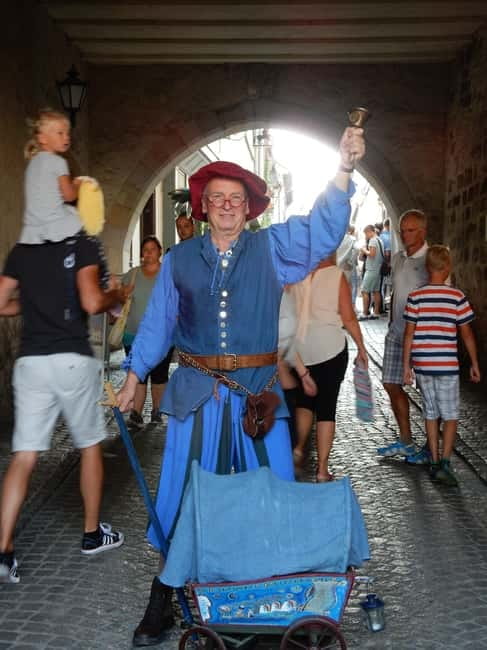
Reinhard Schwalbe leads the experience as Master Schwalbe, a bridge-clearing merchant in period costume. The character matters here. Instead of hearing a detached lecture, you get a guide who presents Erfurt through the voice of a working merchant, with jokes and tales suited to the streets around him.
I like this approach for a first walk in Erfurt because the tour gives you a clear center. You are not simply moving from monument to monument. You are following the story of commerce around the bridge, then seeing how trade, religion, education, politics, and private homes shaped the old town.
The route lasts about two hours. That is long enough to cover several key areas without turning the outing into an all-day commitment. The pace is adapted to the group, a useful feature if you are walking with children, older family members, or anyone who prefers time to look around.
The guide speaks German. You should keep that firmly in mind before booking. If you understand German, the wordplay and local jokes should add a lot to the experience. If you do not, you may still appreciate the costume, route, buildings, and tastings, but much of the tour’s appeal depends on spoken storytelling.
More Walking Tours in Germany:
- Discover Berlin Half-Day Walking Tour
★ 5.0 · 9,624 reviews - Berlin: Third Reich and Cold War 2 Hour Walking Tour
★ 4.9 · 6,830 reviews - Munich: Third Reich & WWII Walking Tour
★ 4.6 · 6,181 reviews
Crossing the 700-year-old Krämerbrücke
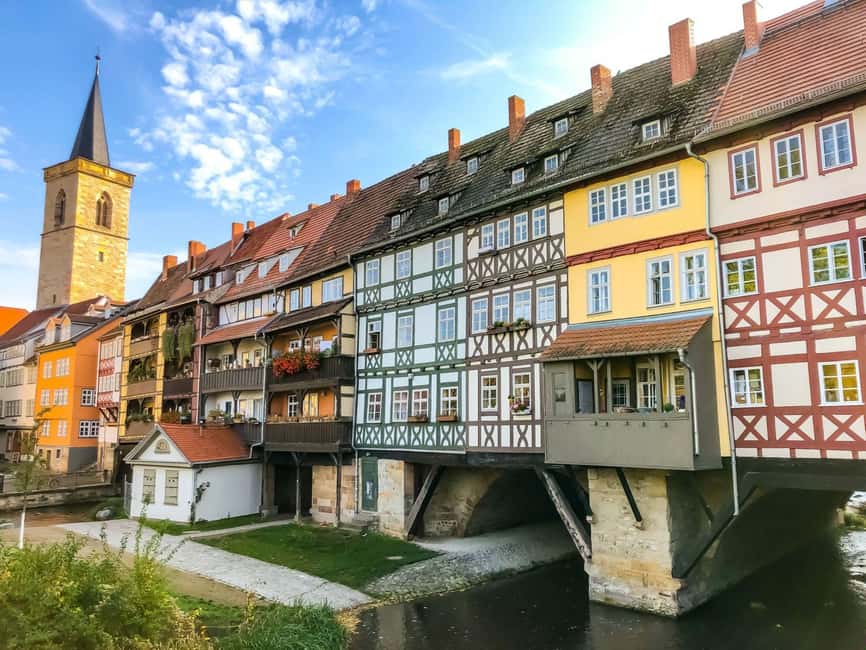
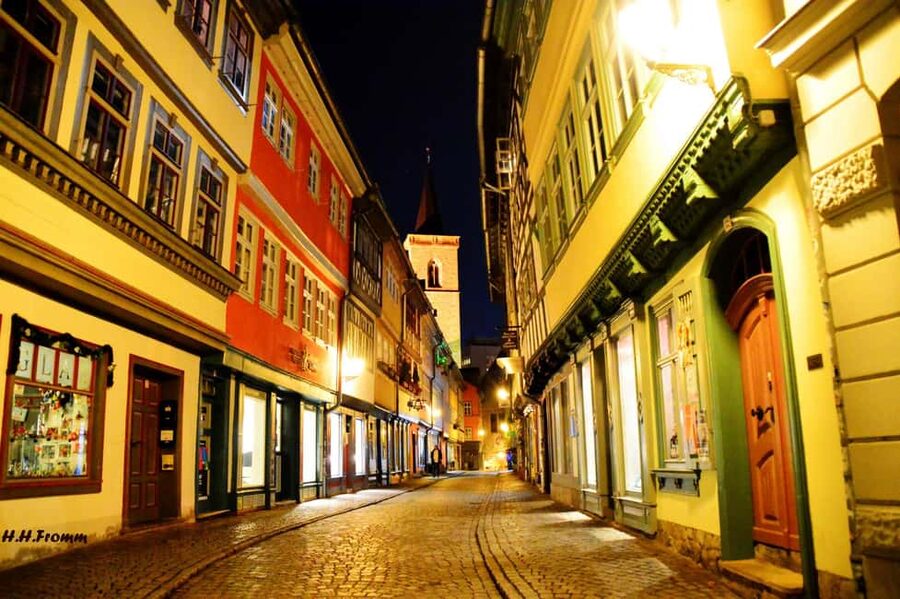
The Krämerbrücke is Erfurt’s natural stage for this tour. Its name points to its old commercial role, and its buildings create a rare sense of a bridge that functions as part of the town rather than as a simple crossing.
The Brückenkrämer leads you over and under its arches, placing the bridge in the setting that made it important. You get more than a view from the middle. The route brings attention to the spaces beneath the bridge and to the medieval lanes and corners nearby.
The 700th anniversary gives the walk a special focus. Rather than treating the bridge as a pretty photo stop, the tour uses the anniversary to tell stories about the people who made their living there. That is the right angle for Erfurt, since the bridge’s character comes from its shops, homes, and daily trade.
I would set aside time before or after the tour to look at the bridge again on your own. The guided walk gives you context, but a quiet second look helps you notice the relationship between the narrow crossing, the attached buildings, and the surrounding lanes.
Do not expect a museum-style presentation with long pauses at every building. The experience is designed as a moving story. You will get a broad sense of place, along with comic details, rather than a specialist architectural study.
Going below the Kramladen to the Brückenkeller
One of the most appealing parts is the visit to the Brückenkeller beneath the Kramladen. This is a compact space, and the group size for the visit is under 10 people. That limit is important because a cellar can quickly feel crowded when a large tour group tries to enter.
The cellar gives the bridge a second level of interest. Above ground, you see the public face of the Krämerbrücke, with its shops and buildings. Below, you get a look at the kind of working space connected with an old merchant setting.
This is where the tour’s theme becomes concrete. Commerce was not just a sign over a shop. It needed storage, family rooms, customers, suppliers, and a private side to daily business. The cellar helps you picture that practical world.
The tour also includes a look into a typical Bohlenstube. The term refers to a room made with timber plank construction, and it offers a glimpse into the domestic side of an old building. For me, this sort of room is more useful than another grand exterior because it shows how people actually occupied these structures.
There is one practical point to remember. The supplied details specify that the cellar visit is for a group under 10, but they do not explain how larger bookings are divided or handled. If the cellar is especially important to you, ask about the arrangement when setting up your date and group size.
Merchant families, private life, and old Erfurt jokes
The strongest part of the tour is its human scale. You learn about the business and private life of a merchant family, not just the names of rulers or the dates of construction.
That family focus gives you a way to understand the old town. A merchant’s life involved trade, household work, reputation, money, and local connections. The tour’s stories help tie those matters to the buildings you are passing.
Schwalbe also uses old Erfurt humor to keep the walk moving. The subjects include the rebellious student Martin Luther, the axe-wielding apostle Boniface, the widely proclaimed magician Dr. Faust, the indulgence seller Tetzel, and Erfurt’s allegedly eaten mayor.
These tales are not presented as a dry academic syllabus. They are city stories, with the rough edges and odd details that help local memory survive. You will also hear about the old university’s learned donkeys, puffed beans, and beer holes. Those subjects may sound unrelated, but that is part of the charm. The walk gives you a sense of the city’s folklore as well as its official past.
I like the balance between major historical figures and silly local references. Martin Luther and the university belong in any serious account of Erfurt, but beans and beer holes make the city feel inhabited. If you prefer only carefully documented political history, the comic approach may seem loose. If you like history with a human voice, it should work well.
The tour’s humor is also a reason German ability matters. A translated summary can convey who Dr. Faust or Tetzel was, but it may not carry the rhythm of an old joke. You will get the most from this experience if you can follow conversational German.
More Food and Drink Tours in Germany:
- Cologne: Brewery Tour with 3 Kölsch Beer Tastings
★ 4.7 · 3,108 reviews - Hamburg: St. Pauli Highlights Guided Tour with Beer for 18+
★ 4.7 · 2,353 reviews - Hamburg: Elbphilharmonie Plaza and HafenCity Food Tour
★ 4.7 · 1,711 reviews - Bavarian Beer and Food Evening Tour in Munich
★ 4.5 · 1,575 reviews
The tasting: chocolate first, herbal liqueur second
The food and drink are small but well chosen. You receive truffles from Goldhelm, the chocolate manufactory on the Krämerbrücke, made with Peru jungle chocolate. This ties the sweet tasting directly to the bridge rather than adding a generic packaged snack.
The second tasting is Erfurt Classic, a clear herbal liqueur with an alcohol content of 40 percent. It comes from the Thuringian Specialties Market. The contrast is clear: chocolate gives you a sweet local bite, while the liqueur offers a stronger regional taste.
I see these tastings as punctuation marks, not a meal. You should eat beforehand if you need lunch or a substantial snack. The tasting adds value because it connects the walk to local products, but it does not replace a food tour.
The liqueur deserves particular care. At 40 percent alcohol, it is strong, even if the serving is small. You should take that into account if you are driving, avoiding alcohol, or touring with children. The available information does not specify serving sizes, so you should not assume a generous pour.
You can also arrange an optional beer tasting for an extra $8 per person. It includes three types of hand-brewed beer and a snack. That could make sense if you want a longer food-and-drink angle, but it is not part of the $16 base price.
For another $6 per person, you can arrange violin accompaniment. This should appeal to you if you want a more theatrical or musical version of the walk. I would treat both extras as optional enhancements rather than necessities. The core tour already has a clear identity through the costume, stories, cellar, and two tastings.
Fish Market, town hall, and Erfurt’s civic center

The route includes the Fish Market, where patrician houses and the town hall frame one of Erfurt’s major civic spaces. Beginning at the town hall steps and then moving through this area gives you a useful introduction to the city’s public face.
The patrician houses help explain the wealth and status of Erfurt’s established families. The town hall points to civic government, while the nearby bridge shows the commercial side of town life. Together, these places create a compact lesson in how money, administration, and trade met in the old center.
You should pay attention to the shift in mood along the route. The Fish Market is formal and public. The Krämerbrücke feels more closely tied to shops and domestic life. The Brückenkrämer’s storytelling works because it connects these different parts rather than treating each sight as an isolated stop.
The tour does not list every stop with exact timing, so you should not expect a minute-by-minute itinerary. The guide has room to adjust the pace, and that is more useful than a rigid schedule for a walk built around jokes and conversation.
University quarter, Old Synagogue, and Waidspeicher
The university quarter adds another layer to the route. The stories about Martin Luther and the learned donkeys of the old university fit naturally here, giving the academic area a memorable, slightly irreverent character.
The Old Synagogue is also included. Its presence widens the story beyond merchants and students, reminding you that Erfurt’s old center held different religious and civic communities. The supplied details do not promise an interior visit, so you should understand this as a stop or view within the walking route, not a separate museum admission.
The Waidspeicher at the Arche brings trade and materials back into the picture. Waid, a plant used historically for blue dye, was important to Thuringia’s economy. The tour listing identifies the Waidspeicher as part of the route, but it does not specify an interior visit or a detailed presentation about dye production. You can still treat it as a meaningful location within the merchant story.
This section should suit you if you want more than the bridge alone. It broadens the walk into a compact tour of Erfurt’s religious, academic, and commercial quarters. The tradeoff is that two hours cannot give each site a full museum-level treatment.
Cathedral Square, Severi Church, and the citadel
The final major area is cathedral square, with the cathedral, Severi Church, and the citadel. This gives the walk a strong architectural finish and shifts the focus toward Erfurt’s religious and defensive landmarks.
The cathedral and Severi Church form one of the city’s most recognizable views. The tour’s costumed character creates an interesting contrast here. You are looking at major monuments while listening to stories about students, merchants, church figures, and city scandals.
The citadel adds a military note to the ending. It helps you see that Erfurt was not only a place of shops and churches. Its position and civic importance also required defense.
Since the activity ends back at the town hall meeting point, you do not need to arrange a separate ride back to your hotel or parking area. That makes the route easy to fit into a day of sightseeing. You can continue exploring from the same central area after the tour.
Is $16 a fair price?
At $16 per person, the basic price is reasonable for a two-hour guided walk with a costumed local guide, two tastings, and access to a small cellar space. You are paying for interpretation and atmosphere, not just for someone to point at buildings.
The value is strongest if you want a lively introduction to Erfurt. The tour combines the bridge, merchant life, city folklore, food, and major sights in one outing. You would likely pay more if you arranged several separate activities around those themes.
The price is less compelling if you want a quiet architectural tour, an English-language guide, or a focused food experience. The tastings are modest, and the walk is not presented as a full meal or a large sampling event.
The optional extras change the total. Beer tasting with three hand-brewed beers and a snack costs $8 per person, while violin accompaniment costs $6 per person. Ask about these when arranging the booking, since the experience provider requests the date, time, meeting point, group size, chosen tour, and extras.
The published rating is 4.9 from 28 reviews, with praise focused on the friendly, informative, entertaining nature of the walk and the chance to try two typical Erfurt treats. That matches the tour’s strongest selling points: a personable guide, a clear sense of place, and a little food along the way.
Who should book the Brückenkrämer tour?
I would recommend this walk to you if you:
- Understand German well enough to follow jokes and spoken stories
- Want a friendly introduction to Erfurt’s old center
- Like history presented through people, gossip, and local tales
- Enjoy small tastings but do not need a full food tour
- Want to see the Krämerbrücke from above and below
- Prefer an adapted walking pace
- Are interested in merchant homes and working spaces, not only grand monuments
You may want a different experience if you need English commentary, a highly academic lecture, or a detailed interior tour of every landmark. The tour passes several important places, but two hours requires selection.
It is wheelchair accessible, according to the activity information. Because the route includes a cellar and old historic areas, I would still confirm the exact access arrangements for your particular mobility needs before booking. The published information does not describe the cellar entrance or every surface along the route.
Should you book it?
Book this tour if you want Erfurt explained by a character who can connect the Krämerbrücke, merchant families, university tales, churches, city politics, and local snacks. The Brückenkeller visit and Bohlenstube give it more substance than a simple costumed walk, while the Goldhelm truffle and herbal liqueur keep the experience light.
Skip it if you need English, dislike theatrical guiding, or want a serious specialist tour with extensive time inside each monument. For German-speaking visitors who enjoy humor and local detail, the $16 price is a strong value. Ask about the date, start time, group size, meeting point, and optional beer or violin additions when you reserve. Free cancellation is available up to 24 hours in advance, and you can reserve now and pay later.
FAQ
Where does the Brückenkrämer tour start?
The tour starts at the center of the town hall steps in Erfurt.
Where does the tour end?
The walk ends back at the town hall meeting point.
How long does the tour last?
The tour lasts two hours. Starting times depend on availability.
What language is the live tour in?
The live tour guide speaks German.
How much does the tour cost?
The listed price is $16 per person.
Is the tour wheelchair accessible?
Yes, the activity is listed as wheelchair accessible.
What tastings are included?
You receive Krämerbrücke truffles made with Peru jungle chocolate and Erfurt Classic, a clear 40 percent herbal liqueur.
Does the tour visit a cellar?
Yes. The route includes the Brückenkeller beneath the Kramladen. The cellar visit is for groups under 10 people.
What sights are included on the route?
The route includes the Fish Market, patrician houses, town hall, Krämerbrücke, university quarter, Old Synagogue, Waidspeicher at the Arche, cathedral square, cathedral, Severi Church, citadel, and other parts of the old town.
Can I add beer tasting or violin music?
Yes. Beer tasting with three hand-brewed beers and a snack costs an additional $8 per person. Violin accompaniment costs an additional $6 per person.
Can I cancel the booking?
You can cancel up to 24 hours in advance for a full refund.
Do I have to pay when I reserve?
No. The activity allows you to reserve now and pay later.
Just added around Germany
- Private Walking Tour in Berlin: Hitler’s Germany & WWII★ 5.0 · 7 reviews
- The History of Berlin: WWII PRIVATE Walking Tour With Locals★ 5.0 · 209 reviews
- Private Berlin WWII and Cold War History Tour with Local Expert Guide★ 5.0 · 28 reviews
- Private Walking Tour Berlin 3 hours: Brandenburg, Historic Center★ 5.0 · 7 reviews
- Berlin: Private Bike Tour of the Berlin Wall and Third Reich★ 5.0 · 23 reviews
- Berlin Photography Masterclass – Private Photography Lesson★ 4.5 · 23 reviews
- Group Driving Tour 1 to 6 people. Berlin Shore Excursion incl pick-up at Port★ 5.0 · 8 reviews
- Berlin: Guided Private Bike Tour to Explore the Highlights★ 5.0 · 12 reviews
Food & Drink, compared.

St. Pauli Highlights Guided Tour with Beer for 18+
Read our review →
Elbphilharmonie Plaza and HafenCity Food Tour
Read our review →
Bavarian Beer and Food Evening Tour in Munich
Read our review →
Classic Mike’s Bike Tour daily @ 11.30 incl Beer Garden & Surfers
Read our review →
Berlin Center Food Tour with 8+ Authentic Local Tastings
Read our review →
Browse the lists this tour appears in