
Reviewed · WALKING TOURS
Jewish Life in Berlin – Private Walking Tour
Berlin remembers its past in plain sight. This three-hour private walk connects old Jewish streets, wartime courage, and the city’s Jewish life today. I like the focus on daily Jewish life before World War II, not only memorials, and I like the chance to ask questions in a private group. The main drawback is that much of the experience happens outdoors, and the short stop at the Otto Weidt site may not provide the full museum visit you expect.
The walk costs $355.25 per group of up to 15 people. That is a steep price for one or two people, but a fairer deal for a larger family or group. It runs in all weather, covers flat ground, and ends at Berlin’s New Synagogue, making it a useful history lesson early in your Berlin stay.
In This Review
- Key Points About This Berlin Jewish History Tour
- Starting at Hackescher Markt
- Hackesche Höfe and the Woman Protest Memorial
- Otto Weidt’s Workshop and Everyday Resistance
- Scheunenviertel and the Shape of Jewish Berlin
- Sophienstraße and Sophia Church
- Große Hamburger Straße: Cemetery, School, and Deportation
- Auguststraße and the Remains of Community Life
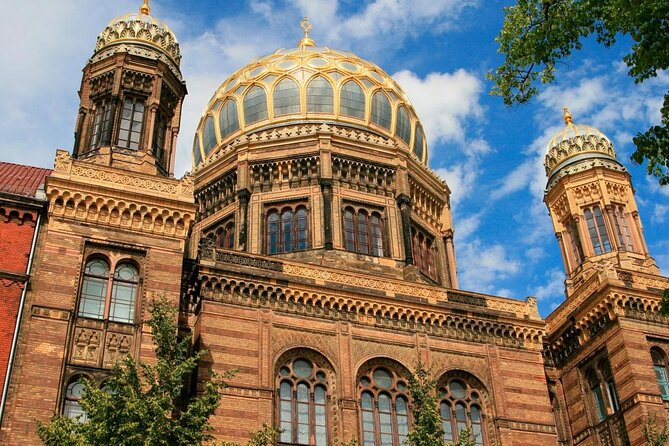
- New Synagogue and the Centrum Judaicum
- What the Three-Hour Format Feels Like
- Is $355.25 a Fair Price?
- Who Will Get the Most From This Walk?
- Should You Book Jewish Life in Berlin?
- FAQ
- Where does the Jewish Life in Berlin tour begin?
- Where does the tour end?
- How long does the tour last?
- How much does the private tour cost?
- Is the tour private?
- Is a professional guide included?
- Does the tour visit the New Synagogue?
- Is the Holocaust Memorial included?
- Does the tour operate in bad weather?
- Can I cancel for a full refund?
Key Points About This Berlin Jewish History Tour
- A walk through the former Scheunenviertel: See the streets and buildings linked to Berlin’s historic Jewish community, including Sophienstraße, Auguststraße, and Große Hamburger Straße.
- Otto Weidt’s wartime workshop: Learn how Otto Weidt tried to protect blind and deaf Jewish workers during the Nazi era.
- More than a Holocaust tour: The route begins with Jewish immigration in the 17th century and includes figures such as Moses Mendelssohn and Albert Einstein.
- A private guide for your group: Your guide can adjust explanations and answer questions from children, adults, and mixed-age groups.
- A powerful finish at the New Synagogue: The tour ends at the former main synagogue of Berlin’s Jewish community, now home to the Centrum Judaicum.
- Flat but fairly continuous walking: The route is manageable for most participants, but three hours on Berlin sidewalks can feel long in hot weather or rain.
Starting at Hackescher Markt
Your guide meets you outside the Hackescher Markt S-Bahn station, specifically at Neue Promenade 3, near the Starbucks. This is a practical meeting point in central Berlin, close to public transportation and easy to pair with other sights in Mitte.
The first ten minutes are used for introductions and a short orientation. That may sound minor, but it gives your guide a chance to explain the shape of the neighborhood before the history becomes more difficult. The tour moves through a part of Berlin where shops, courtyards, churches, galleries, apartments, and memorials occupy the same few blocks.
Because this is a private walk, you are not locked into a large group’s pace. Guides such as Caroline, Carlos, Marriette, and Finn have been praised for answering questions patiently and explaining complex subjects without losing sight of the people involved. One guide handled a sensitive question especially well, while Carlos was praised for speaking clearly to a group with a wide age range.
That matters here. Berlin’s Jewish history includes migration, exclusion, religious life, assimilation, deportation, resistance, and renewal. A good guide needs to shift tone as the subject changes. The strongest accounts of this tour describe guides who used facts, perspective, candid comments, and appropriate humor without making the subject feel casual.
More Walking Tours in Berlin
- Discover Berlin Half-Day Walking Tour
★ 5.0 · 9,624 reviews - Berlin: Third Reich and Cold War 2 Hour Walking Tour
★ 4.9 · 6,830 reviews - Berlin: Discover Berlin Walking Tour
★ 4.9 · 5,998 reviews
Hackesche Höfe and the Woman Protest Memorial
The next stop is Hackesche Höfe, a group of courtyards with a history connected to Berlin’s Jewish neighborhood. The guide explains how the site developed and discusses the memorial to the women who protested the imprisonment of their Jewish husbands in 1943.
This is an important early stop because it brings the Nazi period into the route without making it the whole story. The memorial recalls a rare public protest against Nazi persecution. It also opens a larger question: what did resistance look like when the state controlled the police, courts, newspapers, and daily life?
The courtyard setting can make the stop feel less formal than a museum visit. You are looking at a working part of central Berlin, not a sealed historic site. That contrast is useful, though it also means street noise and surrounding activity can compete with the guide’s voice.
Otto Weidt’s Workshop and Everyday Resistance
The Museum Blindenwerkstatt Otto Weidt is one of the most compelling points on the route. Otto Weidt ran a workshop that employed blind and deaf Jewish people and tried to shield them from Nazi persecution.
The value of this stop lies in its human scale. Instead of discussing only laws, armies, and political leaders, the guide focuses on a workplace and the choices made by one owner trying to protect vulnerable employees. You hear about resistance that depended on practical decisions, personal courage, and the willingness to take serious risks.
The stop is listed as about ten minutes. That is enough for an introduction, but it may not be enough for a full museum visit. This is an important distinction when planning your day. If you want time to study the rooms and displays at length, ask your guide or arrange a separate visit. A shorter stop works well as part of a walking tour, but it can feel brief if the workshop is your main reason for booking.
One of the few less enthusiastic assessments of the tour came from someone who wanted more time inside the museum and at the old synagogue. I would treat that as a planning tip rather than a reason to dismiss the tour. The walk is built around connected sites and explanations, not long interior visits.
Scheunenviertel and the Shape of Jewish Berlin
The Scheunenviertel was once associated with Berlin’s Jewish community, especially Jewish immigrants from Eastern Europe. Here, your guide explains how the neighborhood developed and how Jewish residents shaped old Berlin.
Do not expect a perfectly preserved Jewish quarter. Berlin’s wartime destruction, postwar rebuilding, and modern development mean that the story often survives in fragments. You may see a building, street line, memorial, or plaque rather than a complete historic district.
That is exactly why a guide helps. On your own, you could walk through the neighborhood and see attractive streets without understanding what used to be there. The tour gives meaning to the gaps. It also places Jewish history within the larger story of Berlin, including immigration, social change, religious practice, and urban life.
A guide can also explain the difference between the neighborhood’s physical remains and its historical importance. You are not simply touring a former quarter. You are tracing how a community grew, adapted, faced discrimination, and was nearly destroyed.
Still Berlin, at a slower pace:
- Berlin: Reichstag, Dome and Government District Guided Tour
★ 4.7 · 18,288 reviews - Berlin: 1-Hour City Tour by Boat with Guaranteed Seating
★ 4.3 · 16,993 reviews - Berlin: Boat Tour Along the River Spree
★ 4.4 · 11,252 reviews - Berlin: Hop-on Hop-off Bus Tour with Live Commentary
★ 4.3 · 8,579 reviews
Sophienstraße and Sophia Church
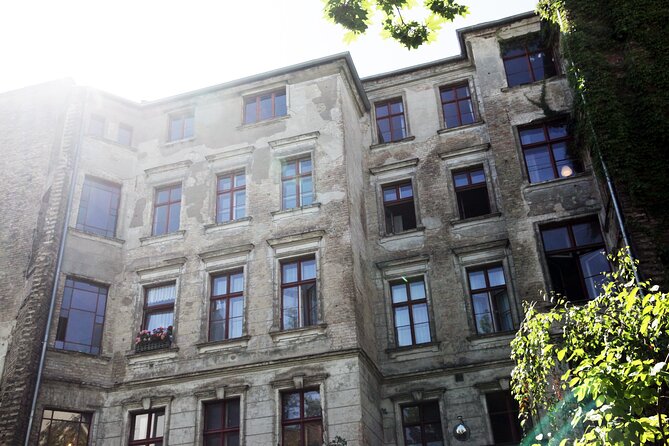
Sophienstraße is one of the more picturesque parts of the walk. Named after Queen Sophie, it offers a quieter change of pace from the larger streets around Hackescher Markt and Oranienburger Straße.
The guide uses this street to discuss local history and the buildings connected to Berlin’s changing population. It is a good reminder that historic Jewish life was not confined to one type of building or one narrow religious story. Homes, schools, workshops, cemeteries, businesses, and churches all form part of the account.
The nearby Sophia Church adds another layer. The guide explains the church’s history and its connection to Martin Luther King. The supplied details do not specify the full nature of that connection, so this is a point where you should listen closely and ask questions if it interests you.
This stop may appeal to people who want a broader Berlin history walk, not just a tour of Jewish memorials. One strength of the route is that Jewish history is placed alongside the city’s general social and religious history.
Große Hamburger Straße: Cemetery, School, and Deportation
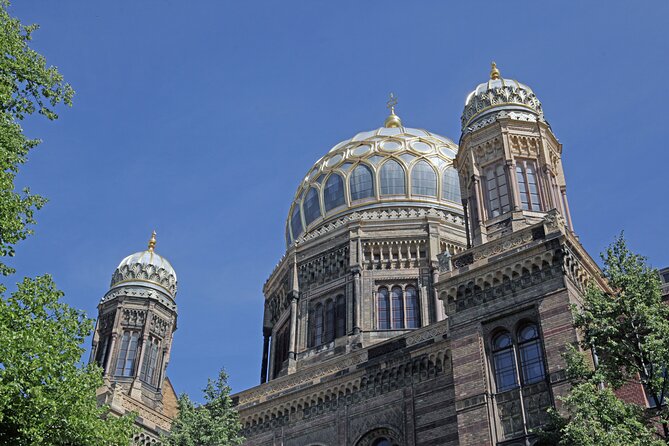
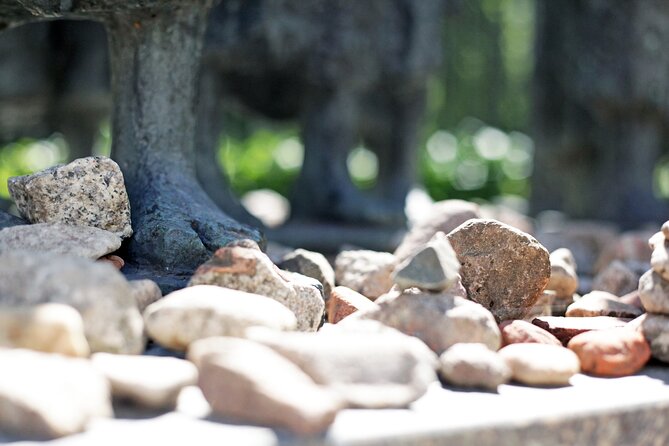
Große Hamburger Straße brings the tour into more difficult territory. Here, the guide discusses the Jewish cemetery, the Jewish school, and the deportation of Jewish people during the Nazi era.
The stop connects several parts of community life. A cemetery points to long-term settlement and memory. A school points to family life and education. Deportation shows how the Nazi state turned a living community into a target for removal and murder.
This is also where the tour’s emotional weight increases. The walk does not treat the Holocaust as an abstract date range. It links the destruction of the Jewish population to actual streets and institutions. That can be more affecting than hearing the same history in a classroom, but it may also feel heavy, especially for younger participants.
The guide’s role is especially important here. Strong guidance keeps the subject precise and respectful. Several guides have been praised for handling difficult questions with care and for explaining propaganda and Nazi policy in a way that made the wider history easier to understand.
Auguststraße and the Remains of Community Life
Auguststraße is known today for art galleries and notable buildings, but the route uses it to recall the older Jewish community. This is another example of modern Berlin sitting directly on top of earlier layers.
The contrast can be striking. A gallery district may feel creative and contemporary, while the guide is describing schools, homes, religious institutions, and people who once lived nearby. I like this part of the tour because it avoids turning Jewish history into something distant and sealed behind glass.
At the same time, you should expect a walking interpretation rather than a long line of major monuments. If you want famous Berlin sights at every turn, this route may seem understated. If you want to understand how communities occupied ordinary city streets, it is more rewarding.
New Synagogue and the Centrum Judaicum
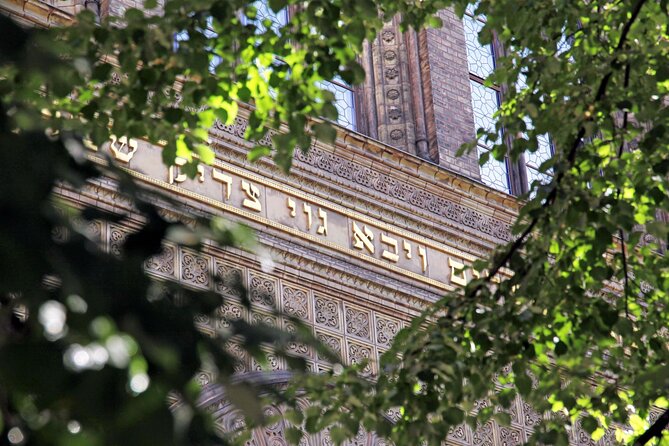
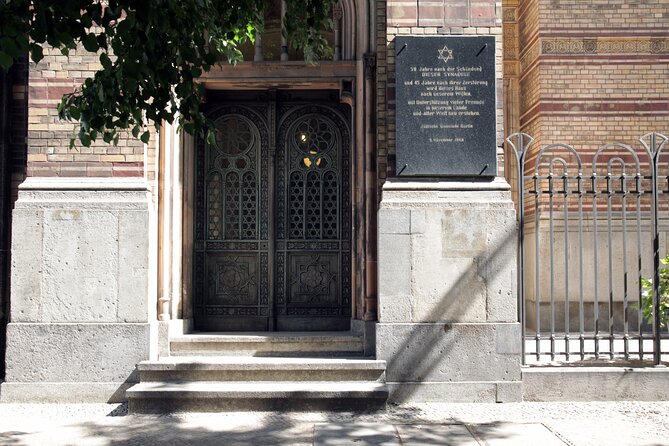
The walk finishes at the New Synagogue on Oranienburger Straße. This 19th-century building was the principal synagogue of Berlin’s Jewish community and remains one of the city’s most important Jewish landmarks.
Its architecture reflects the confidence and size of Berlin’s Jewish community before the Nazi era. The guide explains the building’s history, the November 1938 pogrom known as Kristallnacht, and the people who helped Jewish residents during the Nazi period.
Today, the building houses the Centrum Judaicum, which traces the synagogue’s history and the life connected to it. The tour ends here rather than at the Holocaust Memorial, which is worth noting. Some people may assume the Holocaust Memorial is part of the route, but it is not listed among the stops.
The endpoint is convenient for continuing your day in Mitte. The stated opening hours for the site are 9 a.m. to 3 p.m. daily, though you should confirm current access when booking. Since the walking tour includes a short explanation rather than a guaranteed extended museum visit, set aside additional time if you want to explore the Centrum Judaicum properly.
What the Three-Hour Format Feels Like
The listed itinerary gives about ten minutes to each of nine stops. In practice, the walk also needs time for moving between locations, crossing streets, and answering questions. You are getting a steady narrative through the neighborhood, not nine full museum presentations.
The route is described as quite a lot of walking, but it is flat. That makes it easier than a hillier city tour, though the distance can still be tiring in poor weather. The experience runs in rain and other weather conditions, so wear shoes suitable for wet pavement and bring protection from the elements.
Hot weather can also affect the walk. A small private group makes it easier for the guide to pause or adjust the pace, but there is no promise of a special weather plan. If you are sensitive to heat or rain, morning may be the more comfortable choice when available.
The mobile ticket is useful for keeping the booking on your phone. Confirmation is normally sent at booking, but reservations made within three days of the tour may receive confirmation within 48 hours, subject to availability.
Is $355.25 a Fair Price?
The price is $355.25 for the entire group, with a maximum of 15 participants. For one person or a couple, that is expensive for three hours. For a family, school group, or group of friends splitting the cost, the value improves sharply.
The main thing you are paying for is not entry tickets. The itinerary lists free admission at the stops, and the included service is a professional guide. You are paying for a focused route, private attention, and explanations that connect scattered sites.
A private tour is particularly useful if your group has different ages or different levels of background knowledge. You can ask about Moses Mendelssohn, Albert Einstein, Jewish education, Nazi propaganda, or the synagogue without holding up a large public group.
The price is less attractive if you want long interior visits. The ten-minute format means this is best viewed as a guided introduction to the neighborhood. You may want to add separate museum time at the Otto Weidt workshop or Centrum Judaicum.
Who Will Get the Most From This Walk?
I would recommend this experience to:
- Families who want a serious history lesson that can still include questions and discussion
- Visitors with a particular interest in Jewish life before World War II
- First-time Berlin visitors who want to understand Mitte beyond its postcard sights
- Small groups that value a private guide and flexible conversation
- People who want Jewish history presented alongside the wider story of Berlin
I would be more cautious if you want a museum-heavy experience, the Holocaust Memorial, or a route focused only on famous landmarks. The tour is about streets, remnants, buildings, and interpretation. Some stops may feel modest if you do not enjoy learning from urban details.
The route can suit most participants, and service animals are allowed. Since it is a walking tour in all weather, comfortable footwear and suitable clothing matter more than formal dress.
Should You Book Jewish Life in Berlin?
Book it if you want a thoughtful introduction to Berlin’s Jewish community from the 17th century to today, with special attention to ordinary life, persecution, and individual acts of courage. The strongest part is the guide-led connection between places that can look unrelated when seen alone.
I would book it for a group of four or more, when the private price becomes easier to justify. Ask in advance how much interior access is planned at the Otto Weidt workshop and the New Synagogue. If you want a measured, serious walk through a difficult part of Berlin’s past, this is a worthwhile choice. If you want extensive time inside museums, plan a separate visit after the tour.
FAQ
Where does the Jewish Life in Berlin tour begin?
It begins at Neue Promenade 3 in Berlin, outside the Hackescher Markt S-Bahn station near Starbucks.
Where does the tour end?
The tour ends at the New Synagogue Berlin, Centrum Judaicum, at Oranienburger Straße 28 to 30.
How long does the tour last?
The walking tour lasts approximately three hours.
How much does the private tour cost?
The price is $355.25 per group, for up to 15 people.
Is the tour private?
Yes. Only your group participates in the private walking tour.
Is a professional guide included?
Yes. A professional guide is included.
Does the tour visit the New Synagogue?
The route ends at the New Synagogue Berlin, where the guide explains its history, the 1938 pogrom, and people who helped Jewish residents.
Is the Holocaust Memorial included?
No. The Holocaust Memorial is not listed among the tour stops.
Does the tour operate in bad weather?
Yes. The tour operates in all weather conditions, so you should dress appropriately.
Can I cancel for a full refund?
Yes. You can receive a full refund if you cancel at least 24 hours before the experience begins. Cancellations within 24 hours are not refunded, and changes during that period are not accepted.
Just added around Berlin
- Private Walking Tour in Berlin: Hitler’s Germany & WWII★ 5.0 · 7 reviews
- The History of Berlin: WWII PRIVATE Walking Tour With Locals★ 5.0 · 209 reviews
- Private Berlin WWII and Cold War History Tour with Local Expert Guide★ 5.0 · 28 reviews
- Private Walking Tour Berlin 3 hours: Brandenburg, Historic Center★ 5.0 · 7 reviews
- Berlin: Private Bike Tour of the Berlin Wall and Third Reich★ 5.0 · 23 reviews
- Berlin: Guided Private Bike Tour to Explore the Highlights★ 5.0 · 12 reviews
- Berlin Photography Masterclass – Private Photography Lesson★ 4.5 · 23 reviews
- Group Driving Tour 1 to 6 people. Berlin Shore Excursion incl pick-up at Port★ 5.0 · 8 reviews
Walking Tours, compared.
Old Town & Viktualienmarkt City Walk in German
Read our review →Browse the lists this tour appears in