
Reviewed · CONCENTRATION CAMP MEMORIAL VISITS
Berlin: Sachsenhausen Concentration Camp Bus Tour in English
Some places demand your full attention. This four-hour trip from Berlin to the Sachsenhausen Memorial combines excellent historical guidance with simple bus transport, and I like that the commentary begins on the road rather than only at the gate. I also like the respectful tone praised by visitors who toured with guides including Ariel, Paul, Jamie, Nickolai, and Lewis. The main drawback is time: two hours at the memorial gives you a strong introduction, but not enough for every building and exhibit.
The tour costs about $49 per person and includes transport, entry, a professional licensed guide, a camp map, and a €3 donation to the memorial. You meet outside Friedrichstraße station, between the station and the Tränenpalast, and return there after the visit. Wear good shoes and weather-ready clothes, since this is a serious walking tour across an open site.
In This Review
- Key points at a glance
- Why Sachsenhausen matters in Berlin’s story
- Meeting at Friedrichstraße station
- The 50-minute ride to Oranienburg
- Entering through Tower A
- Barracks, punishment, and daily life
- Crematoria, gas chamber area, and execution trench
- The commandant’s house and the people behind the system
- What two hours can and cannot do
- Guide style makes the biggest difference
- Is $49 a fair price?
- Practical advice for a respectful visit
- Who should book this Sachsenhausen tour?
- Should you book it?
- FAQ
- Where does the Sachsenhausen bus tour begin?
- How do I find the guide?
- How long does the tour last?
- Is hotel pickup included?
- What does the price include?
- What should I bring?
Key points at a glance
- A 50-minute bus ride adds useful context: The guide talks about Berlin, the camp system, and Sachsenhausen before you arrive.
- Two hours inside the memorial covers the core sites: You see Tower A, barracks, infirmaries, isolation cells, the execution trench, crematoria, and the remains of the gas chamber area.
- The bus removes a tiring transfer: You avoid arranging the train journey to Oranienburg and the walk from the station to the memorial entrance.
- Guide quality is the tour’s biggest strength: Names repeatedly praised include Ariel, Paul, Jamie, Nickolai, Lewis, Joseph, and Gregory.
- This is a sobering history visit, not casual sightseeing: The subject calls for quiet attention, respectful clothing, and time afterward to think.
- The tour suits a short Berlin stay: It gives you a structured introduction in half a day, though a longer visit would allow more independent exploration.
Why Sachsenhausen matters in Berlin’s story
Sachsenhausen was built in Oranienburg, north of Berlin, as a concentration camp designed from the start around control and expansion. Its layout was planned to serve the Nazi camp system, making it an important place for understanding not only individual suffering but also the machinery behind it.
That distinction matters. You are not simply looking at old barracks. You are seeing a site designed to organize imprisonment, forced labor, punishment, medical abuse, and killing in a controlled setting. Your guide helps connect the physical remains to the system that operated beyond the barbed wire.
The tour also addresses the uncomfortable question of what people living nearby knew. You pass through Oranienburg and hear about the work inmates were forced to do and the ways the camp affected life outside its fences. The point is not to offer easy answers, but to show that the camp was part of a wider community and national system.
Sachsenhausen was not the largest Nazi camp, but it held a major administrative role. The tour explains how it helped shape the camp network and how Heinrich Himmler’s concentration camp system aimed for bureaucratic efficiency. That background makes the later walk through the grounds easier to understand, though never easier emotionally.
Other memorial sites open to visitors:
- Berlin: Sachsenhausen Concentration Camp Tour in English
★ 5.0 · 5,711 reviews - Berlin: Sachsenhausen Concentration Camp Memorial Tour
★ 4.7 · 3,716 reviews - Sachsenhausen Concentration Camp Bus Tour in English from Berlin
★ 5.0 · 1,962 reviews
Meeting at Friedrichstraße station
The starting point is straightforward once you know where to look. Find Friedrichstraße station, then go outside to the square between the station and the Tränenpalast, also called the Palace of Tears. The address given for the meeting point is Reichstagufer 17, 10117 Berlin.
Look for a guide with a yellow umbrella, blue lanyard, and yellow name tag. That detail is useful in a busy central area, especially if several tours are gathering nearby. The activity ends back at the same meeting point.
Hotel pickup is not included for the regular shared option. Pickup is available for private options, where the guide collects you five minutes before the start. Check the exact option and meeting instructions when booking, since starting times depend on availability.
The 50-minute ride to Oranienburg
The air-conditioned bus takes roughly 50 minutes each way. That makes the transport more than a simple shuttle. The guide uses the journey to explain Berlin landmarks, the rise of the Nazi government, the concentration camp system, and Sachsenhausen’s place within it.
I like this setup because the background arrives before you face the camp itself. A guide can explain terms, dates, and administrative structures while you are still seated, leaving more of the two-hour site visit for the buildings and personal stories.
Several guides receive special praise for continuing the history lesson during the ride home. Joseph, for example, was noted for discussing Berlin points of interest on the way out and answering questions at the end about food and other sights in the city. Jamie and Lewis were also praised for making the bus time part of the educational experience.
The ride is also practical. Getting to Sachsenhausen independently involves a train journey to Oranienburg and a walk onward to the memorial. The bus saves that extra planning and, in poor weather, saves your energy for the memorial itself. One visitor specifically appreciated avoiding the long walk from the train station to the site during rain and wind.
Entering through Tower A
At the memorial, the group enters through Tower A, the former main gate. The words Arbeit Macht Frei remain above the entrance, and your guide explains how the slogan functioned as part of the camp’s system of intimidation and deception.
The entrance is powerful because it frames the rest of the visit. You move from the ordinary rhythm of Berlin into a controlled space built around surveillance, confinement, and punishment. The contrast can be jarring, which is one reason a guided visit helps you process what you are seeing.
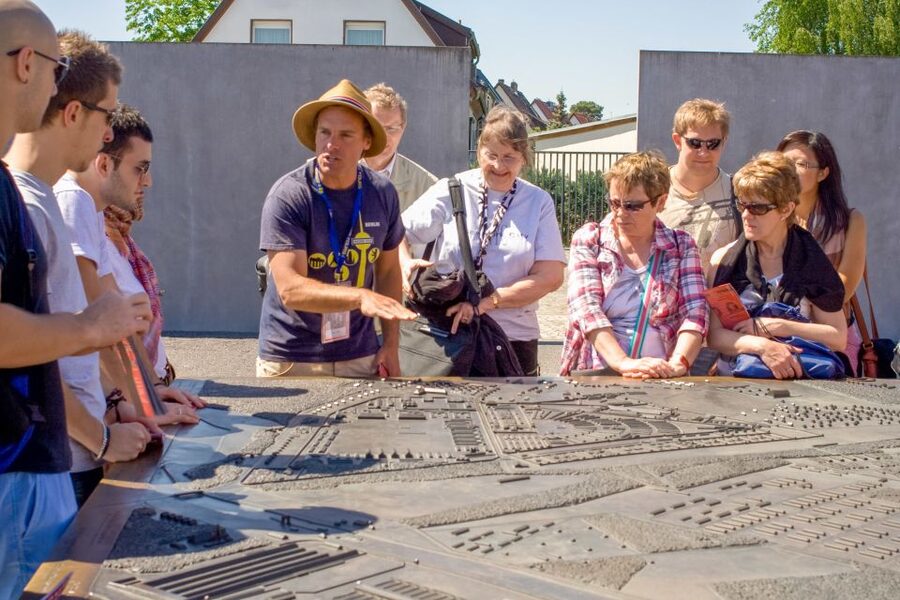
From here, the guide gives you a map of the former camp and leads the group through the surviving structures and marked remains. The original camp was larger than what you see today, so the map helps you read empty ground, foundations, boundaries, and reconstructed areas.
Do not expect a conventional museum route packed with displays at every step. Much of the experience comes from standing in the actual spaces and listening carefully as the guide explains how they were used. The site can feel stark and exposed, particularly in bad weather.
A few more Berlin trips worth comparing
- Berlin: Reichstag, Dome and Government District Guided Tour
★ 4.7 · 18,288 reviews - Berlin: 1-Hour City Tour by Boat with Guaranteed Seating
★ 4.3 · 16,993 reviews - Berlin: Boat Tour Along the River Spree
★ 4.4 · 11,252 reviews - Discover Berlin Half-Day Walking Tour
★ 5.0 · 9,624 reviews
Barracks, punishment, and daily life
The barracks show the harsh routine forced on prisoners. You learn about overcrowding, discipline, labor, and the brutal treatment used to break people down. The experience is strongest when the guide connects a room or corridor to the daily pattern of imprisonment rather than presenting isolated facts.
You also visit punishment cells and isolation areas. These spaces help show that suffering was not limited to forced labor or mass killing. Solitary confinement, beatings, deprivation, and arbitrary punishment were built into the camp’s operation.
The tour includes infirmary barracks, where medical experiments took place during the war. This is among the most difficult parts of the visit, and your guide’s delivery matters greatly. The strongest comments about Ariel, Nickolai, Martin, Scott, and others focus not only on factual detail but also on their sensitivity and calm handling of an upsetting subject.
Because the tour is guided, you can ask questions as the visit unfolds. Guides such as Rebecca, Shawn, and Maria were praised for clear explanations and for making room for questions. That is valuable here, since the site raises difficult issues that a written plaque cannot always explain fully.
Crematoria, gas chamber area, and execution trench
The tour continues to the crematoria, gas chamber area, and execution trench. These are not ordinary historic attractions, and the guide does not treat them as a checklist. Each area is presented as part of the camp’s method of killing and concealing evidence.
The remains of the crematoria show the final stage of a system that had already subjected prisoners to hunger, disease, forced labor, violence, and medical abuse. The execution trench provides another direct link to the organized killing carried out at the camp.
The information provided for the tour states that about 35,000 people were murdered or died of disease at Sachsenhausen. You should allow the scale of that figure to sink in without expecting the site to provide a neat emotional ending. The memorial’s strength is its refusal to make this history comfortable.
Photography is allowed according to the supplied information, but a camera should never distract from the place. You may want to take a few quiet, respectful images of architecture or memorial features, but this is not a location for casual posing or cheerful group photographs.
The commandant’s house and the people behind the system
The commandant’s house is included in the route. Its presence helps shift your attention from the victims alone to the people who planned, managed, and enforced the camp.
That is an important part of the tour. Concentration camps did not operate by accident or through one person acting alone. They depended on offices, orders, guards, medical staff, transport systems, construction, supply chains, and layers of administration.
The guide explains this administrative structure in relation to Heinrich Himmler’s modern concentration camp system. The word modern here refers to organization and planning, not humane progress. Sachsenhausen’s design and operation show how a state can use paperwork, architecture, uniforms, and routine to carry out crimes on a vast scale.
You also learn about the camp’s effect on Oranienburg and the surrounding population. That local context gives the visit more weight than a narrow focus on the fence line. It encourages you to think about visibility, denial, fear, and the many ways ordinary life can continue beside organized brutality.
What two hours can and cannot do
The guided portion inside Sachsenhausen lasts about two hours. That is enough to see the main areas and receive a structured explanation, but it is not enough to examine every surviving building, read every display, or spend long periods alone in reflection.
I would choose this format if you have limited time in Berlin or prefer a guide to organize a difficult site. The route gives you a clear framework and keeps the visit moving. It also prevents the common problem of arriving at a large memorial without knowing what you are looking at.
The limitation is pace. A guide needs to keep the whole group together, so you may not linger wherever you wish. The emotional weight of the site can also make two hours feel both long and short. You cover a lot of ground, but you may leave with questions that deserve further reading.
Several comments praise the amount covered despite the two-hour limit. Nickolai was noted for fitting in a great deal, while another visitor made the fair point that Sachsenhausen deserves more time. Both ideas can be true. This is a strong introduction, not the final word on the memorial.
Guide style makes the biggest difference
The tour’s strongest feature is the quality of the guiding. Names praised include Campbell, Ariel, JR, Lewis, Mikey, Paul, Gregory, Joseph, Maria, Rebecca, Scott, Dr. Thomas, Nickolai, Jamie, Shawn, Martin, and James.
The comments describe guides who explain clearly, answer questions, remain approachable, and handle the subject with care. Mikey was praised for making people feel looked after, while Nickolai was singled out for a thoughtful balance of detail and empathy. Paul received repeated praise for linking the camp to wider German history, war, and government.
Your exact guide will depend on the departure. That means no operator can promise one particular person, but the repeated praise suggests a consistent focus on preparation and presentation. A guide’s character matters greatly at Sachsenhausen. Too little context leaves you lost, while an overdramatic approach would feel wrong.
This tour appears to aim for a calm, direct style. It presents stories of survival and despair without turning the visit into entertainment. For me, that is the right approach for a memorial site.
Is $49 a fair price?
At around $49 per person, the cost is reasonable if you value convenience and guidance. The price includes a private air-conditioned vehicle, driver, licensed guide, memorial entry, a €3 donation, and a map.
You are paying for more than a ride. The bus eliminates the train and local transfer planning, while the guide provides historical explanation on both legs of the journey and during the site visit. For a half-day experience in Berlin, that package offers solid value.
Independent travel may cost less, depending on your transport arrangements, but it requires more effort and gives you less guaranteed context. You would also need to make your own way from Oranienburg to the memorial. If rain, cold, or limited mobility makes that transfer unattractive, the bus becomes especially useful.
Private and small-group options are available. A private option may suit you if you want a more personal pace or pickup, but the shared tour is the better value for most people. Check the selected option carefully before paying, since included services and pickup arrangements can vary.
Practical advice for a respectful visit
Wear comfortable walking shoes. The grounds are open and the tour involves moving between buildings and memorial areas, so thin footwear or uncomfortable shoes will quickly become a nuisance.
Dress for the weather and bring a light snack and drink. Food and beverages are not listed as included, and the four-hour schedule gives you a long stretch away from your hotel. Bring water even on a cool day.
The experience is available in English or Spanish. It can be booked as a private or small-group activity, depending on the option shown for your date. Alcohol and drugs are not allowed, which should go without saying at a memorial, but the rule is clearly stated.
Free cancellation is available up to 24 hours before the tour for a full refund. You can also reserve and pay later, useful when your Berlin schedule is still shifting. Still, check availability and the exact departure time before building other plans around it.
Who should book this Sachsenhausen tour?
I would recommend it to a first-time Berlin visitor who wants to understand the Nazi camp system with a guide rather than tackle the memorial alone. It is also a good choice if you have only half a day, dislike complicated transfers, or want historical commentary from the moment you leave central Berlin.
It suits adults and older children who can engage seriously with genocide, imprisonment, medical abuse, and death. The subject is painful, and you should not choose it simply because it is a popular excursion. Come prepared for a quiet, unsettling visit.
You may prefer an independent visit if you want several hours to read every panel, sketch, photograph, or sit in silence. The two-hour guided visit is focused and efficient, but it leaves limited time for personal exploration.
Should you book it?
Book this tour if you want clear historical context, respectful guidance, and easy transport in a compact four-hour plan. The bus saves time, the guide makes the memorial easier to understand, and the price includes the practical essentials.
Skip it if you want a slow, unstructured day at Sachsenhausen or know that a guided group will feel too fast. For most visitors with limited time in Berlin, though, this is a thoughtful and well-organized way to face an important part of German history.
FAQ
Where does the Sachsenhausen bus tour begin?
Meet outside Friedrichstraße train station, on the square between the station and the Tränenpalast, also called the Palace of Tears. The stated address is Reichstagufer 17, 10117 Berlin.
How do I find the guide?
Look for a guide wearing a blue lanyard and yellow name tag and holding a yellow umbrella.
How long does the tour last?
The full experience lasts about four hours. The bus journey takes roughly 50 minutes each way, and the guided visit at Sachsenhausen lasts about two hours.
Is hotel pickup included?
Hotel pickup and drop-off are not included in the regular tour. Pickup is available for private options, with the guide collecting you five minutes before the tour begins.
What does the price include?
The price includes transport in a private air-conditioned vehicle, a driver, a professional licensed guide, Sachsenhausen Memorial entry, a €3 donation per person to the memorial, and a map of the former camp.
What should I bring?
Bring comfortable walking shoes, weather-appropriate clothing, and a light snack and drink. A camera is allowed according to the supplied information, while alcohol and drugs are not allowed.
Just added around Berlin
- Private Walking Tour in Berlin: Hitler’s Germany & WWII★ 5.0 · 7 reviews
- The History of Berlin: WWII PRIVATE Walking Tour With Locals★ 5.0 · 209 reviews
- Private Berlin WWII and Cold War History Tour with Local Expert Guide★ 5.0 · 28 reviews
- Private Walking Tour Berlin 3 hours: Brandenburg, Historic Center★ 5.0 · 7 reviews
- Berlin: Private Bike Tour of the Berlin Wall and Third Reich★ 5.0 · 23 reviews
- Berlin: Guided Private Bike Tour to Explore the Highlights★ 5.0 · 12 reviews
- Berlin Photography Masterclass – Private Photography Lesson★ 4.5 · 23 reviews
- Group Driving Tour 1 to 6 people. Berlin Shore Excursion incl pick-up at Port★ 5.0 · 8 reviews