
Reviewed · THIRD REICH HISTORY TOURS
Berlin & The Third Reich Private Guided Tour
Berlin’s darkest stories are written into ordinary streets. This private four-hour walk makes that past easier to understand, linking Nazi power, wartime destruction, and postwar division in one carefully focused route. I like the private format, which lets your group ask questions without a crowd, and I like the way the tour connects famous sights with less obvious details, including the former Führerbunker site. The main drawback is the pace: you cover a lot of ground on foot, and some stops are brief.
The experience costs $329.92 for a group of up to 15, so it can be fair value for a family or small group, but less attractive for one or two people. Guides named in the feedback include Walid, Campbell, and Gregor, with particular praise for their clear explanations and ability to make a four-hour stroll feel like a full introduction to Berlin’s modern history.
In This Review
- Key points to know before you book
- Why this four-hour route works in Berlin
- Pariser Platz and Brandenburg Gate: power in plain sight
- The Reichstag: from fire to modern parliament
- The Holocaust Memorial: a quiet pause in the route
- The Führerbunker site: an ordinary place with an awful past
- Potsdamer Platz: destruction and a new Berlin
- Checkpoint Charlie: the Cold War epilogue
- The guides make the difference
- What $329.92 means for your group
- Timing, walking, and practical details
- Who should book this private Berlin history tour?
- Should you book it?
- FAQ
- How long does the Berlin and Third Reich Private Guided Tour last?
- Where does the tour begin?
- Where does the tour end?
- How much does the private tour cost?
- Is this a private activity?
- Are admission tickets included or required at the listed stops?
- Can I cancel or change the booking?
Key points to know before you book
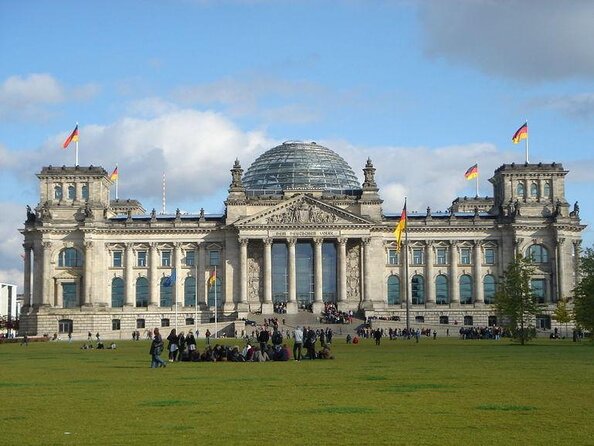
- The route covers eight major sites, from Pariser Platz and the Reichstag to Checkpoint Charlie.
- The Führerbunker site is now a parking lot, marked only by a simple sign, making the stop more understated than many people expect.
- The private group size reaches 15 people, which gives you a personal guide without paying a separate per-person rate.
- The tour links Nazi Germany and the Cold War, rather than treating the Third Reich as an isolated chapter.
- Most of the experience takes place outdoors, with short stops and walking between locations.
- The tour begins and ends at Brandenburg Gate, with pickup offered and a mobile ticket provided.
Why this four-hour route works in Berlin
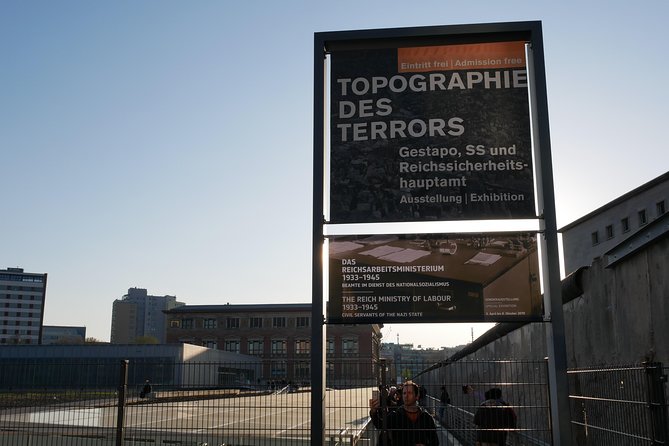
Berlin is not a city where the past sits neatly behind glass. A broad square, a government building, or an empty patch of ground may look ordinary until you learn what happened there. That is the value of a guided walk focused on the Third Reich: it gives names, dates, and human decisions to places you could easily pass without noticing.
I like the route because it does not stop with Hitler’s rise and fall. It also touches the war’s destruction, the Holocaust, the Berlin Wall era, and Germany’s reunification. That wider frame matters. You see how one political period changed Berlin’s buildings, streets, monuments, and public memory for decades afterward.
This is a private walking tour, not a museum visit or a theatrical reenactment. You will not be led through a preserved Nazi headquarters, because many of those buildings no longer exist in their former form. Instead, the guide explains what occupied these sites, how power worked there, and what remains today.
The listed stops add up to about 105 minutes of formal visiting time. The rest of the four hours allows for walking, orientation, and the guide’s explanations. Since no detailed transport plan is provided, you should expect the route to rely mainly on walking, even though pickup is offered.
More Third Reich History Tours in Berlin
- Berlin: Third Reich and Cold War 2 Hour Walking Tour
★ 4.9 · 6,830 reviews - Berlin’s Best: 2 Hour Walking Tour Third Reich and the Cold War
★ 5.0 · 5,486 reviews - Third Reich Berlin: Hitler and WWII Walking Tour
★ 5.0 · 3,301 reviews
Pariser Platz and Brandenburg Gate: power in plain sight
The tour begins at Pariser Platz, Berlin’s grand square at the end of Unter den Linden. This is one of the city’s most important public spaces, with the Brandenburg Gate at its western edge. It is also a useful starting point because you can see how royal Berlin, Nazi Berlin, divided Berlin, and modern Germany overlap in one location.
The Brandenburg Gate began as a royal entrance associated with the Hohenzollern family. It was one of 18 former city gates, but its meaning changed repeatedly as Berlin changed around it. Napoleon passed through, the Second World War left its mark, and the gate later sat beside the Berlin Wall.
The guide’s job here is to prevent the gate from becoming just another photograph. You learn how a royal monument became a Nazi symbol, then a sign of division, and finally an emblem of reunified Germany. That changing meaning is one of the best reasons to take this tour with a guide instead of simply reading a plaque.
The scheduled time at Pariser Platz is 15 minutes, followed by another 15 minutes at the gate. That is enough for an introduction and orientation, but not a long architectural study. If you want detailed information about the square’s surrounding buildings, ask questions early.
The Reichstag: from fire to modern parliament
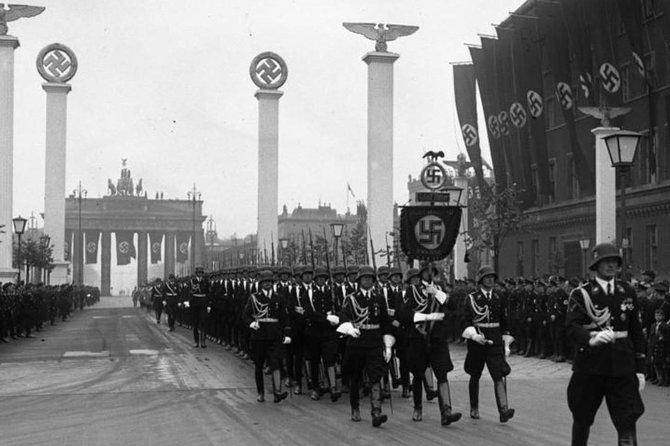
The Reichstag Building is only a short stop on this route, listed at about 10 minutes. Its importance is political rather than decorative. The building is associated with the fire that helped Hitler take total control, so it gives the guide a natural way to explain how the Nazi dictatorship used crisis, fear, and emergency powers to destroy democratic government.
The building was also fought over during the Battle of Berlin, when German and Soviet forces battled for control of the city in 1945. Today it is topped by a glass dome designed by British architect Sir Norman Foster, creating a sharp contrast between the building’s troubled past and its present role as the German parliament.
Do not expect an interior visit based on the information provided. The stop is an exterior history lesson, and that makes the guide’s explanation especially important. A few minutes can feel short here, but the point is to connect the Reichstag to the larger story, not to spend an hour examining its architecture.
The Holocaust Memorial: a quiet pause in the route
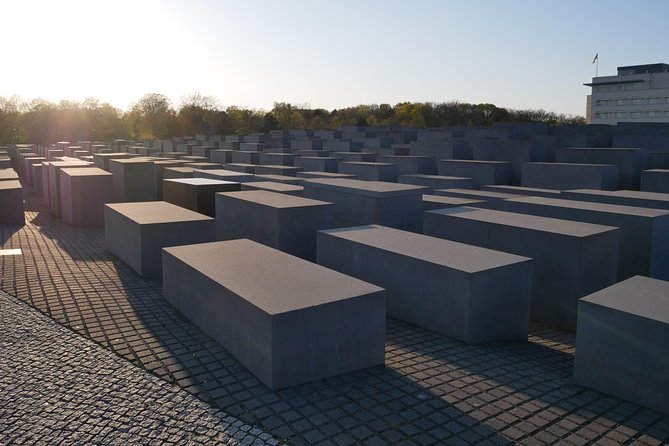
The Memorial to the Murdered Jews of Europe is one of the most serious stops of the morning or afternoon. Its field of stone stelae forms a large, stark space near the Brandenburg Gate. It is Germany’s central memorial to Jewish victims of the Holocaust.
The scheduled visit lasts about 20 minutes. That is a sensible amount of time for walking through the memorial and listening to the guide, though you may want extra quiet time afterward. The memorial does not tell the Holocaust through a long sequence of objects or displays at street level. Its form creates a physical experience of uncertainty and unease, and the guide provides the historical framework.
This is an important point in the tour because it places Nazi persecution at the center of the story. The route is not only about Hitler’s offices, military decisions, or Berlin’s destruction. It also makes clear that the regime’s crimes affected millions of people, with Jewish victims at the heart of this memorial.
Be respectful here. Keep conversation low, avoid treating the stelae as a playground, and give other people space. A private guide can help you understand the memorial, but the site also deserves time without constant commentary.
Still Berlin, at a slower pace:
- Berlin: Reichstag, Dome and Government District Guided Tour
★ 4.7 · 18,288 reviews - Berlin: 1-Hour City Tour by Boat with Guaranteed Seating
★ 4.3 · 16,993 reviews - Berlin: Boat Tour Along the River Spree
★ 4.4 · 11,252 reviews - Discover Berlin Half-Day Walking Tour
★ 5.0 · 9,624 reviews
The Führerbunker site: an ordinary place with an awful past
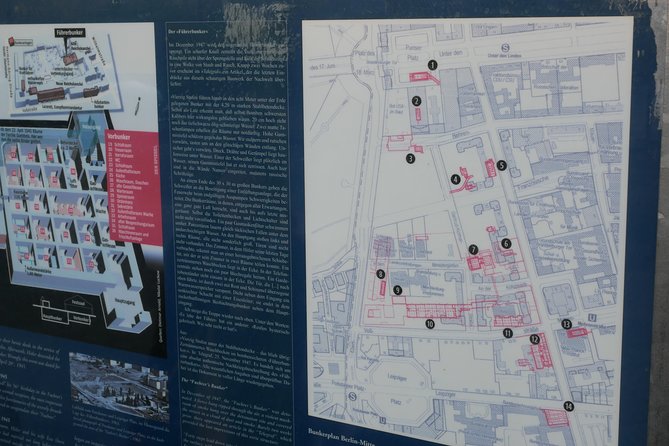
The former Führerbunker is one of the tour’s most striking stops precisely because it is so visually plain. The location is now a parking lot with a simple sign. This is where Hitler spent his final days, married Eva Braun, and then committed suicide during the last days of the war in Europe.
You might expect an underground ruin, a dramatic entrance, or a preserved room. You will not find that here. The absence of a grand structure is part of the lesson. The site does not invite fascination with Hitler’s private surroundings, and the simple marker avoids turning the bunker into a shrine.
The scheduled stop is 15 minutes. That gives the guide time to explain the final days of the Nazi regime and the fate of the bunker without making the location the entire focus of the tour. For many people, this is the moment when the history feels most immediate. A place linked to such major events can now look like any other patch of city.
Potsdamer Platz: destruction and a new Berlin
Potsdamer Platz provides a useful change of scale. Before the war, it was one of Europe’s busiest traffic intersections. After the Second World War, it was almost completely destroyed. During the 1990s and early 2000s, it was rebuilt as one of Berlin’s most modern districts.
The stop is listed at 10 minutes, so the guide will likely focus on the contrast between the prewar crossroads, wartime ruins, and post-reunification construction. You will not get a long architectural tour of the newer buildings, but you will see how quickly Berlin moved from destruction to ambitious redevelopment.
This stop helps balance the heavier memorial sites. Berlin’s story did not end in 1945, and the city you see today was shaped by both absence and construction. Potsdamer Platz shows how reunified Germany tried to create a new center in a place that had once been devastated and later divided.
Checkpoint Charlie: the Cold War epilogue
Checkpoint Charlie is the final major stop, with about 10 minutes allotted. It was a frontline crossing between the American and Soviet sectors during the Cold War, and it remains one of Berlin’s most familiar reminders of the city’s division.
The stop broadens the tour beyond the Third Reich. The defeat of Nazi Germany did not bring a simple return to normal life. Berlin was divided, occupied, and placed at the center of the conflict between the United States and the Soviet Union.
You should keep your expectations realistic. The checkpoint is a public city sight, not a preserved wartime compound, and the short visit will focus on its historical role. Still, it makes sense as the final stop because it shows how the consequences of the war shaped Berlin for another 40 years.
The tour returns to the Brandenburg Gate meeting point. That gives the route a tidy finish and brings you back to the same symbol of a divided city becoming a reunified capital.
The guides make the difference
A route like this depends heavily on the guide. The sights are spread through central Berlin, but the real value comes from the links between them. A weak guide could simply recite dates. A good one explains why the Reichstag mattered, how Nazi power was organized, and why a parking lot can carry more historical weight than a surviving monument.
Walid led one four-hour walk that included stops for discussion at key locations. That format suits this subject well. Instead of talking without pause, the guide can explain a point, let you look around, and then answer questions as the group moves on.
Campbell guided a private tour in early June and was singled out for making the experience essential to a Berlin visit. That is useful advice for first-time visitors who have already passed several of these monuments without knowing what they represented.
Gregor was praised for his command of Berlin’s modern history and for making the subject fascinating. You should still tell the provider what you want from the experience. If your interest is military history, political history, architecture, or memorial design, a private guide may be able to shape the emphasis around your group.
What $329.92 means for your group
The price is $329.92 per group, with up to 15 people included. That changes the value calculation completely. A group of 10 to 15 people gets a reasonable per-person rate for four hours of private guiding. A couple pays much more per person, but receives a guide dedicated only to them.
For a family, reunion group, school-related visit, or several friends traveling together, the arrangement can make good sense. You can ask questions freely, move at your group’s pace within the fixed route, and avoid being folded into a large public tour.
For one or two people on a tight budget, the price is harder to justify. Berlin has many free memorials and public sites, including every listed stop on this route. You are paying for the interpretation, organization, and private attention, not admission tickets.
The tour is best value if you want a clear introduction in a single block of time. It is less useful if you already know Berlin’s Nazi and Cold War history well, or if you prefer to explore each memorial alone at length.
Timing, walking, and practical details
The tour lasts about four hours and begins at Brandenburg Gate in Pariser Platz. It ends back at the meeting point. Pickup is offered, but the supplied details do not explain the exact pickup area or whether it changes the start time, so confirm that when booking.
You receive confirmation at booking and use a mobile ticket. The meeting point is near public transportation, which makes reaching central Berlin easier, but no specific train or bus route is provided.
Most people can participate, and service animals are allowed. Because the route connects several central sites over four hours, comfortable shoes are a sensible choice. The information does not provide a detailed accessibility plan, so contact the provider directly if your group needs a particular route or extra time.
The stops are short. Pariser Platz, Brandenburg Gate, and the Holocaust Memorial receive the most time, while the Reichstag, Potsdamer Platz, and Checkpoint Charlie are brief orientation stops. If you want long periods for photographs or private reflection, you may need to ask the guide whether the schedule can be adjusted.
The activity is non-refundable, and changes are not permitted for any reason. That is a serious booking condition, so check your date and group size carefully before paying.
Who should book this private Berlin history tour?
I would recommend it most strongly to first-time visitors who want the central Berlin story explained in one concentrated walk. It also suits families and small groups that want to ask questions, avoid a crowded tour, and share one guide.
The route works well if you want to understand how the Third Reich emerged, how the war changed Berlin, and how the Cold War followed. It is less suitable if your main goal is museum interiors, detailed Nazi architecture, or an extended visit inside the Reichstag.
The subject is heavy. You will visit a Holocaust memorial, the site of Hitler’s final days, and places tied to war and dictatorship. That seriousness is not a flaw, but you should allow time afterward for a quieter activity.
Should you book it?
Book this tour if you value explanation more than admission tickets and want Berlin’s major historical sites connected into one story. The strongest features are the private format, the range of stops, and guides such as Walid, Campbell, and Gregor, who have been praised for making a long city walk engaging and clear.
Think twice if you are traveling as only one person or a couple on a strict budget. You can visit the sites for free, and the short stop times may frustrate anyone who wants a slow, detailed examination of each place.
For a larger group, this is a practical way to get your bearings fast and understand what Berlin’s streets are telling you. The city supplies the evidence. The guide supplies the context.
FAQ
How long does the Berlin and Third Reich Private Guided Tour last?
The tour lasts approximately four hours.
Where does the tour begin?
It begins at Brandenburg Gate in Pariser Platz, Berlin, Germany.
Where does the tour end?
The activity ends back at the Brandenburg Gate meeting point.
How much does the private tour cost?
The price is $329.92 per group, for up to 15 people.
Is this a private activity?
Yes. Only your group participates in the tour.
Are admission tickets included or required at the listed stops?
Each listed stop has free admission. The supplied details do not list an interior admission visit.
Can I cancel or change the booking?
No. The experience is non-refundable and cannot be changed for any reason.
Just added around Berlin
- Private Walking Tour in Berlin: Hitler’s Germany & WWII★ 5.0 · 7 reviews
- The History of Berlin: WWII PRIVATE Walking Tour With Locals★ 5.0 · 209 reviews
- Private Berlin WWII and Cold War History Tour with Local Expert Guide★ 5.0 · 28 reviews
- Private Walking Tour Berlin 3 hours: Brandenburg, Historic Center★ 5.0 · 7 reviews
- Berlin: Private Bike Tour of the Berlin Wall and Third Reich★ 5.0 · 23 reviews
- Group Driving Tour 1 to 6 people. Berlin Shore Excursion incl pick-up at Port★ 5.0 · 8 reviews
- Berlin: Guided Private Bike Tour to Explore the Highlights★ 5.0 · 12 reviews
- Berlin Photography Masterclass – Private Photography Lesson★ 4.5 · 23 reviews