
Reviewed · THIRD REICH HISTORY TOURS
Third Reich Berlin: Hitler and WWII Walking Tour
History becomes more powerful on foot. This three-hour Berlin walk connects Hitler’s bunker, the Reichstag, Nazi ministries, Holocaust memorials, and the final Battle of Berlin. I like the route because it links famous sights with less obvious places, and I like the guides’ clear storytelling, which helps you understand how dictatorship took hold rather than simply pointing at old buildings. The main drawback is that the experience is entirely outdoors, so cold, rain, or icy paths can make the brisk walk hard work.
At about $24.07 per person, this is strong value for a three-hour tour led by a local guide. You cover roughly 5,000 steps between important sites, according to the practical guidance provided for the walk, so comfortable shoes matter. The subject is grim, but guides such as Maria, Ru, Paul, Chris, Tom, Callam, Ciarán, and others have been praised for making difficult material clear, thoughtful, and easy to follow.
In This Review
- Key points to know before you book
- Why this Berlin history walk is worth your time
- Starting near Friedrichstrasse and the Trains to Life memorial
- The Reichstag and the destruction of democracy
- Soviet War Memorial in Tiergarten
- Brandenburg Gate and the use of public symbols
- The Academy of Arts and Albert Speer’s architectural vision
- The Holocaust Memorial and the weight of absence
- Hitler’s bunker site and the former Reich Chancellery
- Wilhelmstrasse and the offices of Nazi power
- The former Air Ministry on Niederkirchnerstrasse
- Topography of Terror and the end near Checkpoint Charlie
- Resistance, Stauffenberg, and choices under dictatorship
- Guide quality, group size, and walking pace
- Price, timing, and who gets the most value
- Should you book the Third Reich Berlin walking tour?
- FAQ
- How long does the Third Reich Berlin walking tour last?
- Where does the tour begin?
- Where does the tour finish?
- Is the Hitler bunker open to visitors on this tour?
- Is admission to the Reichstag included?
- How large is the group?
Key points to know before you book
- Hitler’s bunker site is now an ordinary patch of ground: You learn what happened beneath the former Reich Chancellery without visiting an underground bunker.
- The route connects Nazi power with its victims: You see government ministries, propaganda offices, deportation memorials, the Holocaust Memorial, and the Topography of Terror.
- The Battle of Berlin gives the walk its shape: The tour follows the final Soviet assault toward the Reichstag and the Soviet War Memorial.
- The guides are the main strength: The best praised qualities are clear explanations, strong storytelling, patience with questions, and a lively but respectful tone.
- Expect a proper walk, not a short sightseeing stroll: The tour lasts about three hours and covers several central Berlin districts on foot.
- Dress for the season: Bring warm layers and comfortable shoes. Winter feedback repeatedly warns that three hours outside can feel very long.
Why this Berlin history walk is worth your time
Berlin has plenty of obvious Nazi-era landmarks, but they are scattered among modern offices, parks, memorials, and rebuilt streets. Without explanation, it is easy to pass the former Air Ministry or the bunker site and miss what made the location important.
This tour gives those places a connected story. You move from the machinery of Nazi power to the destruction of democracy, the persecution of Jewish people, the resistance against Hitler, and the final fighting in 1945. That structure matters. You are not just collecting photographs. You are learning how policies, institutions, propaganda, and military decisions worked together.
I also like the focus on ordinary Berliners. The guide discusses air raids, dictatorship, and daily life under Nazi rule, which adds needed human scale. The story is not only about Hitler, Göring, Goebbels, and military commanders. It also considers what it meant to live in a city where civil rights had been removed and war eventually reached every neighborhood.
The tour is offered in English, uses a mobile ticket, and has a maximum group size of 25. That is large enough to create a group atmosphere but still manageable for a guide speaking outdoors. The exact feel will depend on the guide assigned to your departure. Names praised for clear delivery and engaging storytelling include Ru, Paul, Maria, Chris from Toronto, Canadian Chris, Tom, Callam, Ciarán, Tina, Jimmy, Pete, Xavier, Emma, and others.
More Third Reich History Tours in Berlin
- Berlin: Third Reich and Cold War 2 Hour Walking Tour
★ 4.9 · 6,830 reviews - Berlin’s Best: 2 Hour Walking Tour Third Reich and the Cold War
★ 5.0 · 5,486 reviews - Berlin: Third Reich, Hitler, and WWII Walking Tour
★ 4.9 · 1,133 reviews
Starting near Friedrichstrasse and the Trains to Life memorial
The meeting information gives Reichstagufer 17 as the starting point, close to Friedrichstrasse Station. Arrive 15 minutes early. This is useful advice in Berlin, where a few minutes spent finding the correct side of a station can quickly become a missed departure.
The opening section sets out the route and introduces the main themes: Hitler’s rise, Nazi government offices, the Reichstag fire, resistance groups, the final Soviet attack, and life during the war. You begin with context before moving through the city, which helps keep the later stops from becoming a blur of names and dates.
One early stop is Trains to Life, Trains to Death. This memorial recalls the deportation of Jewish people from Berlin to Nazi concentration camps. It is a small stop, listed at about ten minutes, but its subject gives the tour a necessary moral center.
The memorial makes deportation personal and physical. People were removed from their homes, taken to railway stations, and sent away by train. As you continue through Berlin’s former government quarter, this stop helps connect the polished language of administration with the human consequences of Nazi policy.
The Reichstag and the destruction of democracy
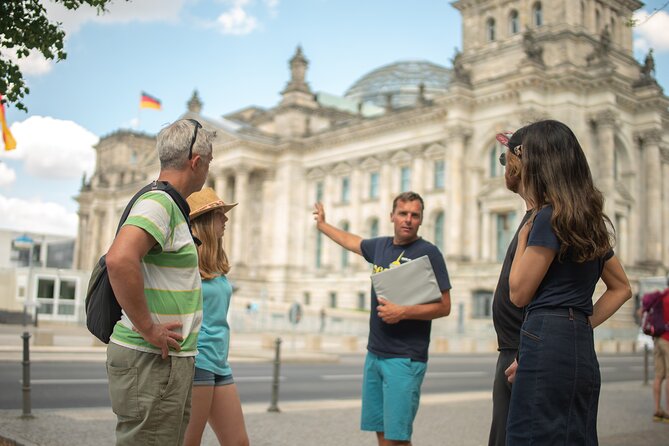
The Reichstag is one of Berlin’s most important political symbols. The 1933 fire was used by the Nazis to suspend civil liberties and crush democratic opposition. The fire itself did not magically create dictatorship, but it gave Hitler’s government a powerful excuse to dismantle constitutional protections.
The guide explains this process while you view the building from outside. The Reichstag later became a symbol of the regime’s defeat when Soviet forces raised their flag there during the final days of the war in 1945.
The stop is listed at about 15 minutes, and admission is not included. The tour does not present this as a visit inside the building. Instead, the value comes from understanding what happened there and why the Reichstag remains central to Berlin’s political story.
This is one of the places where a good guide makes a real difference. A quick photograph tells you little. A clear explanation shows how fragile democratic systems can be when leaders exploit fear, emergency powers, and public confusion.
Soviet War Memorial in Tiergarten
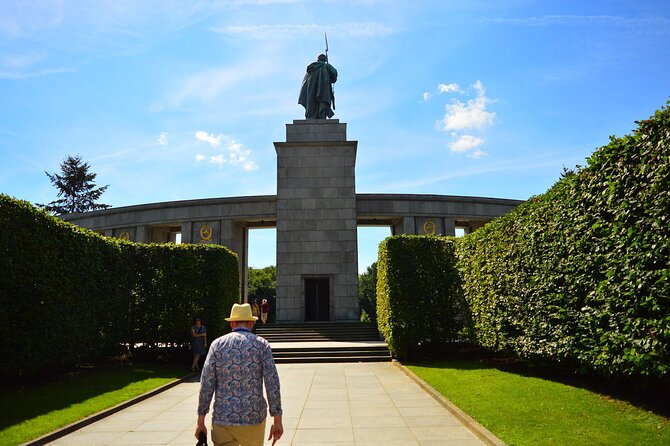
The Soviet War Memorial in Tiergarten honors Red Army soldiers who died in the Battle of Berlin. Its large Soviet soldier sculpture and military cemetery make the site visually imposing and solemn.
The memorial’s imagery reflects the political language of the period. It presents the defeat of Nazism through Soviet military power, and the site also marks the enormous human cost of the final campaign. The Battle of Berlin was not a clean, simple victory march. It was a brutal urban battle fought through a city already damaged by years of war.
You spend about 15 minutes here. The stop works well after the Reichstag because the route moves from a symbol of political collapse to the army that helped bring the Nazi regime down. It also gives the guide room to explain the final Soviet assault and the events that led to the fall of Berlin.
More Walking Tours in Berlin
- Discover Berlin Half-Day Walking Tour
★ 5.0 · 9,624 reviews - Berlin: Discover Berlin Walking Tour
★ 4.9 · 5,998 reviews - Berlin: Hidden Backyards Guided Walking Tour
★ 4.8 · 5,360 reviews - Berlin: Alternative Berlin Walking Tour
★ 4.6 · 1,204 reviews
Brandenburg Gate and the use of public symbols
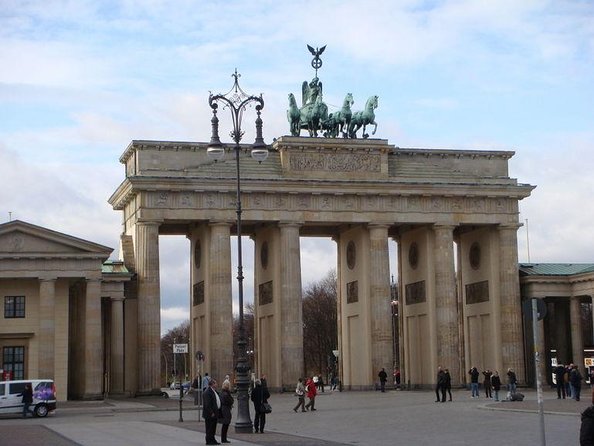
The Brandenburg Gate is now linked with German reunification, but its story includes a darker period. Under Hitler, the gate was used for Nazi ceremonies, public displays, and propaganda. Its familiar form became a backdrop for the regime’s claims of authority and military strength.
This is a useful reminder that famous landmarks do not have one permanent meaning. Political movements can seize an existing symbol and use it to sell a new message. The gate later became associated with division and reunification, but the Nazi period remains part of its story.
The stop lasts around ten minutes. You will likely have seen the gate already, but the guide adds the political context that is easy to miss when you visit alone.
The Academy of Arts and Albert Speer’s architectural vision
At the Akademie der Künste, the tour considers the relationship between art, architecture, and political power. Albert Speer, Hitler’s chief architect and later Minister of Armaments, promoted monumental neoclassical designs that were meant to express Nazi authority and permanence.
The Academy itself was not simply Speer’s personal headquarters, so this stop works best as a wider discussion of institutions and artistic life under the regime. It asks how architecture and culture can support political ideas, even when the buildings appear grand, orderly, or respectable.
This is a shorter stop of about ten minutes. Do not expect a full museum visit here. The value is in seeing how the Nazi government used design, ceremony, and public space to make its ideology feel permanent.
The Holocaust Memorial and the weight of absence
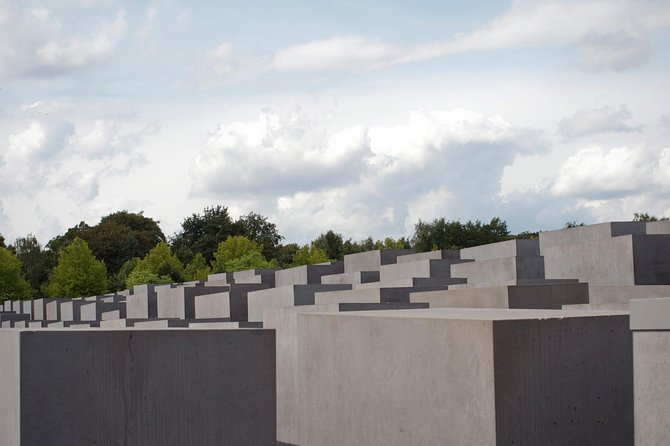
The Memorial to the Murdered Jews of Europe consists of 2,711 concrete slabs set across an uneven field. The paths rise and fall between the blocks, producing a sense of uncertainty and disorientation.
You have about ten minutes at the memorial during the walk. That is enough for an introduction and a short period of reflection, but not enough for an extended visit. If this site matters especially to you, return later on your own for more time.
The memorial does not explain every detail of the Holocaust in a traditional display. Its design creates an emotional response through space, scale, and absence. The guide’s role is to provide historical framing, while the memorial itself gives you room to think about the millions of people murdered under Nazi rule.
This is a solemn part of the route. It should not be treated as a casual photo stop, and a respectful attitude is essential.
Hitler’s bunker site and the former Reich Chancellery
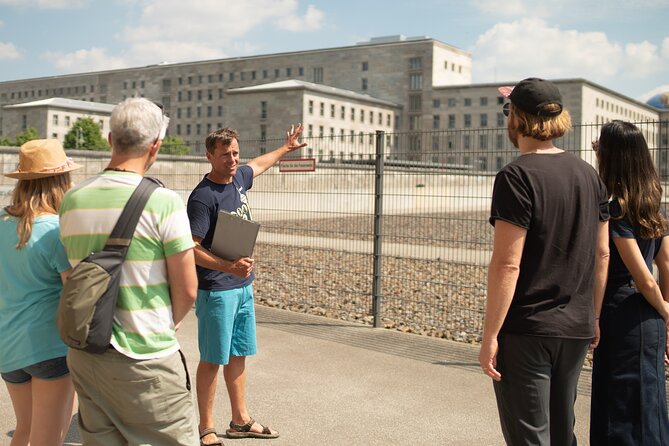
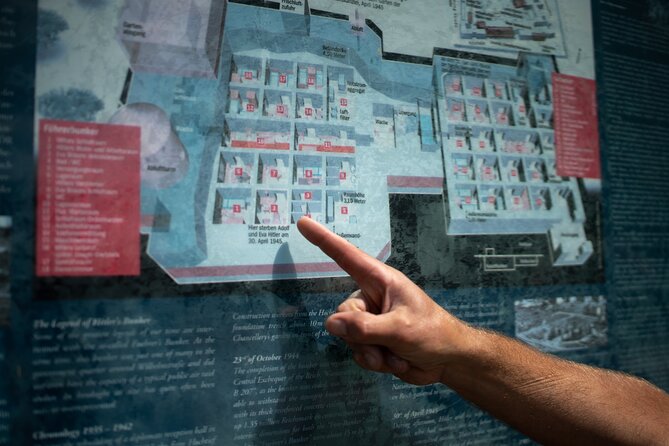
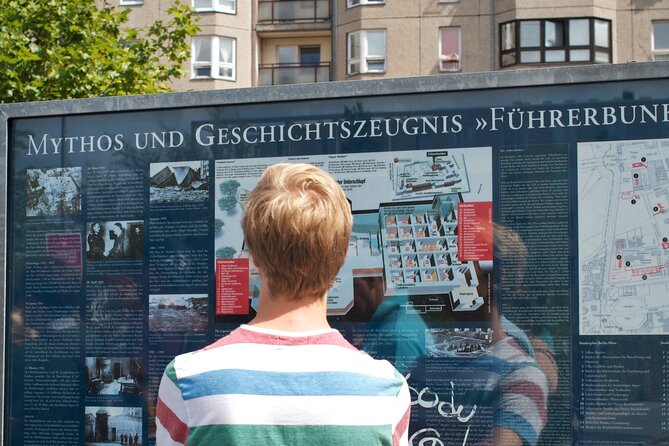
One of the most anticipated stops is the location of Hitler’s bunker. You do not enter a preserved bunker. You stand above the site where Hitler spent his final days, near the former New Reich Chancellery designed by Albert Speer.
The bunker was where Hitler lived during the final stage of the war and died in April 1945. The surrounding area was once the center of the Nazi government, but much of that physical world has disappeared or been rebuilt. Today, the plain setting can feel surprisingly unremarkable.
That contrast is part of the point. There is no grand ruin waiting underground and no dramatic preserved interior. The guide supplies the missing information, explaining the final days, the collapse of the regime, and the confusion surrounding the end of Hitler’s life.
One guide, Eran, was praised for revealing the bunker location only after reaching the site sign. That kind of timing can make the stop more memorable, especially because the site itself gives you so little visual information.
Wilhelmstrasse and the offices of Nazi power
Wilhelmstrasse was the administrative core of Nazi Berlin. The street included the Reich Chancellery, the Ministry of Foreign Affairs, and the Ministry of Propaganda, along with offices used by senior officials such as Joseph Goebbels.
Here the tour shifts from military events to government machinery. Decisions about war, occupation, persecution, and the treatment of Jewish people were made through offices, ministries, paperwork, meetings, and orders. That is an important lesson. State crimes do not happen only in dramatic moments. They also depend on ordinary systems being used for brutal ends.
The guide also discusses Goebbels’ propaganda work and the speeches used to shape public opinion. You learn how propaganda helped the regime build support, silence opposition, and present military aggression as national defense.
Wilhelmstrasse is not a preserved Nazi-era street in the sense of a museum district. Much was destroyed or repurposed after the war. You need the guide to point out what once stood here and explain why these unremarkable modern surroundings were once so powerful.
The former Air Ministry on Niederkirchnerstrasse
The former Reich Air Ministry was associated with Hermann Göring and the Luftwaffe. The building’s scale and design reflected the regime’s preference for imposing architecture and centralized control.
The Luftwaffe played a major role in Nazi military operations, including the Battle of Britain. Viewing the former ministry gives you a chance to consider how military planning was organized from Berlin and how the air force fitted into Hitler’s wider war aims.
Again, this is an exterior historical stop, not an indoor tour of the old ministry. The building has been repurposed, but its connection to Nazi military administration remains important. The contrast between its present use and its former role helps show how Berlin has had to live with, reinterpret, and sometimes quietly absorb its difficult past.
Topography of Terror and the end near Checkpoint Charlie
The walk finishes at the Topography of Terror, located on the former headquarters of the SS and Gestapo. The museum and memorial focus on repression, persecution, and the Holocaust, using photographs, documents, and personal accounts.
This is a fitting end because it brings the tour back to the institutions that enforced Nazi terror. You have seen the government offices and propaganda centers. Here, you confront the police and security organizations that turned ideology into arrests, torture, deportation, and murder.
The tour ends near Checkpoint Charlie, which makes it easy to continue exploring central Berlin. The Topography of Terror itself deserves more than the ten-minute tour stop if you have time. You can return after the walk and examine the material at your own pace.
Resistance, Stauffenberg, and choices under dictatorship
The tour also introduces resistance figures including Henning von Tresckow, Hans Oster, and Claus von Stauffenberg. Their opposition to Hitler is important, but the guide should keep it in proportion. Resistance existed, yet it was dangerous, limited, and often divided.
Stauffenberg is best known for the 20 July 1944 assassination attempt. The tour connects his story with the wider question of how people responded to Nazi rule. You also hear about resistance within military and political circles, rather than receiving a simple story of brave individuals saving the nation.
This part will appeal to visitors who want more than battlefield facts. It adds moral complexity and shows that choices still existed under dictatorship, even when the risks were severe.
Guide quality, group size, and walking pace
The guide is the most important variable in this experience. The strongest feedback praises guides for clear explanations, a good sense of humor, patience, and the ability to connect separate sites into one story.
Ru was praised for linking the rise of the Nazi Party with the places along the route. Paul was praised for balancing sensitive subject matter with accessible storytelling. Ciarán was noted for a comfortable pace and clear explanations, while Callam received especially strong praise for checking that the group understood what they were seeing.
You should not book on the assumption that one named guide is guaranteed. The assigned guide can vary. Still, the repeated strength of the guiding team is encouraging, especially for a subject that can become confusing when overloaded with names and dates.
The maximum group size is 25. That is not a private tour, but it is small enough for questions if you stay close and speak up. The route is brisk, with about 5,000 steps between points of interest. Wear shoes suited to city walking, and bring water and weather protection.
Price, timing, and who gets the most value
At about $24.07, the price is modest for three hours of guided history in central Berlin. You are paying mainly for the guide’s explanations and route planning, not for admissions or special access.
That distinction matters. Most stops are viewed from outside, and admission to the Reichstag is not included. The experience is best value if you want historical context and would otherwise wander past these sites without knowing what happened there.
I would especially recommend it for:
- First-time visitors who want a structured introduction to Nazi Berlin
- World War II and political history enthusiasts
- Families with older teenagers who can handle the subject
- Visitors with only half a day for this part of Berlin
- Anyone who wants to understand how Hitler’s government operated, not just where Hitler died
It may be less suitable if you dislike long outdoor walks, need frequent indoor breaks, or want to spend a great deal of time inside each museum. The Holocaust and Nazi terror are also emotionally heavy subjects. This is not light sightseeing.
The tour is offered in English, uses a mobile ticket, and is near public transportation. Hotel pickup and drop-off are not included. Free cancellation is available up to 24 hours before the start time, which gives you some useful flexibility when planning a Berlin stay.
Should you book the Third Reich Berlin walking tour?
Book it if you want a clear, guided account of Berlin’s Nazi past and the final Battle of Berlin. The route covers more ground and provides more context than most independent walks, especially around Wilhelmstrasse, the former ministries, the bunker site, and the resistance story.
I would book early if your dates are fixed, since the experience is often reserved about 27 days ahead. Choose a day when you can manage three hours outdoors, arrive 15 minutes early, and dress for the weather.
Skip it if you want indoor museum time or a short, relaxed stroll. But if you have comfortable shoes, a serious interest in history, and a willingness to confront Berlin’s darkest chapter, this is a worthwhile and fairly priced way to make sense of the city.
FAQ
How long does the Third Reich Berlin walking tour last?
The tour lasts approximately three hours.
Where does the tour begin?
The meeting point is listed as Reichstagufer 17, 10117 Berlin, close to Friedrichstrasse Station. You should arrive 15 minutes before the scheduled start.
Where does the tour finish?
The walk ends at the Topography of Terror, Niederkirchnerstraße 8, 10963 Berlin, very close to Checkpoint Charlie.
Is the Hitler bunker open to visitors on this tour?
No. You stand above the location of Hitler’s former bunker and learn about his final days there. The bunker itself is not visited.
Is admission to the Reichstag included?
No. Admission to the Reichstag is not included. The tour visits the building as part of the walking route.
How large is the group?
The tour has a maximum of 25 participants.
Just added around Berlin
- Private Walking Tour in Berlin: Hitler’s Germany & WWII★ 5.0 · 7 reviews
- The History of Berlin: WWII PRIVATE Walking Tour With Locals★ 5.0 · 209 reviews
- Private Berlin WWII and Cold War History Tour with Local Expert Guide★ 5.0 · 28 reviews
- Private Walking Tour Berlin 3 hours: Brandenburg, Historic Center★ 5.0 · 7 reviews
- Berlin: Private Bike Tour of the Berlin Wall and Third Reich★ 5.0 · 23 reviews
- Berlin: Guided Private Bike Tour to Explore the Highlights★ 5.0 · 12 reviews
- Berlin Photography Masterclass – Private Photography Lesson★ 4.5 · 23 reviews
- Group Driving Tour 1 to 6 people. Berlin Shore Excursion incl pick-up at Port★ 5.0 · 8 reviews