
Reviewed · THIRD REICH HISTORY TOURS
Hitler’s Germany: Berlin During the Third Reich & WWII
Berlin’s darkest places still speak. This four-hour tour makes the city’s Nazi past easier to understand by linking sites that can otherwise feel scattered across central Berlin. I like the strong route, which moves from the former Jewish district and Anhalter Bahnhof through the Nazi government quarter to the Reichstag. I also like the guides’ presentation, praised again and again for clear English, strong subject knowledge, humor, and care with serious material.
The main drawback is that you do not enter any buildings, and a short metro ride means you need an AB public transport ticket. The tour runs in all weather, too, so sturdy shoes and a rain jacket are sensible. Still, at $23 per person, it offers a lot of historical context for the money.
In This Review
- Key points to know before you book
- Why this tour helps you read Berlin
- The Jewish Quarter and the destruction of Jewish Berlin
- Anhalter Bahnhof and a city broken by war
- The Luftwaffe headquarters and Nazi architecture
- Gestapo and SS power at the Topography of Terror
- Propaganda, the T4 program, and the Holocaust
- Memorials near the Tiergarten
- The Holocaust Memorial and the power of place
- Hitler’s bunker site and the end of the dictatorship
- The Reichstag and the Battle of Berlin
- Guide quality and group atmosphere
- Is $23 good value for four hours?
- Practical advice for a better day
- Should you book Hitler’s Germany?
- FAQ
- How long is the Hitler’s Germany tour?
- What is the price?
- What languages are available?
- Is the tour private or shared?
- Does the tour enter any buildings?
- Is public transportation used?
- Is the public transport ticket included?
- Which major sites are included?
- Does the tour run in bad weather?
- Can I cancel for a full refund?
Key points to know before you book
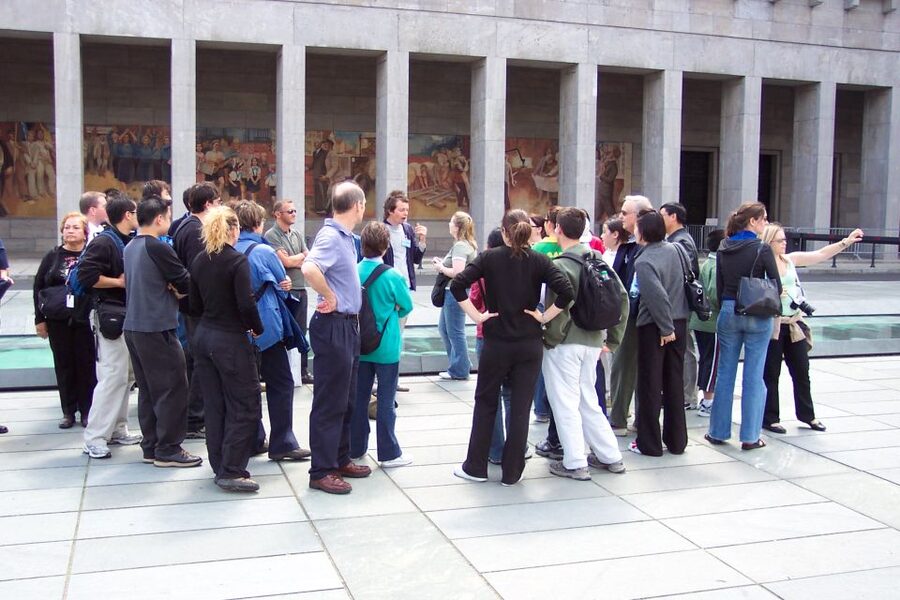
- Four hours connect the major Nazi sites: You see the former Nazi government quarter, Hitler’s bunker site, the Holocaust Memorial, the Topography of Terror area, and the Reichstag.
- The tour begins with Jewish Berlin: You learn about Jewish life, persecution, and the destruction of the nearby Jewish district before moving into the machinery of Nazi power.
- Anhalter Bahnhof adds wartime context: A short metro ride brings you to the remains of one of Berlin’s great railway stations, destroyed during World War II.
- The former Luftwaffe headquarters survives: The huge building once directed by Hermann Göring is one of the clearest surviving examples of Nazi architecture.
- The final stop is the Reichstag: Your guide explains the Battle of Berlin, the Soviet assault, and Hitler’s suicide less than a mile away.
- Guide quality is a major strength: Guides such as Glen, Jonathan N, Jimmy, Artie, Rohan, Emma, Amelie, and Rebecca have been praised for energy, clarity, and thoughtful handling of a difficult subject.
Why this tour helps you read Berlin
Berlin can feel like a history book with missing pages. A modern street may cover a wartime ruin. An ordinary office building may have housed a terrifying government department. Without a guide, you can walk past important places and see almost nothing.
This tour gives those places a clear order. It starts with the people targeted by the Nazi regime, then shows you the offices and institutions that carried out the dictatorship, and ends with the collapse of Hitler’s Berlin. That structure matters. You are not simply collecting famous sights. You are following the growth, crimes, and destruction of the Third Reich through the city itself.
The subject is grim, and the tour does not try to make it comfortable. But the guides use stories, photographs, maps, and occasional humor to keep the four hours human and understandable. Amelie, for example, has been praised for bringing maps and documents to help explain how Berlin looked and functioned. A West Berliner guide has also used personal city experience to add a later layer of memory and change.
I would choose this tour early in your Berlin visit if the Nazi period is important to you. It gives you a framework that makes later visits to museums and memorials much more meaningful.
More Third Reich History Tours in Berlin
- Berlin: Third Reich and Cold War 2 Hour Walking Tour
★ 4.9 · 6,830 reviews - Berlin’s Best: 2 Hour Walking Tour Third Reich and the Cold War
★ 5.0 · 5,486 reviews - Third Reich Berlin: Hitler and WWII Walking Tour
★ 5.0 · 3,301 reviews
The Jewish Quarter and the destruction of Jewish Berlin
The opening section focuses on Berlin’s Jewish district and the Nazi destruction of Jewish life in the city. This is an important choice. Many tours begin with Hitler, military buildings, and grand plans for the capital. This one begins by showing you who suffered under those plans.
Your guide explains Jewish life before the Nazi takeover, then the process of persecution and destruction. That helps you see the Holocaust not as an isolated event but as a policy built through discrimination, exclusion, deportation, and murder.
The Jewish Quarter section also sets the tone for the rest of the walk. You are asked to think about memory as well as architecture. Buildings and streets may have changed, but the guide helps you notice how the city marks what happened and where the physical traces have disappeared.
This part is especially useful if you know the broad outline of the Holocaust but want a better sense of how it affected Berlin itself. It is less useful for anyone hoping for a long indoor museum visit, since the tour does not enter buildings.
Anhalter Bahnhof and a city broken by war
A short metro ride takes you to Anhalter Bahnhof, once a vast railway station. Today, the surviving section gives you a strong visual reminder of how much Berlin lost in World War II.
The station is not just a stop on the way to the government quarter. It helps explain the scale of wartime destruction. Berlin was not merely a city where important decisions were made. It became a battlefield, and its transport links, public buildings, homes, and neighborhoods suffered heavily.
You need a single AB public transport ticket for this part of the tour if you do not already have valid transport. The ticket is not included, so remember to allow for that small extra cost when planning your day.
The metro segment also breaks up the walking. Four hours on city streets is manageable for many people, but the route still asks you to stay with the group and keep moving. Wear comfortable shoes, especially if the weather is wet.
The Luftwaffe headquarters and Nazi architecture
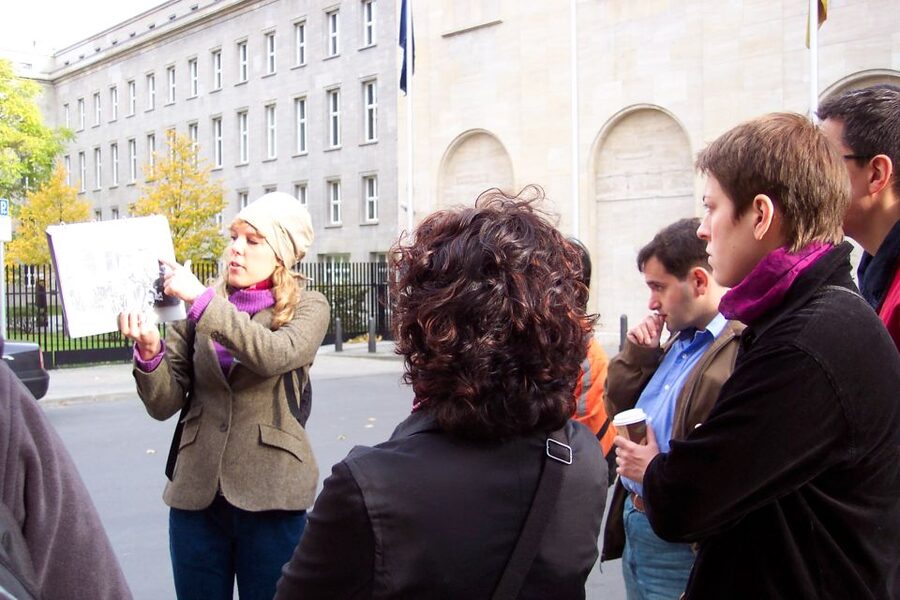
From Anhalter Bahnhof, the route moves through the former Nazi government district. One of the most striking buildings is the enormous former Luftwaffe headquarters, associated with Hermann Göring and the German air force.
This is one of the tour’s most revealing stops because the building survives. Its scale and severe design show how Nazi architecture tried to project order, authority, and permanence. A guide can explain the political message behind the stone and concrete in a way that a quick photograph cannot.
The building also raises a useful question for you: what happens when a dictatorship’s architecture outlives the dictatorship itself? Berlin has had to decide how to use, explain, and remember structures connected to Nazi power. That tension makes the stop more interesting than a simple photo opportunity.
You will not go inside. The value comes from seeing the exterior and hearing how the building fitted into the government district and the wider Nazi system.
Still Berlin, at a slower pace:
- Berlin: Reichstag, Dome and Government District Guided Tour
★ 4.7 · 18,288 reviews - Berlin: 1-Hour City Tour by Boat with Guaranteed Seating
★ 4.3 · 16,993 reviews - Berlin: Boat Tour Along the River Spree
★ 4.4 · 11,252 reviews - Discover Berlin Half-Day Walking Tour
★ 5.0 · 9,624 reviews
Gestapo and SS power at the Topography of Terror
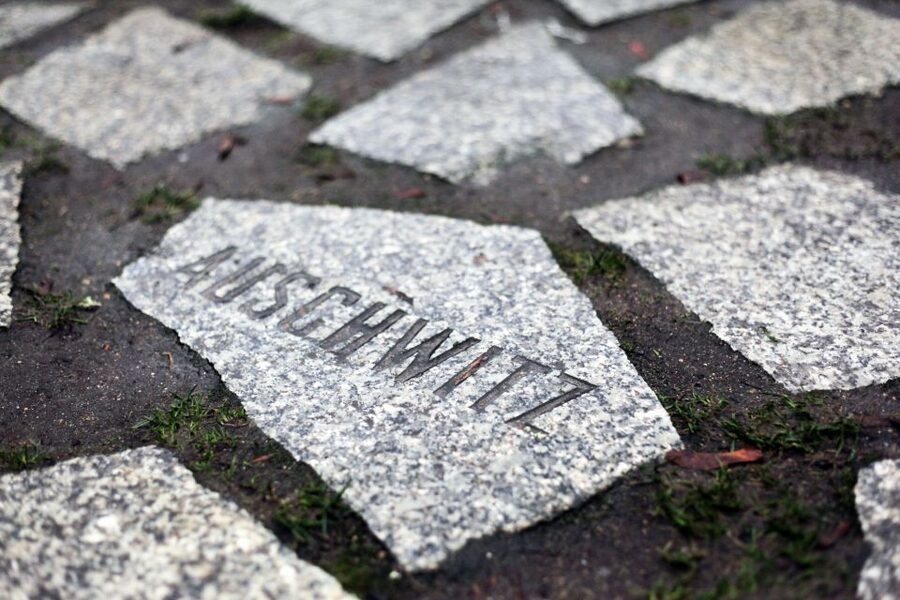
The tour continues to the former Gestapo and SS headquarters, now associated with the Topography of Terror Museum. The Gestapo was the secret police. The SS became one of the central institutions of Nazi terror. This was not just a place where orders were discussed. It was part of the machinery that turned ideology into persecution and mass murder.
The guide explains the role of these agencies and the way power worked inside the regime. That distinction is useful because the Nazi state was not a single office controlled by one person. It was a web of departments, leaders, police forces, military bodies, and party institutions competing and cooperating to carry out criminal policies.
There is a break near the museum, which gives you a chance to pause and absorb the material. The tour information states that no buildings are entered, so treat this as an outdoor stop and break rather than a museum admission. If you want to see the museum’s indoor displays, plan a separate visit.
This is one of the heaviest sections of the day. The subject includes organized terror, imprisonment, and murder. A good guide needs to be precise without turning suffering into spectacle. The strongest guide comments describe exactly that balance: serious, respectful, and still engaging.
Propaganda, the T4 program, and the Holocaust
After the break, the focus shifts from buildings to some of the Nazi regime’s most sinister policies. Joseph Goebbels and the use of propaganda receive attention, along with the T4 euthanasia program and the Holocaust.
The propaganda section is valuable because it moves beyond battlefield history. You hear how the regime used public messaging and control of information to shape what people saw, believed, and accepted. That gives you a better way to understand how a modern society could be drawn into dictatorship and persecution.
The T4 program is another important inclusion. Nazi authorities organized the murder of disabled people under the language of medical care and state efficiency. Including this subject shows that the regime’s killing policies developed before the extermination of Europe’s Jews reached its full scale.
The Holocaust discussion then returns to the central moral fact of the tour: the mass murder of Jewish people was planned and carried out by a state with offices, officials, transport systems, police powers, and propaganda. The guide connects these elements rather than presenting the Holocaust as an unexplained horror.
This portion may be difficult for younger children. It can work well with teenagers who are ready for serious history, and one family specifically found the tour held the attention of three teenagers. Your own judgment should depend on their maturity and prior understanding.
Memorials near the Tiergarten
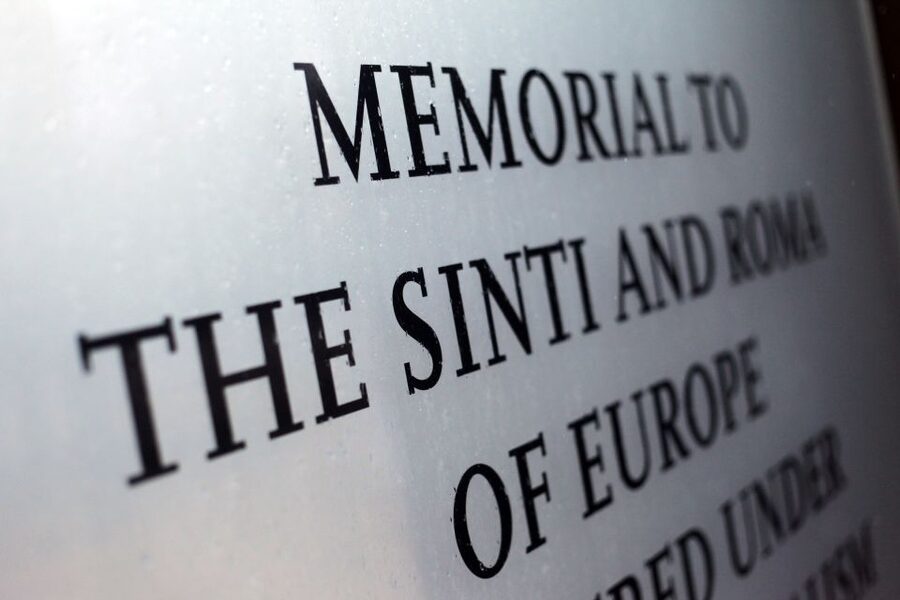
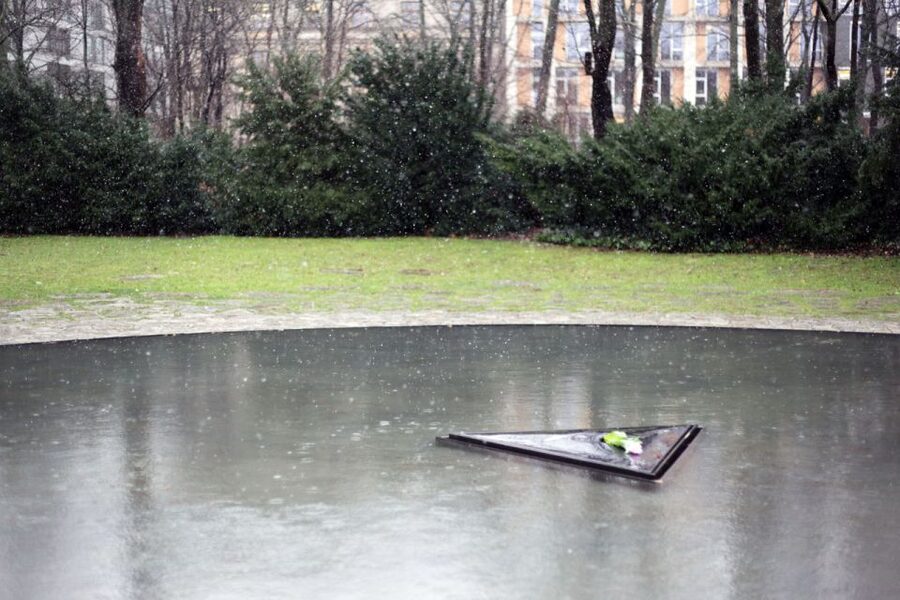
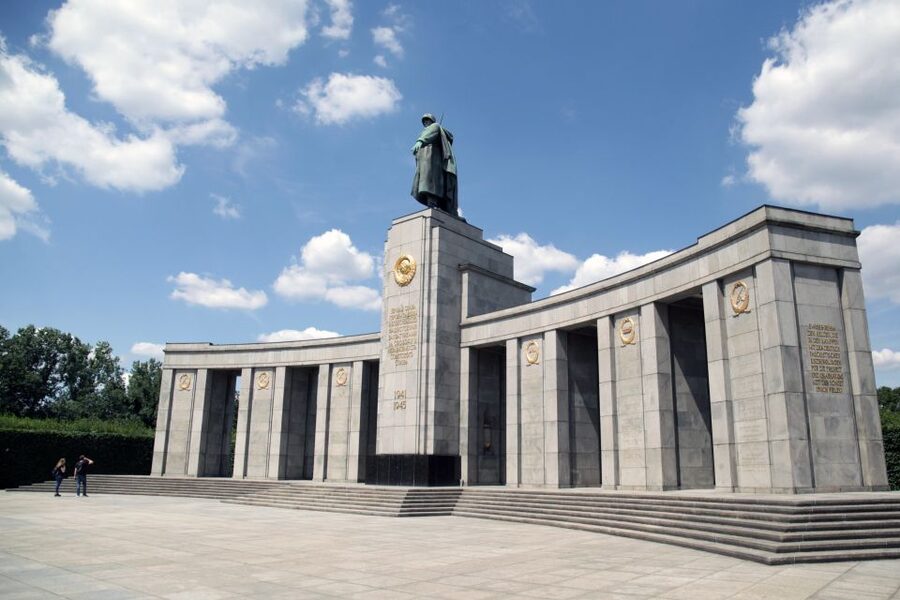
As you head toward the Tiergarten, Berlin’s large central park, the tour visits the Memorial to the Sinti and Roma Victims of National Socialism. This is an important stop because the Nazi regime persecuted and murdered Sinti and Roma people as part of its racial program.
The memorial broadens the tour beyond the most familiar stories. You are reminded that Nazi persecution targeted several groups, each with its own history of discrimination, deportation, and murder. The guide provides the context needed to understand why this memorial belongs in a tour of Nazi Berlin.
The route also includes the memorial for 96 politicians arrested by the Nazis as they seized power in 1933. This stop shows how quickly democratic opposition was attacked. It helps you see the transition from political movement to dictatorship in concrete human terms.
These memorials are not merely pauses between larger attractions. They make the tour’s central point clear: the destruction of democracy and the persecution of minorities happened through actions taken against real communities and individuals.
The Holocaust Memorial and the power of place
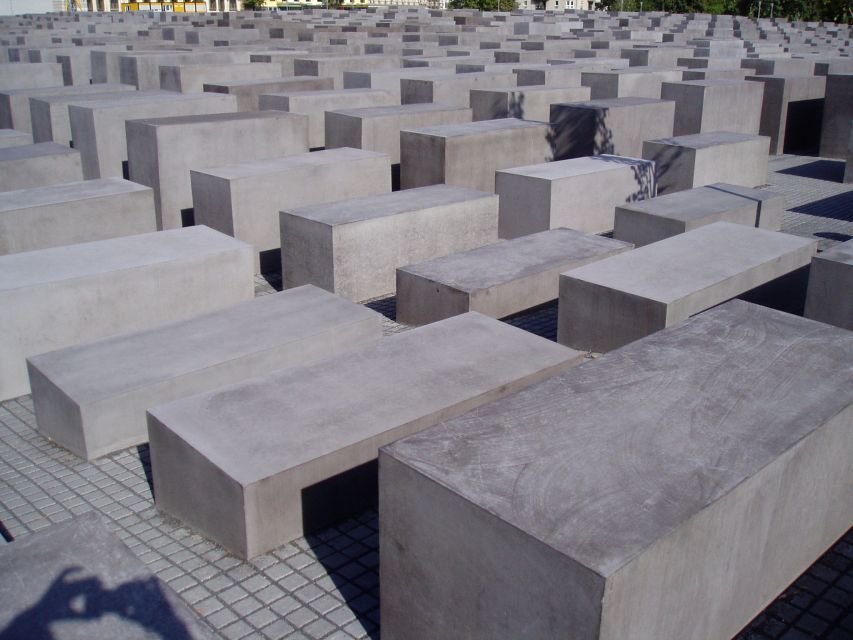
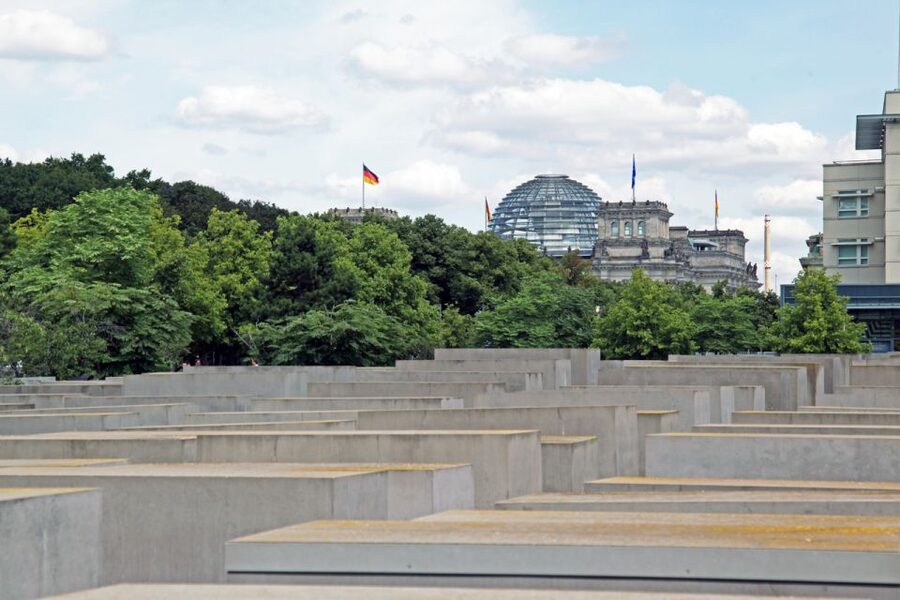
The route includes Berlin’s Memorial to the Murdered Jews of Europe, commonly called the Holocaust Memorial. Its rows of concrete slabs create a serious, unsettled space in the middle of central Berlin.
Your guide explains how the memorial fits into the city’s culture of remembrance and how its location relates to the former Nazi center of power. You can then return on your own if you want more time to walk through it quietly.
Because this tour covers many places, your time at the memorial may feel shorter than on a dedicated memorial visit. I would not treat the stop as a substitute for spending time there alone. Instead, think of the tour as giving you the background and connections, then use another visit to reflect at your own pace.
That combination works well. A guide can explain the historical setting, while an unhurried return visit lets you experience the memorial without trying to keep up with a group.
Hitler’s bunker site and the end of the dictatorship
Near the former Reich Chancellery area, you visit the site of Hitler’s bunker. There is no grand ruin to enter and no dramatic underground chamber waiting below the pavement. The location is important precisely because it can look so ordinary.
Your guide explains where Hitler spent the final days of the war and how the bunker fit into the last stage of Nazi rule. The tour places his suicide in relation to the nearby battlefront and the collapse of the city.
This is a useful correction to the popular image of Hitler’s headquarters as an intact fortress. Berlin’s postwar history, later construction, and efforts to prevent the site from becoming a shrine have left you with a place that requires explanation rather than spectacle.
For me, that makes the stop stronger. You are forced to use historical imagination, but the guide supplies the facts and location. The emphasis stays on the consequences of the regime, not on fascination with its leader.
The Reichstag and the Battle of Berlin
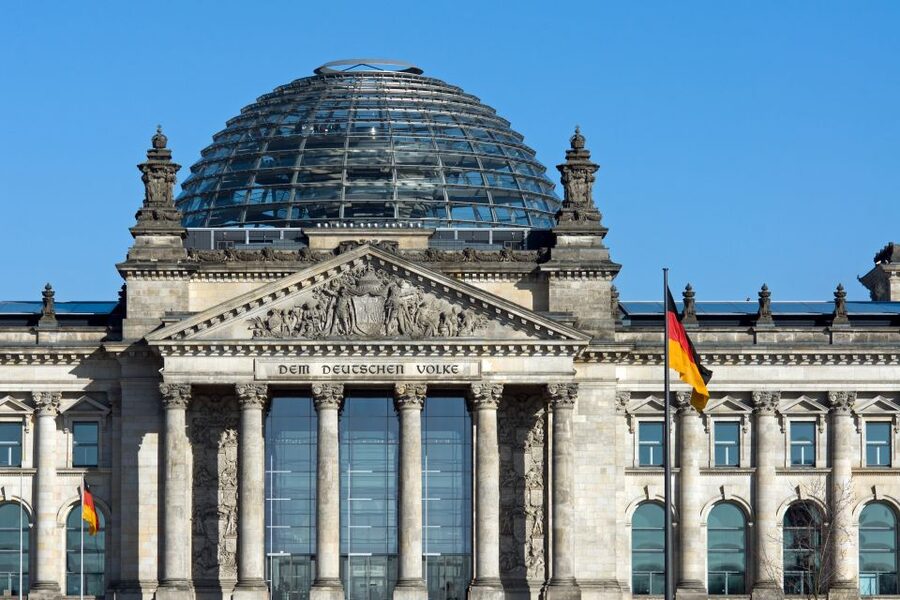
The tour finishes outside the Reichstag, Germany’s parliament building. The final setting gives the route a natural ending because the building represents both democratic government and the violent attempt to destroy it.
Here, the guide explains Hitler and Albert Speer’s plan to rebuild Berlin as Germania, a vast capital for a world empire. The plan reveals the regime’s ambition and its distorted view of Berlin as a stage for power. The city was to be remade on an enormous scale, with architecture designed to suggest dominance and permanence.
You also hear about the Battle of Berlin and the Soviet assault on the Reichstag. Soviet soldiers attacked the building under anti-aircraft fire while Hitler was committing suicide less than a mile away. That physical closeness brings the final days into focus: the supposed thousand-year Reich was collapsing in a city being fought over block by block.
Ending at the Reichstag also gives you a chance to consider what came after. The building now serves a democratic parliament, a sharp contrast with the dictatorship and war discussed during the walk.
Guide quality and group atmosphere
Guide quality appears to be the tour’s strongest feature. Names praised for clear, lively delivery include Glen, Jonathan N, Jimmy, Artie, Rohan, Rebecca, Emma, Amelie, Jasper, and others. Their styles differ, but the repeated strengths are consistent: strong preparation, enthusiasm, good storytelling, and willingness to answer questions.
Several guides have been praised for making difficult material understandable without making it trivial. Jonathan N is described as funny and welcoming, while Glen is repeatedly singled out for his subject knowledge and energy. Emma received praise for a well-planned route and an engaging presentation. Rebecca was noted for bringing Berlin’s story to life.
Group size can vary. A small group of nine allowed one guide to speak with everyone and answer questions along the way. Private groups are also available if you want more control over the pace or a more personal format.
The tour is offered in English and German. English-language visitors have particularly praised the guides’ fluent, natural delivery. If you book a shared tour, the experience will depend partly on the day’s guide and the group itself, but the overall rating of 4.8 from 476 reviews points to a dependable standard.
Is $23 good value for four hours?
Yes, provided you want an outdoor history tour rather than museum entry. At $23, you are paying for four hours of guiding across a wide section of central Berlin, including several places that are easy to miss or misunderstand on your own.
The price does not include the AB transport ticket for the metro ride. That is a small extra cost, but it is worth knowing in advance. You also need to remember that the tour does not include entry to buildings, so the value comes from the guide, route, and explanation.
I consider the tour especially good value for first-time visitors, World War II history fans, and anyone who wants a coherent introduction before visiting Berlin’s museums independently. If you prefer a slow walk with long periods at each memorial, a private tour may be worth considering.
The four-hour length is a sensible middle ground. It is long enough to cover the subject properly, yet several people found that the time passed quickly because the guides kept the group engaged. A short break helps, but this is still a serious walking outing.
Practical advice for a better day
Meet your guide in central Berlin. The exact meeting point depends on the option you book, so check your booking details carefully rather than assuming every departure begins in the same place.
Bring a valid public transport ticket for the AB zone if needed. The route includes a short metro ride, and the ticket is not included in the tour price.
Wear shoes you can walk in for four hours. The tour runs in rain and on public holidays, so pack a waterproof layer and be ready for exposed outdoor stops. An umbrella can help, although one past guide carried spare umbrellas for the group. Do not rely on that being standard.
Keep the schedule open around the tour. The route includes a museum-area break, but no building entries are included. If you want indoor museum time, reserve it separately after you know where the tour ends.
Ask questions. Guides are used to discussing the First, Second, and Third Reich, the Nazi high command, Berlin’s wartime destruction, and the city’s memorial culture. The best experience comes when you treat the walk as a conversation rather than a lecture.
Should you book Hitler’s Germany?
I would book it if you want a clear, serious introduction to Berlin under the Nazis and World War II. The route covers the Jewish district, Nazi administrative power, propaganda, the T4 program, the Holocaust, memorials, Hitler’s bunker site, and the Battle of Berlin in one connected story.
You should choose another experience, or add a separate museum visit, if you want to enter historic buildings or spend long, quiet periods at memorials. This tour stays outdoors and covers a lot of ground.
For $23, the combination of experienced English-speaking guides, a well-planned route, and hard-to-find historical context is a strong deal. Book it early in your stay, dress for the weather, bring your transport ticket, and leave room afterward to revisit the places that stay with you.
FAQ
How long is the Hitler’s Germany tour?
The tour lasts four hours.
What is the price?
The listed price is $23 per person.
What languages are available?
The tour is offered in English and German.
Is the tour private or shared?
You can book a shared group tour, and a private group option is also available.
Does the tour enter any buildings?
No. The tour information states that buildings are not entered.
Is public transportation used?
Yes. The itinerary includes a short metro ride to Anhalter Bahnhof.
Is the public transport ticket included?
No. You need a single AB public transport ticket if required, and it is not included.
Which major sites are included?
The route includes the former Jewish district, Anhalter Bahnhof, the former Luftwaffe headquarters, the former Gestapo and SS headquarters area, the Holocaust Memorial, the Sinti and Roma memorial, the memorial for 96 politicians, Hitler’s bunker site, and the Reichstag.
Does the tour run in bad weather?
Yes. The tour runs in all weather and on public holidays.
Can I cancel for a full refund?
Yes. You can cancel up to 24 hours in advance for a full refund.
Just added around Berlin
- Private Walking Tour in Berlin: Hitler’s Germany & WWII★ 5.0 · 7 reviews
- The History of Berlin: WWII PRIVATE Walking Tour With Locals★ 5.0 · 209 reviews
- Private Berlin WWII and Cold War History Tour with Local Expert Guide★ 5.0 · 28 reviews
- Private Walking Tour Berlin 3 hours: Brandenburg, Historic Center★ 5.0 · 7 reviews
- Berlin: Private Bike Tour of the Berlin Wall and Third Reich★ 5.0 · 23 reviews
- Berlin: Guided Private Bike Tour to Explore the Highlights★ 5.0 · 12 reviews
- Berlin Photography Masterclass – Private Photography Lesson★ 4.5 · 23 reviews
- Group Driving Tour 1 to 6 people. Berlin Shore Excursion incl pick-up at Port★ 5.0 · 8 reviews