
Reviewed · NUREMBERG TOURS
Nuremberg: 1.5-Hour Medieval Tour
Medieval Nuremberg, explained clearly. This 1.5-hour walking tour brings together Nuremberg Castle, Albrecht Dürer’s former home, and the old town’s two historic districts in one compact outing. I like the strong route, which moves from the castle to the streets where artists, merchants, and other notable figures shaped the city.
I also like the focus on stories rather than simply pointing out old buildings. Guide Claudia has been praised for bringing history to life, while another guest found the guide well informed and pleased with the unusual places along the way. The main consideration is practical: the tour is offered in German, requires at least 10 participants, and is not suitable for wheelchair users.
In This Review
- Key points at a glance
- Why this compact Nuremberg tour works
- Meeting at Hauptmarkt and the Schöner Brunnen
- Reaching Nuremberg Castle and the Burgfreiung
- Albrecht Dürer’s house and the artist behind the name
- Sebalder Altstadt and the city’s medieval personalities
- Lorenzer Altstadt and Nuremberg’s divided center
- Venetian Nuremberg and the Italian connection
- What $23 gets you
- Who should book this walking tour?
- My final take on the Nuremberg medieval tour
- FAQ
- Where does the tour begin?
- Where does the tour end?
- How long does the tour last?
- What language is the tour offered in?
- What does the price include?
- Are entrance fees included?
- Are food and drinks included?
- Is public transport included?
- Is there a minimum number of participants?
- Is the tour suitable for wheelchair users?
Key points at a glance
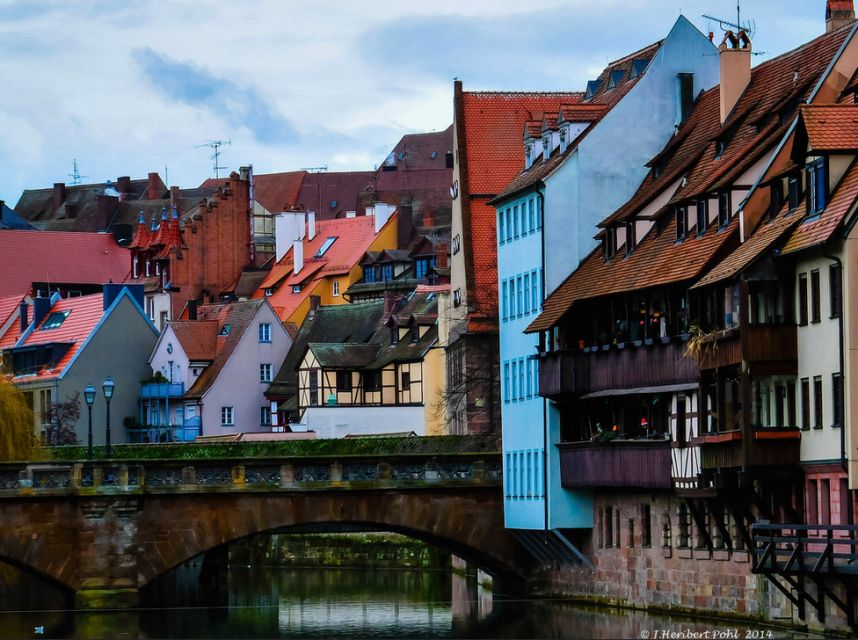
- Start at the Schöner Brunnen: Meet at Nuremberg’s Hauptmarkt, beside the ornate fountain, a central and easy-to-find point in the old town.
- Castle and Burgfreiung: Learn how Nuremberg Castle and the surrounding castle precinct fit into the city’s medieval story.
- Albrecht Dürer’s house: Hear about the famous artist’s life, work, and difficult times while standing outside or near one of Nuremberg’s best-known historic homes.
- Two old-town districts: Walk through the Sebalder Altstadt and Lorenzer Altstadt, seeing how Nuremberg developed on both sides of the river.
- Italian influence: The tour adds an unusual angle by explaining the role of Italian culture and connections in German history.
- Good short-tour value: At $23 per person, it offers a focused introduction for visitors who want context before exploring on their own.
Why this compact Nuremberg tour works
Nuremberg can feel confusing at first. The castle rises above the old town, major churches sit in separate districts, and famous names such as Albrecht Dürer appear on signs, buildings, and museums. A guide helps connect those pieces.
This tour does that in 90 minutes. You are not signing up for a full-day program or a long list of museum interiors. Instead, you get a guided walk through the city’s medieval core, with the castle, Dürer, local personalities, old-town neighborhoods, and Italian influence tied into one story.
I see that as the tour’s main strength. You get enough background to understand what you are seeing, but still have time afterward to return to the places that interest you most. The route ends where it begins, at Hauptmarkt, so you can continue sightseeing without having to find your way back from an unfamiliar part of the city.
The tour has a rating of 4.6 from 33 reviews, which fits the experience described here: strong guides and good storytelling appear to be the heart of the outing. Claudia receives especially warm praise for making the past feel immediate and personal. That matters in Nuremberg, where a short explanation can turn a grand building into a place with a human story.
A few more Nuremberg trips worth comparing
- Nuremberg: City Tour with the Bimmelbahn Train
★ 4.4 · 2,475 reviews - Nuremberg: Old Town Guided Walking Tour
★ 4.6 · 2,416 reviews - Nuremberg: Tunnels and Secret Passages in the City Wall Tour
★ 4.8 · 2,334 reviews
Meeting at Hauptmarkt and the Schöner Brunnen
The tour begins at Hauptmarkt, the central square, beside the Schöner Brunnen fountain. This is a sensible meeting point because it places you in the middle of Nuremberg’s old town from the first minute.
The fountain itself gives you a useful visual introduction to the city. Its elaborate design reflects the public pride and religious world of medieval Nuremberg. You do not need to know every detail before arriving. The guide can use the square to establish the setting and explain how the city’s central spaces functioned.
Starting here also makes the timing practical. You should arrive early enough to identify the fountain and gather before the group moves uphill toward the castle area. The activity includes the guided walk, but not public transport, food, or drinks, so plan to arrive with anything you need for the 90 minutes.
Hauptmarkt is also a useful place to begin if you have only a short stay in Nuremberg. After the tour, you are already near more old-town streets, churches, shops, and places to stop for a meal. The end point is the same as the start, which keeps the logistics simple.
Reaching Nuremberg Castle and the Burgfreiung
From Hauptmarkt, the route heads toward Nuremberg Castle. The castle is one of the city’s defining sights, and its elevated position gives the guide a natural way to explain Nuremberg’s political importance during the Middle Ages.
The tour specifically discusses the Burgfreiung, the area around the castle that had its own special status and traditions. This is the sort of detail that can easily be missed if you only walk up to the castle, take a photo, and move on. You will hear how the castle area related to the wider city and why this part of Nuremberg mattered.
Do not expect a full castle admission experience. Entrance fees are not included, and the description centers on the castle, its surroundings, and its history rather than promising entry into every interior. If you want to visit castle rooms or other paid sights, treat those as separate plans for before or after the walk.
The uphill route is worth keeping in mind. The tour is not suitable for wheelchair users, and the castle section may be more demanding than a flat square-to-square walk. Comfortable shoes are a wise choice, even though the tour lasts only 1.5 hours.
Albrecht Dürer’s house and the artist behind the name
After the castle area, the tour continues to Albrecht Dürer’s house. Dürer is one of Nuremberg’s most important historical figures, but you gain more from this stop than a quick look at a famous address.
The guide discusses his life and work, along with the troubled times in which he lived. That wording matters. Dürer was not simply an artist attached to a pretty old house. His career belongs to a period of change, when printing, trade, religion, politics, and new ideas affected how people understood Europe.
You will learn why Dürer is associated so strongly with Nuremberg and how his work helped give the city a wider reputation. The stop also adds a human scale to the tour. Instead of hearing only about rulers and fortifications, you hear about the daily world and professional life of a major local figure.
If the house is a priority for you, remember that admission is not included. The guided walk gives you the historical setting, while a separate visit may be needed for the full interior experience. That arrangement can be useful because you can decide afterward if the museum deserves part of your day.
Still Nuremberg, at a slower pace:
- Nuremberg: Medieval Dungeons Guided Tour
★ 4.8 · 1,726 reviews - Nuremberg: Walking Tour of Former Nazi Party Rally Grounds
★ 4.7 · 1,665 reviews - Medieval Tour in Nuremberg in Spanish
★ 5.0 · 1,374 reviews - Nuremberg: Historischer Kunstbunker WWII Art Bunker Tour
★ 4.8 · 921 reviews
Sebalder Altstadt and the city’s medieval personalities
The walk then moves through the Sebalder Altstadt, the old town district associated with the area around St. Sebald. Here, the guide broadens the story beyond the castle and Dürer.
You will hear about people who lived and worked in Nuremberg during the Middle Ages. The emphasis is on personalities and living conditions, which gives the streets more meaning than a simple architectural tour. A building becomes connected to a person, an occupation, or a social role.
This part should appeal to you if you like local history that explains ordinary life as well as famous names. The guide also addresses how living conditions have changed over time. That comparison helps you see the old town as a place that has continued to function, rather than as a frozen set of monuments.
The tour’s small amount of time makes this section selective. You will not receive every detail about every street. Instead, the guide chooses enough examples to show how the district developed and how people experienced the city. That is a sensible trade-off for a 90-minute walk.
Lorenzer Altstadt and Nuremberg’s divided center
The route also includes the Lorenzer Altstadt, the historic district on the other side of the old town. Seeing both Sebalder and Lorenzer areas gives you a better sense of Nuremberg’s structure.
A tour that focuses only on the castle can leave you with the impression that Nuremberg is mainly a royal or military city. The two-district route corrects that. It presents the old town as a broader urban center with different neighborhoods, institutions, and working communities.
You will hear more about how the city changed and about the personalities connected with it. This is also where a good guide can make the walk feel less like a list of dates. The most praised quality of this experience is the guide’s ability to make history lively and understandable. Claudia, in particular, has been singled out for her storytelling.
The route is still a walking tour, not a museum visit. You will spend most of the time moving through public streets and listening. If you prefer long interior visits, this will feel too brief. If you want an overview before choosing your own museums, it is a useful first step.
Venetian Nuremberg and the Italian connection
One of the more unusual themes is the influence of Italians on German history and the idea of Venetian Nuremberg. This gives the tour a wider frame than a purely local account.
Nuremberg’s medieval story did not unfold in isolation. Trade, artistic ideas, travel, and political connections linked German cities with other parts of Europe. The Italian angle helps you think about those connections rather than treating Nuremberg as a closed world behind its walls.
This may be the most distinctive part of the tour for repeat visitors. The castle and Dürer’s house are obvious highlights, but the Italian influence provides a less expected way to understand the city. You may not receive a long academic treatment in the time available, but you will come away with a better sense of Nuremberg’s place in wider European developments.
The tour ends back at Hauptmarkt after this old-town circuit. That return is convenient, especially if you plan to continue exploring the Sebalder or Lorenzer districts on your own.
What $23 gets you
The price is $23 per person. For that amount, you receive a 1.5-hour guided tour, but no food, drinks, public transport, or entrance fees.
I consider that fair value if you want a proper introduction to Nuremberg rather than a quick photo walk. The guide covers several major themes in a short period: the castle, Burgfreiung, Dürer, medieval residents, both historic districts, and Italian influence. You are paying for interpretation and orientation, not for admission to a collection of attractions.
The value depends on your plans. If you already know Nuremberg well and intend to visit only museums, you may prefer to spend the money on an entrance ticket. If this is your first visit, the tour can save you time by showing how the main parts of the old town fit together.
A private group is available, which may suit families, friends, or organizations that want a more personal format. The standard experience has a minimum of 10 participants, so check availability carefully when choosing a date. The German-only format is also important. You should be comfortable following a guided explanation in German before booking.
Flexible booking helps if your schedule is still moving. You can reserve now and pay later, and cancellation is free up to 24 hours in advance for a full refund. Those terms are useful, but the key decision remains the language, walking route, and minimum group requirement.
Who should book this walking tour?
I would recommend it to first-time visitors who want a clear introduction to Nuremberg’s medieval center. It also suits people who enjoy local personalities, urban development, and stories about how a city worked, not just famous buildings.
It is a good fit if you have limited time. Ninety minutes is long enough to provide structure without taking over your day. You can follow it with a separate visit to Dürer’s house, the castle interiors, or other attractions, though those entrance fees are separate.
The tour is less suitable if you need English guiding, use a wheelchair, or dislike walking through historic streets. It is also not the best choice if you want an in-depth castle visit or a long museum program.
The strongest reason to book is the guide. A good guide can connect Nuremberg’s architecture, artists, neighborhoods, and European ties in a way that reading a short plaque cannot. The praise for Claudia suggests that storytelling is a particular strength when she leads the tour.
My final take on the Nuremberg medieval tour
Book this tour if you want a short, well-shaped introduction to Nuremberg and can follow German comfortably. At $23, the route covers a lot: Hauptmarkt, the castle and Burgfreiung, Dürer’s house, both old-town districts, and the Italian influence on the city.
I especially like that it returns to the starting point and leaves room for your own museum visits afterward. Just remember the practical limits: the minimum is 10 participants, wheelchair users cannot take part, and admission fees are not included. For the right audience, this is a useful first look at Nuremberg, with the guide’s storytelling providing the real value.
FAQ
Where does the tour begin?
The tour begins at Hauptmarkt square, at the Schöner Brunnen fountain.
Where does the tour end?
The activity ends back at the meeting point in Hauptmarkt.
How long does the tour last?
The guided tour lasts 1.5 hours.
What language is the tour offered in?
The live tour guide speaks German.
What does the price include?
The price includes the guided tour.
Are entrance fees included?
No. Entrance fees are not included in the tour price.
Are food and drinks included?
No. You need to arrange your own food and drinks.
Is public transport included?
No. Public transport is not included.
Is there a minimum number of participants?
Yes. The minimum number of participants is 10 people.
Is the tour suitable for wheelchair users?
No. The tour is not suitable for wheelchair users.
Just added around Nuremberg
- Tour en español al Campo Zeppelin★ 5.0 · 8 reviews
- Stein: Public guided tour of the “Old Mine” museum★ 4.5 · 18 reviews
- “Rotes Bier” and “Blaue Zipfel”. A historical-culinary walk★ 4.4 · 190 reviews
- Nuremberg: Old Town Guided Tour By Bus★ 4.4 · 198 reviews
- Nürnberg kennenlernen: Highlights in der Altstadt★ 4.7 · 189 reviews
- Nuremberg: Bar and Club Tour with Free Shots and Free Entry★ 3.8 · 23 reviews
- Nürnberg Bachelor(ette) Party with Night PubCrawl★ 4.2 · 5 reviews
- Nuremberg: WWII Tour, Courtroom 600 and 3rd Reich Sites★ 4.6 · 94 reviews
Nuremberg Tours, compared.

Tunnels and Secret Passages in the City Wall Tour
Read our review →
Browse the lists this tour appears in