Reviewed · TICKETS
THE WALL: asisi Panorama Berlin Ticket
The Wall still feels close in Berlin. I like the four-meter viewing platform, which lets you look across an entire scene rather than study one small display. I also like the personal photographs and private stories that give the artwork a human scale. One consideration: the exhibition is compact, and you may want a guide if you need help with German historical details.
The $16 price is fair for a one-day ticket, especially if you take time with all three rooms and the artist documentary. This is not a walking tour or a preserved stretch of the Berlin Wall. It is an artistic reconstruction of life in Kreuzberg, set on a fictional autumn day in the 1980s.
In This Review
- Key points to know before you go
- Entering the fictional autumn day of the 1980s
- Seeing Kreuzberg from the four-meter platform
- The Wall as a daily presence, not just a monument
- Personal photographs make the exhibition more human
- Sound turns a still image into a changing experience
- Watch Yadegar Asisi’s documentary before leaving
- How long to spend and what the $16 ticket buys you
- Pairing the Panorama with Checkpoint Charlie
- Who will enjoy this most?
- Booking, cancellation, and practical details
- Should you book the asisi Panorama Berlin?
- FAQ
- Where is the asisi Panorama Berlin?
- How much does admission cost?
- How long is the ticket valid?
- Is a guided tour included?
- What does the Panorama show?
- Is there a viewing platform?
- Does the exhibition include information about the artist?
- Can I cancel my booking?
- Are pets allowed?
Key points to know before you go
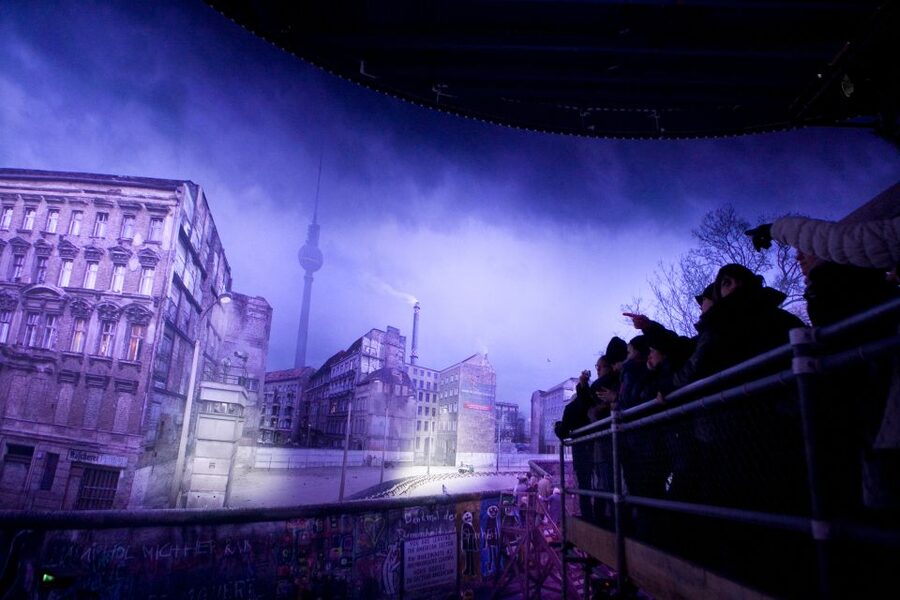
- The four-meter platform changes the view: From above, the Wall, border zone, streets, buildings, and people form one large scene.
- SO 36 is the human center: You see daily life in Kreuzberg, where West Berlin residents lived beside the Wall and only a short distance from East Berlin.
- Sound adds weight: The surrounding noises help turn a still artwork into a more immediate experience.
- Personal photos bring the period down to earth: Private images and stories add detail beyond political events and official dates.
- The artist’s film is worth staying for: Watch the documentary near the exit to learn how Yadegar Asisi developed the Panorama.
- It works well after Checkpoint Charlie: The nearby historical sites give the exhibition extra meaning, though the Panorama also suits first-time Berlin visitors with limited background.
Entering the fictional autumn day of the 1980s
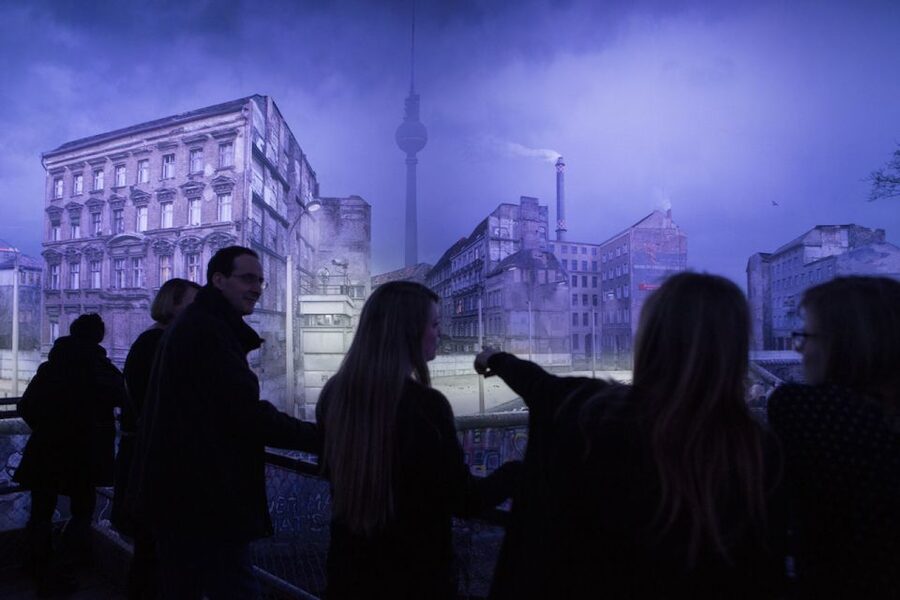
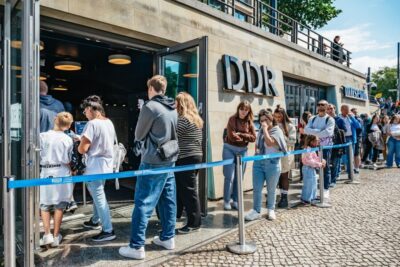
The asisi Panorama Berlin is at Friedrichstraße 205, in central Berlin. The visit is built around a large artistic representation of Kreuzberg, known as SO 36, during an autumn day in the 1980s.
The setting matters. This was West Berlin, surrounded by East Germany and separated from East Berlin by the Wall and its border system. In the artwork, the Wall is not just a political symbol. It is part of the view from windows, streets, courtyards, and ordinary places where people lived their daily lives.
You begin at ground level, where details can be easy to miss if you rush. Look at the photographs, small scenes, and private moments before heading to the platform. The best effect comes from seeing the same world from more than one height.
The exhibition is often described as having three rooms. It is small enough to fit into a busy Berlin day, but it is not a quick postcard stop. Give yourself enough time to scan the scene carefully, listen to the sound, and return to details you missed on the first pass.
A few more Berlin trips worth comparing
- Berlin: Berlin Story Bunker Entry Ticket
★ 4.6 · 6,759 reviews - Berlin: Illuseum Berlin Entrance Ticket
★ 4.1 · 3,970 reviews - Berlin: Madame Tussauds Admission Ticket
★ 4.6 · 3,941 reviews
Seeing Kreuzberg from the four-meter platform
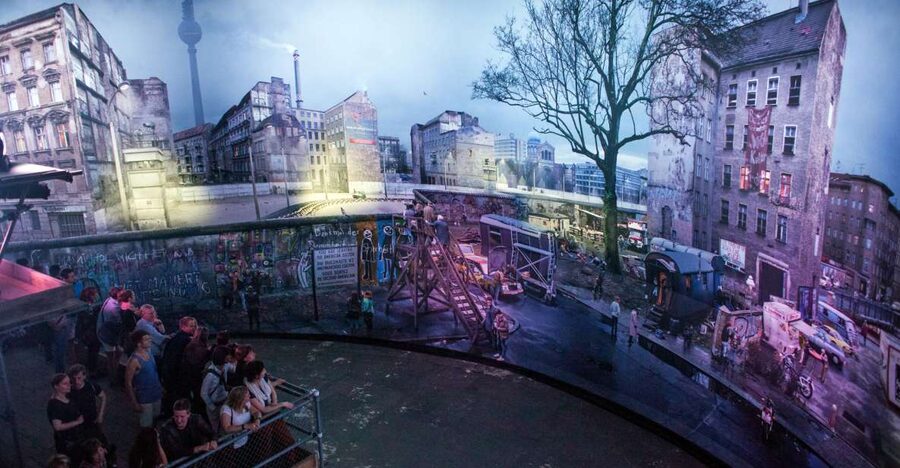
The main feature is the Panorama itself. From the four-meter-high visitor platform, you look across a wide scene showing life in the shadow of the Wall.
This higher view gives you a useful sense of distance. You can see the separation between West Berlin and East Berlin, the border facilities, and the so-called Death Strip. At the same time, the artwork keeps pulling your attention back to ordinary life on the West Berlin side.
That contrast is the point. The Wall could be terrifying, but it was also part of the background of daily life. People went to work, lived in apartments, walked the streets, and carried on while a heavily guarded barrier ran through the city.
I find this approach more effective than a display made only of dates and political speeches. You are asked to look at how the Wall affected people in their homes and neighborhoods. The result is visually striking, but also unsettling. The scene can appear mundane at first, then a border tower, restricted zone, or other detail changes the mood.
The Panorama is designed to look lifelike, and that realism is one of its greatest strengths. It does not recreate a single famous event. Instead, it gives you a broad view of a whole urban setting at one particular moment.
Take your time at the platform. Look for the small figures, buildings, and street details. Then return to ground level, where the scene feels less like a city view and more like a collection of individual lives.
The Wall as a daily presence, not just a monument
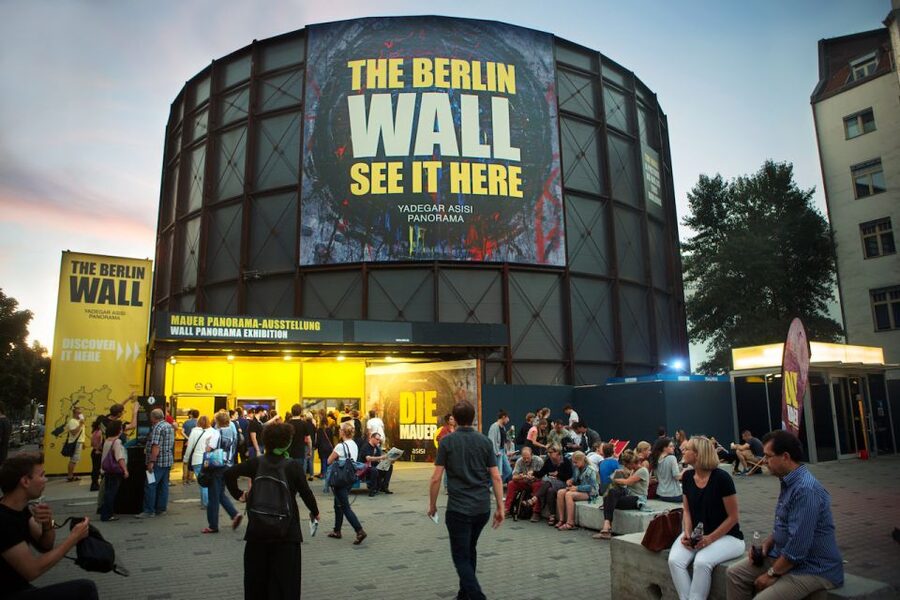
Many Berlin sites focus on the Wall as something that was built, guarded, crossed, or eventually brought down. The asisi Panorama focuses on what it meant to live beside it.
That distinction makes the visit useful for anyone with limited knowledge of Berlin’s divided past. You do not need to arrive with a detailed timeline. The visual setting gives you a starting point, then the images and supporting information add personal context.
The exhibition shows West Berlin’s alternative culture in SO 36, a part of the city separated from East Berlin yet physically close to it. That closeness is hard to grasp from a history book. Here, you can look across the barrier and see how little distance there was, even though the political divide was enormous.
The border facilities and Death Strip are also important parts of the scene. They prevent the Panorama from becoming a nostalgic picture of old Berlin. The everyday details are balanced by the stark machinery of division.
I would not treat this as a substitute for every Berlin Wall site. It is an interpretation, not an untouched historical location. But it gives you a way to understand the emotional pressure of the Wall before or after seeing original sections elsewhere.
Personal photographs make the exhibition more human
The Panorama gains much of its feeling from its smaller displays. Personal photographs and private stories add faces and individual experiences to the broad city scene.
This is where the visit moves beyond spectacle. The giant artwork catches your eye, but the photographs help you think about residents rather than just architecture. You get a sense of people living with an extraordinary political reality as part of their normal surroundings.
English captions are available with the personal snapshot collection, which helps if you do not read German. Translation options have also been offered for English speakers, making the exhibition easier to follow for international visitors.
The information is especially useful if you arrive without much background. It gives you points to notice in the Panorama instead of leaving you to admire the scale without understanding the setting.
I recommend looking at the photographs before spending your final time on the platform. Once you know some of the personal details, the larger scene can feel more specific. A street is no longer just a painted street. It becomes a place where people worked, lived, waited, and adapted.
Still Berlin, at a slower pace:
- Berlin: Reichstag, Dome and Government District Guided Tour
★ 4.7 · 18,288 reviews - Berlin: 1-Hour City Tour by Boat with Guaranteed Seating
★ 4.3 · 16,993 reviews - Berlin: Boat Tour Along the River Spree
★ 4.4 · 11,252 reviews - Discover Berlin Half-Day Walking Tour
★ 5.0 · 9,624 reviews
Sound turns a still image into a changing experience
The Panorama is not only visual. Surrounding sounds help recreate the atmosphere of an autumn day in the 1980s.
That sound element is one reason the exhibition can feel more immediate than a normal wall display. A large still image can sometimes seem distant. Audio gives the scene a sense of activity and tension, even though nothing physically moves.
The effect is not a complete recreation of life in 1980s Berlin, and you should not expect a long theatrical production. Still, the sounds help you focus on the relationship between ordinary city life and the severe presence of the Wall.
The combination of image, sound, photographs, and the viewing platform explains why this short exhibition can leave a stronger impression than its size suggests. You are not simply reading about separation. You are looking at a world arranged around it.
Watch Yadegar Asisi’s documentary before leaving
Near the exit, you can watch a documentary about artist Yadegar Asisi. It follows his early ideas and the process of creating the Panorama.
Do not skip this if you have time. The film explains how the artwork came together and gives useful background to what you have just seen. Without it, you may view the Panorama only as a large and realistic image. With it, you better understand the choices behind the work.
The film also helps put the exhibition in the right category. This is an artist’s interpretation of a historical period, not a literal section of the original Wall. That does not make it less valuable, but it does shape how you should read it.
If your schedule is tight, you can still see the main artwork and photographs in a shorter visit. But the documentary rounds out the experience and is particularly helpful if you are interested in how historical memory can be presented through art.
How long to spend and what the $16 ticket buys you
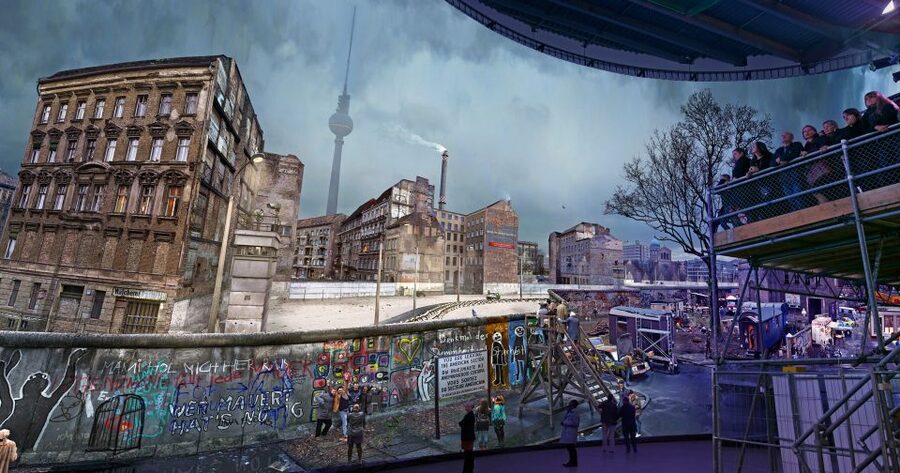
The ticket costs about $16 per person and is valid for one day. For that price, you receive entry to the asisi Panorama Berlin and a free key folder with extra information.
There is no guided tour included. That is the main factor to consider when judging the value. If you prefer a guide to explain German terms, political background, or the finer points of the border system, you may find the experience less satisfying on your own.
On the other hand, the exhibition is easy to approach without a scheduled group tour. You can move at your own pace, study the images, and spend extra time on the platform or documentary. A ticket that lets you skip the ticket line also saves a little time during a busy day.
A group rate is available onsite for groups of 10 or more. For everyone else, $16 is a reasonable price for a focused museum-style visit, particularly if you are already exploring central Berlin.
The value is strongest for first-time visitors who want an introduction to the Wall, families who respond to visual displays, and anyone who wants more context after visiting Checkpoint Charlie. If you have already spent several hours at detailed Wall museums, this may feel brief, but the Panorama still offers a different way to see the period.
Pairing the Panorama with Checkpoint Charlie
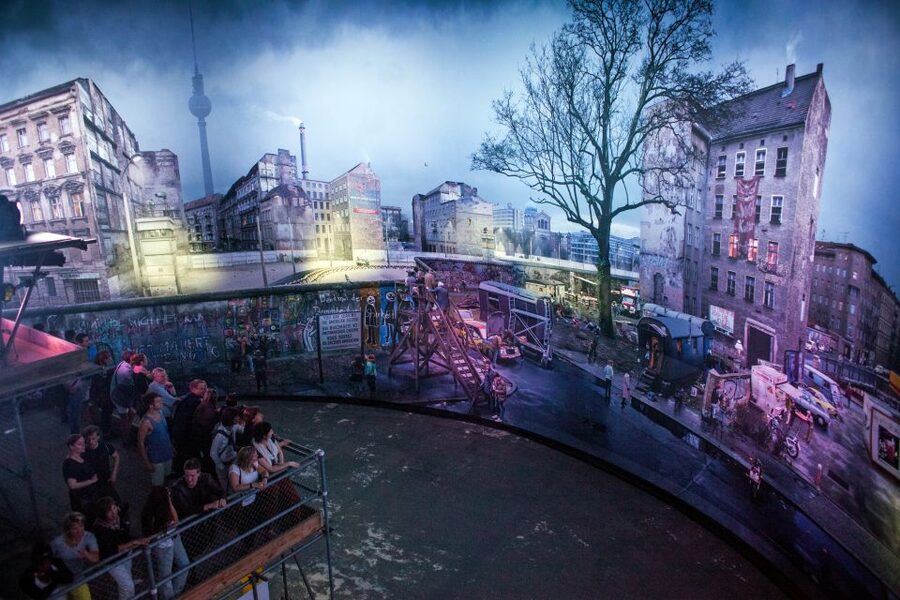
One useful way to plan the visit is to connect it with other Wall-related sights in central Berlin. Checkpoint Charlie is close enough to make a natural pairing, and one visitor found the Panorama especially poignant after spending the morning there.
The two experiences offer different things. Checkpoint Charlie is tied to a specific crossing point and the public memory built around it. The Panorama gives you a broader sense of what it meant to live in the surrounding city.
There is also a remaining section of the original Wall down the road from the installation. A practical tip is to walk toward the traffic lights, cross the road, and look for that surviving section after your visit. Seeing an original fragment after the artistic reconstruction can help you compare interpretation with physical history.
Do not expect every Wall site to tell the same story. That is useful. Berlin’s divided past becomes clearer when you see the border as a political system, a neighborhood reality, and a physical structure.
Who will enjoy this most?
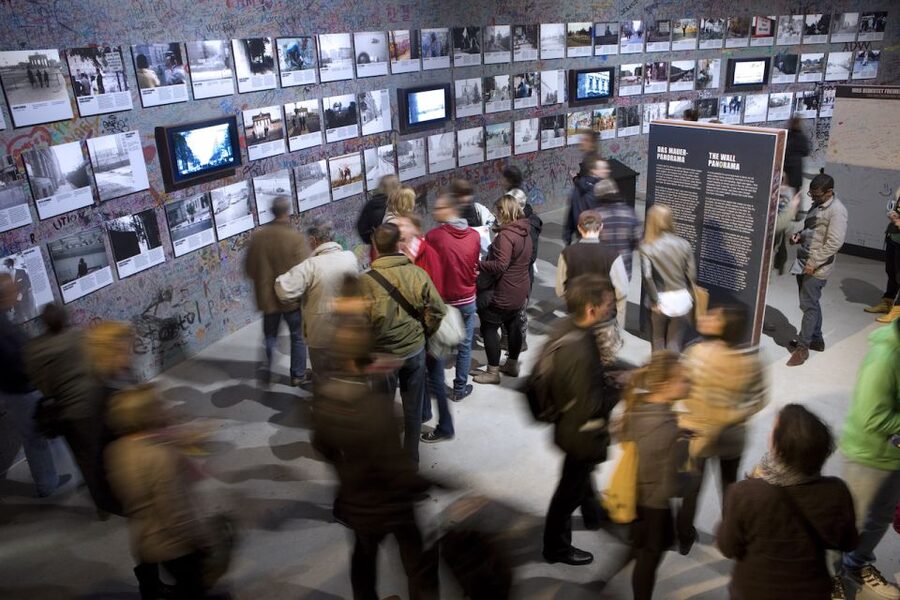
I would recommend the asisi Panorama to you if you want a strong visual introduction to Berlin’s divided past. It is particularly suitable if you have limited time, since the visit fits easily into a day of central sightseeing.
It also works well for people who prefer atmosphere and personal detail to long text panels. The combination of a huge artwork, private photographs, captions, and sound gives you several ways into the subject.
Families may appreciate the direct visual approach, though the subject matter includes the grim reality of border controls and the Death Strip. Younger children may understand the Wall as a barrier without fully grasping its political meaning, so adults may need to provide extra explanation.
History specialists may want more written detail or a guide. The exhibition gives a thoughtful view, but it is not a full course on postwar Germany. I would use it as one part of a Berlin history day rather than your only Wall stop.
Booking, cancellation, and practical details
The meeting point is asisi Panorama Berlin, Friedrichstraße 205, 10117 Berlin. The ticket is valid for one day, and you should check availability for the available starting times.
You can cancel up to 24 hours in advance for a full refund. Reserve now and pay later is also available, which is helpful if your Berlin plans are still shifting.
Pets are not allowed. Groups of 10 or more can ask about the onsite group rate. Since there is no guided tour included, plan to use the information folder, captions, and documentary to build your own understanding.
Should you book the asisi Panorama Berlin?
Book it if you want an engaging, compact introduction to the Berlin Wall, especially before visiting original Wall remains or Checkpoint Charlie. The four-meter platform, realistic city scene, personal photographs, and sound give the period an emotional force that a standard museum display may lack.
Think twice if you want a long, guide-led history tour or a preserved historic site. This is an artistic representation, and the exhibition is relatively small.
For $16, I consider it good value when you give it proper attention. Stay for the documentary, use the viewing platform more than once, and look closely at the personal images. Those simple steps turn a short museum visit into a thoughtful look at how the Wall shaped ordinary life.
FAQ
Where is the asisi Panorama Berlin?
It is located at Friedrichstraße 205, 10117 Berlin, Germany.
How much does admission cost?
The ticket costs about $16 per person.
How long is the ticket valid?
The ticket is valid for one day.
Is a guided tour included?
No. The ticket includes entry to the asisi Panorama Berlin and a free key folder with extra information, but not a guided tour.
What does the Panorama show?
It presents an artistic representation of life in Kreuzberg, or SO 36, on a fictional autumn day in the 1980s, with the Berlin Wall and border facilities nearby.
Is there a viewing platform?
Yes. You can view the Panorama from a visitor platform that is four meters high.
Does the exhibition include information about the artist?
Yes. A documentary near the exit covers artist Yadegar Asisi’s early ideas and the creation of the Panorama.
Can I cancel my booking?
Yes. You can cancel up to 24 hours in advance for a full refund.
Are pets allowed?
No. Pets are not allowed inside the experience.
Just added around Berlin
- Private Walking Tour in Berlin: Hitler’s Germany & WWII★ 5.0 · 7 reviews
- The History of Berlin: WWII PRIVATE Walking Tour With Locals★ 5.0 · 209 reviews
- Private Berlin WWII and Cold War History Tour with Local Expert Guide★ 5.0 · 28 reviews
- Private Walking Tour Berlin 3 hours: Brandenburg, Historic Center★ 5.0 · 7 reviews
- Berlin: Private Bike Tour of the Berlin Wall and Third Reich★ 5.0 · 23 reviews
- Berlin: Guided Private Bike Tour to Explore the Highlights★ 5.0 · 12 reviews
- Berlin Photography Masterclass – Private Photography Lesson★ 4.5 · 23 reviews
- Group Driving Tour 1 to 6 people. Berlin Shore Excursion incl pick-up at Port★ 5.0 · 8 reviews
Tickets, compared.
Munich Hop-On Hop-Off Tour: 1-Day or 2-Day Ticket
Read our review →