
Reviewed · CONCENTRATION CAMP MEMORIAL VISITS
Visita en español al campo de concentración Sachsenhausen
Some places demand your full attention. This Spanish-language visit to Sachsenhausen makes the camp’s history easier to follow through clear explanations, personal anecdotes, and a guide who stays with you from Berlin to the memorial. I especially like the Spanish-language guidance and the organized transfer from central Berlin. I also like that the route covers major areas of the former camp, including the barracks, command headquarters, execution area, prison entrance, casino, armory, Tower A, and kitchen. The main drawback is time: the visit can feel tightly paced, and one participant wanted at least another 45 minutes to explore.
This is a serious half-day outing, not a casual sightseeing stop. The subject is painful, and the site itself is deliberately stark. You should expect a lot of walking outdoors in all weather, a group of up to 30 people, and a 3-hour visit inside the memorial area, with the full experience lasting about five hours.
In This Review
- Key points to know before booking
- Why Sachsenhausen belongs on your Berlin plans
- Meeting at Pariser Platz at 9:00 a.m.
- The journey from Berlin to Oranienburg
- Entering through Tower A
- Barracks and the daily reality of imprisonment
- Command headquarters, casino, and armory
- The execution area and the weight of the visit
- The kitchen and other camp buildings
- The Spanish-language guide makes the difference
- Is $34.58 a fair price?
- Timing, group size, and the pace inside the memorial
- What to wear and what to bring
- Who should book this experience?
- Should you book the Spanish Sachsenhausen tour?
- FAQ
- Where does the Sachsenhausen tour start?
- What time does the tour begin?
- How long does the full experience last?
- Is the tour conducted in Spanish?
- Which areas of Sachsenhausen are included?
- Is public transportation included?
- Are food and drinks included?
- What happens if the weather is bad?
- Can I cancel for a full refund?
Key points to know before booking
- Spanish explanations make difficult history easier to absorb, especially if you would rather not process a subject this complex in English or German.
- The route covers the main surviving areas, from Tower A and the barracks to the execution area, kitchen, casino, and command headquarters.
- The tour begins at Pariser Platz at 9:00 a.m., giving you a central Berlin meeting point near the Brandenburg Gate area.
- An ABC transport ticket is not included, so you must buy the required public transportation ticket before setting out.
- Guide quality is a major strength, with guides including Alberto, Vicent, Ivan, Micaela, Francisco, Edu, Jorge, and Eduardo receiving praise for clarity, patience, and respectful storytelling.
- The experience is highly rated, with a 4.9 rating from 1,170 reviews and 99 percent recommending it, though the fast pace may not suit every group.
Why Sachsenhausen belongs on your Berlin plans
Berlin has no shortage of museums, palaces, and lively neighborhoods. Sachsenhausen offers something different: a place where the physical remains and empty spaces force you to confront how a system of terror operated.
I would not describe this as an entertaining excursion. It is an educational memorial visit, and the value comes from understanding the place with care. A guide can explain how the camp was organized, what different buildings were used for, and how daily life was controlled. Without that context, parts of the site may look like scattered structures and open ground.
That is why the Spanish-language format matters. You are not just reading signs or trying to translate technical terms in your head. You can listen closely, ask questions, and follow the connections between the buildings and the wider history of Nazi Germany and the Second World War.
The strongest feedback centers on the guides. Alberto is praised for his pleasant manner and command of the subject. Vicent is described as bringing the story to life while remaining respectful. Ivan reportedly added useful context beyond the camp itself, helping explain wider events of the war. Micaela, Francisco, Edu, Jorge, and Eduardo are also singled out for patience, clear explanations, organization, and strong subject knowledge.
That range of comments tells me the quality of the experience depends heavily on the individual guide, but the overall standard appears consistently high. The 4.9 rating and 99 percent recommendation rate support that impression.
Other memorial sites open to visitors:
- Berlin: Sachsenhausen Concentration Camp Tour in English
★ 5.0 · 5,711 reviews - Berlin: Sachsenhausen Concentration Camp Memorial Tour
★ 4.7 · 3,716 reviews - Sachsenhausen Concentration Camp Bus Tour in English from Berlin
★ 5.0 · 1,962 reviews
Meeting at Pariser Platz at 9:00 a.m.
The tour starts at Pariser Platz 4, a central Berlin address. Meeting in this part of the city is practical, especially if you are already visiting the Brandenburg Gate area or staying nearby.
The start time is 9:00 a.m., so I would leave plenty of time to reach the meeting point. This is not the kind of excursion where arriving late is easy to fix. The group needs to travel together, and the day follows a set schedule.
The team accompanies you from the first meeting point. One account describes guides Edu and Mika explaining the transfer before splitting the group into two. That can make a group of up to 30 feel more manageable, especially once you reach the memorial and need to hear detailed explanations outdoors.
You need to purchase the ABC public transportation ticket yourself. It is specifically excluded from the price, and this is an important detail when calculating the real cost. Food and drinks are also not included, apart from any value-added offers mentioned in the guidebook.
I would bring water and a small snack for before or after the main visit, but keep the focus of the day in mind. The memorial is not a place for casual picnicking during the guided portion.
The journey from Berlin to Oranienburg
Sachsenhausen Memorial and Museum is in Oranienburg, outside central Berlin. The organized transfer is one of the practical reasons to choose this tour instead of trying to arrange everything alone.
The tour is described as including round-trip access from Berlin, but the stated end point is Sachsenhausen Memorial and Museum, Str. d. Nationen 22, 16515 Oranienburg. Since the ABC transport card is not included, read the final transport instructions carefully when booking and confirm how the return portion is handled on your date.
This is also where the guide adds value before you even enter the camp. The journey gives the group time to understand where the memorial sits in relation to Berlin and what the day will cover. One particularly useful feature is having a guide explain the schedule and transfer process at the beginning, rather than leaving you to work out the route yourself.
The total duration is about five hours, with roughly three hours spent at the memorial. That leaves time for the journey and group coordination. You should not expect a quick visit followed by a free afternoon at the site.
Entering through Tower A
The former entrance area, including Tower A, is one of the most important points on the route. Entering through this part of the camp gives the rest of the visit a clear structure.
The entrance is not treated as a simple photo stop. Your guide explains how the camp was laid out and how authority was concentrated through its buildings and boundaries. That context helps you understand why the route moves from the entrance toward the internal spaces rather than jumping randomly from one remaining structure to another.
I find this kind of guided sequence especially useful at memorial sites. A map or sign can show you where you are, but a guide can explain how the areas related to one another and what function each part served.
The tone should be sober. Photography may be possible in some areas, but your attention belongs to the memorial and the people who suffered there. The best approach is to follow the guide, listen carefully, and avoid treating the entrance as a backdrop.
A few more Berlin trips worth comparing
- Berlin: Reichstag, Dome and Government District Guided Tour
★ 4.7 · 18,288 reviews - Berlin: 1-Hour City Tour by Boat with Guaranteed Seating
★ 4.3 · 16,993 reviews - Berlin: Boat Tour Along the River Spree
★ 4.4 · 11,252 reviews - Discover Berlin Half-Day Walking Tour
★ 5.0 · 9,624 reviews
Barracks and the daily reality of imprisonment
The barracks offer one of the clearest ways to understand daily life inside the camp. The buildings and remaining spaces help move the subject from broad historical dates to the physical conditions faced by prisoners.
Your guide uses anecdotes about daily life to explain what the camp meant in practical terms. That personal scale is important. It can be easier to understand a historical system when you are also hearing how people lived, moved, worked, and endured within it.
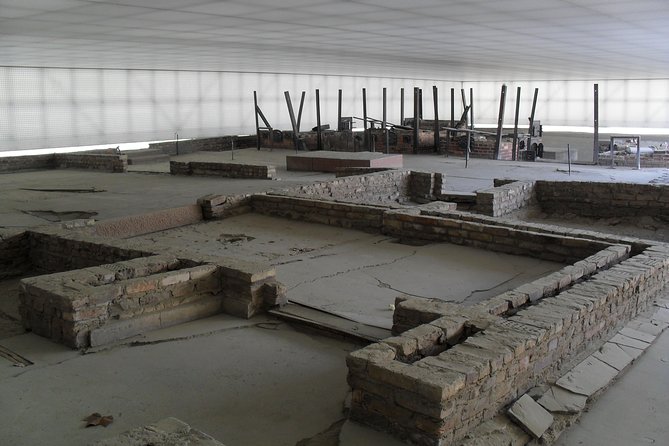
Some of the site has been altered, preserved, or reduced to foundations and open areas. One description notes that there is not always a large amount of material to see in the conventional museum sense. That is not a flaw in the memorial itself, but it does mean the guide’s narration carries much of the experience.
If you come expecting rows of intact rooms and a busy museum display at every turn, you may find the site visually sparse. If you come ready to listen and think, the empty spaces can be powerful.
Command headquarters, casino, and armory
The route also includes the command headquarters, casino, and armory. These names can sound oddly ordinary, which is part of what makes the explanation important.
The guide helps you understand how different parts of the camp served different purposes and how an organized institution supported imprisonment and control. The casino, in particular, may be unfamiliar to people who have only seen photographs or documentaries about concentration camps. Seeing these areas within the overall plan of the site adds detail to your understanding of how the camp functioned.
The armory and headquarters also help widen the story beyond the prisoners’ sleeping quarters. You are shown the administrative and operational side of the camp, not only the spaces where prisoners were held.
This broader route is one of the tour’s best features. You are not limited to a single symbolic building. You move through a connected set of areas that help explain the camp as a system.
The execution area and the weight of the visit
The execution area is among the most difficult parts of the tour. Your guide presents it as part of the historical record, with a serious and respectful tone.
This is where the visit may become emotionally overwhelming. Several descriptions of the experience use words such as devastating, chilling, and unforgettable. You should allow yourself time to absorb the information rather than rushing to the next stop.
The guide’s role matters greatly here. A good explanation can provide historical clarity without turning suffering into spectacle. The strongest guide feedback points to exactly that balance: clear facts, careful timing, patience with questions, and respect for the place.
If you are traveling with children, think carefully about their age and ability to handle the subject. The tour allows most people to participate, but one complaint pointed out that children may move at a slower pace while the schedule remains fixed. There is no separate child-focused version described, so parents should prepare young visitors in advance.
The kitchen and other camp buildings
The camp kitchen is another stop on the route. Like the barracks and headquarters, it helps explain the practical structure of camp life.
A kitchen may seem less immediately dramatic than the execution area, but it can provide useful context about how the camp operated day after day. The guide connects the buildings rather than presenting them as isolated ruins, which gives the visit a more coherent shape.
The itinerary also includes interior and exterior areas of the former camp. That matters because you are not only walking around the perimeter or seeing one preserved section. The experience combines buildings, open spaces, and historical explanations across the memorial grounds.
Wear comfortable shoes. The visit lasts about three hours at the site, and you should expect to stand and walk outdoors. The tour operates in all weather, so rain, cold, or strong sun can change how tiring the day feels.
The Spanish-language guide makes the difference
For Spanish-speaking visitors, this is the central reason to book. A memorial of this importance deserves more than a quick translation of labels.
I like that the guide does more than recite dates. The strongest reports describe guides answering questions, helping people find their way, explaining the schedule, and adding details that connect Sachsenhausen with the Second World War and the Nazi regime more broadly.
Alberto is praised for being both pleasant and well-informed. Vicent is noted for drawing the group into the story while keeping the subject respectful. Ivan is described as giving a wider history lesson, and Micaela as attentive and well prepared. Francisco’s passion for the subject is also highlighted.
Edu receives praise for providing interesting explanations and clearing up questions. Jorge is described as clear and patient, while Eduardo is remembered for setting the tone early and giving a full introduction. These details suggest that the guides do not all use exactly the same style, but they share the qualities you need here: preparation, clarity, seriousness, and the willingness to answer questions.
The tour can be done without a guide, but I would not recommend that if you want to understand the site fully. The buildings alone cannot explain the system that created them.
Is $34.58 a fair price?
At the listed price of $34.58 per person, the tour offers a Spanish-language guide, local guidance, organized access from central Berlin, and about three hours at the memorial.
The value depends on what you would otherwise have to arrange. You would still need to pay for the ABC transport ticket, and food and drinks are not included. You are paying mainly for the explanation, coordination, and language service rather than for an elaborate transport package or meal.
For me, that is a reasonable use of money if Spanish is your preferred language and you want a structured visit. A guide who explains the site well can change the experience from a confusing walk among remains into a coherent lesson.
The price may feel less attractive if you are comfortable researching the memorial yourself and want to spend an unhurried day there. The fixed schedule is another factor. One participant felt the pace was too controlled and that the group lost time at the end because the explanation stopped early.
The tour is booked, on average, 12 days ahead. That suggests planning is wise, particularly if you have only a few days in Berlin.
Timing, group size, and the pace inside the memorial
The maximum group size is 30, though the group may be divided into smaller sections. That is not a private tour, so you should expect a shared pace and a fixed route.
A group of this size can work well when the guide uses a microphone or positions the group carefully, but no equipment details are provided. Stay close enough to hear and keep an eye on the guide when moving between buildings.
The three-hour site visit is long enough to cover the main areas, but it is not designed for slow, independent study at every stop. If you want to read every panel, pause at every memorial, or photograph the site extensively, you may feel hurried.
I would treat the guided portion as the main lesson and accept that you may not see every detail at your own speed. If having extra time matters more than a structured explanation, an independent visit could suit you better. If you want a clear route with someone managing the history and timing, this format is stronger.
What to wear and what to bring
The tour runs in all weather. Wear shoes suitable for several hours of walking and clothing that works for changing outdoor conditions.
In winter, dress much more warmly than you think necessary. A participant specifically warned that cold weather can make the visit hard to bear without proper layers. The memorial grounds may feel exposed, and you will spend substantial time outside.
I would bring:
- Your ABC transportation ticket
- Water
- Weatherproof clothing
- Comfortable walking shoes
- A phone with the mobile ticket available
- A small notebook if you want to record names, dates, or questions
Service animals are allowed, and the tour is near public transportation. Most people can participate, but the emotional weight and walking time are worth considering before you book.
Who should book this experience?
I would recommend it to Spanish-speaking adults and older teenagers who want a guided, historically serious visit to Sachsenhausen. It is especially useful if you prefer learning through spoken explanation and questions rather than exploring a memorial alone.
It also suits first-time visitors to Berlin who want help managing the journey to Oranienburg. The central meeting point and organized group transfer remove some of the uncertainty from reaching the memorial.
I would hesitate to recommend it to anyone seeking a light excursion, a flexible schedule, or a family outing for very young children. The topic is severe, the weather can be unpleasant, and the pace may not allow much wandering.
The guides receive the highest praise for professionalism, clarity, and respect. That is exactly what you need at a site like this. The tour does not make the subject easier in an emotional sense, but it can make the history easier to understand.
Should you book the Spanish Sachsenhausen tour?
Book it if you want a well-organized Spanish-language visit with a guide who can explain both the camp and the wider Nazi period. The route covers the major areas, the central Berlin meeting point is convenient, and the strong rating reflects a generally dependable experience.
Before booking, accept three conditions: you must buy the ABC transport ticket, you will spend several hours walking outdoors, and the schedule may feel tight. Prepare yourself for a difficult visit, not a standard attraction.
For Spanish speakers who value clear historical context, I think the guide makes the $34.58 price worthwhile. For anyone needing a slower, more private, or more self-directed experience, plan an independent visit instead.
FAQ
Where does the Sachsenhausen tour start?
The tour starts at Pariser Platz 4, 10117 Berlin, Germany.
What time does the tour begin?
The stated start time is 9:00 a.m.
How long does the full experience last?
The full experience lasts approximately five hours. About three hours are spent visiting the memorial and museum site.
Is the tour conducted in Spanish?
Yes. The experience is designed specifically for Spanish speakers and includes a Spanish-language guide.
Which areas of Sachsenhausen are included?
The visit includes the former camp’s interior and exterior areas, including the armory, entrance, casino, command headquarters, Tower A, execution area, barracks, and kitchen.
Is public transportation included?
No. You must bring an ABC public transportation ticket that you have purchased separately.
Are food and drinks included?
Food and drinks are not included, except for any value-added offers specified in the guidebook.
What happens if the weather is bad?
The tour operates in all weather conditions. You should dress appropriately for rain, cold, or other outdoor conditions.
Can I cancel for a full refund?
Yes. You can cancel at least 24 hours before the experience start time for a full refund. Cancellations or changes made less than 24 hours before the start time are not accepted for a refund.
Just added around Berlin
- Private Walking Tour in Berlin: Hitler’s Germany & WWII★ 5.0 · 7 reviews
- The History of Berlin: WWII PRIVATE Walking Tour With Locals★ 5.0 · 209 reviews
- Private Berlin WWII and Cold War History Tour with Local Expert Guide★ 5.0 · 28 reviews
- Private Walking Tour Berlin 3 hours: Brandenburg, Historic Center★ 5.0 · 7 reviews
- Berlin: Private Bike Tour of the Berlin Wall and Third Reich★ 5.0 · 23 reviews
- Berlin: Guided Private Bike Tour to Explore the Highlights★ 5.0 · 12 reviews
- Berlin Photography Masterclass – Private Photography Lesson★ 4.5 · 23 reviews
- Group Driving Tour 1 to 6 people. Berlin Shore Excursion incl pick-up at Port★ 5.0 · 8 reviews