
Reviewed · THIRD REICH HISTORY TOURS
Berlin: Hitler and the Third Reich – a private walking tour
Berlin remembers its darkest years in plain sight. This private two-hour walk connects Nazi government buildings, memorials, and the unmarked site of Hitler’s bunker with clear historical explanation.
I like the route’s strong mix of major landmarks and lesser-known sites, especially the former Propaganda Ministry and SS headquarters. I also like the personal format, where a guide such as Stefan can adjust the pace and explain difficult subjects without turning the tour into a dry lecture.
The main drawback is the short duration. Two hours gives you a useful framework, but you will not have time to explore every museum or pause at every memorial for long.
In This Review
- Key points to know before you book
- Why this two-hour Berlin walk matters
- Starting at Brandenburg Gate
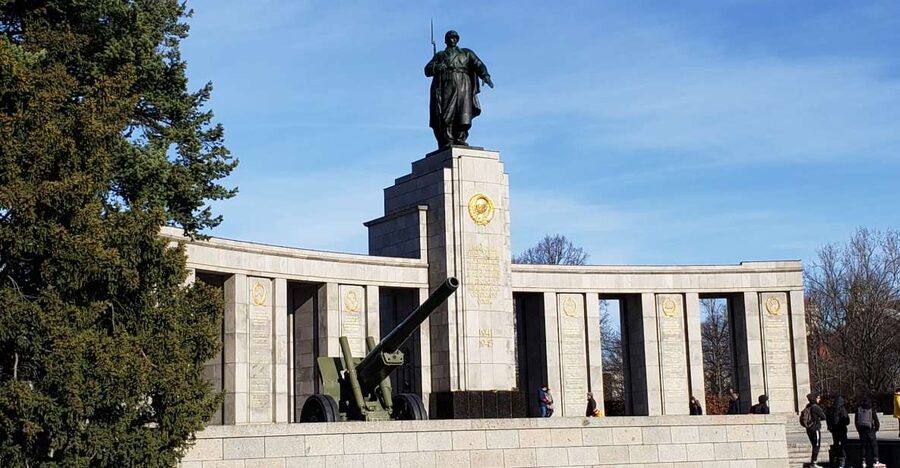
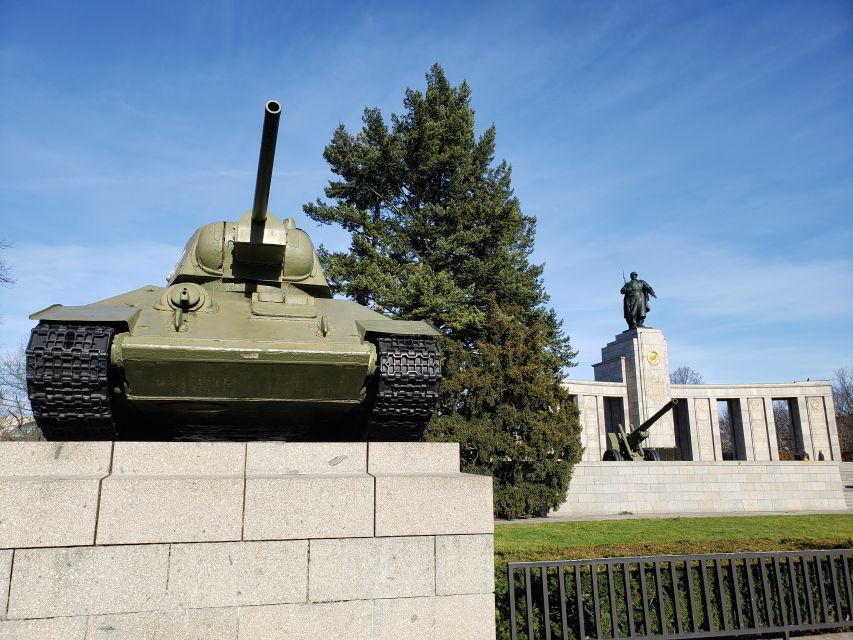
- The Soviet War Memorial in Tiergarten
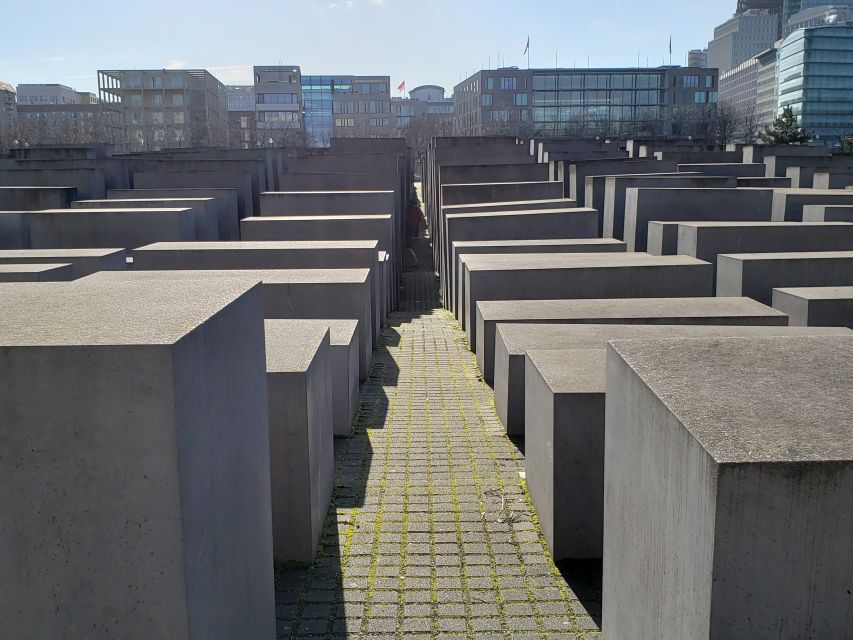
- Walking through the Holocaust Memorial
- Hitler’s bunker site and the end of the regime
- The former Reich Aviation Ministry
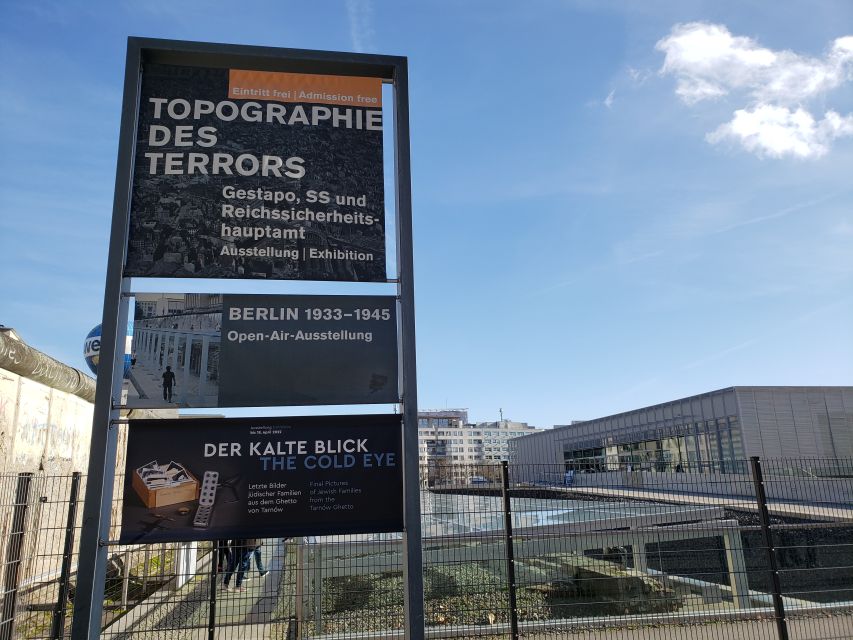
- The SS, Gestapo, and Topography of Terror
- What the private format adds at $22
- Who will get the most from this walk
- Practical details for a smoother experience
- Should you book it?
- FAQ
- Where does the tour begin?
- Where does the tour finish?
- How long does the walking tour last?
- Is the tour private?
- Which languages are available?
- Is the tour wheelchair accessible?
- Are museum entrances included?
Key points to know before you book
- Hitler’s bunker site is deliberately plain: You see the location where Hitler spent his final days, but there is no grand ruin or dramatic entrance to inspect.
- The Holocaust Memorial rewards slow walking: Its 2,710 concrete steles create a changing sense of space, best experienced at an unhurried pace.
- The route links several Nazi power centers: You pass the former New Reich Chancellery site, Göring’s former Reich Aviation Ministry, and locations tied to the SS and Gestapo.
- The Topography of Terror adds visual evidence: The open-air exhibition at the former Secret State Police site helps put names, offices, and crimes into context.
- The private format is the real value: At $22 per person, the price is modest for a private guide, especially if your group can share the cost.
- Comfortable shoes matter: This is a continuous walking tour with no hotel pickup, and you should bring water and clothing suited to the weather.
Why this two-hour Berlin walk matters
Berlin’s Nazi past is not confined to one museum. It is scattered across government offices, empty plots, memorials, and streets that now look ordinary. That can make the subject hard to follow on your own.
This tour gives you a basic map of power. You move from the Nazi government district to military administration, then to the machinery of terror, the Holocaust Memorial, and the place where the regime ended. That sequence helps you see how ideology became government policy, then organized violence, and finally destruction.
I like that the route does not treat Hitler’s bunker as the whole story. The bunker is famous, but it was only the final scene. The more useful lesson comes from seeing how many institutions supported the regime before those last days.
The guide also places the Nazi period inside a broader Berlin story. You hear about the city from the time of the Teutonic Knights through the rise of the National Socialist Party, then onward to the Cold War and reunified Germany. In two hours, that wider timeline cannot be fully detailed, but it helps connect the stops.
More Third Reich History Tours in Berlin
- Berlin: Third Reich and Cold War 2 Hour Walking Tour
★ 4.9 · 6,830 reviews - Berlin’s Best: 2 Hour Walking Tour Third Reich and the Cold War
★ 5.0 · 5,486 reviews - Third Reich Berlin: Hitler and WWII Walking Tour
★ 5.0 · 3,301 reviews
Starting at Brandenburg Gate
The meeting point is in front of the tourist information center at Brandenburg Gate. Your guide carries a sign with your name, which is helpful in a busy central area and removes some of the usual first-meeting uncertainty.
Brandenburg Gate is a fitting place to begin. It is one of Berlin’s best-known symbols, yet it also sits at the center of the city’s political story. From here, the tour moves toward the former government district used by the National Socialists.
You should arrive ready to walk rather than expecting a museum visit. The tour includes guided stops and outdoor explanations, but entrance fees are not included. The route is wheelchair accessible, though outdoor surfaces and the pace of the group can still affect comfort.
The guide’s role matters here. Stefan, who is also referred to as Mr. Knoll, has received especially warm praise for clear explanations, an engaging manner, and the use of old photographs. If he is your guide, those historical images can help you compare the present-day streets with the buildings and spaces that once occupied them.
The Soviet War Memorial in Tiergarten
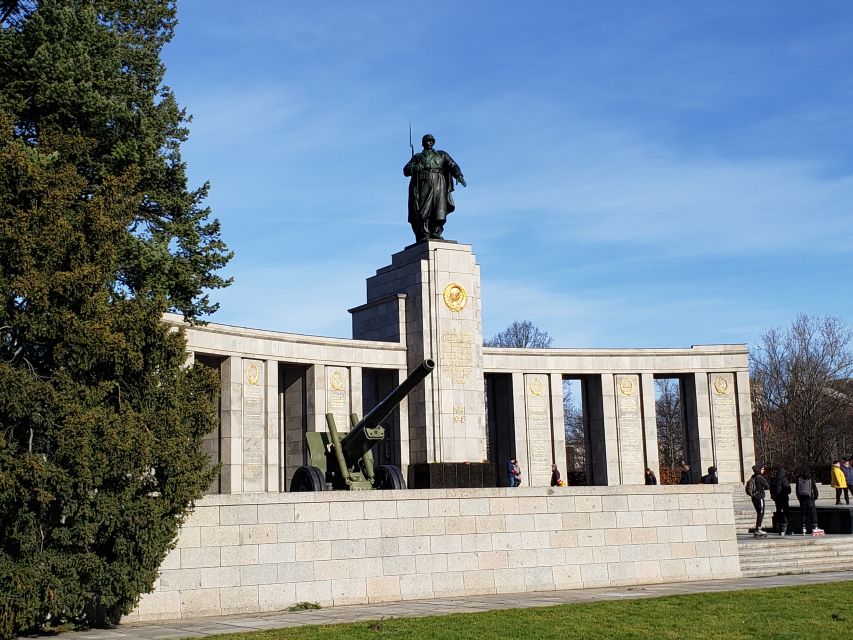
The Soviet War Memorial in Tiergarten brings the story forward to the final defeat of Nazi Germany. Its large scale and military form make it impossible to mistake for a casual park monument.
The setting is important. The memorial is surrounded by leafy Tiergarten, so you move quickly from central city traffic into a more open green space. That contrast can make the monument feel even more imposing.
Your guide explains the memorial as part of the postwar story, not just as an isolated object. It offers a chance to discuss the Soviet role in defeating Nazi Germany and the political division that followed.
I would not expect a long independent visit here. The stop works best as part of the route’s larger argument: Berlin’s Nazi past cannot be separated from the war’s final battles, occupation, and the Cold War that came after.
Because the memorial is outdoors, weather matters. Bring water, wear shoes you can walk in for two hours, and dress for the forecast. There is no mention of a transport break or hotel pickup, so plan on completing the route on foot from Brandenburg Gate to the Topography of Terror.
Walking through the Holocaust Memorial
The Memorial to the Murdered Jews of Europe is one of the tour’s most important stops. It consists of 2,710 concrete steles arranged across an open field near the former government district.
The memorial has no simple viewing point. You walk between the blocks, and the experience changes as the ground and the height of the steles shift around you. I recommend allowing yourself a little quiet time here, even if the guide continues with historical context.
A guided explanation is useful because the memorial is easy to photograph but harder to interpret. The tour helps connect the physical space with the systematic murder of Europe’s Jews, rather than treating the site as an abstract sculpture.
The route also includes a memorial dedicated to the murdered Roma and Sinti. That detail broadens the discussion beyond one victim group and reminds you that Nazi persecution targeted several communities.
This is a serious stop, and the subject can feel heavy. That is not a weakness, but you should choose this tour because you want a direct account of Berlin’s past, not a light sightseeing walk with occasional historical comments.
More Walking Tours in Berlin
- Discover Berlin Half-Day Walking Tour
★ 5.0 · 9,624 reviews - Berlin: Discover Berlin Walking Tour
★ 4.9 · 5,998 reviews - Berlin: Hidden Backyards Guided Walking Tour
★ 4.8 · 5,360 reviews - Berlin: Alternative Berlin Walking Tour
★ 4.6 · 1,204 reviews
Hitler’s bunker site and the end of the regime
The former Hitler bunker site is one of Berlin’s most talked-about locations, partly because it looks so unremarkable. You stand above the area where Hitler spent the final days of his life, but the bunker itself is not presented as an attraction with an open entrance.
That plainness is useful. It avoids turning a place connected to dictatorship and mass murder into a shrine. Your guide explains what happened there and how the Third Reich ended, while the surrounding modern city makes clear how thoroughly the old surface has changed.
I find this stop valuable when it is handled as a conclusion rather than a spectacle. The bunker was the final command post, not the source of Nazi power. By arriving here after the government offices, security buildings, and memorials, you can better understand the collapse that took place at the end of the war.
You may hear about the New Reich Chancellery during this part of the route. The former building is gone, but its location helps explain the scale and symbolism of the Nazi leadership complex.
Do not book this tour expecting visible bunker rooms or preserved Nazi interiors. The experience is based on location, explanation, and historical reconstruction. The absence of a dramatic ruin is part of what makes the stop sober and worthwhile.
The former Reich Aviation Ministry
The former Reich Aviation Ministry was built for Hermann Göring and is one of the clearest examples of how Nazi power operated through ordinary government administration. The building is connected to military planning and state authority, so it helps move the discussion beyond Hitler as one individual.
The tour lets you see the former site as part of a working urban setting. You are not simply looking at a museum object. You are looking at a building that survived while the political system around it disappeared.
This stop also raises a useful question: how does a city deal with buildings tied to a brutal government? The answer is not always a dramatic demolition. Sometimes the structure remains, while its meaning changes through new use, public explanation, and historical documentation.
The exact amount of time here depends on the guide and group. In a private tour, you can ask about the building, Göring, wartime administration, or what happened to the site after 1945. That flexibility is one reason the format works better than a large group for visitors with a focused interest in twentieth-century history.
The SS, Gestapo, and Topography of Terror
The former locations of the SS and Secret State Police are among the most important places on the route. These organizations were central to repression, surveillance, imprisonment, and terror under the Nazi regime.
Today, the area is home to the Topography of Terror documentation center and an open-air exhibition. The setting gives you direct contact with the places where these institutions operated, while the exhibition supplies names, dates, images, and evidence.
The tour finishes at the Topography of Terror. That is a practical ending because you can continue your visit afterward if you want more detail. Entrance to attractions is not included, so check the current arrangements if you plan to go inside rather than only view the outdoor material.
I like ending here instead of at the bunker. The Topography of Terror shifts attention from Hitler’s final days to the wider system that made Nazi crimes possible. It leaves you with institutions and victims in view, rather than with the dictator as the final image.
The outdoor exhibition also helps visitors who have trouble picturing the former buildings. The site is not just a blank patch of Berlin. It carries a documented connection to the SS and Gestapo, and the displays make that connection easier to understand.
What the private format adds at $22
The listed price is $22 per person, which is strong value if you are traveling with family or friends and want a private guide rather than a large shared group. You are paying for a live guide and a private walking tour, not for entry to museums or transportation.
The value depends on what you want. If you only need directions between Brandenburg Gate, the Holocaust Memorial, and the bunker site, you can walk much of central Berlin independently. If you want the sites connected into a clear story, the guide earns the price through context and questions.
A private group also gives you more control. You can ask for clarification, spend longer at a memorial, or move on when a site has been explained. The tour is offered in English or German, so confirm your preferred language when booking.
The four available ratings are all five-star ratings, with particular praise for Stefan’s clear speaking style, engaging explanations, friendly manner, and strong command of the material. One especially useful detail is his practice of bringing photographs showing locations as they looked in earlier decades. Those images can make a vanished building or altered street much easier to picture.
Still, two hours is not a long time for this subject. You will get an organized introduction, not a full museum seminar. I would pair the walk with extra time at the Topography of Terror or another Berlin history museum if you want documents and exhibits beyond the outdoor route.
Who will get the most from this walk
I would recommend this tour to first-time Berlin visitors who want a serious introduction to the Nazi period without spending an entire day indoors. It also suits families with older children, couples, and small private groups who prefer questions and conversation to a fixed large-group script.
It is a good choice if you want to understand how separate sites fit together. The route covers government, military, police, memorial, and bunker locations in one compact walk.
You may want something else if you already know Berlin’s Nazi history in detail. The two-hour format may repeat familiar material, and there is no included museum entrance. In that case, a longer specialist tour or self-guided museum visit could offer more depth.
This walk is also not ideal if you want a relaxed stroll with only light historical content. The subject includes dictatorship, war, genocide, and political terror. Comfortable shoes help, but emotional readiness matters too.
Practical details for a smoother experience
Meet at Brandenburg Gate, in front of the tourist information center, where the guide will hold a sign with your name. Since the tour ends at the Topography of Terror, you should not plan to return to Brandenburg Gate automatically.
Wear comfortable shoes and bring water. Weather-appropriate clothing is important because the route is outdoors and includes time in open memorial spaces and around city streets.
The tour is wheelchair accessible. You should still discuss any specific mobility needs when booking, since a two-hour urban walking route can feel different depending on pace and surface conditions.
The activity offers free cancellation up to 24 hours before the start time, and you can reserve now and pay later. That flexibility is useful when your Berlin schedule is still changing.
Should you book it?
Book this private walk if you want a focused, affordable introduction to Nazi-era Berlin and value a guide who can explain what is no longer visible. The combination of the Holocaust Memorial, Hitler’s bunker site, the former government buildings, the Soviet War Memorial, and the Topography of Terror gives you a strong historical route in only two hours.
The best reason to choose it is the private guidance, especially if Stefan leads your group. His use of older photographs, clear explanations, and friendly delivery has earned especially strong praise.
Skip it if you want extensive museum time, preserved interiors, or a full-day study of the Third Reich. For most first visits, though, $22 per person is a sensible price for a concise walk that helps Berlin’s difficult sites make sense.
FAQ
Where does the tour begin?
It begins at Brandenburg Gate, in front of the tourist information center. The guide will have a sign with your name.
Where does the tour finish?
The tour finishes at the Topography of Terror.
How long does the walking tour last?
The tour lasts two hours.
Is the tour private?
Yes. It is offered as a private group walking tour.
Which languages are available?
The tour is offered in English and German.
Is the tour wheelchair accessible?
Yes, the activity is listed as wheelchair accessible.
Are museum entrances included?
No. Entrance to attractions is not included in the tour price.
Just added around Berlin
- Private Walking Tour in Berlin: Hitler’s Germany & WWII★ 5.0 · 7 reviews
- The History of Berlin: WWII PRIVATE Walking Tour With Locals★ 5.0 · 209 reviews
- Private Berlin WWII and Cold War History Tour with Local Expert Guide★ 5.0 · 28 reviews
- Private Walking Tour Berlin 3 hours: Brandenburg, Historic Center★ 5.0 · 7 reviews
- Berlin: Private Bike Tour of the Berlin Wall and Third Reich★ 5.0 · 23 reviews
- Berlin: Guided Private Bike Tour to Explore the Highlights★ 5.0 · 12 reviews
- Berlin Photography Masterclass – Private Photography Lesson★ 4.5 · 23 reviews
- Group Driving Tour 1 to 6 people. Berlin Shore Excursion incl pick-up at Port★ 5.0 · 8 reviews