
Reviewed · THIRD REICH HISTORY TOURS
Berlin: Jewish Walking Tour including World War II
Berlin’s Jewish story has many chapters. This private walking tour connects Moses Mendelssohn, Eastern European Jewish arrivals, Nazi persecution, and Berlin’s Jewish life today, all on foot through Mitte. I like the way it joins famous places with smaller community sites, and I like that guide Tal can adjust the route to your interests. The main drawback is the $318 per-person price, which is high unless you value a private guide and several hours of focused discussion.
Tal brings both professional and academic experience to the subject, including post-doctoral work on how staff at Berlin’s Charité Hospital address the institution’s Nazi-era past. That background helps place the tour beyond dates and memorials. Plan for roughly 3.5 to 4 hours, comfortable shoes, and a serious look at difficult history.
In This Review
- Key points to know before booking
- Why Berlin’s Jewish story works best as a walking tour
- Hackescher Markt and the arrival of the Ostjuden
- The Block of Women and public resistance in 1943
- Otto Weidt’s workshop and the personal side of rescue
- The old cemetery and Moses Mendelssohn’s grave
- The New Synagogue and the community’s golden era
- Schools and institutions that reveal everyday community life
- From deportation and destruction to Jewish life today
- Tal’s approach and the value of a private guide
- Price, duration, and what you receive
- Who should book this Berlin Jewish history walk?
- Should you book it?
- FAQ
- How long does the Jewish walking tour last?
- Where does the tour start?
- Where does the tour finish?
- Which languages are available?
- Is this a private tour?
- Is entry to the Otto Weidt Museum included?
- Is entry to the old Jewish cemetery included?
- Is entry to the New Synagogue museum included?
- Can the tour be extended?
- What should I bring?
- Is the tour suitable for wheelchair users?
Key points to know before booking
- Moses Mendelssohn’s Berlin: Follow the community from its re-establishment in the late 17th century through Mendelssohn’s influence.
- Mitte’s Jewish sites: See Hackescher Markt, the old cemetery, the first synagogue site, Jewish schools, and community institutions.
- Holocaust history: Visit the Otto Weidt Workshop for the Blind and the memorial connected with the 1943 women’s protest.
- A private, adjustable route: Tal can add sites based on your interests, with optional extensions to cemeteries and deportation memorials.
- Strong guide appeal: Tal is praised for clear historical context, personal stories, passion, and an enjoyable manner.
- Plan for the practical limits: The tour is long, includes sensitive material, and has conflicting accessibility information that you should clarify before booking.
Why Berlin’s Jewish story works best as a walking tour
This is not a tour built around one grand building. It is a chain of places spread through Mitte, each showing a different stage in Berlin’s Jewish life. That makes walking useful: you see how community institutions, schools, businesses, memorials, and religious buildings fit into the city around them.
The story begins with the community’s return and re-establishment in the second half of the 17th century. From there, Tal discusses the era of Moses Mendelssohn, whose name is central to Berlin’s Jewish intellectual life. The route then moves through later changes, including the arrival of Ostjuden, or Eastern European Jews who came to Berlin after persecution and pogroms.
That detail gives the tour a useful social angle. Berlin’s Jewish population was not one uniform group. German Jews and Jews arriving from Eastern Europe did not always share the same customs or social position. Tal also discusses disputes within the community, including arguments over the introduction of an organ in synagogue services. These details show a community dealing with modern life, identity, worship, and class before the Nazi period brought catastrophe.
The tour then turns to World War II and the Holocaust. You will visit memorial sites, hear about resistance and rescue, and consider the destruction of Jewish life in Berlin. The final subject is not only loss. Tal also addresses the community’s re-establishment and present-day Jewish life, giving the walk a necessary sense of time beyond 1945.
More Third Reich History Tours in Berlin
- Berlin: Third Reich and Cold War 2 Hour Walking Tour
★ 4.9 · 6,830 reviews - Berlin’s Best: 2 Hour Walking Tour Third Reich and the Cold War
★ 5.0 · 5,486 reviews - Third Reich Berlin: Hitler and WWII Walking Tour
★ 5.0 · 3,301 reviews
Hackescher Markt and the arrival of the Ostjuden
Meet in front of the Starbucks near Hackescher Markt. It is a practical central meeting point, but the important part is what Tal explains once the walk begins.
Hackescher Markt became a focal point for Eastern European Jews who sought safety in Berlin. Tal uses the area to explain why these newcomers arrived, how they fitted into Berlin society, and why their presence could create embarrassment or tension among established German Jews. This is a more revealing start than a simple introduction to a famous synagogue.
The scheduled discussion here lasts about 15 minutes. That is enough to set the historical frame without spending the whole morning in one place. You should expect more talking than sightseeing at this first stop, so listen closely and ask questions if migration, religious practice, or daily life interests you.
The Block of Women and public resistance in 1943
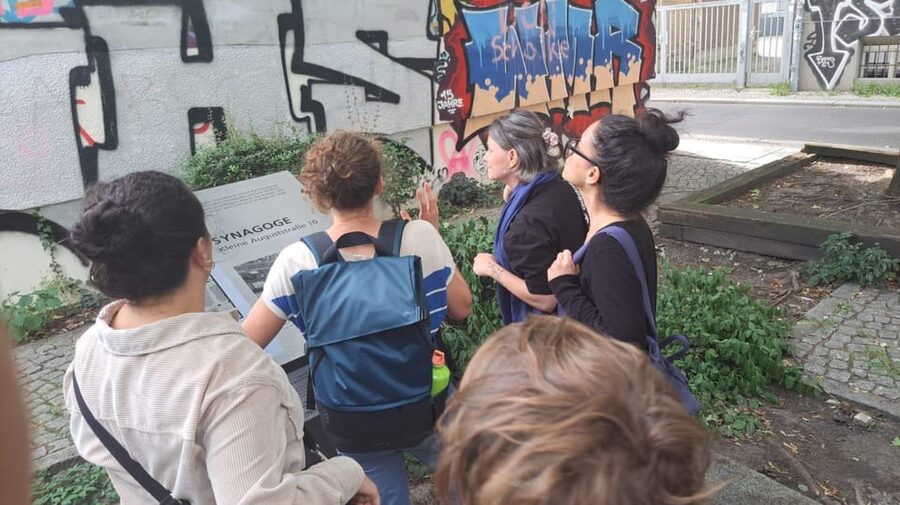
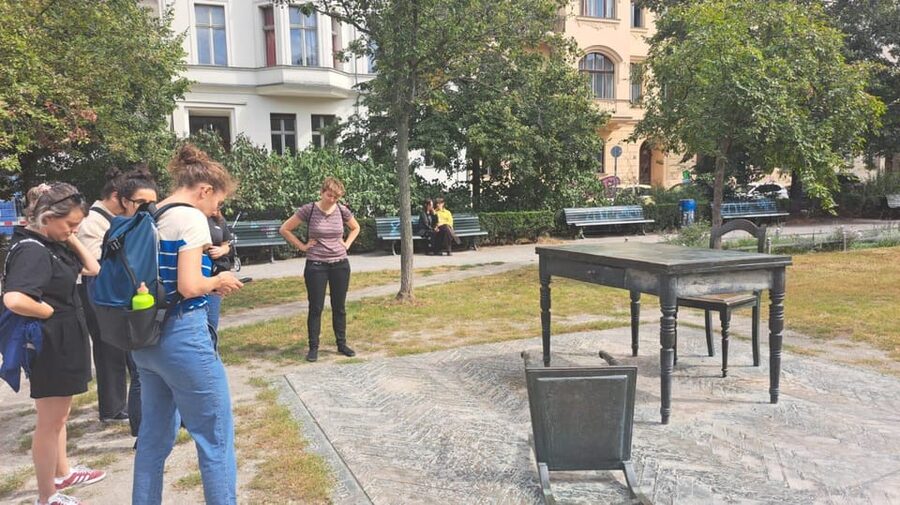
The next major stop is the Block of Women memorial, connected with the women’s protest of 1943. The memorial recalls a public protest by women demanding the release of their Jewish husbands who had been arrested.
Tal gives this site around 20 minutes. Its value comes from the human scale of the story. Instead of treating Nazi persecution only as a sequence of laws, deportations, and numbers, the stop asks you to think about family members who publicly challenged the authorities.
This is also one of the tour’s more powerful reminders that resistance did not always look like armed opposition. A protest by relatives could carry its own risks and force the authorities to respond. The stop is brief, but the subject is likely to stay with you as the route continues.
Otto Weidt’s workshop and the personal side of rescue
The Otto Weidt Workshop for the Blind is one of the most distinctive places on the route. The workshop is linked to Otto Weidt, who worked to protect Jewish employees during the Holocaust.
Entry to the museum is included, except on days when it is closed. The guided visit lasts about 30 minutes, giving you time to hear the story rather than simply pass the doorway. This is an important difference between a walking tour that points out memorials and one that includes an indoor historical site.
The workshop helps make the Holocaust understandable through individual choices and relationships. You learn about one person’s efforts to save lives, while also seeing the danger and uncertainty surrounding those efforts. Tal’s focus on personal stories fits this stop especially well.
You should not expect the museum to offer an easy or comforting account. The subject is painful, and the tour handles a long sequence of difficult sites. Still, this stop adds a human face to the wider history and prevents the World War II portion from becoming only a list of dates.
More Walking Tours in Berlin
- Discover Berlin Half-Day Walking Tour
★ 5.0 · 9,624 reviews - Berlin: Discover Berlin Walking Tour
★ 4.9 · 5,998 reviews - Berlin: Hidden Backyards Guided Walking Tour
★ 4.8 · 5,360 reviews - Berlin: Alternative Berlin Walking Tour
★ 4.6 · 1,204 reviews
The old cemetery and Moses Mendelssohn’s grave
The old Jewish cemetery is one of the tour’s key historical stops. It was the community’s first cemetery, and Moses Mendelssohn is buried there.
The cemetery visit is included, except on Jewish holidays and Saturdays. That restriction matters, so check the proposed date before you book if this site is a priority. The cemetery is also a place where the tour shifts from public institutions to individual memory.
Mendelssohn’s grave gives the earlier part of the story a clear physical anchor. You have already heard about his period and influence, and here that history becomes tied to a specific place. Tal can also connect the cemetery to the growth of Berlin’s Jewish community and the later institutions you see along the route.
One of the listed stops is the site of the first synagogue. The supplied schedule does not give the location or a separate time for it, so ask Tal exactly where it falls in the route. You will likely appreciate that stop most if you want to understand how the first community institutions developed before the later synagogue became a symbol of success.
The New Synagogue and the community’s golden era
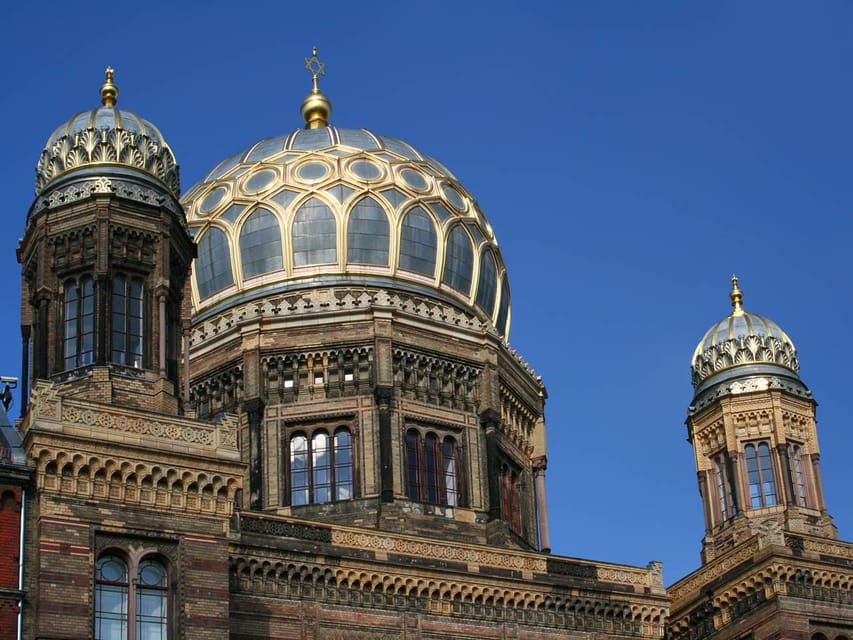
The New Synagogue is the visual high point of the walk. You see the building from outside and learn how it represented the high point of Berlin’s Jewish community, as well as the destruction and collapse that followed.
The guided discussion here lasts about 30 minutes. That is enough time to cover the building’s place in Berlin’s Jewish life without turning the tour into an architectural lecture. Tal can explain why the synagogue mattered as a religious and civic institution, not simply as a striking façade.
The tour does not include entry to the Centrum Judaicum, the museum inside the New Synagogue complex. You can buy a separate ticket if you want to go inside, but that adds time and cost. If you are mainly interested in the exterior and the historical explanation, the walking tour may be enough. If you want museum displays and a longer visit, plan that separately and ask how it fits with the private route.
This stop also helps explain the phrase golden era without making it sound simple. Berlin’s Jewish community reached cultural and institutional heights, yet internal debates and social divisions continued. Tal’s discussion of synagogue reforms, including the controversy over an organ, gives that period more texture.
Schools and institutions that reveal everyday community life
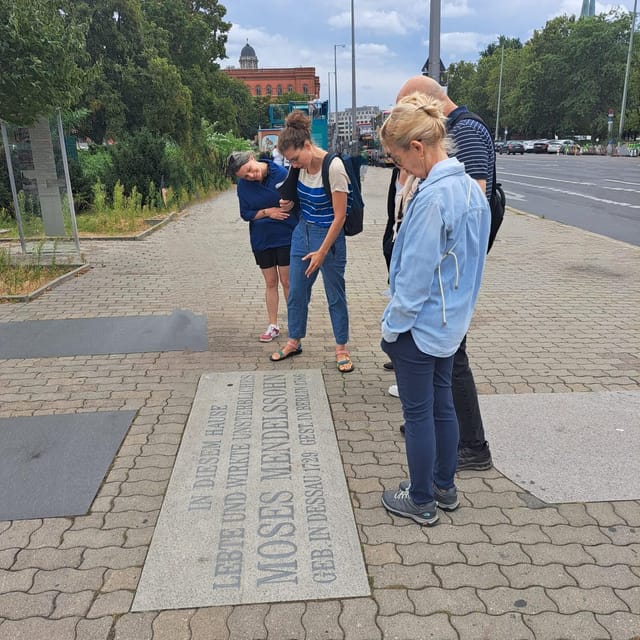
The route includes the Mendelssohn School, a girls’ school, and other Jewish community institutions in Mitte. These stops may not carry the same instant recognition as the New Synagogue, but I consider them essential because they show how a community functioned day to day.
Schools tell you about education, family life, and the effort to prepare young people for the wider society. Community institutions show that Jewish life was not limited to worship. It included teaching, social support, professional work, and organized public life.
The schedule includes two additional guided stops of about 20 and 30 minutes, but their names are not specified in the supplied details. Ask Tal for the exact route if you want to prepare for a particular school or institution. This is also a good place to use the private format: you can request more attention to education, religious reform, immigration, or the community’s modern revival.
From deportation and destruction to Jewish life today
The tour’s subject is not frozen in the 1930s and 1940s. Tal also discusses the community’s return and present-day Jewish life in Berlin. That wider time span gives the walk a better balance, though the Holocaust remains a central part of the experience.
The route ends at the Jewish cemetery memorial according to the stop-by-stop schedule. The meeting-point details also say the activity ends back at the meeting point, so confirm the exact finish location before setting a tight appointment afterward. This small contradiction is easy to resolve, but it matters in central Berlin.
The optional extension can take you to Schönhauser Allee Cemetery, the final resting place of notable figures from the community’s golden era. It can also include the Kindertransport Memorial at Friedrichstraße Station and the Grunewald Deportation Memorial, which recalls the deportation of Berlin’s Jews.
The extension costs extra and takes additional time. It makes sense if you want a fuller memorial-focused day, especially if you have a strong interest in the prewar community or deportation history. If you have already spent several hours with difficult material, the standard route may provide a better emotional and practical balance.
Tal’s approach and the value of a private guide
The guide can make or break a history walk, and Tal receives especially strong praise for passion, clear explanation, historical context, and personal stories. One useful quality is the mix of professional guiding and academic work. Tal’s post-doctoral research examines how current Charité Hospital staff deal with the hospital’s history during the 1930s and 1940s.
That background does not mean you need an academic interest to enjoy the tour. You can ask simple questions about places, people, and events, while also going further into questions about memory, responsibility, and community divisions. A private group gives you more freedom to set that level.
The tour is offered in English or Hebrew. It also allows some customization, so tell Tal in advance if you care most about Moses Mendelssohn, religious reform, Eastern European Jewish immigration, Holocaust memorials, or current Jewish life.
The strongest praise focuses on Tal’s passion and the way the tour combines serious historical context with personal stories. The walk is not presented as entertainment, but the comments about it being enjoyable and fun suggest that Tal keeps the experience human and approachable.
Price, duration, and what you receive
At $318 per person, this is an expensive walking tour. The price is easier to justify for a private group that wants a specialist guide, a flexible route, several hours of discussion, and included entry to the Otto Weidt Museum and old cemetery when those sites are open.
It is harder to justify if you only want a quick introduction to Berlin’s Jewish landmarks. Public memorials and exterior views do not require a private tour fee, and the New Synagogue museum ticket is not included. The value comes from interpretation, connections between sites, and the chance to shape the conversation.
The walk lasts about 3.5 hours, with some descriptions allowing 3.5 to 4 hours, plus a short break. Bring water, sunscreen, a hat, and comfortable shoes. A head covering or kippah may be appropriate for cemetery or Jewish sites, so carry one if that fits your practice.
The experience is described as wheelchair accessible in one section, but the additional information says it is not suitable for people with mobility impairments or wheelchair users. I would not rely on the accessibility label without speaking directly with the provider about surfaces, walking distance, cemetery access, and restroom arrangements.
Free cancellation is available up to 24 hours before the start time, and you can reserve now and pay later. Those terms are useful if your Berlin schedule is still changing, but the central decision is still the price and subject matter.
Who should book this Berlin Jewish history walk?
I would choose this tour if you want a serious, place-based introduction to Jewish Berlin and prefer asking questions rather than following a large group. It suits visitors with an interest in Moses Mendelssohn, Jewish migration, religious reform, Holocaust history, memorial culture, or the community’s life today.
It is also a good choice if you have already seen Berlin’s major World War II memorials but want more connection between them. The route explains how Jewish institutions developed before the Nazi period and how the city remembers what happened afterward.
I would hesitate if you dislike several hours of walking, find Holocaust history too difficult for one outing, or want extensive time inside the New Synagogue museum. I would also compare the price with other private tours if you are booking for several people.
Should you book it?
Book this walk if you value Tal’s specialist guidance, a private pace, and a story that covers both the community’s achievements and its destruction. The included museum and cemetery visits add value, while the custom route lets you focus on the subjects that matter most to you.
Skip it if you want a low-cost overview or prefer exploring museums independently. Before paying, confirm the exact route, ending point, cemetery availability, accessibility, and cost of any optional extension. For the right audience, this is a thoughtful and unusually focused way to understand Jewish Berlin through the places where its story unfolded.
FAQ
How long does the Jewish walking tour last?
The tour lasts about 3.5 hours, with some information allowing up to 4 hours. It includes a short break.
Where does the tour start?
The stated meeting point is in front of Starbucks near Hackescher Markt in Mitte.
Where does the tour finish?
The stop-by-stop schedule lists the Jewish cemetery memorial as the finish. The meeting-point details also say the activity ends back at the meeting point, so confirm the final location with Tal.
Which languages are available?
The live guide is available in English and Hebrew.
Is this a private tour?
Yes. The activity is offered for a private group.
Is entry to the Otto Weidt Museum included?
Yes, entry is included except on days when the museum is closed.
Is entry to the old Jewish cemetery included?
Yes, except on Jewish holidays and Saturdays.
Is entry to the New Synagogue museum included?
No. Entry to the Centrum Judaicum, the museum in the New Synagogue complex, requires a separate ticket.
Can the tour be extended?
Yes. An optional extension can include Schönhauser Allee Cemetery, the Kindertransport Memorial at Friedrichstraße Station, and the Grunewald Deportation Memorial. The extension requires extra time and cost.
What should I bring?
Bring comfortable walking shoes, water, sunscreen, and a hat. A head covering or kippah is also recommended.
Is the tour suitable for wheelchair users?
The supplied information is inconsistent. One section calls it wheelchair accessible, while another says it is not suitable for wheelchair users or people with mobility impairments. Contact the provider before booking to confirm the current conditions.
Just added around Berlin
- Private Walking Tour in Berlin: Hitler’s Germany & WWII★ 5.0 · 7 reviews
- The History of Berlin: WWII PRIVATE Walking Tour With Locals★ 5.0 · 209 reviews
- Private Berlin WWII and Cold War History Tour with Local Expert Guide★ 5.0 · 28 reviews
- Private Walking Tour Berlin 3 hours: Brandenburg, Historic Center★ 5.0 · 7 reviews
- Berlin: Private Bike Tour of the Berlin Wall and Third Reich★ 5.0 · 23 reviews
- Berlin: Guided Private Bike Tour to Explore the Highlights★ 5.0 · 12 reviews
- Berlin Photography Masterclass – Private Photography Lesson★ 4.5 · 23 reviews
- Group Driving Tour 1 to 6 people. Berlin Shore Excursion incl pick-up at Port★ 5.0 · 8 reviews