
Reviewed · THIRD REICH HISTORY TOURS
Private Walking Tour Berlin Third Reich Hitler and World War II
History feels different when you walk it. This private Berlin tour connects Nazi government offices, war memorials, resistance sites, deportation routes, and the places tied to Hitler’s final days. I especially like the hotel pickup and drop-off, which saves you from finding an unfamiliar meeting point, and the chance to shape the day around your interests. A possible drawback is the price: at $192.97 per person, it makes the most sense for a small group that wants personal attention.
The advertised visit lasts about three to four hours, though the stops cover a broad section of central Berlin. You will spend much of the time outdoors, with short visits at places such as the Topography of Terror and the Holocaust Memorial. The subject is serious, but guides such as Daniel, Jimmy, Georgia, Simon, Jasper, and Maria have been praised for making difficult history clear, human, and accessible.
In This Review
- Key points to know before booking
- Why a private Berlin history tour can be worth the price
- How the route makes sense
- Soviet Memorial Tiergarten: victory with a complicated message
- Detlev-Rohwedder-Haus and Wilhelmstraße: where policy became action
- Topography of Terror: the clearest evidence of organized repression
- German Resistance Memorial Center: courage inside a dictatorship
- Bebelplatz: the square where books were destroyed
- The Reichstag and the political use of crisis
- Holocaust Memorial and the former Führerbunker site
- Anhalter Bahnhof: transport, separation, and deportation
- T4 Memorial: the Nazi euthanasia program
- Moltkebrücke and Wilhelmstraße: the war’s final days
- Guides, pace, and the human side of the experience
- Practical advice for your three to four hours
- Should you book this private Berlin WWII tour?
- FAQ
- How long does the private Berlin Third Reich tour last?
- What language is the tour offered in?
- Is hotel pickup included?
- Is this a private tour?
- How much does the tour cost?
- Are admission tickets included?
- Are food and drinks included?
- Does the tour operate in bad weather?
- Is the tour near public transportation?
- Can I cancel for a full refund?
Key points to know before booking
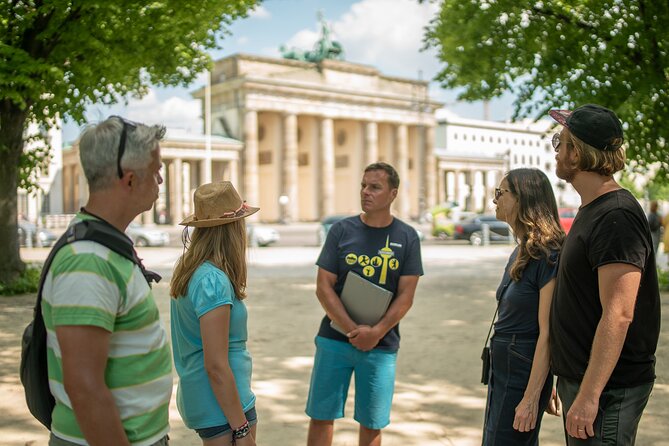
- A private guide shapes the day around you: Guides have adjusted the pace, changed the route to avoid places already seen, and answered questions in depth.
- The route links government and human stories: You move from ministries and military sites to resistance, censorship, murder, deportation, and remembrance.
- Most stops are free: The Reichstag is the exception listed here, with admission not included.
- Expect a lot of walking: One four-hour visit covered about 10,000 steps, so comfortable shoes matter.
- The tour is more than a Hitler biography: It also explains the Holocaust, the Nazi euthanasia program, German resistance, the Soviet assault on Berlin, and the return of democracy.
- Weather matters: The tour operates in all conditions, and winter or rain can make the outdoor portions demanding.
Why a private Berlin history tour can be worth the price
At first glance, $192.97 per person is a serious fare for a walking tour. The value comes from the private format. Your group is not following a fixed script with strangers. You can ask about a particular subject, slow down when a place matters to you, or move on when you have already seen a site.
That flexibility shows up in the guide feedback. Daniel reportedly met a group at its hotel, asked what they wanted to see, and built the route from there. Emma adjusted the experience to match her group’s interests and preferred pace. Another guide, Daniel, avoided sites his group had already visited. These are small details, but they are exactly what you pay for in a private tour.
A private guide can also make this difficult subject easier to discuss. The best accounts describe guides who mixed large political events with individual stories. Artie, for example, was praised for listening closely and answering questions fully. That exchange is harder to get on a crowded group walk.
The cost becomes more reasonable when shared among a family or a few friends. Group discounts are offered, though the exact saving is not provided. For a solo participant, the same price is harder to justify unless having a private guide is especially important to you.
More Third Reich History Tours in Berlin
- Berlin: Third Reich and Cold War 2 Hour Walking Tour
★ 4.9 · 6,830 reviews - Berlin’s Best: 2 Hour Walking Tour Third Reich and the Cold War
★ 5.0 · 5,486 reviews - Third Reich Berlin: Hitler and WWII Walking Tour
★ 5.0 · 3,301 reviews
How the route makes sense
The stops are spread across central Berlin, and the visit is described as a walking tour with hotel pickup and drop-off. In practice, the guide may use public transport or arrange the route around your starting point. One group praised the chance to see the city while also using Berlin’s public transport system.
The listed stop times add up to roughly two hours and forty minutes. That leaves time for walking, transfers, and conversation during a three to four-hour visit. Do not expect long museum sessions at every stop. Most visits last 10 to 20 minutes, enough for an explanation and a look around, but not enough to read every panel in detail.
That is not necessarily a flaw. I like this format for a first Berlin visit because it gives you a citywide framework. You can then return on your own to the Topography of Terror, Holocaust Memorial, or another site that deserves more time.
Soviet Memorial Tiergarten: victory with a complicated message
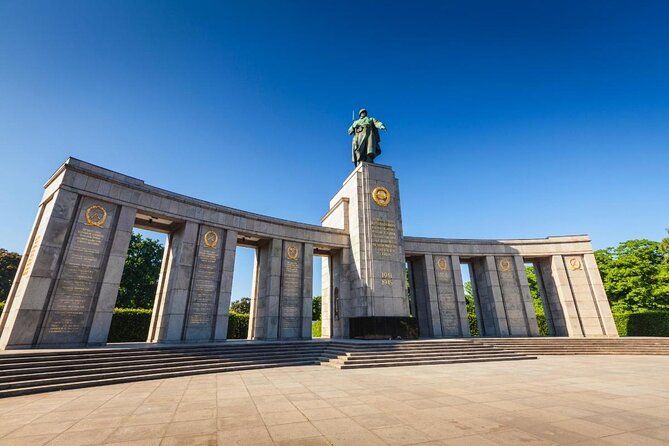
The Soviet Memorial in Tiergarten opens the tour with the final battle for Berlin. Built in 1949, it honors Soviet soldiers killed during the 1945 Battle of Berlin. Its central statue shows a soldier holding a sword and shield, a clear image of victory and sacrifice.
Your guide explains the Soviet role in defeating Nazi Germany and the memorial’s place in both Soviet and German memory. The stop is brief, about 10 minutes, but it gives you an important starting point: Berlin was not simply liberated in an abstract political sense. It was taken through a brutal battle that caused enormous destruction.
This is an outdoor memorial, so your understanding depends heavily on the guide’s explanation. The site itself does not provide the full story in the few minutes allotted. If military history interests you, ask for more detail about the Battle of Berlin.
Detlev-Rohwedder-Haus and Wilhelmstraße: where policy became action
The former Detlev-Rohwedder-Haus on Wilhelmstraße connects architecture with Nazi administration. Built in the 1930s as the Reichsbank headquarters, it later housed the Ministry of Aviation under Hermann Göring. The building was part of the economic and political machinery of the Third Reich.
The guide places it within Wilhelmstraße, once the core of German government. Ministries and offices along this avenue helped turn Nazi ideas into laws, orders, and wartime policy. Military parades and propaganda events also helped project control.
The building later became the German Federal Treasury. That change is useful to remember: Berlin does not preserve its past in a neat museum district. Ordinary government buildings often carry several layers of political history.
The visit lasts about 10 minutes and admission is free. Much of the value comes from learning what happened inside and around the building, not from entering a grand exhibition.
More Walking Tours in Berlin
- Discover Berlin Half-Day Walking Tour
★ 5.0 · 9,624 reviews - Berlin: Discover Berlin Walking Tour
★ 4.9 · 5,998 reviews - Berlin: Hidden Backyards Guided Walking Tour
★ 4.8 · 5,360 reviews - Berlin: Alternative Berlin Walking Tour
★ 4.6 · 1,204 reviews
Topography of Terror: the clearest evidence of organized repression
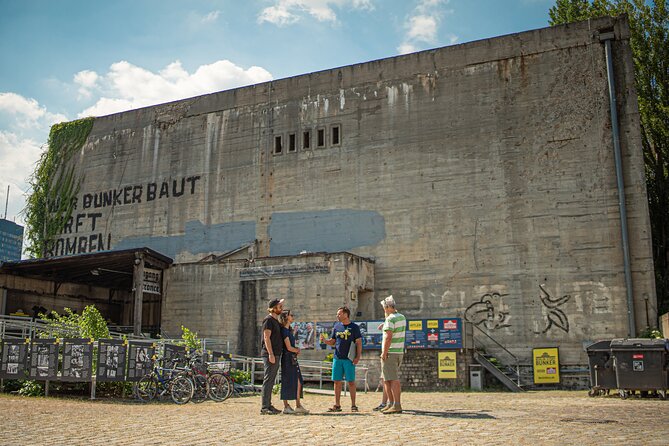
The Topography of Terror is one of the strongest stops on the route. It occupies the former grounds of the SS and Gestapo headquarters, with indoor and outdoor displays built around photographs, documents, and testimony.
Here the story moves from speeches and ideology to the machinery of terror. You learn how the Nazi state targeted political opponents, used police power, and silenced dissent. The material also brings victims into focus, which helps prevent the history from becoming a list of dates and officials.
The scheduled visit is about 20 minutes. That is enough for orientation and a few key explanations, but not enough for the full exhibition. Simon’s group used this short visit to decide to return the next day for a longer look. I think that is the right approach. Let the guide point out what matters, then return independently if you want to read the displays carefully.
Admission is free. The subject is grim, and the site rewards a calm, attentive pace rather than hurried sightseeing.
German Resistance Memorial Center: courage inside a dictatorship
At the Bendlerblock, the German Resistance Memorial Center tells the story of Germans who opposed Hitler. The focus includes Claus von Stauffenberg and the July 20, 1944 attempt to kill Hitler.
This stop matters because it complicates the lazy idea that every German accepted the regime. Resistance took many forms, and the people involved had different motives, beliefs, and chances of success. The guide discusses their decisions, sacrifices, and the consequences they faced.
The memorial is scheduled for about 20 minutes. That is short for a site devoted to many resistance movements, but the private setting allows you to ask about the people or events that interest you most. It also provides a needed change in tone. After seeing how the dictatorship operated, you consider the moral courage required to oppose it.
Bebelplatz: the square where books were destroyed
Bebelplatz is linked to the Nazi book burning of May 10, 1933. Thousands of books described as un-German were destroyed here, making the square an enduring reminder of censorship and the attack on free expression.
Your guide points out the State Opera House and Humboldt University, then explains the underground memorial. Empty bookshelves represent the books and ideas that were lost. The design is easy to miss if you do not know where to look, which makes a guide particularly useful.
The stop lasts about 10 minutes. It is a small site with a large lesson: authoritarian power does not begin only with prisons and violence. It also works by controlling what people may read, teach, publish, and remember.
The Reichstag and the political use of crisis
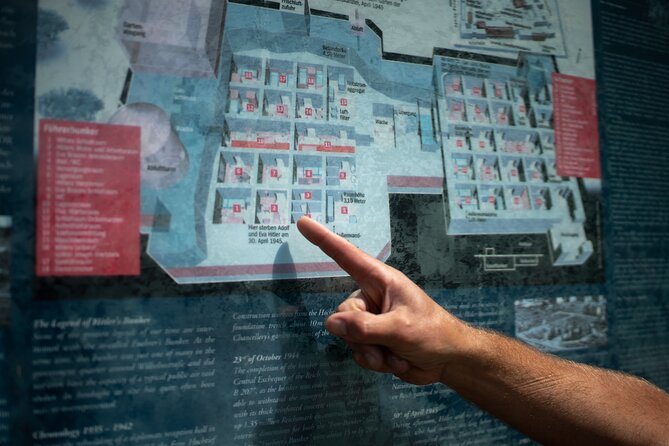
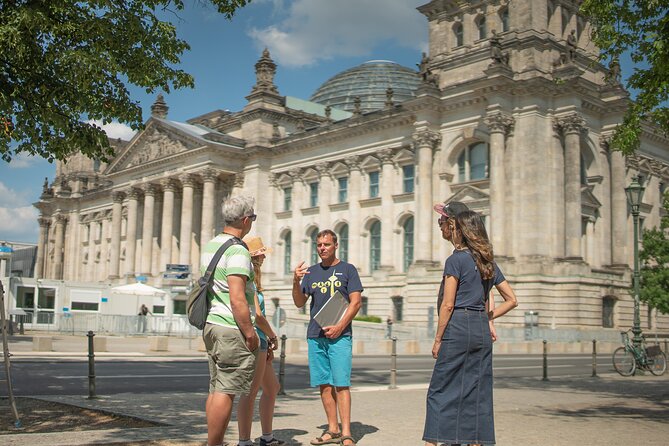
The Reichstag Building gives the tour a wider political frame. Completed in 1894, it became central to German public life and later to the Nazi seizure of power.
The guide explains the Reichstag Fire of 1933 and how the Nazis used the crisis to suppress opposition and consolidate control. The building was badly damaged during World War II and later restored as a symbol of parliamentary democracy.
The listed visit lasts about 15 minutes. Admission is not included, so treat this as an exterior history stop unless your guide confirms a separate arrangement. The important point is not only the fire itself, but how fear and emergency powers can be used to dismantle democratic rights.
Holocaust Memorial and the former Führerbunker site
The Memorial to the Murdered Jews of Europe covers a city block with 2,711 concrete slabs of different heights. Walking between them can feel confusing and uneven. That physical experience supports the memorial’s focus on loss, uncertainty, and the difficulty of representing the Holocaust.
Your guide provides the historical context of Nazi persecution and the murder of Europe’s Jews. The listed time is about 15 minutes, enough to explain the design and give you a first encounter with the site. You may want to return later, especially if you wish to visit the underground information center.
Nearby, the tour takes you to the site above the former Führerbunker. Hitler used the underground complex as his final refuge during the last months of the war. Much of the original structure was destroyed after the war, and the site is now marked only in a restrained way.
That restraint is important. There is no grand ruin to photograph and no dramatic entrance. The guide instead reconstructs the final days of the Nazi leadership and explains the bunker’s place in the collapse of the regime. The stop lasts about 10 minutes and works best as a lesson in consequences, not as a shrine.
Anhalter Bahnhof: transport, separation, and deportation
Anhalter Bahnhof was once one of Berlin’s major railway terminals. The surviving façade hints at its former scale, while the history connected to the station is far darker.
The guide explains how the station functioned during the Nazi period, including its role in the deportation of Jews to concentration camps. Families passed through the station under coercion, often unaware of what awaited them. The stop shifts the focus from government decisions to the physical process of persecution: people were registered, gathered, transported, and separated from their homes.
The visit takes about 10 minutes and admission is free. The station is especially useful for showing how mass crimes relied on ordinary systems such as railways and administration.
T4 Memorial: the Nazi euthanasia program
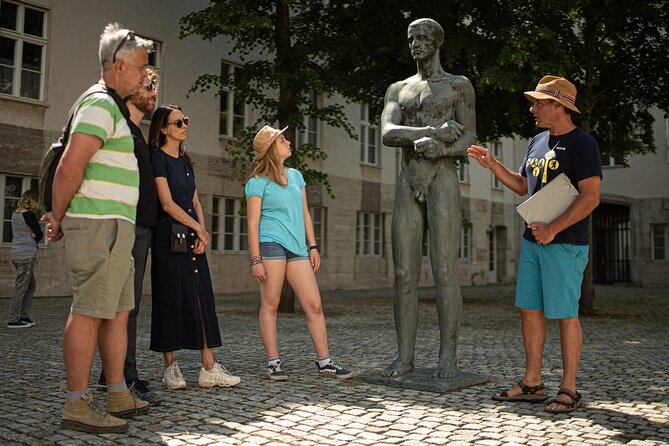
At Tiergartenstraße 4, the T4 Memorial commemorates victims of the Nazi euthanasia program. The campaign targeted people with disabilities and mental illnesses, labeling them unworthy of life and subjecting them to systematic murder.
The memorial explains the program, its victims, and the ethical questions it raises. It also shows how discrimination can move from language to policy and then to organized killing.
This is another short stop, about 10 minutes, but do not mistake a small memorial for a minor subject. The T4 program is essential to understanding the wider Nazi system of dehumanization. It also helps you see why protecting human dignity cannot be separated from studying the Holocaust.
Moltkebrücke and Wilhelmstraße: the war’s final days
Moltkebrücke is tied to the Soviet advance into Berlin in April 1945. Soviet forces crossed the bridge during the assault on the city, while fierce fighting took place nearby.
From the bridge, your guide explains the strategic importance of the route and the rapidly changing military situation. This is a good place to connect maps and battle accounts with the actual city. Berlin’s final days were fought street by street, not only in distant headquarters.
The final walk along Wilhelmstraße returns you to the center of Nazi administration. The guide points out ministries and offices, including the former aviation ministry, and explains how the street helped project political and military power.
Together, these stops close the circle. You begin with the Soviet victory, trace the institutions that enabled Nazi rule, examine resistance and persecution, and finish with the physical collapse of the regime.
Guides, pace, and the human side of the experience
The strongest feature of this tour is the guide. Names repeatedly praised for clear teaching, warmth, flexibility, or enthusiasm include Jimmy, Daniel, Georgia, Jasper, Simon, Tobi, Callum, Oren, Artie, Xavier, Martin, Maria, and Ariel.
That range also tells you something useful: the quality depends on the person assigned to your group. The best guide accounts describe a relaxed teacher who welcomes questions and adjusts the route. Jimmy was praised for engaging children, while Maria kept a group interested despite very cold weather. Xavier mixed World War II material with other Berlin stories when appropriate.
One account felt the guide sometimes followed a personal agenda and preferred a guide born in Berlin. I would not treat birthplace as a reliable measure of historical skill. A guide’s preparation, teaching style, and willingness to listen matter more. Still, if you have a very specific focus, explain it at the start so the day does not drift.
The tour can suit families, including older children and teenagers, if they are ready for difficult material. It also works well for history lovers who already know the basics and want to ask detailed questions.
Practical advice for your three to four hours
Wear comfortable shoes. One group walked about 10,000 steps, and the route includes outdoor memorials, bridges, squares, and long stretches between sites.
Dress for the forecast. The tour runs in all weather, and a cold day can make three hours outside feel much longer. Rain gear and warm layers are sensible, especially because several stops are brief outdoor explanations.
Plan to eat before or after. Food and drinks are not included, and the tour does not list a meal break. Hotel pickup and drop-off are included, but confirm the meeting details when booking, particularly if your hotel is outside the usual central route.
The experience is offered in English and includes a mobile ticket. It operates near public transportation, and most participants can take part. Free cancellation is available up to 24 hours before the start time for a full refund. Changes or cancellations inside that window are not accepted for a refund.
Should you book this private Berlin WWII tour?
Book it if you want a serious, personal introduction to Berlin’s Nazi and World War II history. The route covers an unusually broad set of subjects: military defeat, government power, censorship, resistance, the Holocaust, deportation, Nazi euthanasia, and the return of democratic symbols.
I would choose it for a family, a small group of friends, or anyone who prefers questions and conversation over a fixed group script. The hotel pickup is useful, and the private format can save time by avoiding places you already know.
I would skip it if you want long museum visits, a light sightseeing walk, or the lowest possible price. The short stop at each site means you will gain a strong framework, not a complete study of every exhibition.
For most history-focused visitors, the tour is worth considering because it helps Berlin make sense as a real city rather than a collection of isolated memorials. Just bring good shoes, warm clothes, and the patience to give this difficult subject the attention it deserves.
FAQ
How long does the private Berlin Third Reich tour last?
The tour lasts approximately three to four hours.
What language is the tour offered in?
The tour is offered in English.
Is hotel pickup included?
Yes. Hotel pickup and hotel drop-off are included.
Is this a private tour?
Yes. Only your group participates in the private activity.
How much does the tour cost?
The listed price is $192.97 per person. Group discounts are offered, though the exact discount is not specified.
Are admission tickets included?
Most listed stops have free admission. Admission to the Reichstag Building is not included.
Are food and drinks included?
No. Food and drinks are not included.
Does the tour operate in bad weather?
Yes. The tour operates in all weather conditions, so you should dress appropriately.
Is the tour near public transportation?
Yes. The experience operates near public transportation.
Can I cancel for a full refund?
Yes. You can cancel at least 24 hours before the start time for a full refund. Cancellations or changes made less than 24 hours before the start time are not accepted for a refund.
Just added around Berlin
- Private Walking Tour in Berlin: Hitler’s Germany & WWII★ 5.0 · 7 reviews
- The History of Berlin: WWII PRIVATE Walking Tour With Locals★ 5.0 · 209 reviews
- Private Berlin WWII and Cold War History Tour with Local Expert Guide★ 5.0 · 28 reviews
- Private Walking Tour Berlin 3 hours: Brandenburg, Historic Center★ 5.0 · 7 reviews
- Berlin: Private Bike Tour of the Berlin Wall and Third Reich★ 5.0 · 23 reviews
- Berlin: Guided Private Bike Tour to Explore the Highlights★ 5.0 · 12 reviews
- Berlin Photography Masterclass – Private Photography Lesson★ 4.5 · 23 reviews
- Group Driving Tour 1 to 6 people. Berlin Shore Excursion incl pick-up at Port★ 5.0 · 8 reviews